
AI Study Abroad Guide
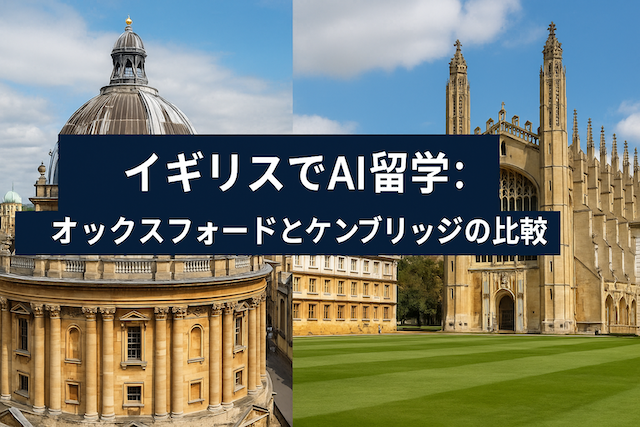
AI Study in the UK: Oxford vs. Cambridge Compared
01
Introduction
AI (artificial intelligence) has now permeated every industry and field of research around the world and become a core technology shaping the society of the future. For students and researchers who want to study at the forefront of this field, the choice of “which university to study AI at” can be a major turning point in life.
The UK is one of the world's leading centers of AI research, and it stands out for the quality of its education, its research environment and its international networks. Among its universities, the **University of Oxford** and the **University of Cambridge** combine centuries of tradition with innovative research, and attract attention from around the world in the field of AI as well.
However, although both are “top UK universities,” each has its own distinct character, from research style and strengths to the way it engages with industry and the atmosphere of student life. When considering AI study abroad, the question “which one suits my vision of the future?” is unavoidable for many applicants.
In this article, we compare Oxford and Cambridge in detail from the perspectives of AI research characteristics, learning style, career prospects, tuition and living environment. We hope it helps those aiming for AI study in the UK to identify the path that suits them best.
02
Characteristics of AI Research at the University of Oxford
The University of Oxford is one of the oldest universities in the world, yet it continues to drive innovative research in the field of AI. An academic environment where tradition and cutting-edge technology merge is highly attractive for students aiming to study AI abroad.
1. Internationally Acclaimed Research Groups
Oxford has several AI-related research organizations, and the best known is the **Oxford Machine Learning Group**. It works on a wide range of topics, from fundamental research on machine learning algorithms to applications, and its results in reinforcement learning and statistical machine learning in particular are internationally recognized. At the **Oxford Internet Institute (OII)**, research on the relationship between AI and society is also active, including social-science research on data ethics and AI governance.
2. Diversity of Research Areas
Oxford's strength lies in pursuing AI from both the “theoretical research” and “applied research” sides.
- **Natural language processing (NLP)**: Leads world-class research in language understanding and generative AI.
- **Medical AI**: Research on using AI for diagnostic imaging support and drug discovery is advancing.
- **AI ethics**: Research focusing on the social impact of AI, privacy, transparency and bias is a distinctive feature.
In particular, “AI ethics and responsible development” attracts attention from policy bodies and researchers around the world.
3. Strong Ties with Industry
Thanks in part to its geographical advantage of being close to London, Oxford has very active collaboration with major global IT companies and AI startups.
- Joint research is conducted with major companies such as **DeepMind, Google, Amazon and Microsoft**.
- Through industry-academia collaboration projects and internships, students can gain experience applying research results to real business and society.
4. Learning Style
A hallmark of Oxford's education is the traditional **tutorial system**. This is a small-group or one-on-one teaching format in which students deepen their understanding through in-depth discussion with professors and researchers. This style is also used in AI research, allowing students to learn both theory and practice in good balance.
03
Characteristics of AI Research at the University of Cambridge
The University of Cambridge has a long tradition of leading the world in science and technology, and has established a very strong position in AI research as well. It is characterized by its emphasis on both theoretical inquiry and applied research, and by its close collaboration with industry.
1. Renowned Research Organizations
Cambridge has several AI-related research hubs that produce world-class results.
- **Cambridge Machine Learning Group**: Conducts a wide range of research, from the fundamental theory of machine learning to applications. It is particularly highly regarded in Bayesian inference and deep learning.
- **Leverhulme Centre for the Future of Intelligence (CFI)**: Focuses on the future, safety and ethical challenges of AI, and carries out research that leads to policy recommendations.
- **Cambridge Centre for Data-Driven Discovery**: An interdisciplinary center working on big data analysis and AI applications.
2. Research Strengths
The University of Cambridge is characterized by its thriving applied and practical research.
- **Robotics**: Innovative research in autonomous driving systems, industrial robots and medical robots.
- **AI safety and ethics**: Scientific examination of the risks AI poses to society and of how it should be governed.
- **Data science and simulation**: Internationally recognized for technologies for handling complex datasets.
In “AI safety research” in particular, it has produced many of the world's leading experts, and it has a significant influence on AI regulation and international policy.
3. Network with Industry
A major attraction of the University of Cambridge is its close connection to the tech industry cluster known as **“Silicon Fen.”**
- It can collaborate with hundreds of AI and IT-related startups and major research laboratories.
- For students who aspire to start a business, there are abundant opportunities to meet accelerators and investors.
- Research hubs such as Google DeepMind and Microsoft Research Cambridge are also located nearby.
4. Learning Style
Like Oxford, Cambridge uses a college system, but its distinguishing feature is its **lab-centered research culture**. In AI, there are many opportunities to learn through team-based joint research, experiments and projects, making it an ideal environment for students who want to acquire practical skills.
04
Differences in Student Life and Learning Style
Both the University of Oxford and the University of Cambridge have the distinctive college system, in which students belong to a “college” at the same time as to their department or laboratory. However, the actual way of learning and student life each have different characteristics.
1. Differences in Teaching Style
- **Oxford**: Traditionally famous for its “tutorial system.” The emphasis is on deepening theoretical understanding through one-on-one or small-group discussion with professors and researchers. In AI as well, there is a lot of close reading of papers and thorough discussion of theory, in an educational style that cultivates critical thinking.
- **Cambridge**: It likewise has a supervision system (small-group teaching), but a laboratory (lab) culture is more deeply rooted. Group work and joint research projects are thriving, offering abundant opportunities to be exposed to practical AI research.
2. Student Community and Atmosphere
- **Oxford**: Tradition and history are strongly felt, and there is a calm, academic atmosphere. There are also many students of the social sciences and humanities, so it is a stimulating environment for those who want to think about AI from social and ethical perspectives.
- **Cambridge**: It has a strong science orientation, with many students from engineering and science faculties in particular, so the tech-focused student community is well developed. A startup culture is firmly rooted, which makes it an environment with plenty of practical stimulation for students who want to apply AI technologically.
3. Lifestyle Outside the University
- **Oxford**: A calm academic city where the whole town functions as a “community of knowledge.” It has an ideal atmosphere for immersing yourself in reading and research.
- **Cambridge**: Located close to the tech industry cluster “Silicon Fen,” the town itself is full of the spirit of innovation and experimentation. Another attraction is the many opportunities to interact with researchers and entrepreneurs on a daily basis.
4. Environments Suited to Different Learning Directions
- **Oxford**: Suited to those who want to dig deeply into theory through individual tutoring, and those who place importance on AI ethics and its impact on society.
- **Cambridge**: Suited to those who value lab experiments and joint research, and who aim to become researchers, technology developers or entrepreneurs in the future.
05
Employment and Career Prospects
For students considering AI study abroad, career paths after graduation are a very important point. Both Oxford and Cambridge have world-class brand power, and their graduates are active in a wide range of fields, including research institutions, global companies, government agencies and startups, but differences can be seen in their career tendencies.
1. Career Prospects at the University of Oxford
- **Strength in international organizations and policy** Because Oxford has strong links with AI ethics and the social sciences, many graduates tend to go on to positions involved in policymaking, such as the United Nations, EU institutions and government-affiliated research institutes.
- **Careers at global companies** Making use of its location close to London, Oxford also offers abundant career opportunities at major global companies such as Google, Microsoft, Amazon and financial institutions. Demand is growing in areas such as “AI x finance” and “AI x healthcare” in particular.
- **Academia** Going on to universities and research institutes around the world and building a career as a researcher is also a classic path, and graduates can show their strengths in theoretical AI research and research on social impact.
2. Career Prospects at the University of Cambridge
- **Startups and entrepreneurial culture** Cambridge is closely connected to the tech industry cluster known as “Silicon Fen,” and it is characteristic that many graduates found startups or join early-stage companies. There are abundant places to apply your skills on the front line as an AI engineer or researcher.
- **Direct links to research and development** Research hubs such as Microsoft Research Cambridge and DeepMind are located nearby, and another attraction is that there are many chances to move straight into top-level R&D positions after completing your program.
- **Bridging academia and industry** Cambridge is strong not only in theoretical research but also in implementation and applied research, which is advantageous for building a career that moves between academia and industry.
3. Shared Strengths
What both universities have in common is their “brand power” and the “breadth of their international networks.”
- Oxford and Cambridge graduates have strong alumni networks around the world, and enjoy outstanding credibility in international research and business settings.
- With demand for AI talent surging at present, a wealth of career options opens up whichever university you choose.
06
Tuition and Living Environment
Practical costs such as tuition and living expenses are indispensable considerations when thinking about AI study abroad. Oxford and Cambridge are both among the world's most prestigious universities, and their tuition and living costs are at correspondingly high levels, but there is little major difference between them, and spending varies with each student's lifestyle.
1. Approximate Tuition
- **University of Oxford** For AI-related master's programs (e.g., MSc in Advanced Computer Science, MSc in Social Data Science), the guideline is about **£27,000 to £32,000** per year. Doctoral programs are at a similar level, but there may be a chance to use research funding or scholarships.
- **University of Cambridge** For AI and machine learning-related master's programs (e.g., MPhil in Machine Learning and Machine Intelligence), the cost is about **£28,000 to £33,000** per year. In doctoral programs, there are many cases where research grants can be received, and scholarships are offered to outstanding students.
2. Approximate Living Costs
- At both universities, student living costs are generally **£12,000 to £15,000** per year. The breakdown is as follows: Housing (dorm or shared flat): £600 to £900 per month Food: £250 to £400 per month Books and study materials: £500 to £1,000 per year Entertainment and socializing: £100 to £200 per month
- If you live in a student dorm, you may be able to choose a meal-inclusive plan, which in some cases helps keep expenses down.
3. Differences in the Urban Environment
- **Oxford** A calm academic city surrounded by historic buildings, where the whole town functions as a “community of knowledge.” It is easily accessible, about 1 hour by train from London, and a major attraction is that it is easy to take advantage of the networks of an international city.
- **Cambridge** A town with a strong science and technology character, where many startups and research facilities are concentrated. It is very convenient, about 50 minutes by train from London, and there are abundant opportunities to interact with industry outside the university as well.
4. Scholarships and Financial Support
- Both universities have well-established scholarship systems for international students, and there are chances to receive financial support based on academic excellence or research theme.
- In the AI field in particular, there is a lot of sponsorship from companies and research institutions, making it a field in which international students can more easily obtain financial support.
07
Summary: Which Should You Choose?
The University of Oxford and the University of Cambridge both offer the world's top AI research environments, and whichever you choose, you can gain great learning and career opportunities. However, because the two differ in research direction and learning style, it is important to choose the university that suits your own vision of the future.
Who Oxford Suits
- You have a strong interest in AI **ethics, social impact and policy**
- You want to **dig deeply into theory** through individual tutoring
- You aim for a career in international organizations, major companies or policy-related fields
- You want to study in a calm academic city with history and tradition
Who Cambridge Suits
- You are interested in **robotics, applied AI and startups**
- You want to emphasize **joint research in labs and experimental projects**
- You value entrepreneurship and collaboration with industry, and want to be active on the front lines of technology
- You want to study in a lively tech-industry city that gives you stimulation
Key Points for Making Your Final Choice
- The most important thing is to use **how you want to apply AI in society** as your criterion. If you value connections with society and policy, choose Oxford If you value technology development and practical research, choose Cambridge
Although the two universities are rivals, they also complement each other in the field of AI. Whichever you choose, you will receive a world-leading education and open the door to an international career.
08
FAQ
Q1. What are the major differences between Oxford and Cambridge in AI research?
A. Oxford is strong in AI ethics, social impact and policy collaboration, and is characterized by learning that digs deeply into theory through individual tutoring (tutorials). Cambridge is lab-centered and characterized by a practice-oriented approach strong in robotics, applied AI and startup collaboration (Silicon Fen).
Q2. When are the application periods and deadlines?
A. For both universities, the main deadlines for entry the following year are usually concentrated between November and January. Early deadlines for scholarship eligibility are often set, so start preparing your application at least in the summer to autumn of the year before entry.
Q3. What English scores are required? What are the guidelines for IELTS and TOEFL?
A. For many master's programs, the guideline is IELTS 7.0 (6.5 or above in each section) or around TOEFL iBT 100. The required level may be higher depending on the field of study, so be sure to check the requirements of your chosen course.
Q4. Are the GRE and a mathematics background necessary?
A. For UK master's programs the GRE is often not required, but a strong mathematical foundation (linear algebra, probability and statistics, optimization) and programming experience (Python, machine learning frameworks) are valued.
Q5. What are the representative AI/ML-related courses?
A. Oxford: MSc in Advanced Computer Science, MSc in Social Data Science, etc. Cambridge: MPhil in Machine Learning and Machine Intelligence, MPhil in Advanced Computer Science, etc. There are also routes to progress to doctoral programs (DPhil/PhD).
Q6. How should I choose a research topic?
A. Look into the faculty and papers of research groups that interest you (ML, NLP, medical AI, robotics, AI ethics, etc.), and it is effective to concisely present your “problem setting, related work and hypothesis of your own contribution” in your statement of purpose.
Q7. Are there opportunities for industry-academia collaboration or internships?
A. Yes. Oxford tends to have abundant collaboration with London companies and medical institutions, while Cambridge tends to offer many opportunities for joint research and internships with Microsoft Research and nearby startups.
Q8. What are the guidelines for tuition and living costs?
A. As a guideline, tuition is roughly £27,000 to £33,000 per year and living costs about £12,000 to £15,000 (varying with dorm, meals and type of housing).
Q9. Can I receive scholarships or financial support?
A. Both universities have university and college scholarships, and external foundations and corporate sponsors can also be used. Many scholarships have early deadlines, so pay attention to the timing of your application.
Q10. How should I choose a college?
A. Compare location, type of accommodation, meal plans, community atmosphere and the availability of scholarships. Because research supervision is carried out at the department or lab level, it is generally best to give priority first to the fit with your supervisor and research theme.
Q11. What is the difference in learning style (tutorial / supervision)?
A. Oxford uses tutorials for individual or small-group in-depth study of theory, while Cambridge, in addition to supervisions, often uses a lab-centered, project-based approach with abundant opportunities for experimentation and implementation.
Q12. Is it advantageous for employment outside the UK as well?
A. Yes. The international brand of Oxbridge and its alumni networks work strongly in Europe, North America and Asia. A wide range of options is available, including research positions, Big Tech, healthcare, finance and startups.
Q13. Does the difference in urban environment affect learning?
A. It does. Oxford is a calm academic city where it is easy to concentrate, while Cambridge is close to a tech cluster and offers plenty of stimulation for entrepreneurship and R&D. Living costs are roughly similar.
Q14. Can I progress to a doctoral program after completing an MPhil/MSc?
A. Yes. With excellent grades, a good research plan and a match with a faculty member, there are routes to progress to doctoral study (DPhil/PhD), including continuing within the university. It is advantageous to settle on a supervisor and research theme early.
Q15. What about visas and medical care for international students?
A. You enter on a student visa (Student Route), and during your studies you can use public healthcare services by paying the NHS immigration health surcharge. Be sure to check the latest requirements before applying.
Q16. I can't decide which to apply to. What should I base my decision on?
A. Using “which problems you want to solve in the future, and with which methods” as your axis, compare the fit with supervisors and research groups, the research style (in-depth theory vs. implementation and joint research), and the direction of industry-academia collaboration (policy, healthcare, finance vs. R&D, entrepreneurship).
Q17. What makes the difference in application documents?
A. The keys are the specificity of your research proposal (problem setting, related work, methods, evaluation metrics), your portfolio (papers, software, Kaggle, etc.), the substance of your recommendation letters, and a clear motivation (a match with faculty and labs).
Q18. Can credits be transferred between courses, or can I change courses?
A. It depends on the case. Because course design and assessment methods differ, you need to check with the program office in advance and obtain your supervisor's agreement.
Q19. Which do you recommend, a dorm or private housing?
A. In the first year, a dorm is a safe choice because the procedures are simple and it is easy to join the community. Depending on your living needs, such as research requirements or bringing family, you can also choose to move to a private flat.
Q20. May I apply to both rather than narrowing down to one?
A. Yes. Both are highly competitive, so applying to multiple universities to spread risk is common. However, it is important to prepare a dedicated set of documents tailored to each university and each course.
AI Study Abroad Guide [2025 Latest Edition]: How to Study Machine Learning, Generative AI, and Data Science Overseas09
Related article
10
Recommended Courses
Course
Business English Course
A course for intensively learning practical business English: presentations, meetings, emails, negotiations, and more. You can build English skills useful in the global business scene after AI study abroad, matched to your level across 6 levels.
See moreCourseOne-on-One Intensive Course
A fully one-on-one system with no group classes. English preparation before AI study abroad and discussion practice on technical topics can be intensively trained to match your level.
See moreThe first step in IELTS preparation is choosing the right environment
With one-on-one classes and real-format mock exams, we help you reach your target score by the most direct route.