2026年4月5日
3D ACADEMY offers affordable English study programs in Cebu, Philippines – perfect for beginners, professionals, and exam takers.

3D UNIVERSAL ENGLISH INSTITUTE INC
info.3d-universal.com
8:00-17:00(Mon-Fri)
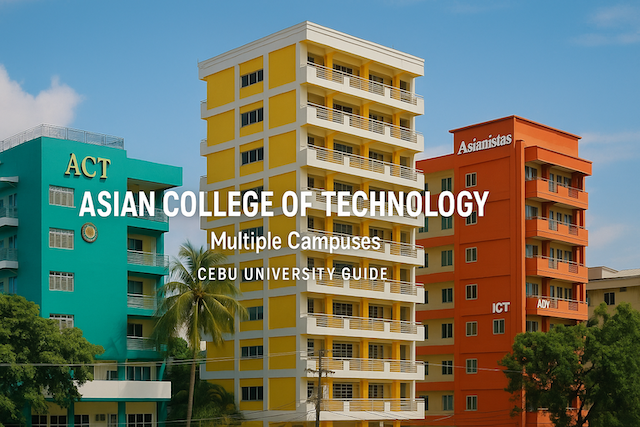
Asian College of Technology (Multiple Campuses): Cebu University Guide
Contents
- Asian College of Technology (Multiple Campuses): Cebu University Guide
- Overview of Asian College of Technology
- Campuses of Asian College of Technology
- Academic Programs Offered
- Tuition and Fees
- Admissions Process
- Campus Facilities and Student Resources
- Student Life at Asian College of Technology
- Pros and Cons of Studying at ACT
- Nearby Housing and Transportation
- Graduation Outcomes and Career Opportunities
- Is ACT a Good Choice for International Students?
- Final Thoughts
- FAQs (Frequently Asked Questions)
- What is Asian College of Technology (ACT) known for in Cebu?
- Where are the ACT campuses located in Cebu?
- What senior high school strands are offered at ACT?
- What college degree programs can I take at ACT?
- Does ACT offer TESDA-accredited short courses?
- How much is the tuition fee at Asian College of Technology?
- What are the basic admission requirements for new college students?
- Is there an entrance exam for ACT?
- What kinds of facilities and resources are available for students?
- What is student life like at Asian College of Technology?
- What career opportunities do ACT graduates typically have?
- Is ACT a good option for international or out-of-town students?
- FAQs (Frequently Asked Questions)
- What is Asian College of Technology (ACT) known for in Cebu?
- Where are the ACT campuses located in Cebu?
- What senior high school strands are offered at ACT?
- What college degree programs can I take at ACT?
- Does ACT offer TESDA-accredited short courses?
- How much is the tuition fee at Asian College of Technology?
- What are the basic admission requirements for new college students?
- Is there an entrance exam for ACT?
- What kinds of facilities and resources are available for students?
- What is student life like at Asian College of Technology?
- What career opportunities do ACT graduates typically have?
- Is ACT a good option for international or out-of-town students?
Asian College of Technology (Multiple Campuses): Cebu University Guide
Asian College of Technology (ACT) is one of the most recognized private higher education institutions in Cebu, known for its strong focus on IT, business, hospitality, and technical-vocational programs. With several campuses—ACT Cyber Tower, ACT Bulacao, and ACT N. Bacalso—this institution offers accessible education for both local students and international learners seeking quality, industry-aligned courses. Its flexible programs, modern facilities, and emphasis on job-readiness make it a popular choice for students planning to build careers in technology-driven and service-oriented fields.
This Cebu University Guide provides a comprehensive overview of ACT’s campuses, programs, tuition expectations, admission process, student life, and what makes the institution stand out in Cebu’s competitive academic landscape.
Overview of Asian College of Technology
Asian College of Technology International Educational Foundation (ACT-IEF) has grown from a small computer school into a respected multi-campus institution offering senior high school, undergraduate degrees, and TESDA-accredited technical-vocational programs. Known for producing skilled graduates in IT and business, ACT maintains strong ties with local industries, outsourcing firms, and multinational companies operating in Cebu City.
Its mission focuses on delivering quality and affordable education while preparing students for immediate employment or entrepreneurship. Over the years, ACT has also gained recognition for its academic competitions, robotics programs, digital innovation efforts, and community outreach activities.
Campuses of Asian College of Technology
One of ACT’s strengths is its multiple strategic locations across Cebu, making it easily accessible to students from different parts of the metro.
ACT Cyber Tower Campus (Main)
Located along P. del Rosario Street, ACT Cyber Tower is the institution’s flagship modern building. It houses most college programs, laboratories, and administrative offices.
Highlights:
-
State-of-the-art computer labs and multimedia rooms
-
Modern classrooms equipped with digital learning tools
-
Central library and e-learning facilities
-
Accessible from major jeepney and MyBus routes
-
Near food hubs, boarding houses, and commercial centers
This campus is ideal for IT, business, computer engineering, and digital arts students due to its strong focus on technology-enabled education.
ACT N. Bacalso Campus
Situated along N. Bacalso Avenue, this campus serves several senior high school strands and selected college programs.
Highlights:
-
Large classrooms for SHS programs
-
Laboratories for STEM and TVL tracks
-
Close proximity to malls and transport terminals
Its location benefits students coming from the southern part of Cebu City and neighboring municipalities.
ACT Bulacao Campus
The Bulacao campus primarily handles basic education and selected TESDA programs.
Highlights:
-
Hands-on training facilities for technical-vocational courses
-
Cheerful, safe, and student-friendly environment
-
Accessible for students from Talisay City and southern Cebu areas
This campus is especially popular among students taking vocational training, caregiving, and practical skills programs.
Academic Programs Offered
ACT offers a broad range of academic and technical programs designed to meet the evolving demands of Cebu’s industries.
Senior High School (SHS)
ACT is known for one of the most comprehensive SHS programs in Cebu, offering:
Academic Track
-
Accountancy, Business, and Management (ABM)
-
Humanities and Social Sciences (HUMSS)
-
Science, Technology, Engineering, and Mathematics (STEM)
-
General Academic Strand (GAS)
Technical-Vocational-Livelihood (TVL) Tracks
-
Information and Communications Technology (ICT)
-
Home Economics (HE)
-
Industrial Arts (IA)
These programs prepare students for both college readiness and TESDA certification.
College Degree Programs
ACT offers several undergraduate programs, including:
Computer and Technology Programs
-
Bachelor of Science in Information Technology (BSIT)
-
Bachelor of Science in Computer Science (BSCS)
-
Bachelor of Science in Computer Engineering (BSCpE)
-
Digital Arts and Animation programs
These programs are among the strongest in the region, emphasizing practical, project-based learning.
Business and Management Programs
-
Bachelor of Science in Business Administration (BSBA)
-
Major in Financial Management
-
Major in Marketing Management
-
Major in Human Resource Management
These programs align with Cebu’s dynamic business process outsourcing (BPO) and corporate sectors.
Hospitality and Tourism Programs
-
Bachelor of Science in Tourism Management (BSTM)
-
Bachelor of Science in Hospitality Management (BSHM)
Students benefit from exposure to hotels, restaurants, and travel companies in Cebu’s tourism hub.
TESDA Programs
ACT offers multiple TESDA-accredited courses such as:
-
Computer Systems Servicing NC II
-
Contact Center Services NC II
-
Programming NC III
-
Caregiving NC II
-
Cookery NC II
-
Bread and Pastry Production NC II
These short courses are highly valued by students seeking fast employment in both local and overseas markets.
Tuition and Fees
ACT is considered affordable compared to many other private colleges in Cebu, especially given its modern facilities and program quality. Tuition varies by course but typically falls within the low to mid-range bracket.
Estimated tuition ranges:
-
College: PHP 18,000 to PHP 30,000 per semester
-
Senior High School: PHP 12,000 to PHP 25,000 per semester
-
TESDA Programs: PHP 6,000 to PHP 20,000 depending on course length
ACT also offers payment installment options and scholarships for academically strong students or those in financial need.
Admissions Process
The admissions process at ACT is designed to be simple and accessible.
Step 1: Online or On-Campus Application
Students can apply online through ACT’s admissions portal or visit any campus. Requirements include:
-
Completed application form
-
2×2 photo
-
PSA Birth Certificate
-
Report Card / Transcript of Records
-
Good Moral Certificate
For transfers, additional documents such as Honorable Dismissal and evaluation forms may be required.
Step 2: Entrance Assessment
While ACT does not require an entrance exam for most programs, some technical and specialized courses may conduct additional evaluations or interviews.
Step 3: Enrollment and Orientation
After payment of fees and submission of documents, students proceed to class scheduling and orientation sessions. ACT places strong emphasis on preparing students for academic success from day one.
Campus Facilities and Student Resources
ACT provides a range of facilities that support modern learning and vibrant student life.
Computer Laboratories
With its technology-centered academic identity, ACT maintains updated computer labs equipped with high-performance systems ideal for programming, animation, and digital design.
Multipurpose Training Rooms
Hospitality and tourism students benefit from simulated hotel front desks, kitchen labs, and dining training areas.
Libraries and E-Resources
The institution offers physical libraries and digital platforms that support research and self-paced learning.
Student Lounges and Study Areas
ACT campuses include dedicated areas where students can collaborate on projects, relax, and socialize.
Wi-Fi Connectivity
All campuses have campus-wide Wi-Fi access, ensuring that students can perform school-related tasks efficiently.
Student Life at Asian College of Technology
ACT is known for its lively student culture and active participation in competitions, clubs, and community events.
Student Clubs and Organizations
Students can join organizations related to:
-
Programming and technology
-
Robotics
-
Digital arts and animation
-
Journalism and communication
-
Business leadership
-
Tourism and hospitality
-
Community service
These groups help enhance leadership skills, teamwork, and creativity.
Competitions and Events
ACT regularly competes in:
-
IT competitions
-
Robotics challenges
-
Business idea contests
-
Campus journalism events
-
Cultural and sports activities
Its students frequently rank well in Cebu-wide academic competitions.
Internship and Job Placement
One of the strongest advantages of studying at ACT is its long-standing relationship with BPO companies, hotels, tech firms, and local enterprises.
Internship placements include:
-
IT parks
-
Tech outsourcing companies
-
Hotels and resorts
-
Retail and corporate businesses
Many ACT graduates secure job offers shortly after completing their internships.
Pros and Cons of Studying at ACT
Advantages
-
Strong IT and tech-related programs
-
Affordable tuition compared to other private colleges
-
Multiple campuses with accessible locations
-
Practical, industry-focused learning
-
Strong internship and job placement network
-
TESDA programs for fast employment pathways
Disadvantages
-
Some facilities can become crowded during peak hours
-
Limited degree offerings compared to larger universities
-
Campuses are spread across different locations, which may be inconvenient for some students
Nearby Housing and Transportation
ACT campuses are located in well-connected parts of Cebu City, making housing and transportation convenient.
Housing Options
Students can find:
-
Boarding houses
-
Dormitories
-
Apartment rentals
-
Shared student accommodations
Most of these are within walking distance of P. del Rosario Street and N. Bacalso Avenue.
Transportation Access
ACT is accessible through:
-
Jeepney routes (including 01k, 13c, 14d, and more)
-
MyBus routes
-
Taxis and Grab
-
Motorbike taxis (habal-habal or Angkas)
Its central location makes commuting easy for students from Cebu City, Mandaue, and Talisay.
Graduation Outcomes and Career Opportunities
Graduates from ACT are known for their practical skills and job-readiness. Common career paths include:
For IT graduates:
-
Software developer
-
IT support specialist
-
Web designer
-
Network technician
-
Systems analyst
For business graduates:
-
Corporate assistant roles
-
Marketing specialist
-
HR assistant
-
Accounting staff
For hospitality graduates:
-
Front office agent
-
Housekeeping supervisor
-
Food and beverage service staff
-
Tourism guide
For TESDA graduates:
-
Caregivers (local or overseas)
-
Call center agents
-
Computer technicians
-
Culinary and baking professionals
Is ACT a Good Choice for International Students?
Yes. ACT is becoming increasingly popular among Southeast Asian and Middle Eastern students due to:
-
Affordable tuition
-
English-based learning
-
Strong IT and tech programs
-
Proximity to Cebu’s city center
-
Safe and comfortable student environment
Final Thoughts
Asian College of Technology offers a well-rounded mix of affordability, accessibility, and quality education. Its focus on technology, business, and vocational skills makes it an excellent choice for students pursuing industry-aligned careers. With multiple campuses strategically located across Cebu, ACT makes education reachable for a wide range of learners in Cebu City and beyond.
If you are looking for a modern, practical, and career-oriented institution in Cebu, ACT is one of the top private schools to consider.
FAQs (Frequently Asked Questions)
What is Asian College of Technology (ACT) known for in Cebu?
Asian College of Technology is known for its strong focus on information technology, business, hospitality, and technical-vocational education.
It has multiple campuses in Cebu and is recognized for practical, industry-oriented training, updated computer laboratories, and good linkages
with BPO companies, hotels, and other employers. Many students choose ACT because it offers affordable tuition and job-ready programs.
Where are the ACT campuses located in Cebu?
ACT has several campuses in Cebu, including ACT Cyber Tower (main campus) along P. del Rosario Street, ACT N. Bacalso Campus along N. Bacalso Avenue,
and ACT Bulacao Campus in the southern part of the city. These locations make the school accessible to students from Cebu City, Talisay,
and nearby municipalities through public transportation.
What senior high school strands are offered at ACT?
ACT offers a wide range of Senior High School strands under the Academic and TVL tracks. Academic strands include ABM (Accountancy, Business,
and Management), HUMSS (Humanities and Social Sciences), STEM (Science, Technology, Engineering, and Mathematics), and GAS (General Academic Strand).
For TVL, ACT offers ICT, Home Economics, and Industrial Arts, often combined with TESDA-aligned competencies to prepare students for both college
and employment.
What college degree programs can I take at ACT?
Popular college programs at ACT include BS Information Technology (BSIT), BS Computer Science (BSCS), BS Computer Engineering (BSCpE),
and various BS Business Administration majors such as Marketing, Financial Management, and Human Resource Management.
There are also programs in Hospitality and Tourism Management. These degrees are structured to combine theory with hands-on training
and internship opportunities in Cebu’s growing industries.
Does ACT offer TESDA-accredited short courses?
Yes. ACT offers several TESDA-accredited programs such as Computer Systems Servicing NC II, Contact Center Services NC II, Programming NC III,
Caregiving NC II, Cookery NC II, and Bread and Pastry Production NC II, among others. These programs are ideal for students who want faster,
skills-based pathways to employment either locally or abroad, especially in caregiving, culinary arts, and IT support.
How much is the tuition fee at Asian College of Technology?
Tuition at ACT is considered affordable compared to many private colleges in Cebu. While exact amounts may change over time, college tuition
often falls in the lower to mid-range bracket per semester, and Senior High School and TESDA courses are generally budget-friendly.
ACT commonly offers installment payment schemes, and some scholarships or discounts may be available for deserving or financially needy students.
What are the basic admission requirements for new college students?
For new college students, common requirements include a completed application form, recent ID photos, PSA Birth Certificate, Form 138 or Senior High School
report card, and a Certificate of Good Moral Character. Transferees may need a Transcript of Records, Honorable Dismissal, and subject evaluation.
International students may be asked to provide additional documents such as passports, visas, and English proficiency credentials.
Is there an entrance exam for ACT?
ACT’s admission policies can vary by program and academic year. In many cases, there may not be a traditional entrance exam for general courses,
but some specialized or technical programs could require placement tests, interviews, or skills assessments. It is always best to check directly
with the admissions office for the most updated entrance exam or assessment requirements for your chosen course.
What kinds of facilities and resources are available for students?
ACT provides computer laboratories with updated hardware and software, multimedia classrooms, libraries with print and digital resources,
Wi-Fi access, simulation rooms for hospitality and tourism, and training areas for technical-vocational courses. There are also student lounges,
study spaces, and function rooms for events, seminars, and competitions. These facilities are designed to support both academic work
and extra-curricular activities.
What is student life like at Asian College of Technology?
Student life at ACT is active and engaging. Learners can join organizations related to IT, business, robotics, digital arts, tourism, journalism,
and community service. The school participates in academic competitions, cultural presentations, and sports events. Internship programs and
industry immersion activities also form a major part of student life, helping learners build confidence and real-world experience.
What career opportunities do ACT graduates typically have?
ACT graduates often find work in IT companies, BPOs, corporate offices, hotels, restaurants, and service-oriented businesses in Cebu and beyond.
Common roles include software developer, IT support staff, call center agent, office assistant, marketing staff, hotel front office personnel,
and caregivers. For TESDA graduates, opportunities also extend to overseas employment, especially in caregiving, hospitality, and technical fields.
Is ACT a good option for international or out-of-town students?
Yes. ACT is a practical option for international and out-of-town students who want English-based, career-focused education at a relatively
affordable cost. The campuses are centrally located, with many nearby boarding houses, apartments, and dormitories. The school’s emphasis
on practical skills and internships, as well as Cebu’s generally friendly environment, make it appealing for students coming from other provinces
or countries.
FAQs (Frequently Asked Questions)
What is Asian College of Technology (ACT) known for in Cebu?
Asian College of Technology is known for its strong focus on information technology, business, hospitality, and technical-vocational education.
It has multiple campuses in Cebu and is recognized for practical, industry-oriented training, updated computer laboratories, and good linkages
with BPO companies, hotels, and other employers. Many students choose ACT because it offers affordable tuition and job-ready programs.
Where are the ACT campuses located in Cebu?
ACT has several campuses in Cebu, including ACT Cyber Tower (main campus) along P. del Rosario Street, ACT N. Bacalso Campus along N. Bacalso Avenue,
and ACT Bulacao Campus in the southern part of the city. These locations make the school accessible to students from Cebu City, Talisay,
and nearby municipalities through public transportation.
What senior high school strands are offered at ACT?
ACT offers a wide range of Senior High School strands under the Academic and TVL tracks. Academic strands include ABM (Accountancy, Business,
and Management), HUMSS (Humanities and Social Sciences), STEM (Science, Technology, Engineering, and Mathematics), and GAS (General Academic Strand).
For TVL, ACT offers ICT, Home Economics, and Industrial Arts, often combined with TESDA-aligned competencies to prepare students for both college
and employment.
What college degree programs can I take at ACT?
Popular college programs at ACT include BS Information Technology (BSIT), BS Computer Science (BSCS), BS Computer Engineering (BSCpE),
and various BS Business Administration majors such as Marketing, Financial Management, and Human Resource Management.
There are also programs in Hospitality and Tourism Management. These degrees are structured to combine theory with hands-on training
and internship opportunities in Cebu’s growing industries.
Does ACT offer TESDA-accredited short courses?
Yes. ACT offers several TESDA-accredited programs such as Computer Systems Servicing NC II, Contact Center Services NC II, Programming NC III,
Caregiving NC II, Cookery NC II, and Bread and Pastry Production NC II, among others. These programs are ideal for students who want faster,
skills-based pathways to employment either locally or abroad, especially in caregiving, culinary arts, and IT support.
How much is the tuition fee at Asian College of Technology?
Tuition at ACT is considered affordable compared to many private colleges in Cebu. While exact amounts may change over time, college tuition
often falls in the lower to mid-range bracket per semester, and Senior High School and TESDA courses are generally budget-friendly.
ACT commonly offers installment payment schemes, and some scholarships or discounts may be available for deserving or financially needy students.
What are the basic admission requirements for new college students?
For new college students, common requirements include a completed application form, recent ID photos, PSA Birth Certificate, Form 138 or Senior High School
report card, and a Certificate of Good Moral Character. Transferees may need a Transcript of Records, Honorable Dismissal, and subject evaluation.
International students may be asked to provide additional documents such as passports, visas, and English proficiency credentials.
Is there an entrance exam for ACT?
ACT’s admission policies can vary by program and academic year. In many cases, there may not be a traditional entrance exam for general courses,
but some specialized or technical programs could require placement tests, interviews, or skills assessments. It is always best to check directly
with the admissions office for the most updated entrance exam or assessment requirements for your chosen course.
What kinds of facilities and resources are available for students?
ACT provides computer laboratories with updated hardware and software, multimedia classrooms, libraries with print and digital resources,
Wi-Fi access, simulation rooms for hospitality and tourism, and training areas for technical-vocational courses. There are also student lounges,
study spaces, and function rooms for events, seminars, and competitions. These facilities are designed to support both academic work
and extra-curricular activities.
What is student life like at Asian College of Technology?
Student life at ACT is active and engaging. Learners can join organizations related to IT, business, robotics, digital arts, tourism, journalism,
and community service. The school participates in academic competitions, cultural presentations, and sports events. Internship programs and
industry immersion activities also form a major part of student life, helping learners build confidence and real-world experience.
What career opportunities do ACT graduates typically have?
ACT graduates often find work in IT companies, BPOs, corporate offices, hotels, restaurants, and service-oriented businesses in Cebu and beyond.
Common roles include software developer, IT support staff, call center agent, office assistant, marketing staff, hotel front office personnel,
and caregivers. For TESDA graduates, opportunities also extend to overseas employment, especially in caregiving, hospitality, and technical fields.
Is ACT a good option for international or out-of-town students?
Yes. ACT is a practical option for international and out-of-town students who want English-based, career-focused education at a relatively
affordable cost. The campuses are centrally located, with many nearby boarding houses, apartments, and dormitories. The school’s emphasis
on practical skills and internships, as well as Cebu’s generally friendly environment, make it appealing for students coming from other provinces
or countries.
Philippines University Guide
Cebu University Guide
Cebu Province All Universities Lists

How to Register for eTravel Philippines (2025 Guide)
Step-by-step guide to completing your eTravel registration before arriving in the Philippines, with images and tips.

Night Market in Cebu – Things You Don’t Know About Cebu Life
Discover the hidden charm of Cebu’s night markets, from street food stalls to local life tips you won’t find in tourist guides.

How to Use ChatGPT for IELTS Preparation: A Complete Guide
Learn how to prepare for IELTS using ChatGPT — including strategies for Writing, Reading, Listening, Speaking, and grammar support.

How to Build a Website Without Coding Using ChatGPT
Discover how to build your own website using AI—no coding skills needed. From structure planning to SEO and design, let ChatGPT guide you.