
Frequently Asked Questions
Cambridge English exams are widely recognized qualifications that help learners prove their English ability for study, work, and personal goals. Below are some of the most common questions students ask before choosing a Cambridge exam.
What are Cambridge English exams?
Cambridge English exams are internationally recognized English proficiency tests developed by Cambridge Assessment English. They are designed to measure practical language skills in reading, writing, listening, and speaking. These exams are used by students, professionals, and job seekers around the world who want to show their English level in a reliable and respected way. Because the exams are aligned with the CEFR, they provide a clear framework for measuring progress from beginner to advanced levels.
What is the difference between Cambridge English levels?
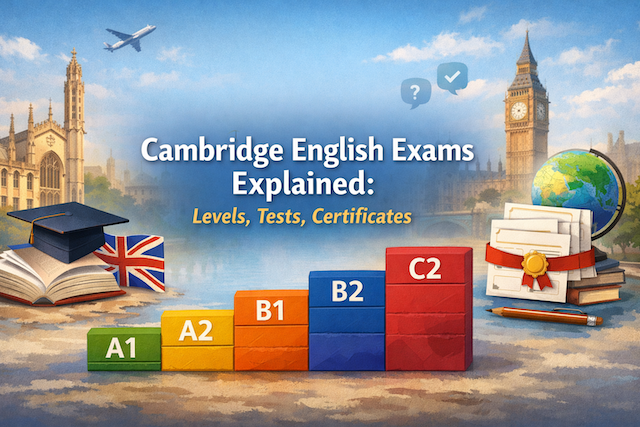
Cambridge English exams follow the CEFR scale, which includes A1, A2, B1, B2, C1, and C2. Lower levels such as A2 are suitable for basic communication in everyday situations, while B1 and B2 show that a learner can study, travel, or work with more confidence. C1 and C2 represent advanced to near-native levels of English. Each exam is designed to match a specific stage of language development, so learners can choose a test that fits their current ability and goals.
Which Cambridge exam should I take?
The best exam depends on your current English level and why you need a certificate. If you are still building basic skills, A2 Key may be a suitable starting point. B1 Preliminary is a good option for intermediate learners, while B2 First is one of the most popular choices for students and professionals. C1 Advanced is often used for university admission or professional purposes, and C2 Proficiency is aimed at those who want to prove a very high command of English. Taking a placement test first can help you decide more accurately.
Do Cambridge English certificates expire?
One of the main advantages of Cambridge English qualifications is that they do not expire. Once you earn a certificate, it remains valid for life. This makes Cambridge exams different from some other English tests that are only accepted for a limited number of years. However, some universities, employers, or immigration offices may still prefer a more recent proof of English ability depending on their own rules. Even so, the certificate itself remains a permanent qualification.
What skills are tested in Cambridge English exams?
Most Cambridge exams assess the four main language skills: reading, writing, listening, and speaking. Some exams also include a Use of English section that focuses on grammar and vocabulary. The goal is to test how well candidates can use English in real-life situations rather than simply memorize rules. The speaking test is especially notable because it is often conducted face-to-face, allowing candidates to demonstrate communication skills in a more natural way.
How are Cambridge English exams scored?
Cambridge exams use the Cambridge English Scale, which gives detailed scores based on performance in each part of the test. Candidates receive an overall score as well as information about their level in individual skills. In some cases, if a test taker does not fully reach the target exam level, they may still receive a certificate showing performance at the level below. This scoring system gives learners a better understanding of their strengths and areas for improvement.
Are Cambridge English exams accepted by universities and employers?
Yes, Cambridge English qualifications are accepted by many universities, employers, and institutions around the world. B2 First, C1 Advanced, and C2 Proficiency are especially well known in academic and professional settings. Many organizations value Cambridge exams because they are rigorous, internationally respected, and based on clear language standards. Still, acceptance rules vary by country and institution, so it is always wise to check the exact requirements before taking an exam for a specific purpose.
How is Cambridge different from IELTS or TOEFL?
Cambridge English exams are different in purpose and structure. Cambridge qualifications are level-specific, meaning each test is designed for a particular CEFR level. They also offer certificates that do not expire. IELTS and TOEFL, on the other hand, are often used for immediate academic admission or immigration purposes and usually remain valid for only two years. Cambridge exams are often chosen by learners who want a long-term qualification, while IELTS and TOEFL are often selected for short-term application requirements.
How should I prepare for a Cambridge English exam?
The best preparation combines general English improvement with exam-focused practice. Learners should spend time reading different types of texts, writing regularly, listening to English audio, and practicing speaking with others. It is also helpful to study the format of the chosen exam and complete official practice tests. This helps candidates understand timing, question types, and scoring. Many students benefit from joining an English course or working with a teacher who is familiar with Cambridge exams.
Is a Cambridge English exam worth taking?
For many learners, the answer is yes. A Cambridge English qualification can be a valuable long-term investment because it proves your English level through an internationally trusted exam. It can support university applications, improve job opportunities, and give you a clear learning goal. Even beyond academic or professional use, preparing for the exam can strengthen practical communication skills and increase confidence in English. For students who want a respected certificate that reflects real language ability, Cambridge exams remain one of the strongest options available.
Cambridge English Exams: Complete Guide to Tests, Levels, and Certificates