
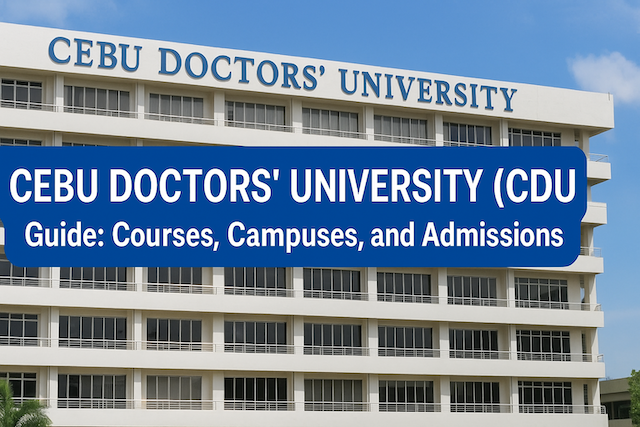
What programs does Cebu Doctors’ University (CDU) offer?
CDU specializes in health sciences and offers programs such as Medicine (MD), Dentistry (DMD), Nursing (BSN), Pharmacy (BS Pharmacy), Physical Therapy, Occupational Therapy, Psychology, Biology, and Communication. At the graduate level, options typically include Master’s in Nursing, Public Health, Education, and Business Administration. Availability may change each year, so applicants should verify the latest program list on the official admissions page before applying.
Where is the CDU campus located, and how accessible is it?
CDU is located in the North Reclamation Area of Mandaue City, Cebu. It is accessible from Cebu City, Lapu-Lapu City, and major residential districts via public transport, ride-hailing, and main road networks. The urban setting places students close to affiliated hospitals, dormitories, review centers, and essential services, making daily commutes and clinical rotations practical and efficient.
What are the general admission requirements for undergraduates?
Typical requirements include: application form, senior high school report card (Form 138 or equivalent), Certificate of Good Moral Character, PSA birth certificate, ID photos, and program-specific entrance tests or interviews. Some colleges may have additional prerequisites (e.g., health clearance or aptitude exams). Applicants should prepare digital and hard copies and follow the timeline published by the CDU admissions office.
How do international students apply to CDU?
International applicants generally submit authenticated academic records, passport and valid visa pages, proof of English proficiency (e.g., IELTS/TOEFL, if applicable), affidavit of support and financial documents, and medical clearance. Additional steps may include an interview and program-specific tests. It is advisable to apply early to account for processing times for visas and document authentication.
Does CDU require an entrance examination?
Entrance testing and interviews can be required depending on the college and program. Medicine, Dentistry, and certain allied health programs may implement screening mechanisms to assess academic readiness and program fit. Applicants should monitor official announcements for testing windows, formats (on-site or online), and minimum qualifying scores.
How much is the tuition at CDU?
Tuition varies by program and year level. As a private university focused on health sciences, professional programs such as Medicine and Dentistry typically cost more than undergraduate allied health programs. Prospective students should consult the latest fee matrix for per-unit rates, laboratory or clinical fees, and miscellaneous charges. Always factor in books, uniforms, equipment, and living expenses.
Are scholarships and financial aid available?
Yes. CDU commonly offers academic scholarships for high performers, grants for students with demonstrated financial need, and possible discounts for siblings enrolled simultaneously. Some colleges also provide merit-based incentives tied to board exam performance or leadership and service. Requirements, coverage, and renewal criteria differ, so review the fine print and deadlines carefully.
What is the academic calendar and term structure?
CDU typically follows a semester-based calendar with summer terms used by some programs for laboratories, clinics, or bridging courses. Start and end dates can shift each school year. In addition, certain colleges may have early orientations, white coat ceremonies, or clinical onboarding that occur before regular classes begin.
What facilities and learning resources can students expect?
Students have access to discipline-specific laboratories, simulation and skills centers, a library with online resources, e-learning platforms, research support, and study areas. Health programs benefit from proximity to training hospitals and partner clinics, which facilitates early patient exposure, supervised rotations, and competency-based assessments aligned with program outcomes.
How strong are CDU’s board exam results and graduate outcomes?
CDU is widely recognized for competitive performance in national licensure examinations, especially in Nursing and other allied health fields. Outcome indicators—such as board pass rates, residency placements, and overseas employment—vary by cohort and year. Applicants should review recent official statistics where available and speak with program chairs or alumni for context.
What does clinical training look like for Medicine, Nursing, and Allied Health?
Clinical education typically progresses from simulation to supervised patient care in affiliated hospitals and community settings. Students learn history-taking, physical examination, diagnostics, documentation, and interprofessional collaboration. Rotation schedules, case quotas, and assessment rubrics are determined by each college, aligning with local regulatory standards and program learning outcomes.
Is CDU suitable for international career pathways?
Many graduates pursue further training or employment abroad, especially in Nursing and allied health professions. Success depends on meeting destination-country licensing requirements, English proficiency benchmarks, and credential evaluation standards. CDU’s curriculum and clinical exposure can provide a strong foundation, but students should plan early for specific international exams and documentation.
What is student life like on campus?
Student life blends rigorous academics with organizations focused on service, leadership, faith, culture, and research. Health missions, outreach programs, and community health education are common. The urban location offers access to internships, review centers, and part-time opportunities compatible with program demands, while campus policies prioritize safety and professionalism.
Are there dormitories or recommended housing options near CDU?
While on-campus dorm availability may be limited, many students rent apartments, boarding houses, or shared units within commuting distance. Prioritize safety, commute time to campus and hospitals, study-friendly environments, and budget. Signing leases early—especially before peak intake months—helps secure better options and rates.
How can I strengthen my application?
Maintain strong grades in science and math (or pre-medical subjects for MD), prepare thoroughly for required tests, and highlight relevant experiences such as volunteer work, research, or healthcare exposure. Craft a clear motivation statement, secure credible recommendation letters, and meet all documentation and deadline requirements to avoid processing delays.
What support services does CDU provide?
Support often includes academic advising, guidance and counseling, library and IT help desks, research mentoring, campus ministry or wellness programs, and career services such as mock interviews and board exam preparation. Availability varies by college, so ask about program-specific mentoring, remediation pathways, and review support.
How do I contact CDU for the most accurate information?
For official announcements on programs, admissions, testing, fees, scholarships, and calendars, consult the university’s website and contact the admissions office directly by phone or email. Because policies and offerings can change, always rely on current official sources when making decisions and submitting documents.
Top 100 Universities in the Philippines (2025 Ranking Guide)
Cebu University Guide: Top Universities and Programs for Local and International Students