
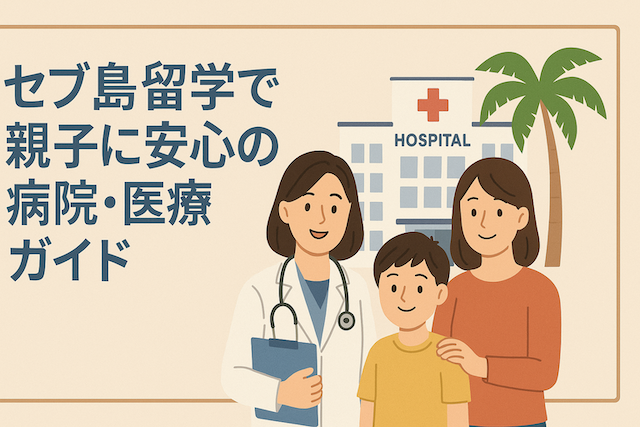
Parent-Child Study Abroad Guide
Hospital and Medical Guide for Parents and Children Studying in Cebu
01
Introduction
Parent-and-child study abroad in Cebu is an attractive option that lets you experience English learning and a resort lifestyle at the same time. However, when traveling with small children, what worries many parents is **the medical system in case of illness or injury**. Overseas in particular, language barriers, differences in medical standards and payment methods tend to be sources of anxiety.
Fortunately, Cebu has **private hospitals and pediatric facilities** that foreigners and international students also use, and consultations in English are available. This article clearly explains what you should know to stay worry-free during parent-and-child study abroad: Cebu's healthcare situation, reliable hospitals, pediatric care and emergency response.
02
Healthcare in Cebu
Cebu has a relatively high medical standard even within the Philippines, and because there are many foreign expatriates, international students and tourists, there are many doctors who can provide consultations in English. **Private hospitals** in particular are equipped with the latest medical facilities and offer a clean environment where you can receive care with confidence.
Public hospitals, on the other hand, charge low fees but have many patients and long waiting times, and concerns remain about facilities and hygiene, so we do not recommend using them during parent-and-child study abroad.
Consultation and hospitalization fees are cheaper than in Japan, but **payment is basically required in cash or by credit card**. Some insurance companies work with hospitals that accept cashless payment, but in many cases you must pay up front, so enrolling in overseas travel insurance or study abroad insurance is essential.
03
Major Hospitals Convenient for Parent-and-Child Study Abroad
1. Chong Hua Hospital
- The largest private general hospital in Cebu
- Equipped with the latest medical equipment and widely used by foreign patients
- Has pediatric and obstetrics/gynecology departments and can handle children's illnesses
- Location: Around Fuente Osmena (city center)
2. Cebu Doctors’ University Hospital
- A hospital popular with foreigners, where doctors communicate smoothly in English
- Full-time pediatric specialists
- About 10 minutes by car from Ayala Center
- Location: Near the Capitol in Cebu City
3. Perpetual Succour Hospital
- Well equipped to receive emergency cases, handling sudden fevers and injuries
- Close to Ayala Mall and easy to reach from the international student area
- Location: Near Gorordo Avenue
4. UCMed (University of Cebu Medical Center)
- A relatively new hospital with clean, well-equipped facilities
- Good access from Mandaue and Mactan
- Convenient if you are staying in Mactan as a parent and child
- Location: Mandaue City
04
Pediatrics and Children's Healthcare
- Cebu's major private hospitals have **full-time pediatric (Pediatrics) specialists** who can handle symptoms typical of children such as fever, colds and allergies.
- Some hospitals have 24-hour emergency rooms, so you can receive care even for sudden illness at night or on holidays.
- Vaccinations are also available, but the types of vaccines and schedules may differ from those in Japan. For this reason, **it is advisable to complete the necessary vaccinations in Japan before studying abroad**.
- Medicine can also be obtained at local pharmacies, but children's syrups and brands familiar from Japan may be hard to find. In particular, it is reassuring to bring regular medications and allergy medicine from Japan.
05
Clinics and Medical Support for Japanese Visitors
- **Medical services with Japanese-language support** At Cebu's large hospitals, a Japanese interpreter can sometimes be arranged, so even parents and children who are unsure of their English can receive care with confidence. At Cebu Doctors’ University Hospital in particular, Japanese-language support is available if you make a reservation in advance.
- **Japanese-language support from insurance companies** Some overseas travel insurance and study abroad insurance plans provide **24-hour telephone support in Japanese** and cashless treatment at partner hospitals. When you enroll in insurance, it helps to check the “hospitals available in Cebu”.
- **School support system** Depending on the language school, there is transport to partner hospitals and staff accompaniment. For parent-and-child study abroad, it is reassuring to check whether school staff can accompany you to the hospital.
06
Emergency Response
- **Ambulance** In the Philippines, you can call an ambulance on the nationwide emergency number 911. However, arrival can be delayed, so for mild symptoms it is also common to go directly to a hospital by Grab or taxi.
- **Payment methods** Most hospitals require **cash payment in advance**. Even when using insurance, you are often asked to pay up front first and then claim from the insurance company later. Some hospitals accept credit cards, but it is reassuring to have cash ready in case card payment does not go through.
- **Required documents** When going for emergency care, be sure to bring your **passport and proof of insurance**. You will be asked to present them, especially if hospitalization or tests are needed.
- **Communication system** It is important to note down in advance the emergency contacts of school staff, your insurance company and the Japanese Embassy. For parent-and-child study abroad, sharing an emergency flow within the family helps you act smoothly if your child's condition suddenly changes.
07
Medical Preparedness Checklist for Parent-and-Child Study Abroad
- **Be sure to enroll in overseas travel insurance or study abroad insurance** Hospital costs can be high, so choose insurance with cashless service and Japanese-language support for peace of mind.
- **Bring regular medications from Japan** Prepare familiar items from Japan such as fever reducers, stomach medicine, children's cold medicine, allergy medicine and a thermometer.
- **Check the nearest hospital in advance** Use Google Maps or similar to look up the hospital closest to where you are staying (school dormitory, condominium, hotel).
- **Note down emergency contacts** Prepare phone numbers for school staff, hospitals, your insurance company and the Japanese Embassy, both on your smartphone and on paper.
- **Compile your child's health information** Prepare a short note in English on allergies, chronic conditions and current medications to make consultations smoother.
- **Secure cash and a credit card for payment** Prepare multiple ready payment methods in case of sudden hospitalization or tests.
08
Summary
Cebu has a relatively well-developed healthcare system within the Philippines, and, centered on private hospitals, offers **an environment where even foreigners and parent-and-child students can receive care with confidence**. There are pediatric specialists and hospitals with emergency care, and by knowing the information in advance you can respond calmly to unexpected illness or injury.
To make parent-and-child study abroad a success, in addition to setting up the learning and living environment, **medical preparedness** is essential. With measures such as enrolling in insurance, preparing regular medications, checking the nearest hospital and sharing emergency contacts, you can enjoy your study life in Cebu with peace of mind.
09
Frequently Asked Questions
What is the medical standard in Cebu? Is it safe for parent-and-child study abroad?
The medical standard is relatively high, centered on private hospitals, and consultations in English are common. There are several general hospitals with pediatrics and emergency rooms, so you can receive appropriate care even during parent-and-child study abroad.
Should I use a public hospital or a private hospital?
For parent-and-child study abroad, we recommend using a **private hospital**. Public hospitals are cheaper but can have concerns about crowding and facilities. Private hospitals are clean, and waiting times and service are relatively smooth.
How do I pay? Can I use cashless payment?
At many hospitals, cash or credit card payment is standard. Some hospitals support insurance cashless service, but in some cases you will need to pay up front. To be safe, prepare both cash and a card.
Is overseas travel or study abroad insurance necessary? What should I look for when choosing?
Whether cashless treatment is available (list of partner hospitals in Cebu) / 24-hour Japanese-language support / coverage limits for outpatient care, hospitalization, emergency, tests and medication / handling of pre-existing conditions, dental care, vaccinations and so on
What should I do in an emergency? Can I call an ambulance?
The emergency number is **911**. You can call, but arrival may be delayed, so for minor conditions going directly to a private hospital by Grab or taxi is also an option. In serious cases, do not hesitate to use 911.
Is there a pediatrics department? Can I be seen at night?
Major private hospitals have pediatrics departments, and some have 24-hour emergency rooms. You can be seen even at night or on holidays.
Where can I get vaccinations? How do they differ from Japan?
They are available in Cebu too, but the types of vaccines and schedules may differ from Japan. Basically, **complete the necessary ones in Japan before traveling**, and check with your family doctor whether additional shots or boosters are needed.
What is the initial response to common symptoms (fever, diarrhea, cough)?
Fever: Drink fluids frequently and use a fever reducer suited to age and weight. See a doctor for high fever, listlessness or difficulty breathing. / Diarrhea: Prevent dehydration with oral rehydration solution. See a doctor if accompanied by bloody stool, severe abdominal pain or vomiting. / Cough and runny nose: Rest and humidify. See a doctor for breathlessness, wheezing or a persistent high fever.
Should I bring medicine from Japan? Can I also buy it locally?
We recommend bringing familiar regular medications from Japan such as fever reducers, stomach medicine, children's cold medicine, allergy medicine and a thermometer. They can also be purchased at local pharmacies, but equivalent products may not be available, or dosage labeling may differ.
I am worried about the language. Is Japanese-language support available?
English is the basic language, but a Japanese interpreter can sometimes be arranged through the hospital or your insurance company. When you enroll in insurance, check “whether interpreter arrangement is possible” and the “contact information”.
What should I bring when going to see a doctor?
Passport / insurance policy (or proof of enrollment and contact information) / cash and credit card / a note in English on your child's health information (allergies, chronic conditions, medications) / vaccination records (such as an English translation of the Maternal and Child Health Handbook)
What should I do if I am unsure which hospital to go to?
Make the **private general hospital** closest to where you are staying (school dormitory, condominium, hotel) your first choice. It is smoother to contact school staff or your insurance company's 24-hour desk and ask for directions on where to go.
How much do medical fees cost?
It varies by symptoms, tests and hospital. A first consultation fee plus basic tests are often cheaper than in Japan, but imaging tests, IV drips and hospitalization can be expensive. Check your insurance coverage in advance.
Are infectious diseases and water conditions a concern? What should I watch out for in daily life?
Tap water is not drinkable. Use bottled water. / Be careful with raw vegetables and street food depending on your condition. / Make hand washing and hand sanitizing a habit. / Mosquito protection (repellent, long sleeves, checking window screens at your accommodation).
What are the criteria for emergency versus outpatient care?
Emergency: severe dehydration, impaired consciousness, convulsions, difficulty breathing, severe abdominal pain or headache, persistent high fever, bleeding from an injury that will not stop, etc. / Outpatient is fine for: mild fever, cough, diarrhea, skin problems, etc. However, see a doctor if symptoms worsen or persist.
Are there hospitals around Mactan Island, IT Park and Ayala?
Yes. There are also private hospitals and emergency-capable general hospitals in the city center (IT Park, Ayala), Mandaue and around Mactan, so you can choose a conveniently located one. Check the hospital nearest your planned stay on a map in advance.
Does the school help with hospital visits?
Many language schools may provide support such as guidance to nearby hospitals, staff accompaniment and transport arrangements. Check the scope of support during enrollment procedures.
Can I use telemedicine (online consultation)?
Some insurance companies and clinics offer online consultations. They are useful for initial consultations for minor symptoms and for deciding where to go, but switch to a hospital visit when in-person care is needed.
Is There a Checklist?
It is reassuring to have these five points ready before departure: enrolling in insurance, preparing regular medications, checking the nearest hospital, noting down emergency contacts, and your child's health information (English note).
10
Related article
11
Recommended Courses
Course
One-on-One Intensive Course
A fully one-on-one system with no group classes. Your child's English skills can be intensively trained to match their level and goals.
See moreCourseParent-Child Study Abroad Course
A course where children from first grade of elementary school to age 15 can study together with their parent or guardian. You can join from 1 week, and choose a plan suited to both the junior and the parent.
See moreThe first step in IELTS preparation is choosing the right environment
With one-on-one classes and real-format mock exams, we help you reach your target score by the most direct route.