
Cost Guide
Cebu Study Costs and English Progress: How Much Should You Invest?
01
Introduction
Cebu in the Philippines has been attracting more and more attention as a place to study English. Not only is it **less expensive** than Western countries, it also offers **an efficient learning environment built around one-on-one lessons**, which is why it is chosen by students and working adults who want to improve quickly.
When people actually start considering study abroad, however, many wonder: **How much do I need to spend to reach what level of English?**
Cebu is said to offer excellent value for money, but results vary greatly depending on the length of stay, the lesson style and your own study habits. In other words, simply spending more money is not the answer, and choosing only on price may not give you enough progress.
This article outlines **a guide to the costs of studying in Cebu** and **the English progress you can expect from that investment**, and introduces ways of thinking that help you get results efficiently.
02
1. Main Costs of Studying in Cebu
One of the attractions of studying in Cebu is that the **total cost is lower** than in Western countries. However, the costs you actually need to cover are not just tuition but several elements. Here are the main costs involved in life as a student.
1) Tuition
- Because the program centers on one-on-one lessons, costs vary in proportion to the quality of instruction.
- An intensive curriculum of about 6-8 lesson periods per day is typical.
- Depending on the school and plan, a guide is **about JPY 60,000-120,000 per month**.
2) Accommodation
- Many schools have **a student dorm on site**, and costs vary by room type. 1-person room: comfortable but more expensive. 2- to 4-person rooms: easier to keep costs down.
- A guide is **about JPY 30,000-70,000 per month**.
3) Meals
- Many dorms offer meal plans, and many include **3 meals a day**.
- Eating out typically costs PHP 200-300 per meal (about JPY 500-800).
- With a dorm that includes meals, extra costs are small; eating out separately adds roughly a few thousand yen to JPY 10,000 per month.
4) Visa-Related Costs
- The **Special Study Permit (SSP)** is required for stays of 30 days or more.
- For stays over 60 days, a visa extension and an ACR I-Card are also required.
- Typically about JPY 15,000-20,000 for one month, and tens of thousands of yen in total for three months or more.
5) Flights and Travel Costs
- A round-trip direct flight from Japan to Cebu costs **about JPY 30,000-70,000**.
- Prices vary greatly by season, and the high season (summer and the year-end/New Year period) is more expensive.
6) Local Living and Entertainment Costs
- Transportation (jeepney, Grab, etc.): about JPY 3,000-5,000 per month
- Including cafes, shopping and weekend trips, it is safest to budget **an extra JPY 10,000-30,000 per month**.
Estimated Total Cost per Month
- **Budget style:** around JPY 150,000 (shared room + mostly local food)
- **Standard style:** JPY 180,000-220,000 (2- to 3-person room + school meals included)
- **Comfort style:** JPY 250,000 or more (1-person room + eating out and sightseeing)
03
2. Factors That Affect How Fast Your English Improves
A big attraction of studying in Cebu is that you can feel results even in a short time. Still, progress differs from person to person. What creates that difference is not the size of the cost but several factors, such as **the learning environment, the length of stay and your own attitude**.
1) Lesson Style
- **One-on-one lessons** -> Far more output, with instruction tailored to your weak points. You can feel progress even in a short time.
- **Group classes** -> Fewer chances to speak, but you get stimulation from discussions with other students. Costs tend to be lower.
In general, the more a curriculum centers on one-on-one lessons, the faster your English improves, but the cost is also somewhat higher.
2) Length of Stay
- **1-2 weeks:** A chance to get started with English. Progress is limited.
- **1 month:** A stage for building the basics and getting a little used to everyday English conversation.
- **3 months:** You can easily feel the change in your English, and you gain confidence in listening and speaking.
- **6 months or more:** You can reach a level that supports exam preparation such as TOEIC and IELTS, and that connects directly to work or further study.
3) Study Habits and Self-Study Time
- Lessons run 6-8 hours a day, but that alone is not enough.
- **Securing self-study time** for review, vocabulary memorization and listening practice **determines your progress**.
- A student who does a total of 10 hours of lessons plus self-study and a student who only attends lessons will see a big difference in results, even over the same period.
4) Purpose and Motivation for Studying Abroad
- **Travel or hobby purposes** -> English tends to be a secondary benefit.
- **Employment or career purposes** -> With clear goals, concentration is higher and progress comes more easily.
- **Exam preparation purposes** -> Results vary greatly depending on the choice of school and the quality of teachers.
To sum up, progress in English depends on **learning style + length of stay + personal effort + sense of purpose** more than on cost. In other words, even with the same payment, the results people get can be very different.
04
3. The Relationship Between Cost and English Progress
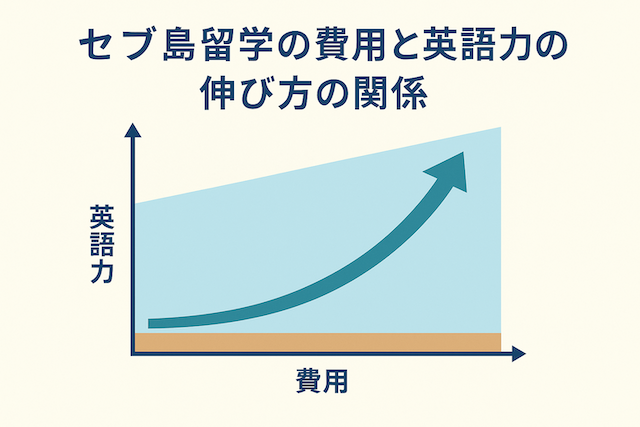
Cebu is highly rated for letting you get results while keeping costs down, but in practice **the relationship between cost and progress is not a simple straight line**. Even with the same spending, results change greatly depending on the length of stay and your learning attitude. Here are some typical cases.
1) Short Stay x Low Budget (1-2 weeks / JPY 150,000 or less)
- **Estimated cost:** around JPY 150,000 (flights + tuition + dorm fees)
- **What to expect:** A good opportunity to get started with English; you can experience life abroad and one-on-one lessons; progress in English is limited (mainly getting used to it and gaining confidence)
- **Suited to:** Trial study abroad, or pre-study abroad before a longer stay
2) Mid-Term Stay x Standard Budget (1-3 months / JPY 400,000-700,000)
- **Estimated cost:** around JPY 200,000 for 1 month, and about JPY 600,000 for 3 months
- **What to expect:** Your basic listening and speaking skills are strengthened; you become less hesitant about conversation and gain confidence in everyday English; improvement tends to show in scores such as TOEIC
- **Suited to:** University students on leave, working adults upgrading their skills, and those preparing for a career change
3) Long Stay x High Budget (6 months to 1 year / JPY 1,200,000 or more)
- **Estimated cost:** JPY 1,200,000-1,500,000 for six months, and around JPY 2,500,000 for one year
- **What to expect:** A dramatic jump from intermediate to advanced level; a level at which you can aim for TOEIC 800 or higher and IELTS 6.5-7.0 or higher; practical English that connects directly to business and further study
- **Suited to:** Those aiming for study abroad, jobs at foreign-affiliated companies, or English certifications
4) Why Cost Does Not Equal Results
- The amount of self-study you do outside lessons makes the difference
- If you spend your stay mostly with other Japanese people, progress is limited
- If motivation is low, results are hard to get even on a long stay
In other words, **how you use the money matters more than how much you pay** for your progress in English. In particular, a mid-term stay of around three months offers high value for money and is the range where the most students feel their progress.
05
4. Tips for Keeping Costs Down While Boosting Results
Even though Cebu is cheaper than Western countries, several weeks to several months is by no means a small investment. Since results differ from person to person even at the same cost, **how to keep costs down while improving your English as much as possible** is the key.
Here are some practical ideas.
1) Focus on Quality and Self-Study Rather Than the Number of Lessons
- Even with 8 lesson periods a day, knowledge does not stick if your review cannot keep up.
- **One-on-one lessons + securing review time** is the most effective approach.
- By reducing lessons slightly and using that time for self-study, you can cut costs and keep your learning efficient.
2) Save on Living Costs by Living Like a Local
- Using local eateries (carinderia) or food courts, a meal costs about PHP 100-200.
- By using jeepneys and MyBus, you can cut transport costs to less than half the cost of Grab.
- If you spend what you save on extra lessons or mock exams, it is easier to turn into results.
3) Choose a School That Matches Your Purpose
- **Focus on conversation** -> A speaking-focused school centered on one-on-one lessons
- **Focus on exam preparation** -> A school with dedicated IELTS and TOEIC courses
- **Working adults / short, intensive stays** -> A curriculum that produces results even in a short time. If your goals and the school's strengths do not match, results are weak even if you spend a lot.
4) Prepare the Basics Before You Go
- If you review junior-high-level grammar and vocabulary beforehand, lessons are easier to follow.
- Avoid starting from zero: **the basics in Japan, practice in Cebu** is the best division of work for value for money.
5) Choose an Environment With a Low Proportion of Japanese Students
- Depending on the school and room type, there may be many Japanese students, and you may end up spending your time in Japanese.
- If you choose a multinational school with Korean, Taiwanese and Vietnamese students, you will naturally have more chances to speak English.
The key is **to clearly separate where you spend money from where you save**. Invest in the parts that lead directly to results, such as lessons and materials, and keep down the parts where you can be resourceful in daily life, such as meals and transportation. This is the golden rule of study abroad that keeps costs down while maximizing results.
06
5. Examples of Cost-Effective Study Plans
The cost and results of studying in Cebu change greatly depending on your purpose and length of stay. Here are some typical cases, introducing **plans that make it easy to balance cost and effect**.
1) 1 Month x Intensive One-on-One
- **Estimated cost:** JPY 180,000-220,000
- **Features:** 5-6 one-on-one lessons per day, with plenty of time reserved for self-study
- **Results:** Confidence in speaking English in a short time / a solid base in listening
- **Recommended for:** Working adults using paid leave, university students on vacation
2) 3 Months x Balanced Plan (Most Popular)
- **Estimated cost:** JPY 550,000-650,000
- **Features:** A combination of one-on-one and small group lessons for a manageable study cycle
- **Results:** More fluent everyday conversation / clear score improvement on exams such as TOEIC can be expected
- **Recommended for:** University students on leave, working adults before a career change, and anyone who wants to build real English skills
3) 6 Months or More x Exam Preparation / Advanced
- **Estimated cost:** JPY 1,200,000-1,500,000 or more
- **Features:** Long-term study with dedicated IELTS, TOEFL and TOEIC curricula
- **Results:** English at a level to aim for overseas university admission or jobs at foreign-affiliated companies
- **Recommended for:** Students and working adults seriously aiming for study abroad or career advancement
4) A Trial Stay That Makes the Most of a Short, Low-Budget Trip
- **Estimated cost:** JPY 120,000-150,000 (1-2 weeks)
- **Features:** A big improvement in English is hard, but you can experience life abroad and the lesson style
- **Results:** More motivation for a future long-term stay
- **Recommended for:** Students going abroad for the first time, and working adults who want to try it first
In summary:
- **1 month -> a chance to get started**
- **3 months -> the best value for money**
- **6 months or more -> serious skill acquisition**
This is the general guide. If you clarify your purpose and budget, it becomes easier to choose the plan that suits you best.
07
Summary
Studying in Cebu is highly attractive because you can **improve your English while keeping costs down** compared with Western countries. However, progress in English is not decided only by how much money you pay, and depends greatly on the following:
- **Lesson style (whether centered on one-on-one lessons)**
- **Length of stay (short or long)**
- **Self-study time (amount of review and preparation)**
- **Purpose and motivation for studying**
These factors have a major influence.
In general, you can expect **to build the basics in 1 month, feel results in 3 months, and acquire serious skills in 6 months or more**. A stay of around three months in particular can be said to offer the best value for money.
In addition, ways to keep costs down include:
- Focus on review rather than the number of lessons
- Save on living costs by living like a local
- Choose a school that matches your purpose
- Build the basics before you go
Efforts like these are effective.
**Conclusion: Studying in Cebu offers high value for money, but to maximize results you need smart investment and good study habits.**
By making a plan that matches your purpose and budget, you can feel your English improve even in a short time.
08
Frequently Asked Questions (FAQ)
We have collected frequently asked questions about the cost of studying in Cebu and English progress. Amounts and conditions vary by school, season and exchange rate. Please be sure to check the latest information before making your final decision.
How much does one month cost in total? A guide is **JPY 180,000-220,000** (including tuition, dorm fees, some meals and local costs). With a shared room and mostly local food, a budget style of **around JPY 150,000** is also possible. For a 1-person room or a lot of sightseeing, expect **JPY 250,000 or more**.
How long does it take for English to improve? **1-2 weeks:** A trial experience; mainly getting used to it and gaining confidence. **1 month:** Building the basics and getting used to everyday conversation. **3 months:** You feel the progress; smoother conversation and better listening. **6 months or more:** You can reach exam preparation and business English.
Are one-on-one lessons really that effective? Yes. Instruction tailored to your weak points **maximizes the amount you speak**, so you can feel progress even in a short time. However, it assumes that you **secure time for review**.
Are more lessons always better? Not necessarily. If you pack in too many lessons, your review cannot keep up and nothing sticks. **A moderate amount of one-on-one lessons plus planned self-study** gives the best value for money.
Which length of stay offers the best value for money? **About 3 months** is generally the zone with high value for money. You can repeat enough input and output, and it is easy to feel results.
Is a short stay (1-2 weeks) worth it? Yes. It is useful as a pre-study-abroad before a long stay, or as an experience of life abroad and one-on-one lessons. Satisfaction goes up if your goal is **getting used to it and building motivation** rather than a big score increase.
Does the proportion of Japanese students affect results? Yes. In a strongly Japanese-speaking environment, the time you spend using English tends to fall. Choosing a **multinational school and room type** increases your opportunities to use English.
How much should I study on my own? A guide is **a total of 8-10 hours a day of lessons plus self-study**. Progress is steadier if you go through lesson review, vocabulary retention and extensive listening every day.
What should I prepare before going to get better value? **Review grammar and vocabulary** at junior high to high school level. Set **target goals** that match your purpose (conversation / exams / work). Practice **speaking templates** (self-introduction, requests, questions) in advance.
Which is better, a dorm or an outside hotel? **A dorm** has no commute and includes meals, making it easier to secure study time. **An outside hotel** is more comfortable but costs more and requires travel. If study time is your top priority, a dorm is the safer choice.
How much do visa and SSP costs run? For study in the Philippines, the **SSP (Special Study Permit)** is **required**, and it costs **PHP 12,040** (paid by everyone the first time). If your stay **exceeds 30 days**, a **visa extension** is required, and the first extension costs **PHP 4,440**. After that, additional fees apply for each extension according to the length of stay. If your stay **exceeds 59 days**, an **ACR I-Card** (alien registration card) must be issued, which also costs PHP 4,000. Many schools **handle** these procedures for you, so it is common to pay everything to the school together.
What are some tips for saving on meals and living costs? Use the dorm's **meal plan**. Keep meals to about **PHP 100-200** at local eateries and food courts. Save on transport with **jeepneys / MyBus**, and use Grab only when necessary.
When should I buy my flight? The high season (summer and the year-end/New Year period) is more expensive. **Booking early** and being flexible with dates make it easier to keep costs down.
What are some tips for getting results in exam preparation (IELTS/TOEIC)? Choose a school with **dedicated exam courses** and experienced teachers. Cycle through **weekly mock exams** with official practice books and work on your weak points. For speaking and writing, prioritize **individual feedback**.
How can working adults on short stays maximize results? Design your stay with **speaking time per day** as the top priority, centered on one-on-one lessons with a fixed daily review routine. Focusing on **phrases for specific uses** based on situations you will face at work gets your investment back faster.
What should I watch for regarding safety and health? Check **safety information** along your commute and around your accommodation in advance. Use **bottled water** for drinking (3D ACADEMY provides water dispensers). Take out overseas travel insurance and know how to reach a hospital.
What are the golden rules for lowering the total cost while getting better results? **Choose a school that fits your purpose** (conversation / exams / business). **One-on-one lessons + securing review time**. **Optimize living costs** (dorm, local food, public transport). **Build the basics before you go** to maximize lesson efficiency.
Note: Amounts are guides. They may change due to school price revisions, exchange rates and seasonal factors.
The first step in IELTS preparation is choosing the right environment
With one-on-one classes and real-format mock exams, we help you reach your target score by the most direct route.