
Cost Guide
Living in an External Condominium While Studying in Cebu: Costs and Living Environment
01
What Is an External Condominium Stay?
An external condominium stay means renting a private condominium in or near the city and commuting to school, instead of living in a dorm run by the language school. Condominiums are basically furnished and equipped with appliances. Many units come with a bed, closet, refrigerator, air conditioner, Wi-Fi and even a kitchen, so you can start living there right after signing the contract.
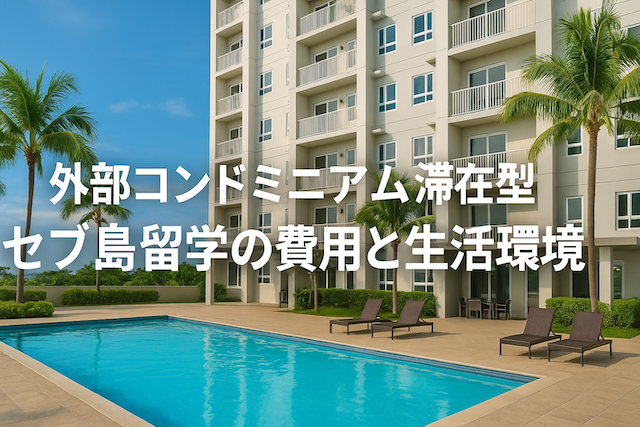
Some units are within walking distance of the school, while others are a 15-30 minute ride by Grab or taxi. Compared with a school dorm, there are no curfews or set meal times, so it is easier to keep your own daily rhythm. Many condominiums also offer shared facilities such as a pool, a gym and 24-hour security, making it possible to live comfortably and privately even while studying abroad.
How Do You Rent a Condominium in Cebu?02
Estimated Costs of an External Condominium Stay
The cost of an external condominium stay varies greatly depending on the **location, floor plan, age of the building and quality of facilities**. Below are monthly estimates as of 2025.
| Item | Estimated amount | Notes |
|---|---|---|
| Condominium rent | PHP 25,000-45,000 (about JPY 65,000-120,000) | Studio or 1-bedroom, furnished and with appliances |
| Utilities and internet | PHP 3,000-6,000 (about JPY 8,000-16,000) | Electricity varies with air conditioner use |
| Water | PHP 500-1,000 (about JPY 1,300-2,600) | May be included in the management fee |
| Food | PHP 8,000-15,000 (about JPY 21,000-40,000) | A mix of home cooking and eating out |
| Commuting | PHP 1,000-3,000 (about JPY 2,600-8,000) | When using Grab or taxis |
| **Estimated total** | **PHP 37,500-70,000 (about JPY 100,000-185,000) + tuition** | Varies with your standard of living |
03
Living Environment of an External Condominium Stay
An external condominium stay lets you enjoy a **life that values privacy and comfort** even while studying abroad. On longer stays in particular, the freedom of daily life and the benefits for your health management are easy to notice.
Kitchen for home cooking
- Most condominiums in Cebu are equipped with an induction or electric stove, a microwave, a refrigerator and basic cooking utensils.
- If you choose an area close to large supermarkets and Japanese grocery stores such as Ayala Center, SM City Cebu and Landers, home cooking becomes even more convenient.
- Without relying on eating out, you can **keep your meals nutritionally balanced and save on food costs**.
Rich shared facilities
- Many properties offer hotel-like facilities such as a pool, gym, lounge and 24-hour security.
- From a high-floor room, you may enjoy superb views of the sea or the city.
Privacy and freedom
- There are no curfews or meal-time restrictions like those of a school dorm, so you can live on your own schedule.
- Between studying and work, you can relax in a quiet, calm environment.
Access to school
- Some properties are within walking distance, but most are about a 15-30 minute ride by Grab or taxi.
- If you want to shorten your commute, properties near the school or along main roads are recommended.
04
Why an External Condominium Stay Is Recommended for Long-Term Study
An external condominium stay is especially suitable for people planning a **mid- to long-term stay of 3 months or more**. In addition to the freedom and ease of living, it also tends to bring financial benefits.
1. You can control food and living costs
- Many units have a kitchen, and home cooking can keep spending lower than eating out most of the time
- Bulk buying and meal prep save time and also support your health management
2. You can keep staying after school ends
- You must move out of a language school dorm when you graduate, but with a condominium you can extend the contract and keep living there
- It is easy to move on to sightseeing or remote work after your studies
3. Privacy and your own daily rhythm
- With no curfew or meal-time restrictions, you can study and rest at your own pace
- You can avoid the stress of shared living with other students
4. Furnished and ready to move in
- Beds, air conditioners, refrigerators, Wi-Fi and more are provided, so you can start living right after arrival
- Some properties offer discounts for long-term rental contracts
In this way, an external condominium is the best way to stay for **people who want to enjoy both study life and local life**, and for **people who value comfort and freedom**.
05
Points to Note About an External Condominium Stay
An external condominium stay offers freedom and comfort, but there are points to watch regarding contracts and daily life. Knowing them in advance helps you avoid trouble and unexpected expenses.
1. Costs other than rent
- Utilities (especially electricity) vary greatly with usage, and **heavy air conditioner use can push the bill above PHP 5,000 a month**
- Internet, management fees, parking fees and similar items need to be confirmed when you sign the contract
2. Contract period and deposit
- Most properties offer monthly contracts, but short-term contracts can be more expensive
- At signing you are often asked for **a deposit of 1-2 months' rent plus rent in advance**
3. Commuting time and transportation costs
- If you commute to school by Grab or taxi, **traffic jams can make travel time hard to predict**
- Transportation costs several thousand pesos every month, so choosing the location is important
4. Condition of facilities and furniture
- Furniture and appliances provided may show signs of wear, so check them before moving in
- Record any damage or defects with photos at move-in to prevent trouble at move-out
5. Security and surroundings
- A property with 24-hour security is preferable
- Also check the safety of the neighborhood and local infrastructure (supermarkets, hospitals, public transportation)
06
Summary
An external condominium stay is an ideal choice for **people who want to keep their own lifestyle** while studying in Cebu and for **people who want a better quality of life on a long stay**. With a kitchen for home cooking and shared facilities such as a pool and gym, it is easier to enjoy a comfortable and healthy study-abroad life.
On the other hand, be aware of additional costs that a school dorm does not have, such as utilities beyond rent, the deposit and commuting costs. When choosing a property, carefully check the **location, facilities, contract terms and surroundings**, and pick a place that suits your study goals and budget.
For long-term study in particular, an external condominium stay lets you achieve both **control over living costs and a high degree of freedom**, so you can balance study and daily life and make the most of your time in Cebu.
07
Frequently Asked Questions (FAQ): Studying in Cebu with an External Condominium Stay
Q1. What is an external condominium stay? It is a style of stay in which you rent a private condominium in or near the city and commute to school instead of living in a school dorm. Many units come with furniture, appliances, Wi-Fi and a kitchen, and the freedom of daily life is a key feature.
Q2. How much should I budget per month? Sample estimates (excluding tuition): - Rent: PHP 25,000-45,000 (studio to 1BR) - Utilities and internet: PHP 3,000-6,000 - Water: PHP 500-1,000 (may be included in the management fee) - Food: PHP 8,000-15,000 (home cooking and eating out) - Commuting: PHP 1,000-3,000 (Grab/taxi) Estimated total: PHP 37,500-70,000 + tuition
Q3. How well equipped are the kitchens? An electric stove (or induction cooktop), microwave, refrigerator, and basic cookware and tableware are standard. Some units have no oven or rice cooker, so consider buying or renting one locally if you need it. Many properties restrict the use of gas, so electric cooking is the norm.
Q4. What are the advantages and disadvantages compared with a school dorm? **Advantages:** adjustable food costs through home cooking, no curfew, privacy, and good facilities (pool, gym, etc.) **Disadvantages:** utilities are charged separately, commuting takes effort and costs money, and you need to manage the contract and move-out procedures yourself
Q5. What about the deposit and contract terms? Can I rent for a short period? In general, you need rent in advance plus a deposit (1-2 months' rent). Some properties can be rented by the month, but short stays tend to cost more, and cleaning or management fees may be charged separately.
Q6. I hear electricity is expensive. How much does it cost, and how can I save? It depends on your lifestyle, but heavy air conditioner use makes the bill climb. To save: - Use the air conditioner only when you are in the room and set the temperature higher - Block daytime sunlight with curtains to limit the rise in room temperature - Open the refrigerator less often and use the microwave to shorten cooking time
Q7. Is the internet good enough for study or remote work? Quality differs by property and provider. At the viewing, check whether a line is available, its speed and whether a wired connection is possible, and if necessary consider a pocket Wi-Fi or an additional line (as far as the property allows).
Q8. How should I choose the location? How long is the commute? To reduce commuting stress, aim for **within 15-30 minutes of the school** or along main roads. Traffic jams tend to occur in the morning and evening, so we recommend trying the Grab/taxi fare and travel time at your actual commuting hours.
Q9. What about security and safety? Many condominiums have 24-hour security and a front desk, with entry control and guest registration. Avoid traveling alone at night, and check for street lights, foot traffic and security cameras around the building for peace of mind.
Q10. Are the noise rules and house rules strict? Can I invite guests? It depends on the property rules. Loud noise and parties are generally not allowed, and guests may be required to show ID or be subject to time limits. At move-in, check the guest policy and whether smoking and pets are allowed.
Q11. What if furniture or appliances have problems? How do I avoid trouble at move-out? Right after moving in, **record the condition of the room and appliances with photos or videos**, and contact the owner or management immediately about anything you notice. Keeping agreements on repairs or replacements in messages makes the deposit settlement at move-out smoother.
Q12. What is the best balance between home cooking and eating out? A popular mix is cooking at home on weekdays to manage nutrition and cost, and eating out on weekends to save time and refresh. Bulk buying, meal prep and freezing help you secure study time on weekdays.
Q13. How do I handle cleaning and linen changes? You generally clean yourself, but some properties or management companies offer paid housekeeping (about once a week to every other week). Check at move-in whether it can be arranged and what it costs.
Q14. What should I watch for regarding payment methods and extra costs? Rent may be paid in cash, by bank transfer or through e-wallets (for example, GCash). Possible extra costs include management fees, move-out cleaning fees, card key loss fees and parking fees, so make the **total payment amount and payment schedule** clear before signing.
Q15. What happens during a power outage (brownout)? Some properties have an emergency generator that powers **only common areas**, so the air conditioner and kitchen in your unit may not work. Check in advance how outages are handled (the range of power supply, securing drinking water and elevator operation).
Q16. Are there long-term discounts or renewals? For mid- to long-term stays of 3 months or more, a **rent discount** may apply. Confirm the renewal terms (whether rent stays the same or is revised, and whether a new deposit is required) in writing at signing.
The first step in IELTS preparation is choosing the right environment
With one-on-one classes and real-format mock exams, we help you reach your target score by the most direct route.