2025年12月15日
3D ACADEMY offers affordable English study programs in Cebu, Philippines – perfect for beginners, professionals, and exam takers.

3D UNIVERSAL ENGLISH INSTITUTE INC
info.3d-universal.com
8:00-17:00(Mon-Fri)
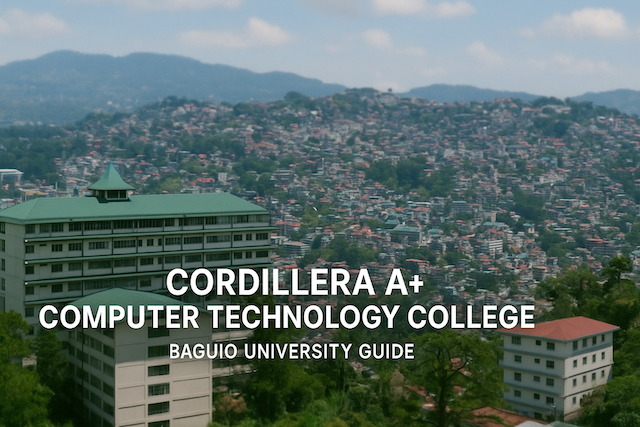
Cordillera A+ Computer Technology College:Baguio University Guide
Contents
- Cordillera A+ Computer Technology College:Baguio University Guide
- Overview
- Location and Campus Environment
- Vision, Mission, and Core Values
- Academic Programs
- Admission Requirements and Process
- Tuition, Fees, and Cost of Living
- Scholarships and Financial Assistance
- Campus Facilities and Learning Environment
- Student Life and Community Engagement
- For Students Comparing Baguio and Cordillera Options
- Career Outcomes and Industry Connections
- Tips for Prospective Students
- How Cordillera A+ Fits into Your Baguio–Cordillera Study Plan
- Conclusion
- FAQs (Frequently Asked Questions)
- Where is Cordillera A+ Computer Technology College located?
- Is this school a good option if I am originally planning to study in Baguio?
- What degree programs are offered at Cordillera A+ Computer Technology College?
- What type of students is this college best suited for?
- Does the school require an entrance examination?
- What are the usual admission requirements for new students?
- How much is the tuition and overall cost of studying there?
- Are there scholarships or financial assistance programs available?
- What is student life like at Cordillera A+ Computer Technology College?
- What kinds of careers can graduates pursue after finishing their degree?
- How can I decide between studying in Baguio City and studying at Cordillera A+ in Tabuk?
Cordillera A+ Computer Technology College:Baguio University Guide
Overview
Cordillera A+ Computer Technology College (often written as C/A+CT College) is a private, non-sectarian higher education institution based in Tabuk City, Kalinga, within the Cordillera Administrative Region of Northern Luzon. Founded in 1997, the college focuses on technology, business, and service-oriented programs that support both local development and national workforce needs.
Although it is located in Tabuk rather than Baguio City, C/A+CT College is part of the broader network of Cordillera higher education institutions often considered by students who are also comparing options in Baguio, La Trinidad, and nearby towns
The college is known for:
-
Strong emphasis on computer-related courses (Computer Science, Information Technology, Office Administration with tech integration).
-
Programs in electronics and communications engineering, which respond to the growing demand for tech and telecom professionals.
-
A values-based mission that highlights Christian principles, life skills, and character formation.
-
A reputation as an accessible institution for first-generation college students and learners from Kalinga, Apayao, and other Cordillera provinces.
If you are exploring schools in or near the Cordillera region and want a smaller, more community-oriented campus with strong tech offerings, Cordillera A+ Computer Technology College is a practical option to consider alongside Baguio-based universities.
Location and Campus Environment
C/A+CT College is located along Quezon Street, Dagupan West, Tabuk City, Kalinga, housed in the Bersamin Building.
Key points about the location:
-
Regional capital setting: Tabuk City is the capital of Kalinga, serving as a gateway to the rest of the Cordillera region.
-
Urban–rural mix: Compared to Baguio City’s busy urban center, Tabuk offers a quieter environment with less congestion and a more laid-back pace—appealing for students who prefer fewer distractions.
-
Nearby services: Around the campus, you can find small eateries, cafés, lodging houses, and local businesses, making everyday life convenient for students.
For students comparing Baguio versus Tabuk:
-
Climate: Baguio is known as a cooler “summer capital,” while Tabuk is generally warmer and lower in elevation.
-
Cost of living: Tabuk tends to have lower rent and day-to-day costs than central Baguio, which can significantly reduce overall study expenses (especially for dormitory or boarding-house residents).
-
Accessibility: Baguio and Tabuk are connected by regional highways and provincial buses or vans. Travel times can vary depending on road conditions, but it is realistic to visit Baguio during breaks or long weekends.
Vision, Mission, and Core Values
The institution’s identity is strongly rooted in its vision and mission, which emphasize both academic excellence and social responsibility.
According to its official materials, C/A+CT College envisions itself as:
“A leading educational institution in the Kalinga Province committed to developing the total person into responsible citizens vital to regional and national development.”
Its mission highlights:
-
Providing technical and intellectual empowerment to the people of Kalinga and Apayao.
-
Combining academic training with Christian values to help students overcome poverty and underdevelopment.
The core values are summarized as:
-
Skills – Building competent, job-ready graduates who can contribute directly to regional growth.
-
Values – Encouraging respect, integrity, and service, modeled on Christian ethics.
-
Excellence – Striving for high-quality outputs that can match global standards.
This combination of technical training and value formation makes the college attractive for families who want both employability and character education.
Academic Programs
C/A+CT College primarily offers undergraduate degree programs focused on technology, business, and service industries.
Based on public program listings, the college offers:
-
BS in Computer Science
-
Focus: Programming, software development, algorithms, data structures, and basic systems design.
-
Suitable for students who want to become software developers, programmers, or IT specialists.
-
-
BS in Information Technology
-
Focus: Practical IT support, networking, systems administration, and applied technologies.
-
Ideal if you are interested in IT infrastructure, tech support, or systems management.
-
-
BS in Electronics and Communications Engineering
-
Focus: Electronics, communications systems, circuits, and basic telecommunications.
-
Prepares students for engineering licensure and careers in telecoms, broadcasting, or electronics-related industries.
-
-
BS in Office Administration
-
Focus: Office systems, clerical and administrative skills, computer applications, and business communication.
-
Suitable for careers in corporate offices, government agencies, and administrative roles.
-
Other references also note offerings and specializations related to:
-
Business administration and business computing
-
Hotel and restaurant or tourism-related fields
-
Criminology
-
Senior High School (SHS) programs, with strands aligned to IT, business, and related areas
Because program availability can change over time (especially for SHS tracks or new majors), it is essential to confirm the current list of programs directly with the college or through updated official pages.
Admission Requirements and Process
C/A+CT College is described in some directories as not requiring an entrance exam for admission, making it relatively accessible compared with larger universities.
While exact requirements may vary by program and year, a typical admissions process for first-year college students usually includes:
-
Accomplished application form (from the registrar or admissions office)
-
Form 138 / Senior High School Card or equivalent report card
-
Certificate of Good Moral Character
-
Birth certificate (PSA)
-
Recent ID photos
-
For transfer students: Honorable Dismissal and copies of Transcript of Records / Subject Descriptions
-
For working students or second-coursers: additional documents may be requested
For Senior High School applicants, expect:
-
Junior High School completion documents
-
Good moral certificate and birth certificate
-
Possibly a brief orientation or interview
International or foreign students (if accepted) would generally need:
-
Passport and visa documents
-
Academic records translated into English (if necessary)
-
Proof of financial capability and/or guardianship in the Philippines
Because policies can change, especially with CHED and DepEd regulations, contact the registrar or check the college’s official online channels for the most up-to-date requirements.
Tuition, Fees, and Cost of Living
Specific tuition amounts for C/A+CT College are not always published openly on public directories, and they may change per semester. However, based on similar private colleges in the Cordillera region:
-
Tuition is generally more affordable than large private universities in Metro Manila or some high-profile schools in Baguio.
-
There may be separate fees for:
-
Laboratory or computer lab usage
-
Miscellaneous and student organization fees
-
Uniforms, ID, and school materials
-
Because the college is located in Tabuk, overall cost of living (rent, food, transportation) is typically lower than in Baguio City’s central districts. This can make C/A+CT College a cost-effective option for students from nearby municipalities or neighboring provinces.
Practical advice:
-
Request an updated assessment
-
Ask the registrar for a sample assessment of fees for your chosen course and year level. Many colleges also provide estimated per-semester costs via email.
-
-
Factor in boarding or dorm costs
-
If you are not local to Tabuk, include monthly rent, utilities, and food expenses when comparing schools.
-
-
Look into payment schemes
-
Many private colleges offer installment plans per month or per grading period. Ask whether these options are available.
-
Scholarships and Financial Assistance
While detailed scholarship lists are not fully public, institutions like C/A+CT College commonly offer:
-
Academic scholarships – For students who maintain a high general weighted average (GWA).
-
Government scholarships and grants – Such as CHED or TES-type programs, if applicable.
-
Private or local government support – LGUs, provincial offices, or NGOs sometimes sponsor students in priority courses like IT or engineering.
If you are from Kalinga, Apayao, or nearby areas, it is worth checking with:
-
Your local government unit (LGU) for education assistance.
-
Scholarship offices in your municipality or province.
-
Community organizations that support indigenous or low-income students.
Campus Facilities and Learning Environment
Public listings and posts suggest C/A+CT College has facilities suitable for its tech and service programs, such as:
-
Classrooms equipped for lectures and group learning
-
Computer laboratories for programming, IT, and office applications
-
Basic laboratories or workshop spaces for electronics and communications courses
-
A college library (referenced in the school’s official materials)
-
Multi-purpose areas for co-curricular activities and community events
Because the college is relatively compact, students often experience:
-
Smaller class sizes compared to big universities
-
More direct access to instructors and staff
-
A more tight-knit community, where faculty and students know each other personally
For tech-focused students, the quality and availability of computers, internet access, and software are crucial. When visiting, ask:
-
How many computers are available per lab session?
-
Are there updated operating systems and development tools?
-
Is Wi-Fi available on campus, and what are the usage policies?
Student Life and Community Engagement
Social media posts show that C/A+CT College actively involves students in community extension and civic programs, such as Civic Welfare Training Service activities in nearby communities and schools.
Student life typically includes:
-
NSTP and CWTS projects in partner communities
-
Participation in local outreach, literacy, or environmental activities
-
School-organized events like seminars, orientations, and recognition days
Because Tabuk is smaller than Baguio, student life here tends to be more:
-
Community-oriented – You engage more with local residents and barangays.
-
Budget-friendly – Food, transport, and entertainment are generally cheaper.
-
Safe and familiar – You see familiar faces around campus and town, which can be reassuring for first-time college students.
If you want the “big city university” atmosphere with malls and nightlife, Baguio City’s schools might have more options. If you prefer a calmer, more grounded lifestyle, a Tabuk-based institution like C/A+CT College may fit you better.
For Students Comparing Baguio and Cordillera Options
Because this article is part of a Baguio University Guide, it helps to position C/A+CT College among other choices in the region.
You might choose Cordillera A+ Computer Technology College if:
-
You live in Kalinga, Apayao, or nearby and want to stay closer to home.
-
Your priority is a practical, technology-focused degree (IT, Computer Science, ECE, Office Administration with tech skills).
-
You value a Christian-influenced, values-based education alongside technical training.
-
You are conscious of budget and cost of living, and see Tabuk as more affordable than Baguio’s central districts.
On the other hand, you might prefer a Baguio City institution if:
-
You want a wider variety of specialized majors (e.g., architecture, fine arts, nursing in large teaching hospitals, etc.).
-
You are looking for a bigger campus with extensive student organizations, varsity sports, and large-scale events.
-
You plan to work part-time in Baguio’s tourism, BPO, or service sectors while studying.
A balanced strategy for some students is:
-
Start with a tech or foundational program in a lower-cost area like Tabuk.
-
Consider transferring or pursuing graduate studies or certifications in Baguio later, once you have built academic records and possibly some work experience.
Career Outcomes and Industry Connections
Based on its program mix, C/A+CT College prepares students for careers in:
-
IT and software – Junior developer, IT support, helpdesk technician, network support.
-
Electronics and telecoms – Technical support, maintenance, telecom technician (for ECE graduates who later pass licensure, broader engineering roles open up).
-
Office and administrative work – Administrative assistant, office staff, executive secretary, records clerk.
-
Business and entrepreneurship – Small business operations or roles in local companies and LGUs.
-
Tourism and hospitality (if enrolled in related programs) – Front desk, reservations, guest services, or local tourism offices.
The college’s mission emphasizes empowering local human resources to break cycles of poverty and underdevelopment through practical skills and Christian values.
When you evaluate the school’s career outcomes, you can:
-
Check FindUniversity and similar platforms for board exam performance and alumni feedback.
-
Ask the registrar or department heads about:
-
Recent employers of graduates
-
Internship or OJT placement partners
-
Alumni success stories or typical career paths
-
Tips for Prospective Students
If you are considering Cordillera A+ Computer Technology College, here are practical steps:
-
Clarify your goal
-
Are you more interested in programming and software, hardware and electronics, or business/office work?
-
Match your goal to BS Computer Science, BS IT, BS ECE, or BS Office Administration accordingly.
-
-
Visit the campus (if possible)
-
Check the facilities, especially the computer labs and electronics laboratories.
-
Observe the neighborhood—safety, food options, boarding houses, and commute routes.
-
-
Ask about class sizes and teaching approach
-
Smaller classes can mean more interaction with instructors, which can be an advantage for technical subjects.
-
-
Compare costs with Baguio schools
-
List tuition + miscellaneous fees + cost of living in Tabuk.
-
Compare with a Baguio-based university you are also considering.
-
Look not only at the per-semester cost, but at the total four-year cost.
-
-
Explore scholarship and funding options
-
Ask about any institutional discounts, LGU scholarships, or government grant programs.
-
-
Check online presence
-
Look at the college’s Facebook page, local listings, and unofficial reviews to get a sense of student experiences and announcements.
-
How Cordillera A+ Fits into Your Baguio–Cordillera Study Plan
If your original plan was “study in Baguio,” expanding that vision to a Cordillera-wide perspective gives you more options. Think of it like this:
-
Baguio – Major academic hub with many universities, higher competition for slots and boarding, and a vibrant city lifestyle.
-
Tabuk (Kalinga) – Regional capital with emerging institutions like C/A+CT College, more relaxed pace, and lower living costs.
You could:
-
Do your entire degree at Cordillera A+ Computer Technology College if its programs match your goals.
-
Start there for foundational years or SHS, then move to a Baguio school for specialized or graduate studies.
-
Use Tabuk as a base while building skills and work experience in local businesses, then later transition to bigger cities if needed.
By considering C/A+CT College as part of a broader Baguio University Guide, you give yourself flexibility in terms of budget, environment, and life rhythm while still staying in the Cordillera region.
Conclusion
Cordillera A+ Computer Technology College is a practical, values-driven option for students who want:
-
Solid training in computer science, information technology, and electronics
-
A smaller, more personal campus experience
-
An education grounded in Christian values, skills development, and excellence
-
A location within the Cordillera region but away from the busier streets of Baguio City
If you are comparing schools across Baguio and the wider Cordillera area, include C/A+CT College in your shortlist—especially if you prioritize affordability, community atmosphere, and technology-focused programs.
Before making your final decision, visit the campus (or contact them online), request updated program and tuition information, and honestly assess which environment will best support your academic goals and personal growth over the next four years.
FAQs (Frequently Asked Questions)
Where is Cordillera A+ Computer Technology College located?
Cordillera A+ Computer Technology College is located in Tabuk City, Kalinga, within the Cordillera Administrative Region in Northern Luzon.
It is not in Baguio City itself, but it is often considered by students who are comparing different schools across the wider Baguio–Cordillera
area. The campus sits in an urban–rural environment, giving students access to city services while still enjoying a more relaxed provincial feel.
Is this school a good option if I am originally planning to study in Baguio?
Yes, it can be a good option, especially if you are open to studying anywhere in the Cordillera region and not only inside Baguio City.
Tabuk City generally offers lower cost of living, smaller class sizes, and a quieter atmosphere. Many students compare programs and tuition
between Baguio-based universities and Cordillera A+ to find a balance between affordability, environment, and program fit.
What degree programs are offered at Cordillera A+ Computer Technology College?
The college focuses on technology, business, and service-oriented courses. Programs typically include degrees in Computer Science,
Information Technology, Electronics and Communications Engineering, and Office Administration. In addition, there may be related offerings
in business, tourism or hospitality, and senior high school tracks. Since programs can change over time, you should always confirm the
current list directly with the registrar or official school channels.
What type of students is this college best suited for?
Cordillera A+ Computer Technology College is well suited for students who want practical, technology-focused training in a more personal,
community-oriented setting. It is a strong match for first-generation college students, those coming from Kalinga and nearby provinces,
and learners who value a combination of skills training, Christian values, and an environment that is less crowded than major city campuses.
Does the school require an entrance examination?
Public information suggests that the college may not always require a competitive entrance examination for admission, making it relatively
accessible compared to larger universities. However, admission policies can change, and certain programs may have their own additional
requirements or screening. The safest approach is to contact the registrar, ask about the latest admission procedures, and request an updated
checklist of required documents.
What are the usual admission requirements for new students?
For most first-year college applicants, you can expect to submit a completed application form, your senior high school card or equivalent
report card, a Certificate of Good Moral Character, a PSA birth certificate, and recent ID photos. Transferees often need a copy of their
Transcript of Records and an Honorable Dismissal from their previous school. International students, if accepted, may be asked to provide
passport, visa, and proof of financial capability.
How much is the tuition and overall cost of studying there?
Exact tuition fees are not always listed publicly and may vary by course and academic year. Generally, tuition at Cordillera A+ Computer
Technology College is expected to be more affordable than that of large private universities in bigger cities. You should also consider the
lower cost of living in Tabuk City compared with central Baguio. To plan realistically, ask the school for a sample fee assessment and then
add estimated monthly housing, food, transportation, and school supplies.
Are there scholarships or financial assistance programs available?
Like many private colleges in the region, Cordillera A+ Computer Technology College is likely to participate in a mix of academic scholarships,
government aid, and local support programs. Students with strong grades may qualify for merit-based discounts. In addition, local government
units and private organizations sometimes sponsor students in priority fields such as IT or engineering. It is a good idea to ask both the
school and your LGU about current scholarship options and application deadlines.
What is student life like at Cordillera A+ Computer Technology College?
Student life is generally community-centered and modest in scale. Because the campus and city are not as crowded as larger urban universities,
you are likely to know many of your classmates and instructors personally. Activities often revolve around classes, community extension work,
and school events such as orientations, seminars, and recognition programs. While nightlife and big malls are limited compared with Baguio,
students benefit from a calmer environment and lower day-to-day expenses.
What kinds of careers can graduates pursue after finishing their degree?
Career options depend on your program. Graduates of Computer Science and Information Technology typically pursue roles in software development,
IT support, systems administration, or networking. Electronics and Communications Engineering students may work in telecommunications,
electronics repair, or related technical fields, especially after passing licensure exams where applicable. Office Administration graduates
often take on administrative and clerical positions in government offices, private companies, and NGOs. Some graduates also choose to start
small businesses or pursue further studies in larger universities.
How can I decide between studying in Baguio City and studying at Cordillera A+ in Tabuk?
When choosing between Baguio and Tabuk, consider your priorities in four areas: academic program, budget, lifestyle, and long-term plans.
Baguio offers a more urban atmosphere, a wide range of universities, and more part-time job options in tourism and services, but costs are
higher. Cordillera A+ in Tabuk offers lower living expenses, smaller classes, and a stronger community feel, especially if you come from the
region. List each factor that matters to you, compare actual costs and available programs, and then choose the environment where you think
you can stay motivated, healthy, and focused for the next several years.
Baguio University Guide
Baguio Province All Universities Lists
Philippines University Guide

How to Register for eTravel Philippines (2025 Guide)
Step-by-step guide to completing your eTravel registration before arriving in the Philippines, with images and tips.

Night Market in Cebu – Things You Don’t Know About Cebu Life
Discover the hidden charm of Cebu’s night markets, from street food stalls to local life tips you won’t find in tourist guides.

How to Use ChatGPT for IELTS Preparation: A Complete Guide
Learn how to prepare for IELTS using ChatGPT — including strategies for Writing, Reading, Listening, Speaking, and grammar support.

How to Build a Website Without Coding Using ChatGPT
Discover how to build your own website using AI—no coding skills needed. From structure planning to SEO and design, let ChatGPT guide you.