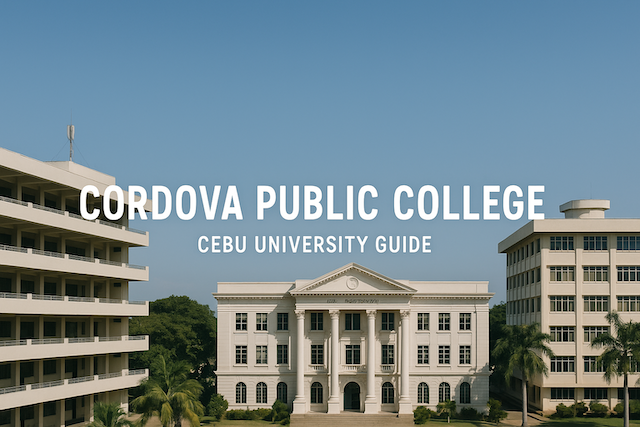
Cordova Public College: Cebu University Guide
Introduction
Cordova Public College (CPC) is one of the key public higher education institutions located in the growing municipality of Cordova, Cebu. Designed to offer affordable and accessible tertiary education, the college plays an essential role in supporting local students who aim to pursue degrees related to education, business, hospitality, tourism, information technology, and community development. Over the years, CPC has gradually expanded both its academic offerings and facilities, reflecting the rapid urban development occurring in Cordova and the broader Mactan region.
This comprehensive guide provides an in-depth look into Cordova Public College—its programs, campus features, tuition and financial support, student life, admissions process, and its relevance to students seeking quality and budget-friendly education in Cebu. Whether you are a student evaluating your options or a parent looking for reliable higher education pathways, this guide offers detailed insights to help you make informed decisions.
Overview of Cordova Public College
Cordova Public College is a government-funded institution offering undergraduate programs that align with the needs of the community and industries within Cebu. The college emphasizes practical skill-building, foundational learning, and developing job-ready competencies. As Cordova evolves into a developing tourism and economic hub, CPC has been strategically strengthening programs that support workforce growth, including education, business management, and hospitality.
The institution is known for:
-
Low tuition and accessible financial aid
-
Community-focused curriculum
-
A local but growing student population
-
Simple but functional campus facilities
-
Strong municipal support
These features make CPC an excellent choice for students prioritizing affordability and proximity to home without compromising educational value.
Academic Programs Offered
Cordova Public College offers several bachelor’s degree programs designed to meet industry demand. While offerings may expand over time, the current flagship programs typically include:
Bachelor of Elementary Education (BEEd)
A program focused on preparing future educators equipped to teach in primary schools. Students undergo coursework in pedagogy, curriculum development, psychology of learning, and classroom management. Practice teaching in partner public schools is part of the curriculum.
Bachelor of Secondary Education (BSEd)
CPC’s BSEd program allows students to specialize in subject areas such as English, Mathematics, or Science. The program includes advanced coursework in teaching methodologies, assessment strategies, and educational technology.
Bachelor of Science in Business Administration (BSBA)
This program aims to build foundational business knowledge and managerial competencies. Subjects include accounting, finance, marketing, entrepreneurship, and human resource management—ideal for students planning to enter the corporate field or start a business.
Bachelor of Science in Hospitality Management / Tourism
Due to Cordova’s rapid tourism development, CPC continues to strengthen its hospitality-related courses. Students gain exposure to tourism operations, hotel management, culinary services, and customer service.
Bachelor of Science in Information Technology (BSIT)
BSIT equips students with IT fundamentals like programming, networking, database management, and system analysis. While CPC’s facilities are basic, the program emphasizes developing technical skills applicable in Cebu’s expanding tech sector.
Technical-Vocational Courses
Some years, the college may also offer TESDA-aligned short courses, depending on funding and local demand.
Admissions Process
Getting admitted to Cordova Public College is relatively straightforward, as the institution aims to support students residing in Cordova and nearby municipalities.
General Admission Requirements
-
Accomplished application form
-
Form 138 (Report Card) for high school graduates
-
PSA Birth Certificate
-
Good Moral Certificate
-
2×2 or passport-size photos
-
For transferees: TOR or Certificate of Grades
-
Entrance assessment or interview (depending on program)
While CPC prioritizes Cordova residents for enrollment slots, non-residents may still be admitted depending on availability.
Application Timeline
Admissions typically open around May to July. It is recommended to submit requirements early, as the college has limited classroom capacity and fills slots quickly.
Tuition Fees and Scholarships
One of the most attractive aspects of studying at Cordova Public College is its affordability.
Tuition
As a public institution, CPC is covered under the Universal Access to Quality Tertiary Education Act, which allows qualified students to study tuition-free in state-supported colleges.
Other Minimal Fees
Students may still need to pay small miscellaneous fees, commonly ranging between ₱1,000–₱2,500 per semester, covering:
Scholarships and Financial Assistance
Students can apply for various financial aid options:
-
Local government scholarships from the Municipality of Cordova
-
CHED Scholarships
-
TESDA financial support (for short programs)
-
Private foundation grants
These opportunities help reduce student expenses even further.
Campus Facilities
Cordova Public College is modest in size, with basic but functional facilities designed to support learning and student activities. While not as large or modern as private institutions, it continues to improve through municipal funding and partnerships.
Classrooms
Ventilated classrooms with essential teaching equipment. Some rooms are gradually being upgraded with multimedia capabilities.
Library
A small but growing collection of academic reference materials and online resources. Digital expansion is ongoing.
Computer Laboratory
Available for IT and digital literacy classes. Equipment is functional but may be limited in number during peak usage.
Multipurpose Hall
Used for assemblies, performances, seminars, and student organization events.
Outdoor Spaces
Students often gather in shaded outdoor areas for group work and leisure.
Accessibility
Located centrally in Cordova, the campus is reachable via local tricycles and jeepney routes, making daily commuting convenient.
Student Life and Culture
CPC has an engaging campus life, despite being smaller in scale compared to larger universities. Students enjoy a community-centered environment that emphasizes:
Student Organizations
Students can join organizations focused on:
Events and Activities
Common campus events include:
These provide students with holistic development beyond classroom learning.
Career Opportunities After Graduation
Cordova Public College graduates typically pursue careers aligned with their degree programs. Some typical fields include:
Education Graduates
Business Graduates
-
Office staff and administrative assistants
-
Marketing and sales roles
-
Accounting assistants
-
Small business owners or entrepreneurs
Hospitality Graduates
IT Graduates
-
Technical support staff
-
Junior programmers
-
Web designers
-
Network assistants
Overall, CPC positions its graduates to contribute to Cebu’s growing economy, especially in education, tourism, and service-based industries.
Why Choose Cordova Public College?
Several advantages make CPC an appealing choice for students in Cebu:
1. Tuition-Free Education
A key advantage, allowing more students to access higher education without financial strain.
2. Convenient Location
Ideal for Cordova residents and students from nearby Lapu-Lapu and Cebu City areas.
3. Developing Academic Programs
Programs aligned with regional economic needs enhance employability.
Students benefit from strong support systems and approachable faculty.
5. Increasing Opportunities
As Cordova grows, more partnerships, internships, and job openings become available to CPC students.
Conclusion
Cordova Public College is a practical and valuable option for students seeking affordable and community-oriented higher education in Cebu. Despite being modest in infrastructure, it offers essential programs and opportunities that align with the region’s workforce demands. As the municipality continues to rise as an economic and tourism hub, CPC’s role in shaping the next generation of professionals, teachers, business leaders, and service workers becomes even more vital.
Whether you are pursuing a degree in education, business, IT, or hospitality, CPC provides a strong foundation to begin your academic and career journey within Cebu.
FAQs (Frequently Asked Questions)
Where is Cordova Public College located in Cebu?
Cordova Public College (CPC) is located in the municipality of Cordova in Cebu, on Mactan Island. It primarily serves students from Cordova, nearby barangays, and surrounding areas such as Lapu-Lapu City. The campus is generally accessible by local transport like tricycles and jeepneys, making it convenient for students who live within the municipality or in neighboring communities. Its location is ideal for those who prefer to study close to home while still having access to the growing economic and tourism opportunities in the Mactan–Cordova area.
What degree programs are offered at Cordova Public College?
Cordova Public College offers several undergraduate programs that respond to local industry needs. Typical degree offerings include education programs such as Bachelor of Elementary Education (BEEd) and Bachelor of Secondary Education (BSEd), business-related courses like Bachelor of Science in Business Administration (BSBA), and courses aligned with tourism and hospitality. In some cases, information technology programs and selected technical-vocational courses may also be available. Specific offerings can change over time, so applicants should always check directly with the college for the latest list of programs.
Is Cordova Public College tuition-free?
Yes, as a public higher education institution, Cordova Public College generally operates under the Philippines’ Universal Access to Quality Tertiary Education Act. This means that qualified students can enjoy tuition-free education in approved bachelor’s degree programs. However, students may still need to pay small miscellaneous or registration fees for items such as IDs, student services, laboratories, or organizational dues. Even with these minor costs, studying at CPC remains significantly more affordable than many private colleges and universities in Cebu.
What are the typical admission requirements for new students?
Applicants usually need to submit a completed application form, high school Form 138 (Report Card) or its equivalent for senior high graduates, a PSA birth certificate, a certificate of good moral character, and recent ID photos. Some programs may require an entrance test, basic screening, or an interview, particularly for education or competitive courses. Transferees typically need to provide their transcript of records or certified true copy of grades from their previous school. As policies can change, it is always best to confirm exact requirements with the school’s registrar or admission office.
Does Cordova Public College prioritize Cordova residents for admission?
Because CPC is a community-oriented public institution, priority is often given to residents of Cordova, especially when slots are limited. The college’s mission includes providing accessible higher education to local students who might otherwise struggle to afford private universities in Cebu City or Mactan. That said, non-residents may still be accepted if there are available spaces in certain courses or if they meet specific program criteria. The exact policy may vary each year based on enrollment capacity and local government guidelines.
What scholarships or financial assistance are available?
Students at Cordova Public College may access several forms of financial support. Aside from tuition-free education for eligible programs, the local government of Cordova may offer municipal scholarships or educational assistance to qualified residents. In addition, students can apply for national-level scholarships from CHED or other government agencies, as well as grants from private foundations or NGOs. For technical or short courses, TESDA-related financial assistance may also be available periodically. Interested students should directly inquire with the school’s scholarship office or guidance office for current opportunities.
What kind of facilities does the campus have?
CPC’s campus is modest but functional, typically including standard classrooms, a basic library, computer laboratories for IT and digital subjects, and a multipurpose hall for events and assemblies. Outdoor spaces are often used for informal gatherings, group work, and student activities. Facilities may not be as large or as modern as those in big private universities, but they are sufficient for core teaching and learning needs. Over time, improvements are usually made through municipal support, donations, and partnerships with local stakeholders.
How is student life at Cordova Public College?
Student life at CPC tends to be friendly, community-based, and down-to-earth. Since many students come from nearby barangays and towns, there is a strong sense of familiarity and support among classmates. Learners can join academic organizations, interest-based clubs, or student councils related to education, business, IT, and the arts. The college may host events such as foundation celebrations, sports tournaments, academic contests, and community outreach programs. The overall environment is suitable for students who prefer a close-knit campus rather than a highly competitive or anonymous university atmosphere.
What career opportunities can graduates expect after studying at CPC?
Career paths depend largely on each student’s degree program. Education graduates can pursue roles as public or private school teachers, tutors, or school staff after passing the necessary board exams. Business administration graduates often work in offices, sales and marketing, customer service, administrative support, or entrepreneurship. Hospitality and tourism students are well positioned to work in hotels, resorts, restaurants, and travel services within Mactan, Cordova, and Cebu City. IT graduates can look for entry-level roles in technical support, programming, web development, or systems administration. Many graduates choose to stay and work within Cebu’s growing economy, but some also explore opportunities in other Philippine regions or abroad.
Is Cordova Public College a good option for budget-conscious students?
Yes. Cordova Public College is especially suitable for students and families who are budget-conscious but still want access to formal higher education. With tuition usually covered under government programs and only minimal miscellaneous fees, the total cost of studying at CPC is relatively low. Students can live at home if they are from Cordova or nearby areas, reducing expenses for rent and daily commuting. The combination of affordable education, community support, and courses aligned with local employment needs makes CPC a practical and attractive choice for many learners in Cebu.
How can I get updated information about programs and enrollment?
Because course offerings, admission schedules, and policies may change from year to year, the best way to get accurate and updated information is to contact Cordova Public College directly. You can visit the campus in person, call the registrar or administrative office, or check any official online pages or social media channels that the college maintains. Doing so ensures that you receive the latest details on program availability, deadlines, entrance procedures, scholarships, and other important announcements before making your final decision.