
Cost Guide
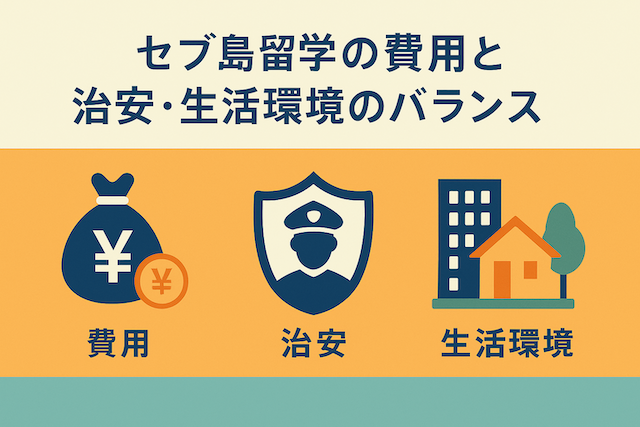
Studying in Cebu: Balancing Cost, Safety and Living Environment
01
1. Introduction
Studying English in Cebu is chosen by many students because it costs less than studying English in Japan, Europe or North America and allows efficient learning centered on one-on-one lessons. The environment is also appealing, with a warm climate all year round, beautiful beaches and relatively friendly people.
However, what is easily overlooked when planning a study trip is the **balance between cost, safety and living environment**. Even if tuition and living costs are low, worries about safety or an inconvenient daily life can become stress and keep you from concentrating on study. On the other hand, if you choose only safe and comfortable areas, you may end up far over budget.
This article organizes the **estimated costs**, the **current safety situation** and the **characteristics of the living environment** for studying in Cebu, and explains how to balance them for a fulfilling study-abroad life. Please use it as a guide when choosing where to study.
02
2. Estimated Costs of Studying in Cebu
The cost of studying in Cebu varies greatly depending on the style of stay, the location of the school and the lesson format. The total is lower than at destinations in Japan, Europe or North America, but it is important to set your budget with your living environment and safety in mind.
2.1 Tuition (Lessons + Accommodation + Meals)
- **1 week**: about JPY 50,000-80,000
- **1 month**: about JPY 150,000-250,000
- **3 months or more**: long-term discounts and promotions can make it cheaper (3D ACADEMY is currently running a promotion for applications made by the end of December 2025: 5% off for 12-23 weeks and 10% off for 24 weeks or more). Most schools in Cebu build their curriculum around **one-on-one lessons**, so high learning results can be expected even in a short period.
2.2 Living Costs
- **Food**: JPY 10,000-30,000 per month if you eat out often; you can save more by using the meals provided by the school
- **Transportation**: JPY 5,000-10,000 per month when using Grab or taxis; even less if you live within walking distance
- **Entertainment and travel**: island hopping on weekends or nearby trips add a few thousand to tens of thousands of yen
2.3 Money-Saving Tips
- Choose a dorm room for 3-6 people
- Rely mainly on the meals provided by the school
- Choose a living area where you can get around on foot or with short trips
It is possible to keep costs down, but **sacrificing safety or living environment too much can end up lowering your learning efficiency**, so balance is important.
03
3. Safety in Cebu
Cebu is considered a relatively safe area in the Philippines, but if you live with the same mindset as in Japan, you may get caught up in trouble. Petty crime such as pickpocketing and bag theft in particular tends to occur in areas with many tourists and students, so caution is needed.
3.1 Relatively Safe Areas
- **IT Park**: home to foreign companies and high-end condominiums, with strong 24-hour security
- **Parts of Mabolo, Banilad and Lahug**: many language schools and shopping malls, and many students and foreign residents
- **Around large shopping malls (Ayala Center, SM City, etc.)**: security guards are stationed there and there are many people around
3.2 Points to Be Careful About
- **Walking alone at night**: avoid back streets and residential areas with little foot traffic in particular
- **Managing valuables in crowds**: the risk of pickpocketing is high at markets, jeepneys and ferry terminals
- **Carrying too much cash**: carry only the minimum cash and cards you need
3.3 Basic Safety Measures
- Use **Grab** or a reliable taxi company for getting around
- Carry your bag in front of your body and always keep zippers closed
- Get the latest safety information from local people and school staff
There is no need to worry excessively about safety, but **not letting your guard down is the best prevention**. With proper precautions, you can enjoy study and daily life safely.
04
4. Living Environment and Style of Stay
In Cebu, comfort, safety and even cost change greatly depending on where you stay and how you live. Choosing according to your goals and priorities determines how satisfying your study-abroad life will be.
4.1 School Dorm
- **Advantages**: no commute, which saves time and transportation costs; meals and cleaning are often included
- **Disadvantages**: living rules can be strict, and privacy may be limited
- **Best for**: first-time students, people who prioritize safety, and people who want to minimize preparation for daily life
4.2 Condominium
- **Advantages**: home cooking is possible, and many properties have a pool and gym, making them comfortable
- **Disadvantages**: rent and utilities are somewhat higher, and even furnished units may require you to buy cookware
- **Best for**: people who want a flexible daily rhythm, long-term stays and people who like to cook
4.3 Local Apartment
- **Advantages**: the lowest rent
- **Disadvantages**: security and facilities are poorer, and depending on the surroundings there may be noise or inconvenience
- **Best for**: people used to local life, and long-term students who want to cut costs as much as possible
4.4 Tips for Choosing an Area
- Distance to school (can you get there on foot or with a short trip?)
- Whether supermarkets, cafes, hospitals and other daily infrastructure are nearby
- Safety by day and by night
It is important to choose your living environment based on the **triangle balance of cost, safety and comfort**. For a short stay, choose a comfortable and safe area even if it costs a little more; for a long stay, adjust to your goals, for example by living slightly outside the center to keep costs down.
05
5. Tips for Balancing Cost, Safety and Living Environment
To make your study in Cebu a success, it is important to combine not only low cost but also the three elements of safety and comfort in a good balance. Especially in your first life abroad, small worries or inconveniences directly affect your motivation to study, so judge carefully at the planning stage.
5.1 For a First Study Trip, Put Safety First
- Choose a school dorm or a condominium around IT Park
- Give priority to properties with on-site security
- An environment with a mall or cafes within walking distance is preferable
5.2 Ideas for Keeping Costs Down
- Choose a room for 3-4 people to keep tuition down
- Make full use of the school's meal plan
- Keep your daily life within walking distance or short trips
5.3 Finding a Middle Ground Between Comfort and Cost
- If you want a private room, choose a safe area slightly outside the center
- Use long-term condominium discounts
- Combine school meals and home cooking to adjust your living costs
5.4 Extreme Saving Backfires
- Cutting costs at the expense of safety can end up costing more through theft or poor health
- If worry or inconvenience continues, you cannot concentrate on study and the results of your stay decline
**The key is a step-by-step approach: put safety and comfort first at the beginning, then adjust costs once you are used to life there.** This secures both learning efficiency and satisfaction with daily life.
06
6. Summary
Studying in Cebu combines cost advantages with attractions such as a warm climate and a friendly culture. However, the key to a fulfilling study-abroad life is to choose where you stay from a comprehensive viewpoint that includes **safety and living environment**, not just tuition and living costs.
- **Cost** varies greatly with the school and style of stay, so look for the best combination within your budget
- **Safety** differs by area and time of day, so collect safety information in advance and take thorough precautions
- **Living environment** should be chosen based on convenience of commuting, the quality of nearby facilities and the comfort of your home
For a first study trip, we recommend staying in a safe and convenient area and adjusting your costs after you get used to life there. If you plan around three pillars, **not only low cost but also peace of mind and comfort**, you can enjoy a study-abroad life with strong learning results and high satisfaction.
07
Studying in Cebu FAQ (Balancing Cost, Safety and Living Environment)
We have gathered common questions about cost, safety and living environment so that even first-time students are not left wondering. Please always check official information for the latest systems and prices.
Q1. What is the total monthly cost of studying in Cebu? The school (tuition + dorm + meals) costs about JPY 150,000-250,000, and living costs (eating out, transportation, miscellaneous) are about JPY 10,000-30,000. It goes up or down depending on the style of stay and room type.
Q2. How can I keep costs down? Choose a dorm room for 3-6 people. Use the school's meal plan. Choose an area within walking distance of the school or nearby to minimize transportation costs.
Q3. Is Cebu safe? Tourist and student areas are relatively safe, but measures against petty crime such as pickpocketing and bag theft are essential. Avoid walking alone at night and back streets with little foot traffic, and use Grab or similar services to get around.
Q4. Which areas are recommended for beginners? Around IT Park, Mabolo, Banilad and parts of Lahug offer a good balance of convenience and security. School dorms are also popular for their safety and low effort.
Q5. What is the difference between a school dorm, a condominium and a local apartment? **School dorm:** no commute and easy to manage (with rules) **Condo:** home cooking possible and comfortable, but somewhat more expensive **Local apartment:** cheapest, but facilities and safety vary greatly from place to place
Q6. Which is better, a single room or a shared room? Choose a single room if you want to focus on study or care about sleep quality. Choose a shared room if you want to save money or meet more people. It is also fine to start with a single room and switch to a shared room once you are used to life there.
Q7. What transportation is safe to use? Mainly Grab (ride-hailing app) and taxis arranged by hotels or schools. Jeepneys and buses are cheap, but do not push yourself until you are used to them.
Q8. Are the food and tap water safe? Local eateries are cheap and tasty, but tap water is not drinkable. Use mineral water or a water purifier as a rule. For street food, consider how you feel and start with clean shops.
Q9. Is the internet comfortable? Schools and condos generally have Wi-Fi. Speed and stability differ by property, so using a pocket Wi-Fi or SIM as well gives peace of mind.
Q10. How should I prepare for hospitals and illness? Major areas have private hospitals. Overseas travel insurance is essential. Bring regular medicine, stomach medicine and a fever/pain reliever, and carry oral rehydration solution for dehydration.
Q11. How do I check visa and entry rules? Rules may change, so check the latest guidance from the embassy in the Philippines, the immigration bureau or your school. Extension procedures are generally supported by the school.
Q12. How should I exchange money and pay? Carry a small amount of cash on arrival, then use a combination of credit/debit cards and ATM withdrawals. Avoid carrying large amounts of cash.
Q13. What about risks such as typhoons and power outages? During the rainy season there may be squalls and typhoons. Keep a flashlight and a power bank on hand, follow the school's safety guide and check weather information regularly.
Q14. How long should I study to be effective? 4-8 weeks strengthens the basics, and 12 weeks or more stabilizes practical ability. For short stays, increasing the number of one-on-one lessons and the amount of homework raises the intensity.
Q15. What should I look at when choosing a school for the first time? Curriculum (ratio of one-on-one lessons, availability of exam preparation) Dorm safety, rules and meal quality Location (convenience within walking distance, atmosphere at night)
Q16. Is it okay for English beginners? Because lessons are mainly one-on-one, it suits beginners well. Preparing before arrival (self-introduction and phrases for making requests) changes how much you improve in the first week.
Q17. How do I balance study and sightseeing? Focus on study on weekdays and plan trips such as nearby beaches on weekends. Fatigue lowers learning efficiency, so avoid staying up late and overly packed schedules.
Q18. What should women studying alone be careful about? Avoid traveling at night and choose busy streets and facilities. Keep clothing and belongings inconspicuous and use Grab as your basic means of getting around. At move-in, also check that security is working.
Q19. What should I watch for regarding noise and the surroundings? Downtown areas are convenient but may have noise or event sounds at night. At the viewing, check the floor level, the building's soundproofing and the window seals.
Q20. How do I strike the final balance? For your first stay, put safety and comfort first (school dorm or around IT Park), then optimize costs with a shared room or an area outside the center once you are used to life there. Extreme saving harms safety and learning efficiency.
* This FAQ gives general guidelines. Prices, rules and safety conditions change, so be sure to check the latest information.
The first step in IELTS preparation is choosing the right environment
With one-on-one classes and real-format mock exams, we help you reach your target score by the most direct route.