
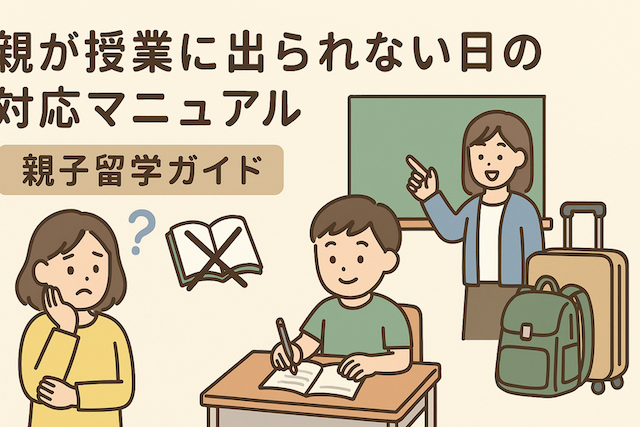
Parent-Child Study Abroad Guide
What to Do on Days When the Parent Cannot Attend Class: Parent-Child Study Abroad Guide
01
Introduction
Parent-and-child study abroad is based on the premise that parent and child live and learn together. However, it is not unusual for there to be days when the parent cannot attend class because of illness, a sudden errand or administrative procedures at a government office.
At such times, many parents feel anxious, wondering "What about my child?", "Can I reschedule the lesson?" and "Is it safe?"
This manual summarizes the basic response when a parent cannot attend class and the points to check in advance. We recommend reading it before your study abroad so that you can respond calmly even to unexpected trouble.
02
Contacting the school is essential
If a parent cannot attend class, the first thing to do is to contact the school.
- **Contact them early - this is the golden rule** Tell the school as soon as you know you will be absent or late. Contact made right before class starts may delay the response.
- **Check how to contact them** Depending on the school, there are designated means of contact such as email, LINE, a dedicated app or phone. Before departure, be sure to confirm the emergency contact and the usual method for reporting absences.
- **What to tell them** Whether only the parent is absent or both parent and child are absent The reason for the absence (illness, government procedures, etc. - a brief reason is fine) When you expect to be back (back in half a day, or absent for the whole day)
By conveying these clearly, the school can smoothly arrange the child's participation in class and supervision.
03
What about the child's class participation?
Even if the parent cannot attend class, in many cases the child can attend lessons as scheduled. However, handling differs depending on age and school rules, so it needs to be confirmed in advance.
- **When the child can attend class alone** Elementary school age and above can often take class alone, with no particular problem. Even if the parent is absent, the child can continue learning.
- **For small children (such as preschoolers)** If the child is at an age where attending class alone is difficult, the school may assign temporary staff. Some schools partner with babysitter services, so check in advance.
- **Supporting the child's emotional wellbeing** Some children feel anxious without their parent. In that case, it is reassuring to let the teachers and staff know that the parent is absent today.
The key point is to be sure to confirm with the school before departure whether your child can attend class.
04
How a parent can make up for missed lessons
When a parent is absent, how that day's lesson is made up differs by school. It is reassuring to check in advance.
- **When make-up classes are possible** Many language schools have a system allowing make-up classes if you miss class due to illness or unavoidable circumstances. Note that the number of make-ups and their expiry periods are often limited.
- **Follow up with materials and homework** Even if a make-up is not possible, asking the teacher to give you the lesson materials and homework helps minimize falling behind.
- **If the absence continues for a long time** If you cannot attend class for several days or more, you can consult the school about temporarily adjusting the schedule, or consider options such as a leave of absence or an extension.
The key point is to **check with the school in advance about how you can catch up after an absence**. This lets you respond flexibly and with peace of mind.
05
For short absences (hospital visits, government procedures, etc.)
There are also cases where a parent does not miss the whole day but has to step out for the morning or a few hours. In that case, the following responses are possible.
- **The child can continue class** Even if the parent is temporarily absent, the child can attend class as usual. It is reassuring to tell school staff, "I plan to be back around (time)."
- **Pick-up/drop-off and lunch** Even for a short time, the child may need pick-up/drop-off or lunch. School or dorm staff may be able to help, so check in advance how to request it.
- **Ensuring safety when no guardian is present** Small children may feel anxious or run into trouble during the time their parent is away. It is reassuring to ask a babysitter or school staff to temporarily look after them as needed.
Short absences are not unusual. What matters is **telling the school in advance and setting up a support system for your child**.
06
Preparing for long absences
You also need to anticipate cases where a parent cannot attend class for several days to more than a week. Prepare in advance for sudden trouble such as illness or family circumstances.
- **Advance confirmation is important** Before departure, check with the school how absences of several days by a parent are handled. Also check whether the child can attend alone and whether there are systems for make-up lessons or temporary leave.
- **Check your insurance coverage** If you will be absent for a long time because of hospitalization or outpatient treatment, it is reassuring to check whether your overseas study insurance includes tuition coverage or extension coverage.
- **Set up a proxy support system** It is reassuring to arrange for a trusted family member or a friend attending the same school to help with your child's pick-up and support in an emergency.
- **Strengthen coordination with the school** As soon as you know a long absence is unavoidable, be sure to share the situation with school staff and teachers. They may be able to respond flexibly regarding your child's care and learning progress.
The key point is to **prepare in advance rather than panic after an absence occurs**.
07
Summary
In parent-and-child study abroad, a day when the parent cannot attend class may come suddenly. However, if you understand the response in advance and set up a way to communicate with the school, it will not become a major problem.
- **Always contact the school early** about absences or lateness
- The child can basically continue class, but depending on age may need support
- The parent's own learning can be followed up with **make-up lessons and materials**
- For short absences, **ask the school for pick-up/drop-off, lunch and safety supervision**
- Prepare **insurance and a proxy support system** for long absences
What matters is **not to decide on your own but to consult the school**. If you treat trouble as something to expect and respond calmly, you can continue your parent-and-child study abroad life with peace of mind.
08
Frequently Asked Questions
What should I do first if I will be absent?
As soon as you know you will be absent or late, contact the school promptly by the method the school designates (email, LINE, a dedicated app, phone, etc.). Clearly state whether only the parent is absent or both parent and child, and when you expect to return (half a day / one day).
Can my child attend class even when I am not there?
In most cases, yes. Conditions differ depending on age and school rules, so before departure confirm with the school whether your child can attend alone and what supervision arrangements are in place.
What about preschool-age children?
Preschool-age children may find it difficult to attend alone. Check in advance whether the school offers temporary support or partner babysitters, the cost of supervision, and the request deadline.
Can I take a make-up class?
Availability, number of sessions and expiry period differ by school. Also check how to report the reason for absence (including whether a medical certificate is needed) and how materials and assignments are provided.
What about a short absence (hospital, government office, etc.)?
Share your expected return time with the school, and request pick-up/drop-off, lunch and supervision in advance if needed. Explain to your child beforehand that you will be away, and ask the teacher to help reduce any anxiety.
What if the absence looks likely to be long?
Share the situation with the school early and consult about options such as a temporary timetable adjustment, leave of absence, extension or online make-up lessons. Check the policy terms to see whether tuition is covered.
Is online attendance or online make-up possible?
Some schools can offer temporary online make-up lessons. Check the tools used, connection tests, how materials are distributed, and how the absence is treated.
What should I check about insurance?
Check in advance the presence and conditions of coverage for medical treatment during hospitalization and outpatient visits, tuition coverage, extra-stay and extension costs, and family nursing costs. Also know the required documents (such as a medical certificate).
How is safety (safeguarding) ensured?
It is reassuring to receive in writing from the school, in advance, the person responsible for supervising a child who attends alone, hand-over rules, permitted areas, and the emergency response flow (order of contact and a guide to the time from incident to notification).
Who takes care of pick-up and drop-off?
When a parent is absent, school staff, dorm staff, partner drivers, babysitters and others may be able to help. Check the cost, maximum waiting time and means of contact.
How are costs incurred?
Additional fees for make-up lessons, babysitting/supervision fees, transport fees and the cost of arranging special meals may arise. Check whether payment is per use or settled at month end, and the payment method.
Are certificates or school documents needed?
For long absences or insurance claims, proof of enrollment, attendance records and medical certificates may be required. Check the submission deadline and where to obtain them (school or medical institution).
How should I handle my child's mental care?
Explain the parent's absence in advance and share it with the homeroom teacher on the day. Ask the school to check in with your child during breaks, consider seating arrangements, and introduce favorite activities.
What should I be careful about with food allergies or medication?
Share in writing with the school a list of allergens, where epinephrine auto-injectors and the like are stored, medication timing and dosage, and emergency contacts, and make sure the person taking over is informed of the same content.
What is the backup if I cannot be reached?
Submit in advance a second contact (another guardian, family member or friend), the priority order of contacts, the means of calling/messaging, and rules that take time differences into account. As protection against a dead battery, also prepare a spare device and a portable charger.
What are the points to avoid breaking school rules?
Before traveling, check lessons that require a parent to accompany the child, whether photography and recording are allowed, rules for external babysitters entering the premises, and deadlines for reporting early departures and lateness, to avoid the risk of violations.
Can I get a refund or extend the course?
Treatment of refunds, credits and extension transfers differs depending on the reason and length of the absence. Check in advance the conditions that apply under the rules (application deadlines and fees).
What can I do to prevent recurrence and reduce risk?
It is effective to prepare a contact template, make a list of alternative pick-up arrangements, carry your insurance certificate and medical information, share a campus map and meeting points, and hold regular review meetings.
Is There a Checklist?
Yes. At a minimum, prepare these eight items: absence contact, expected return, whether the child can attend alone, supervision/pick-up arrangements, how to receive materials, insurance documents, a second contact, and allergy/medication information sharing.
09
Related article
10
Recommended Courses
Course
One-on-One Intensive Course
A fully one-on-one system with no group classes. Your child's English skills can be intensively trained to match their level and goals.
See moreCourseParent-Child Study Abroad Course
A course where children from first grade of elementary school to age 15 can study together with their parent or guardian. You can join from 1 week, and choose a plan suited to both the junior and the parent.
See moreThe first step in IELTS preparation is choosing the right environment
With one-on-one classes and real-format mock exams, we help you reach your target score by the most direct route.