
Two-Country Study Abroad
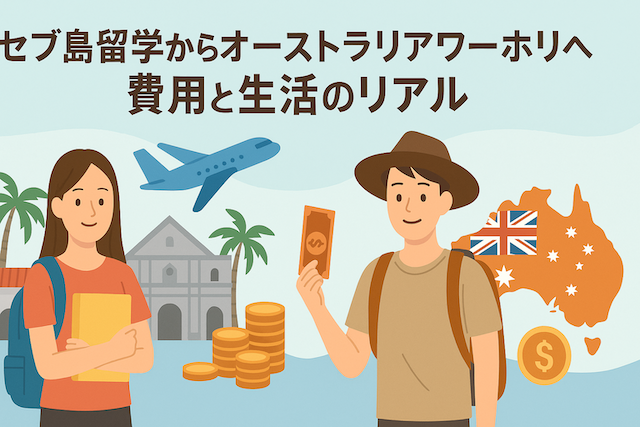
From Cebu Study Abroad to an Australia Working Holiday: The Reality of Costs and Daily Life
01
Introduction
A working holiday is a special visa program that lets you live abroad while working. Australia is especially popular with young people from Japan and across Asia thanks to its rich natural environment, high minimum wage, and relatively abundant job opportunities.
However, when you read the accounts of people who have actually gone, it is not unusual to hear things like “I couldn't find a job because my English wasn't good enough” or “I ended up sticking with other Japanese people and my English never improved.” The first three months in particular are a period when the gap in English ability strongly affects how stable your life becomes and whether your job search succeeds.
That is why attention is turning to **a short study stint in Cebu, Philippines, before heading to Australia**. Cebu mainly offers one-on-one lessons at a far lower cost than language schools in Western countries, and it provides an environment where you can study English intensively even in a short time.
This article explains the appeal of the route from Cebu study to an Australian working holiday, with a **cost simulation** and a look at **what life there is really like**. We aim to give you a realistic picture, close to firsthand experience, of how much preparation is enough for peace of mind if you are considering a working holiday.
02
Benefits of Preparing Your English by Studying in Cebu
The key to a successful working holiday in Australia is English preparation before you leave. If you arrive without English skills, the jobs you can choose from at first are limited, and you often struggle with finding housing and managing daily life. This is where **Cebu study, a cost-effective way to learn English**, comes in handy.
1. Low cost
At language schools in Western countries, tuition and accommodation alone typically cost JPY 300,000-400,000 per month. In comparison, studying in Cebu costs **around JPY 150,000-250,000 per month**, including tuition, dorm, and meals. For the same budget, you can study for nearly twice as long. Being able to preserve your funds before the working holiday is also a major attraction.
2. Efficient learning through one-on-one lessons
At language schools in Cebu, the typical style is **4-6 hours of one-on-one lessons out of 6-8 hours of study per day**. Because teachers adapt their instruction to your level, listening and speaking improve quickly. In particular, you can focus on practical content such as “introducing yourself in an interview” and “the English conversation you need for job hunting.”
3. Results come easily even in a short time
Many Cebu programs use an intensive curriculum, so **it is not unusual for complete beginners to reach an everyday conversation level in three months**. Because you can feel the results in a short time, you can approach your working holiday with confidence.
4. Getting used to English reduces anxiety
Rather than flying to Australia while worrying “Will people understand my English?”, practicing English in real situations in Cebu beforehand greatly reduces stress after you arrive. Being able to engage actively with local people from the very start is a big step toward a successful working holiday.
Around-the-World & Working Holiday English Course | 3D ACADEMY | Study Abroad in Cebu, Philippines03
The English Level You Need for an Australian Working Holiday
Australia offers a wide range of jobs for working holiday makers, but **the types of jobs you can choose and your income vary greatly depending on your English ability**. How much English you prepare before departure directly affects how stable your life will be afterward.
1. English needed for daily life
English is essential even for basic everyday procedures, such as viewing and signing for a home, opening a bank account, and getting a mobile phone contract. Without at least minimal listening and speaking skills, even getting to the starting line is a struggle.
2. Jobs possible at a beginner level
Jobs you can do without much English include **farm work, factory work, and cleaning**. However, in popular cities such as Sydney and Melbourne, competition is fierce, and with weak English it can be difficult to secure a job.
3. Jobs that open up at an intermediate level or above
People who have studied intensively in Cebu for about three months can take on customer-service jobs such as **cafe and restaurant service, hotel staff, and shop assistant positions**. These tend to pay higher hourly wages and offer many chances to interact with locals, making it an environment where your English can grow even further.
4. Jobs that lead to a long-term career
If you hold a score such as TOEIC or IELTS and have intermediate or higher English, you can also try for **office work or specialist jobs**. Some people aim for fields such as IT, education, and trade that connect to career-building after the working holiday.
If you go with zero English, you are likely to hit the wall of “I can't find a job,” but if you build a foundation in Cebu first, you have a better chance of going after well-paid jobs from the start.
04
Cost Simulation
When taking on a working holiday, cost is the biggest concern. In practice, there is a big difference between “attending a language school in Australia only” and “going on a working holiday via Cebu study.” Let's compare the two cases.
Case 1: Australian working holiday only (1 year)
- Travel preparation costs (visa, airfare, insurance, etc.): approx. 400,000 yen
- Language school (3 months): approx. JPY 600,000-800,000
- Living costs (rent, food, transport, etc.): JPY 150,000-200,000 per month x 12 months = approx. JPY 1,800,000-2,400,000 **Total: approx. JPY 2,800,000-3,600,000**
If you attend a language school after arriving, tuition and living costs become expensive, and many people find it hard going without a financial cushion.
Case 2: 3 months of Cebu study + Australian working holiday (1 year)
- Cebu study cost (tuition, dorm, and meals included): approx. JPY 450,000-750,000 (*JPY 150,000-250,000 per month x 3 months)
- Travel preparation costs (visa, airfare, insurance, etc.): approx. 400,000 yen
- Australian living costs: JPY 150,000-200,000 per month x 12 months = approx. JPY 1,800,000-2,400,000 **Total: approx. JPY 2,650,000-3,550,000**
By studying English in Cebu first, you no longer need to attend a language school in Australia, so in some cases the total cost is actually lower.
Key Points
- Even with Cebu study added, the total amount does not change much
- With better English, you have more chances to get a high-paying job locally, so you may be able to recoup the cost sooner
- It is important to think not only about “cheapness” but also from an investment perspective: “building English skills efficiently so that you can earn more easily”
05
What Life in Australia Is Really Like
Working holiday life in Australia varies greatly depending on how you find work, your housing style, and your daily spending. Here we outline actual living costs and the job situation.
1. Rent (shared houses are the mainstream)
In Australia, living in a shared house is common. Amounts vary by city and room type, but the guidelines are as follows.
- Shared room (dormitory): AUD 150-200 per week (approx. JPY 15,000-20,000)
- Private room (in a shared house): AUD 200-300 per week (approx. JPY 20,000-30,000)
- Studio: AUD 350 or more per week (approx. JPY 35,000 and up)
Many people start out in a shared house to keep living costs down.
2. Food costs
- If you mainly cook for yourself: AUD 70-100 per week (approx. JPY 7,000-10,000)
- If you mainly eat out: AUD 15-20 per meal (approx. JPY 1,500-2,000), which can exceed JPY 15,000-20,000 per week
Learning to cook for yourself saves a lot. There are many Asian supermarkets, and Japanese ingredients are available.
3. Transport costs
- Public transport in big cities (Sydney, Melbourne, etc.) costs around AUD 30-50 per week.
- Some people save money by using bicycles or shared scooters.
4. Part-time job income
Australia's minimum hourly wage is high at around AUD 24 (approx. JPY 2,400), and working 20 hours a week can bring in an income of **roughly JPY 180,000-200,000** per month.
- Easy for beginners to try: cafes, restaurants, hotel cleaning
- Advantageous if you have English skills: floor staff, front desk, shop assistants, etc.
- The standard choice for those not confident in English: farms, factories
5. Real voices on daily life
- “Thanks to my English, I was able to work at a local cafe and quickly made friends.”
- “I went with zero English at first, and farm work was my only option.”
- “When looking for a shared house, there was an interview (inspection), and sometimes I was turned down because I couldn't speak English.”
Training your English in Cebu beforehand makes it easier to lower these everyday hurdles.
06
Patterns for Success: Cebu Study to Australian Working Holiday
To make the most of your working holiday, it is important to plan and take action from the preparation stage. Here we introduce the steps common to people who succeeded in Australia after studying in Cebu.
1. Build a foundation in English in Cebu (about 3 months)
- Practice intensively the phrases needed for everyday conversation, self-introductions, and interviews
- Do role-plays with teachers to sharpen practical conversation skills
- Shift English from something you “study” to something you can “use”
2. Take action actively right after arriving
- Right after arriving at the airport, start looking for a shared house, opening a bank account, and so on
- Drawing on the “negotiating in English” you experienced in Cebu, you can move with confidence from the start
3. Use the internet and word of mouth for your job search
- Check job listings on Gumtree, Facebook groups, and similar sites
- Don't rely entirely on schools or the Japanese community; apply for local jobs as well
- Show off the English you trained in Cebu and aim for customer-service or high-paying jobs
4. Expand your local network
- Value the connections you make in your shared house and workplace
- Join hobbies and events to meet Australians and fellow working holiday makers from other countries
- Through your network, opportunities for your next job or home open up
5. Keep a second visa and skill-building in view
- If you complete a certain period of farm work, you can also obtain a visa for a second year
- With English preparation in Cebu, in your second year you can blend in even more with locals at work
- Many people also aim to take an English exam (IELTS or TOEIC) to help their careers after returning home
Following this flow minimizes the risk of “my working holiday failed because I couldn't speak English.”
07
Summary
The quality of a working holiday in Australia varies greatly depending on your English ability and financial planning. The first few months after arrival in particular are directly tied to job hunting and establishing a stable base for life, so the reality is that many people struggle when underprepared.
In that respect, the route via Cebu study has the following advantages.
- You can learn English cost-effectively at JPY 150,000-250,000 per month
- One-on-one lessons make it easy to improve conversation skills even in a short time
- You can move smoothly into job hunting and daily life right after arrival
On cost, people tend to assume “adding Cebu makes it more expensive,” but in practice it is often cheaper than attending a language school in Australia, making it a more efficient investment.
**To avoid a failed working holiday, preparation is everything.** Rather than taking on the challenge with zero English and regretting it, building a foundation of English in Cebu before going to Australia makes success more likely in work, daily life, and relationships alike.
The route of Cebu study followed by an Australian working holiday can be described as “a realistic option for fulfilling your dream by the shortest path.”
08
How many months of Cebu study is best before a working holiday?
As a guide, **3 months**. With a one-on-one focus you get plenty of speaking time, and it is a period in which you can work through everything from self-introductions to interviews and set phrases used at work. If time and budget allow, extending in stages from 4-8 weeks to 12 weeks is also effective.
09
How much does Cebu study cost?
**JPY 150,000-250,000 per month** (as a guide, tuition, dorm, and meals included). It varies with the school, room type, and high season. Budget separately for airfare and insurance.
10
What is a rough estimate of living costs in Australia?
They vary by city and housing, but roughly **JPY 150,000-200,000 per month** (rent, food, transport, etc.). For rent, a private room in a shared house is about AUD 200-300 per week.
11
What is the total cost of the “Cebu to Australia” route?
Model example (3 months in Cebu + 1 year in Australia): Cebu (JPY 450,000-750,000) + departure preparation (approx. JPY 400,000) + Australian living costs (JPY 1,800,000-2,400,000) = a guide of **approx. JPY 2,650,000-3,550,000**.
12
How is it different from going to a language school after arriving in Australia?
Attending school in Australia means high tuition on top of living costs running at the same time. If you raise your conversation skills in Cebu first, you can **go straight to job hunting without attending a language school locally**, which makes it easier to save on initial expenses and time.
13
Can complete English beginners find work?
It is not impossible starting from zero, but your options are limited. If you build a foundation in Cebu, it becomes easier to go after **customer-service and well-paid local jobs**.
14
Which jobs are easiest to aim for?
Beginner to intermediate English: cafes, restaurants, hotels, shops, cleaning, farms and factories, etc. Intermediate and above: front desk, barista, sales, back-office support, etc. The key is putting your self-PR and work history into words in an English interview.
15
What are typical hourly wages and income?
The minimum wage is high, and many people expect **the equivalent of JPY 180,000-200,000 per month at 20 hours a week** as a general guide (varies by job, city, and shifts). Public holiday rates, tips, and late-night allowances can sometimes push it higher.
16
How should I prepare my resume and interviews?
Write an English resume (1 page recommended) and **describe your duties concisely, starting with verbs**. Practice interviews in the flow of “self-introduction -> work experience -> customer service -> shift availability -> questions for the interviewer.” Repeating role-plays in Cebu makes you stronger in real situations.
17
Any tips for choosing a city (Sydney / Melbourne / Brisbane / Perth)?
Big cities are strong on jobs and wages but rent is also high. One option is to **start in Brisbane or a mid-sized city** to keep living costs down, then move once you are settled.
18
What should I watch out for when looking for housing?
Viewings (inspections) are a must; check the advance rent, bond (security deposit), and move-out conditions. Beware of **advance-payment scams and photos that differ from the actual place**, and always keep the contract and receipts.
19
Should I aim for a second working holiday (year 2)?
There is a system under which you can apply after working a specified number of days in certain regions and jobs that meet set conditions. **Conditions can change, so check the latest official information.** Having English skills widens your options locally.
20
How much money is enough to bring?
Many people aim for **an initial fund of around JPY 600,000-800,000 in total**, covering airfare, insurance, initial rent, and 1-2 months of living costs, plus a cushion for the job-hunting period (varies by individual).
21
What Are Some Tips for Saving Money?
**Cooking for yourself, shared housing, and using public transport** are the basics. Even in urban areas, you can reduce fixed costs by living slightly toward the suburbs, traveling off-peak, and shopping at supermarkets on sale days.
22
What should I focus on learning in Cebu?
Thoroughly practice **interview English, workplace phrases, phone etiquette, and handling complaints** in one-on-one lessons. Train speaking and listening every day, and make **memorizing your self-introduction and motivation** a morning-and-evening routine.
23
What is the to-do list after arrival?
TFN / bank account / mobile SIM / residence-related registration (varies by state) / securing housing / handing out resumes / booking interviews. Aim to **finish laying the groundwork in the first week**.
24
Is Insurance Necessary?
Yes. Prepare **overseas travel insurance (illness, injury, liability, personal belongings)** that fits your period of stay. The requirements differ from insurance for student visas, so check against working holiday conditions.
25
What Are Common Mistakes and How Can You Avoid Them?
- Zero English on arrival -> **3 months of preparation in Cebu**
- Resume not getting through -> write out your achievements in numbers, starting with verbs
- Rent trouble -> check the contract, receipts, and move-out conditions beforehand
- Narrow community -> expand your network through hobby events and volunteering
26
What does a model timeline look like?
(Example) 12 weeks in Cebu for conversation basics and interview practice -> set up your life base in week 1 in Australia -> decide on a job in weeks 2-4 -> from month 3 onward, raise your hourly wage or position, and if needed move to a regional area or another city.
27
Do I need to check the latest information?
Yes. Wages, visas, insurance, and tax systems can change. Be sure to check the latest requirements on **official websites, embassy pages, and state government pages**.
From Cebu Study Abroad to a Working Holiday: A Complete Guide to the Fastest Route [2026 Edition]28
Related article
29
Recommended Courses
Course
Around-the-World & Working Holiday English Course
A survival English course for English beginners heading off on a round-the-world trip or a working holiday. It costs the same as the Practical English (ESL) Course and builds the English you need through short, intensive study.
The first step in IELTS preparation is choosing the right environment
With one-on-one classes and real-format mock exams, we help you reach your target score by the most direct route.