2026年1月10日
3D ACADEMY offers affordable English study programs in Cebu, Philippines – perfect for beginners, professionals, and exam takers.

3D UNIVERSAL ENGLISH INSTITUTE INC
info.3d-universal.com
8:00-17:00(Mon-Fri)
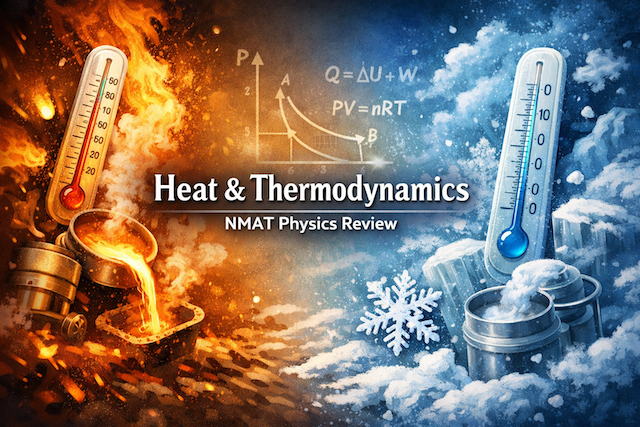
Heat and Thermodynamics: NMAT Physics Review
Contents
- Heat and Thermodynamics: NMAT Physics Review
- Temperature and Heat: Fundamental Concepts
- Temperature Scales and Conversions
- Thermal Expansion of Matter
- Heat Capacity and Specific Heat
- Calorimetry and Heat Transfer
- Change of Phase and Latent Heat
- Modes of Heat Transfer
- Gas Laws and the Kinetic Theory of Gases
- The Zeroth Law of Thermodynamics
- The First Law of Thermodynamics
- The Second Law of Thermodynamics
- Heat Engines and Refrigerators
- Common NMAT Question Patterns
- Study Tips for NMAT Physics
- Summary
- Heat and Thermodynamics: NMAT Physics Review
- Temperature and Heat: Fundamental Concepts
- Temperature Scales and Conversions
- Thermal Expansion of Matter
- Heat Capacity and Specific Heat
- Calorimetry and Heat Transfer
- Change of Phase and Latent Heat
- Modes of Heat Transfer
- Gas Laws and the Kinetic Theory of Gases
- The Zeroth Law of Thermodynamics
- The First Law of Thermodynamics
- The Second Law of Thermodynamics
- Heat Engines and Refrigerators
- Common NMAT Question Patterns
- Study Tips for NMAT Physics
- Summary
Heat and Thermodynamics: NMAT Physics Review
Heat and Thermodynamics is a core topic in the NMAT Physics section and frequently appears in both conceptual and numerical questions. This chapter tests your understanding of how energy is transferred as heat, how temperature is defined and measured, and how physical systems obey fundamental laws governing energy conversion. A strong grasp of thermodynamics not only helps in solving direct problems but also supports related topics such as gases, engines, and phase changes.
This review provides a comprehensive NMAT-focused discussion of heat and thermodynamics, emphasizing key principles, formulas, and common question patterns encountered in the exam.
Temperature and Heat: Fundamental Concepts
Temperature and heat are closely related but fundamentally different concepts. Temperature is a measure of the average kinetic energy of particles in a substance, while heat refers to the transfer of thermal energy due to a temperature difference.
Temperature indicates how hot or cold a system is, whereas heat describes energy in transit. Heat flows naturally from a body at higher temperature to one at lower temperature until thermal equilibrium is reached.
In NMAT questions, confusion between heat and temperature is common. Always remember that temperature is a state variable, while heat depends on the process by which energy is transferred.
Temperature Scales and Conversions
Three main temperature scales are used in physics:
- Celsius (°C)
- Fahrenheit (°F)
- Kelvin (K)
The Kelvin scale is the absolute temperature scale and is most commonly used in thermodynamics. Zero Kelvin corresponds to absolute zero, where molecular motion theoretically stops.
Important conversion formulas:
- K = °C + 273
- °C = (°F − 32) × 5/9
- °F = (°C × 9/5) + 32
NMAT problems often involve converting Celsius to Kelvin, especially when applying gas laws or thermodynamic equations.
Thermal Expansion of Matter
Most substances expand when heated and contract when cooled. This phenomenon is known as thermal expansion and occurs because particles move more vigorously at higher temperatures.
There are three types of thermal expansion:
- Linear expansion (solids)
- Area expansion (solids)
- Volume expansion (solids, liquids, gases)
The formula for linear expansion is:
ΔL = αL₀ΔT
Where α is the coefficient of linear expansion, L₀ is the original length, and ΔT is the change in temperature.
NMAT questions may test your understanding of how expansion affects structures, such as gaps in bridges or the behavior of liquids in thermometers.
Heat Capacity and Specific Heat
Heat capacity is the amount of heat required to raise the temperature of an object by one degree. Specific heat capacity refers to the heat required to raise the temperature of one unit mass of a substance by one degree.
The fundamental heat equation is:
Q = mcΔT
Where Q is the heat energy transferred, m is mass, c is specific heat capacity, and ΔT is the temperature change.
Substances with high specific heat, such as water, require large amounts of heat to change temperature. This concept is frequently tested in NMAT through calorimetry problems.
Calorimetry and Heat Transfer
Calorimetry deals with the measurement of heat transfer. In an isolated system, the heat lost by a hotter object equals the heat gained by a cooler object.
This principle is expressed as:
Heat lost = Heat gained
Calorimetry problems often involve mixing substances at different temperatures or phase changes, such as ice melting in water.
NMAT questions may require setting up energy balance equations rather than simply applying formulas.
Change of Phase and Latent Heat
A phase change occurs when a substance changes its physical state without a change in temperature. Common phase changes include melting, freezing, vaporization, condensation, and sublimation.
Latent heat is the heat required to change the phase of a substance without changing its temperature.
The equation for latent heat is:
Q = mL
Where L is the latent heat of fusion (melting/freezing) or vaporization (boiling/condensing).
Understanding phase diagrams and latent heat is essential for NMAT problems involving heating curves and energy calculations.
Modes of Heat Transfer
Heat can be transferred in three ways:
- Conduction
- Convection
- Radiation
Conduction involves heat transfer through direct contact, primarily in solids. Convection occurs in fluids due to bulk motion of particles. Radiation involves energy transfer through electromagnetic waves and does not require a medium.
NMAT questions may ask you to identify the dominant mode of heat transfer in real-life situations.
Gas Laws and the Kinetic Theory of Gases
The behavior of gases is closely linked to thermodynamics. The kinetic theory explains gas pressure and temperature in terms of molecular motion.
Important gas laws include:
- Boyle’s Law: PV = constant (at constant temperature)
- Charles’ Law: V/T = constant (at constant pressure)
- Gay-Lussac’s Law: P/T = constant (at constant volume)
These laws combine to form the Ideal Gas Equation:
PV = nRT
Where n is the number of moles and R is the universal gas constant.
The Zeroth Law of Thermodynamics
The Zeroth Law states that if two systems are each in thermal equilibrium with a third system, then they are in thermal equilibrium with each other.
This law forms the basis of temperature measurement and the use of thermometers.
Although simple, NMAT questions may test conceptual understanding of thermal equilibrium using this principle.
The First Law of Thermodynamics
The First Law of Thermodynamics is a statement of energy conservation. It relates heat, work, and internal energy.
The mathematical form is:
ΔU = Q − W
Where ΔU is the change in internal energy, Q is the heat added to the system, and W is the work done by the system.
NMAT problems often involve interpreting this law in processes such as isothermal, isobaric, and adiabatic changes.
The Second Law of Thermodynamics
The Second Law introduces the concept of entropy and the direction of natural processes. It states that heat cannot spontaneously flow from a colder body to a hotter body without external work.
This law explains why no heat engine can be 100% efficient.
Understanding the qualitative meaning of entropy and irreversibility is crucial for conceptual NMAT questions.
Heat Engines and Refrigerators
A heat engine converts thermal energy into mechanical work by operating between a hot and a cold reservoir.
The efficiency of a heat engine is given by:
Efficiency = Work output / Heat input
Refrigerators and heat pumps operate on similar principles but aim to transfer heat from colder to hotter regions.
NMAT may test basic understanding rather than detailed cycle analysis.
Common NMAT Question Patterns
Typical NMAT questions on heat and thermodynamics include:
- Conceptual distinctions between heat and temperature
- Simple calorimetry calculations
- Gas law applications
- Energy conservation using the First Law
- Conceptual questions on entropy and efficiency
Most questions emphasize clarity of concepts rather than lengthy calculations.
Study Tips for NMAT Physics
To perform well in heat and thermodynamics:
- Focus on understanding physical meaning, not just formulas
- Practice unit consistency, especially with temperature scales
- Memorize key equations and when to apply them
- Analyze diagrams carefully in conceptual problems
Consistent practice with NMAT-style questions will strengthen both speed and accuracy.
Summary
Heat and Thermodynamics is a high-yield topic in NMAT Physics that blends conceptual understanding with practical problem-solving. Mastery of temperature, heat transfer, thermodynamic laws, and energy relationships provides a solid foundation for answering a wide range of questions efficiently.
By focusing on core principles and practicing regularly, you can approach thermodynamics questions with confidence on exam day.
Heat and Thermodynamics: NMAT Physics Review
Heat and Thermodynamics is a core topic in the NMAT Physics section and frequently appears in both conceptual and numerical questions. This chapter tests your understanding of how energy is transferred as heat, how temperature is defined and measured, and how physical systems obey fundamental laws governing energy conversion. A strong grasp of thermodynamics not only helps in solving direct problems but also supports related topics such as gases, engines, and phase changes.
This review provides a comprehensive NMAT-focused discussion of heat and thermodynamics, emphasizing key principles, formulas, and common question patterns encountered in the exam.
Temperature and Heat: Fundamental Concepts
Temperature and heat are closely related but fundamentally different concepts. Temperature is a measure of the average kinetic energy of particles in a substance, while heat refers to the transfer of thermal energy due to a temperature difference.
Temperature indicates how hot or cold a system is, whereas heat describes energy in transit. Heat flows naturally from a body at higher temperature to one at lower temperature until thermal equilibrium is reached.
In NMAT questions, confusion between heat and temperature is common. Always remember that temperature is a state variable, while heat depends on the process by which energy is transferred.
Temperature Scales and Conversions
Three main temperature scales are used in physics:
- Celsius (°C)
- Fahrenheit (°F)
- Kelvin (K)
The Kelvin scale is the absolute temperature scale and is most commonly used in thermodynamics. Zero Kelvin corresponds to absolute zero, where molecular motion theoretically stops.
Important conversion formulas:
- K = °C + 273
- °C = (°F − 32) × 5/9
- °F = (°C × 9/5) + 32
NMAT problems often involve converting Celsius to Kelvin, especially when applying gas laws or thermodynamic equations.
Thermal Expansion of Matter
Most substances expand when heated and contract when cooled. This phenomenon is known as thermal expansion and occurs because particles move more vigorously at higher temperatures.
There are three types of thermal expansion:
- Linear expansion (solids)
- Area expansion (solids)
- Volume expansion (solids, liquids, gases)
The formula for linear expansion is:
ΔL = αL₀ΔT
Where α is the coefficient of linear expansion, L₀ is the original length, and ΔT is the change in temperature.
NMAT questions may test your understanding of how expansion affects structures, such as gaps in bridges or the behavior of liquids in thermometers.
Heat Capacity and Specific Heat
Heat capacity is the amount of heat required to raise the temperature of an object by one degree. Specific heat capacity refers to the heat required to raise the temperature of one unit mass of a substance by one degree.
The fundamental heat equation is:
Q = mcΔT
Where Q is the heat energy transferred, m is mass, c is specific heat capacity, and ΔT is the temperature change.
Substances with high specific heat, such as water, require large amounts of heat to change temperature. This concept is frequently tested in NMAT through calorimetry problems.
Calorimetry and Heat Transfer
Calorimetry deals with the measurement of heat transfer. In an isolated system, the heat lost by a hotter object equals the heat gained by a cooler object.
This principle is expressed as:
Heat lost = Heat gained
Calorimetry problems often involve mixing substances at different temperatures or phase changes, such as ice melting in water.
NMAT questions may require setting up energy balance equations rather than simply applying formulas.
Change of Phase and Latent Heat
A phase change occurs when a substance changes its physical state without a change in temperature. Common phase changes include melting, freezing, vaporization, condensation, and sublimation.
Latent heat is the heat required to change the phase of a substance without changing its temperature.
The equation for latent heat is:
Q = mL
Where L is the latent heat of fusion (melting/freezing) or vaporization (boiling/condensing).
Understanding phase diagrams and latent heat is essential for NMAT problems involving heating curves and energy calculations.
Modes of Heat Transfer
Heat can be transferred in three ways:
- Conduction
- Convection
- Radiation
Conduction involves heat transfer through direct contact, primarily in solids. Convection occurs in fluids due to bulk motion of particles. Radiation involves energy transfer through electromagnetic waves and does not require a medium.
NMAT questions may ask you to identify the dominant mode of heat transfer in real-life situations.
Gas Laws and the Kinetic Theory of Gases
The behavior of gases is closely linked to thermodynamics. The kinetic theory explains gas pressure and temperature in terms of molecular motion.
Important gas laws include:
- Boyle’s Law: PV = constant (at constant temperature)
- Charles’ Law: V/T = constant (at constant pressure)
- Gay-Lussac’s Law: P/T = constant (at constant volume)
These laws combine to form the Ideal Gas Equation:
PV = nRT
Where n is the number of moles and R is the universal gas constant.
The Zeroth Law of Thermodynamics
The Zeroth Law states that if two systems are each in thermal equilibrium with a third system, then they are in thermal equilibrium with each other.
This law forms the basis of temperature measurement and the use of thermometers.
Although simple, NMAT questions may test conceptual understanding of thermal equilibrium using this principle.
The First Law of Thermodynamics
The First Law of Thermodynamics is a statement of energy conservation. It relates heat, work, and internal energy.
The mathematical form is:
ΔU = Q − W
Where ΔU is the change in internal energy, Q is the heat added to the system, and W is the work done by the system.
NMAT problems often involve interpreting this law in processes such as isothermal, isobaric, and adiabatic changes.
The Second Law of Thermodynamics
The Second Law introduces the concept of entropy and the direction of natural processes. It states that heat cannot spontaneously flow from a colder body to a hotter body without external work.
This law explains why no heat engine can be 100% efficient.
Understanding the qualitative meaning of entropy and irreversibility is crucial for conceptual NMAT questions.
Heat Engines and Refrigerators
A heat engine converts thermal energy into mechanical work by operating between a hot and a cold reservoir.
The efficiency of a heat engine is given by:
Efficiency = Work output / Heat input
Refrigerators and heat pumps operate on similar principles but aim to transfer heat from colder to hotter regions.
NMAT may test basic understanding rather than detailed cycle analysis.
Common NMAT Question Patterns
Typical NMAT questions on heat and thermodynamics include:
- Conceptual distinctions between heat and temperature
- Simple calorimetry calculations
- Gas law applications
- Energy conservation using the First Law
- Conceptual questions on entropy and efficiency
Most questions emphasize clarity of concepts rather than lengthy calculations.
Study Tips for NMAT Physics
To perform well in heat and thermodynamics:
- Focus on understanding physical meaning, not just formulas
- Practice unit consistency, especially with temperature scales
- Memorize key equations and when to apply them
- Analyze diagrams carefully in conceptual problems
Consistent practice with NMAT-style questions will strengthen both speed and accuracy.
Summary
Heat and Thermodynamics is a high-yield topic in NMAT Physics that blends conceptual understanding with practical problem-solving. Mastery of temperature, heat transfer, thermodynamic laws, and energy relationships provides a solid foundation for answering a wide range of questions efficiently.
By focusing on core principles and practicing regularly, you can approach thermodynamics questions with confidence on exam day.
NMAT Study Guide: Complete Preparation Guide for Medical School in the Philippines

How to Register for eTravel Philippines (2025 Guide)
Step-by-step guide to completing your eTravel registration before arriving in the Philippines, with images and tips.

Night Market in Cebu – Things You Don’t Know About Cebu Life
Discover the hidden charm of Cebu’s night markets, from street food stalls to local life tips you won’t find in tourist guides.

How to Use ChatGPT for IELTS Preparation: A Complete Guide
Learn how to prepare for IELTS using ChatGPT — including strategies for Writing, Reading, Listening, Speaking, and grammar support.

How to Build a Website Without Coding Using ChatGPT
Discover how to build your own website using AI—no coding skills needed. From structure planning to SEO and design, let ChatGPT guide you.