
AI Study Abroad Guide
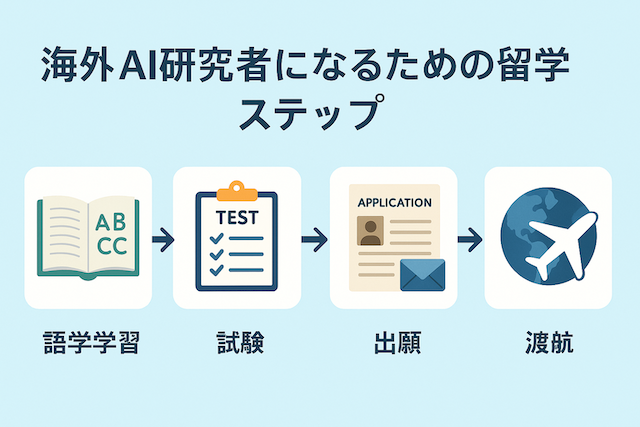
Study Abroad Steps to Becoming an AI Researcher Overseas
01
Introduction
AI (artificial intelligence) research is now one of the most closely watched fields in the world, and the pace of technological innovation is accelerating. Research is progressing within Japan as well, but to truly encounter cutting-edge knowledge and research methods, studying at a university or research institution overseas still carries great significance. Placing yourself in a frontline research environment, competing and growing alongside researchers from around the world, and building an international network through study abroad will be a valuable experience for taking off as an AI researcher. In this article, we explain step by step the study abroad steps needed to become an AI researcher overseas.
02
Step 1: Prepare Your Academic Foundation and Research Mindset
The first step toward becoming an AI researcher overseas is to build a strong academic foundation and prepare your attitude toward research. Studying abroad for research also requires language ability and adaptability, but what is demanded even more is an “academic foundation” and “curiosity.”
Strengthen Mathematics and Statistics
Mathematical understanding is at the heart of AI research. The following areas in particular are essential.
- **Linear algebra**: The foundation of neural networks and matrix computation.
- **Probability and statistics**: Indispensable for building and estimating machine learning models.
- **Optimization theory**: Directly tied to gradient descent and reinforcement learning algorithms.
Acquire Programming Skills
Without implementation ability, you cannot turn research ideas into reality.
- **Python**: The most widely used language in AI (TensorFlow, PyTorch, etc.).
- **R and C++**: Useful for statistical analysis and high-speed processing.
- It is also effective to publish your code through GitHub and Kaggle and build a track record.
Reading Papers and Research Habits
- Read one or two papers a week from arXiv and international conferences (NeurIPS, ICML, CVPR).
- Besides understanding new methods, build the habit of thinking about “why that research matters.”
Explore Your Own Research Theme
- Find a theme that interests you from a wide range of fields, such as **natural language processing (NLP)**, **computer vision**, **reinforcement learning**, and **generative AI**.
- At the undergraduate and master's stage your specialty need not be settled yet, but having a direction such as “I want to explore this field” will also help when choosing where to study.
By solidifying your foundation here, you will be able to picture the next step, “Purpose of Study Abroad and Career Path Design,” more concretely.
03
Step 2: Clarify Your Purpose for Studying Abroad and Design Your Career Path
In building a career as an AI researcher, it is essential to clarify the purpose of your study abroad and design your career path deliberately. If you go abroad with a vague purpose, you risk wasting time and money. It is important to put into specific words “why you want to study overseas” and “what kind of career you want to build.”
Decide Between a Master's and a PhD Program
- **Master's program (Master)** Well suited to learning applied research on the latest technologies, and after graduation you can work as a corporate researcher or data scientist. Can be completed in a relatively short time (1 to 2 years).
- **Doctoral program (PhD)** Necessary to deepen your own theme as an independent researcher. Opens the path to publishing papers, accumulating research results, and becoming a professor or postdoc.
Choose the Country and University
AI research is advancing in countries around the world, but each has its own characteristics.
- **United States**: World-leading research hubs such as MIT, Stanford, and Carnegie Mellon. Strong industry-academia collaboration, with many research opportunities with big tech companies.
- **Canada**: World-famous for deep learning research, including MILA in Montreal (the institute of Professor Yoshua Bengio).
- **United Kingdom**: Oxford, Cambridge, and UCL. Strong in both theory and applications.
- **Europe**: ETH Zurich, the Max Planck institutes, and others. There are also systems that let you study in multiple countries through the Erasmus program.
- **Asia**: The National University of Singapore (NUS), Tsinghua University (China), and others are growing rapidly. Being close to Japan is also an advantage.
Link Your Future Career and Research Theme
- The program you should choose differs depending on whether you aim in the future to be a **university researcher** or a **researcher in industry**.
- The best advisor and lab also change depending on where you place your focus, such as “generative AI,” “robotics,” “AI ethics,” or “healthcare AI.”
04
Step 3: Prepare Your Applications and Secure Scholarships
To realize overseas AI research study, it is important to prepare your application to pass the admissions screening and to secure funding so you can keep studying over the long term. Because competition in AI research is especially high, early preparation is essential.
Required Language Scores
- **TOEFL iBT**: Required at universities in North America and Europe. A score of 100 or higher is a guideline.
- **IELTS**: Widely used in the United Kingdom, Australia, and elsewhere. A score of 7.0 or higher is desirable.
- **GRE (Graduate Record Examination)**: Often required for applications to graduate schools in the United States. Aim for a high score in Quantitative Reasoning.
Write Your Research Proposal
- Describe concretely your research theme, the problem you want to solve, the methods you will use, and the expected results.
- Making clear “why it has to be that university and that lab” is the key to acceptance.
Prepare Letters of Recommendation
- Recommendations from professors who supported you in your undergraduate or master's program and from advisors with whom you have collaborated on research are important.
- If possible, ask for a recommendation that can highlight your international collaborative research or experience presenting research in English.
Scholarships and Ways to Raise Funds
AI research is a long-term project, so stable funding is indispensable.
- **Fulbright Scholarship** (for study in the United States)
- **Erasmus Mundus** (joint degree programs across multiple European countries)
- **Google PhD Fellowship** (for promising PhD students around the world)
- **University RA (Research Assistant) / TA (Teaching Assistant) systems**: In some cases you can receive tuition waivers plus living-expense support
- **Support from Japanese foundations**: Including TOBITATE! Study Abroad JAPAN and the Japan Society for the Promotion of Science (JSPS) support for doctoral students
Managing the Application Schedule
- Ideally, start preparing one year before the application deadline.
- Summer to autumn: Language exam and GRE preparation
- Autumn to winter: Prepare the research proposal and letters of recommendation
- Spring of the following year: Admission results and scholarship application results
- Autumn: Departure and enrollment
Once your applications and funding are in order, you can finally move on to “learning and results in an overseas lab.”
05
Step 4: Learning in an Overseas Lab and Building Results
Once your study abroad begins, it is time to move into full-scale research activity. In an overseas lab you are surrounded by advanced facilities and excellent research colleagues, so you are expected to learn proactively and build up results.
Deepen Your Research Theme
- Consult with your advisor in your host lab and make your research theme more concrete and develop it further.
- By encountering cutting-edge research, your initial idea is often refined further.
- Your research theme is always judged on whether it is “novel on a global scale” and “academically significant.”
Writing Papers and Presenting at International Conferences
- A major goal as a researcher is to submit papers to top conferences such as **NeurIPS, ICML, CVPR, and ACL**.
- Receiving feedback through conference presentations lets you improve your research.
- Paper-writing experience connects directly to your future career.
Collaborative Research and Networking
- Interact actively not only with colleagues in your own lab but also with researchers at other universities and companies.
- International collaborative research raises paper acceptance rates and builds trust as a researcher.
- Conferences and workshops are excellent places to expand your network.
Making Use of Internships
- Research labs such as Google DeepMind, Meta AI, and Microsoft Research have internship programs for PhD students.
- Gaining internship experience exposes you to applied research in industry and broadens your career options.
Adapting to Daily Life
- To concentrate on research activity, a stable living base is also important.
- Getting your housing, visa, and living-expense management in order early is the key to improving research efficiency.
Building solid results at this stage will lead to your next career choice.
06
Step 5: Career Development and the Next Stage
After building up research results through study abroad, you move on to the next career stage based on that experience. How you make use of what you learned overseas differs from person to person, but broadly there are three directions: “academia,” “industry,” and “contributing to society.”
Careers in Academia
- **Postdoc (postdoctoral researcher)** A step for deepening your research further after completing your PhD. Increase the quantity and quality of your papers and open the path to a professorship or leading your own lab.
- **Teaching at universities and research institutions** There are also options to stay at an overseas university by drawing on the network you built while studying abroad, or to return to Japan and set up your own lab.
Careers in Industry
- **Research positions at tech companies** Continue your research at major research labs around the world, such as Google DeepMind, OpenAI, Meta AI, and Microsoft Research. There is a wide range of options, from themes close to basic research to applied product development.
- **Startups and corporate research labs** A path in which you start a business drawing on your field of expertise, or link your research results to real-world implementation. Opportunities are also expanding in new areas such as AI ethics and solving social issues.
Giving Back Knowledge to Japan and Your Home Country
- Bring the research skills and international perspective you developed overseas back to Japan and contribute to the development of education and research.
- Through teaching at universities and companies, you can also take on the role of nurturing the next generation of AI talent.
Points for Career Development
- From the time you are in your PhD program, act with awareness of whether you will stay in academia or go into industry.
- Networking, publication record, and internship experience greatly influence your later career path.
- In the fast-changing field of AI, an attitude of continuous learning is itself the greatest weapon.
07
Summary
The path to becoming an AI researcher overseas begins with strengthening your academic foundation and continues through clear career design, careful application preparation, building research results, and career development. Study abroad is not merely a place of learning; it is a major step toward experiencing the world's most advanced knowledge and taking flight as an international researcher.
08
FAQ
What academic fields are essential for becoming an AI researcher overseas?
Mathematics (linear algebra, probability and statistics, optimization), the fundamentals of computer science, and the theory and implementation of machine learning and deep learning are essential. Skills in reading, writing, and presenting in English are also important.
Should I study abroad at the master's level or the PhD level?
As a rule, choose a master's for applied-leaning careers or an entry into research work, and a PhD if you aim to be an independent researcher or work in academia. Decide based on how clear your research plan is and whether you have a publication record.
Which country and university should I choose?
Prioritize the top labs and advisors (papers, awards, collaborative research record) in your field of interest. The United States, Canada, the United Kingdom, Europe (ETH, Max Planck, etc.), and Asia (NUS, Tsinghua, etc.) all have many strong labs.
What English scores are needed to apply? Is the GRE necessary?
Many graduate schools require TOEFL/IELTS. For the United States, some programs may require the GRE. Always check the latest requirements in each program's application guidelines.
What should I write in my research proposal?
In addition to the background of the problem setting, hypotheses, methodology, evaluation metrics, and expected impact, show concretely “why it is necessary to take this on in that particular lab.”
Who should I ask for letters of recommendation?
It is best to choose people who can speak to your research ability and integrity with concrete examples, such as faculty with research supervision experience or supervisors from collaborative research. Share a draft and your list of achievements 1 to 2 months before the deadline.
How do I secure scholarships and funding?
Combine external scholarships (e.g., Fulbright, Erasmus-type programs, various foundations), corporate and university fellowships, and in-university RA/TA positions. Because eligibility and deadlines are scattered, list them early and manage them.
What should I build up at the undergraduate and master's stage to improve my chances of acceptance?
Research internships, presentations at conferences and workshops, arXiv preprints, open-source contributions, placing in competitions (Kaggle, etc.), and collaborative research that leads to strong letters of recommendation are all effective.
Do I need to contact labs or advisors?
It is optional but effective. Send a brief self-introduction, a research overview, related papers, the reasons for the match, and specific questions, concisely. Assume the email may only be skimmed, and keep it to about 300-400 words.
Is submitting to top conferences mandatory?
It is not mandatory, but acceptance at NeurIPS/ICML/ICLR/ACL/CVPR and similar venues is a big plus. If that is difficult, build a track record starting with workshops and domain-specific conferences.
How do I balance industry internships with academic research?
It is common to work on lab projects during the semester and do research lab or company internships during breaks. Keeping your theme consistent with your advisor makes it easier to turn the work into papers.
When should I prepare practical matters such as visas and housing?
Start immediately after acceptance. Because visas can take several months, work backward from your departure date and act right away, and make a checklist of housing, insurance, bank accounts, and so on.
I'm worried about my research ability in my master's. Can I still go on to a PhD?
If you build up papers, collaborative research, and strong recommendations during your master's, applying to a PhD is entirely possible. Even in a coursework-centered master's, secure a research project early.
What are the recovery measures if I keep getting rejected or not accepted?
Create multiple tracks: redefine your research theme, reproduce experiments and add analysis, submit short papers or workshop papers, apply in parallel to other countries or formats (course-based or research-based), and transfer in via an RA position.
What are the career paths after graduation? What is the difference between a postdoc and corporate research?
A postdoc deepens your own theme and expands your publication record, while corporate research tackles problems closer to products and real-world implementation. Choose based on the scope of impact you aim for and the degree of research freedom.
Do you have any tips for schedule management?
Create a Gantt chart working backward from deadlines, and manage English exams, recommendations, proposals, scholarships, and visas in parallel. Review progress and identify risks every week.
AI Study Abroad Guide [2025 Latest Edition]: How to Study Machine Learning, Generative AI, and Data Science Overseas09
Related article
10
Recommended Courses
Course
Business English Course
A course for intensively learning practical business English: presentations, meetings, emails, negotiations, and more. You can build English skills useful in the global business scene after AI study abroad, matched to your level across 6 levels.
See moreCourseOne-on-One Intensive Course
A fully one-on-one system with no group classes. English preparation before AI study abroad and discussion practice on technical topics can be intensively trained to match your level.
See moreThe first step in IELTS preparation is choosing the right environment
With one-on-one classes and real-format mock exams, we help you reach your target score by the most direct route.