
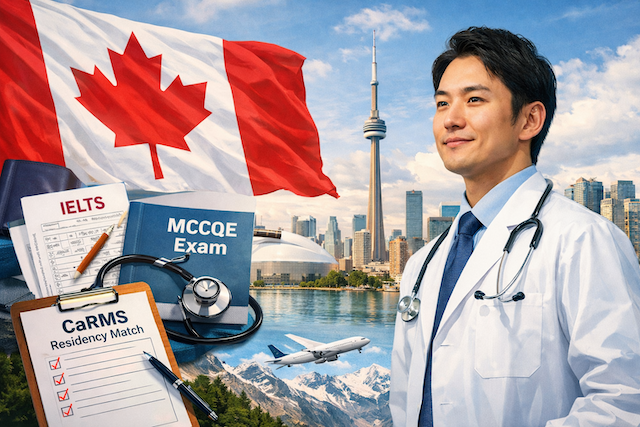
Doctor Study Guide
How to Work as a Doctor in Canada: Difficulty and Reality | Doctor Study Guide 2026
01
Introduction
Canada is one of the countries with the best working conditions and living standards for doctors in the world, and it is a very attractive career option for Japanese doctors as well. However, the bottom line is this: **becoming a doctor in Canada is extremely difficult**.
International Medical Graduates (IMGs), including doctors who graduated from medical school in Japan, are at a disadvantage compared with Canadian medical students, and attempting the path without a clear strategy almost certainly ends in failure.
This article gives a thorough explanation of:
- The routes to working as a doctor in Canada
- The required exams (MCCQE and others)
- The reality of the residency match
- Difficulty and success rates
- Realistic alternative routes
and more.
02
The Basic Structure of Working as a Doctor in Canada
To work as a doctor in Canada, you need to go through the following steps.
The Basic Route
- Graduate from medical school (in Japan or overseas)
- English exam (IELTS / OET)
- MCC exams (Medical Council of Canada)
- Residency match (CaRMS)
- Complete residency
- Obtain a medical licence and start work
In other words, **getting into a residency (training) program is the biggest hurdle**.
03
Required Exam: The MCC (Medical Council of Canada)
The following exams are important if you want to become a doctor in Canada.
MCCQE Part I
- Computer-based exam
- Basic medical science and clinical knowledge
- Content close to USMLE Step 2
NAC OSCE
- Clinical skills exam (interviews and examinations)
- Communication skills are emphasised
Key Point
- Passing the MCCQE alone does not allow you to work
- **It is a screening cut-off for the residency match**
04
English Requirements (Very Important)
Canada is an English-speaking (and French-speaking) country, so English ability is essential.
Main Requirements
- IELTS Academic: 7.0 to 7.5 or higher
- OET: B or higher (depending on the profession)
The Reality
- Many candidates are held back by English rather than by medical knowledge
- Speaking and writing are especially important
05
The Biggest Barrier: CaRMS (the Residency Match)
What Is CaRMS?
- Canada's matching system
- Medical students and IMGs compete for training positions
The Reality for IMGs
This is the most important point.
- Canadian medical students get top priority
- There are very few positions for IMGs
- Competition is extremely fierce
The Reality in Numbers
- IMG match rate: about 10 to 20%
- Popular specialties: almost impossible
- Mainly rural positions and family medicine
06
Difficulty Rating (Conclusion)
To sum up the difficulty of becoming a doctor in Canada:
Difficulty: 5 out of 5 stars (the hardest)
Reasons:
- The system is closed to IMGs
- Residency positions are limited
- Canadian experience is essential
- Connections and references matter
07
Canadian Clinical Experience (Close to Essential)
The Importance of Clinical Experience
In Canada, the following are strongly expected:
- Clinical electives (clinical placements)
- Observerships (shadowing)
- Letters of recommendation from Canada
Why Is It Important?
- Programs look at whether you can adapt to Canadian healthcare
- Without local evaluations, matching is difficult
08
Main Specialties IMGs Choose
The specialties where IMGs can match are limited.
Relatively Possible
- Family Medicine
- Internal Medicine (some programs)
- Psychiatry
Almost Impossible
- Surgical specialties
- Dermatology
- Ophthalmology
- Radiology
09
The Reality for Japanese Doctors
Patterns of Success
Japanese doctors who succeed in Canada share these characteristics:
- Experience abroad (US/UK)
- High English ability (native level)
- Clinical experience in Canada
- Strong letters of recommendation
Patterns of Failure
- A career only in Japan
- Insufficient English ability
- No Canadian experience
10
Realistic Strategies
Strategy 1: Go Through Another Country First
Because going straight to Canada is difficult:
- USMLE: the route through the United States
- UK: the PLAB route
Then move on to Canada
Strategy 2: Aim for Family Medicine
- More positions are available for IMGs
- Rural work offers opportunities
Strategy 3: Target Less Populated Provinces
- Manitoba
- Saskatchewan
- Newfoundland
-> Staff shortages create opportunities
11
Alternative Routes (Important)
If you are set on Canada, you should also consider the following.
Physician Assistant (PA)
- Not a doctor, but you can work in healthcare
- Relatively low difficulty
Research
- Graduate school, then a career as a researcher
- Positions at medical institutions
12
Salary and Lifestyle of Doctors in Canada
Annual Income
- Family physicians: JPY 15 million to 30 million
- Specialists: JPY 20 million to over 50 million
Lifestyle
- Good work-life balance
- Strong social security
- Free (publicly funded) healthcare
13
Pros and Cons
Pros
- High income
- Stable lifestyle
- Excellent healthcare environment
Cons
- Extremely high difficulty
- Takes a long time (5 to 10 years)
- Harsh on IMGs
14
Comparison with Other Countries
| Country | Difficulty | Features |
|---|---|---|
| United States | High | Opportunities exist (IMG positions) |
| United Kingdom | Medium | Relatively realistic via PLAB |
| Australia | Medium to high | Rural routes available |
| Canada | Hardest | Extremely harsh on IMGs |
15
Who Should Aim for Canada
The challenge is worthwhile if you meet the following conditions:
- Very high English ability
- Willing to play the long game (5 years or more)
- Strongly committed to Canada
16
Summary
It is possible to work as a doctor in Canada, but the reality is extremely tough.
**Key Points**
- The biggest barrier is the residency match (CaRMS)
- The success rate for IMGs is low
- Canadian experience is almost essential
- Almost impossible without a strategy
Therefore,
rather than going straight to Canada, a strategic approach via another country
is the realistic route.
17
Frequently Asked Questions (FAQ)
Q1. Can I work in Canada with only a Japanese medical licence?
No. A Japanese medical licence is not recognised as is in Canada. You must go through the MCC exams and residency (training) to obtain Canadian medical qualifications.
Q2. If I pass the MCCQE, can I work as a doctor right away?
No. The MCCQE is only a basic exam. To work as a doctor, you must succeed in the CaRMS residency match and complete residency.
Q3. How difficult is the Canadian residency match (CaRMS)?
It is extremely difficult. There are very few positions for IMGs (international medical graduates) in particular, and the match rate is said to be roughly 10 to 20%.
Q4. How much English ability do I need?
As a guide, you need at least 7.0 to 7.5 on IELTS Academic, but in practice you need even stronger practical English ability (especially speaking and writing).
Q5. Is clinical experience in Canada essential?
It is almost essential. Without medical experience in Canada, such as clinical electives or observerships, matching into a residency becomes very difficult.
Q6. Are there specialties where IMGs can match more easily?
Yes. The specialties with relatively good chances are Family Medicine, Psychiatry, and some Internal Medicine programs. Surgical specialties and other popular specialties are extremely difficult.
Q7. Can Japanese doctors succeed in Canada?
It is possible, but it requires very high English ability, experience abroad, clinical experience in Canada, strong letters of recommendation, and more. The reality is that it is difficult without sufficient preparation.
Q8. Which is more realistic: going straight to Canada or going via another country?
In many cases, it is more realistic to go through the United States (USMLE) or the United Kingdom (PLAB) first and then aim for Canada.
Q9. Are there ways to be involved in Canadian healthcare other than as a doctor?
Yes. There are careers that involve healthcare in roles other than doctor, such as Physician Assistant (PA) and research positions.
Q10. How long does it take to become a doctor in Canada?
It varies from person to person, but it is usually a long-term project that takes about 5 to 10 years.
The Complete Doctor Study Guide | How to Work Abroad, Difficulty by Country, Required English Level and the Fastest Route18
Related Articles
19
Recommended Courses
Course
IELTS Preparation Course
One-on-one lessons and exam-style mock tests help you improve all four skills in a balanced way in a short time.
See moreCourseOET Preparation Course
Practical training tailored to doctors and nurses helps you raise your Writing and Speaking scores as quickly as possible.
See moreThe first step in IELTS preparation is choosing the right environment
With one-on-one classes and real-format mock exams, we help you reach your target score by the most direct route.