
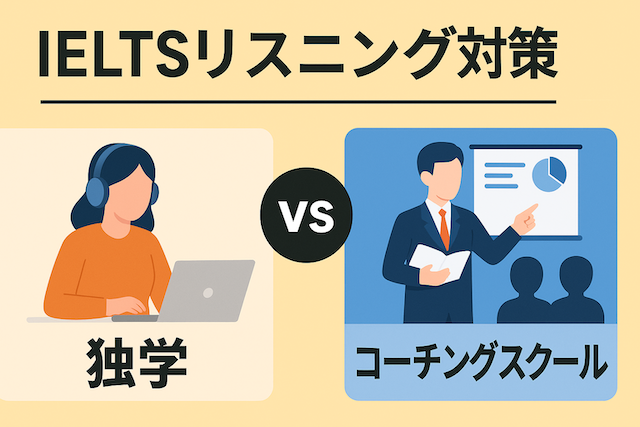
IELTS Listening Preparation
IELTS Listening Preparation: Self-Study vs Coaching School Comparison for IELTS Listening
01
Introduction
IELTS Listening is one of the sections where many test takers struggle to raise their scores. In particular, if you rarely use English in daily life, keeping up with native speed and a variety of accents is not easy. That is why how you choose to study makes a big difference.
Broadly speaking, there are two study styles: self-study and attending a coaching school. Each has advantages and disadvantages, and the best answer differs depending on your personality and study situation. This article compares self-study and coaching schools and explains how to choose the IELTS Listening preparation that suits you.
02
Advantages of Studying IELTS Listening on Your Own
- Lower cost: The biggest strength of self-study is cost. By using textbooks, official practice books, and free online materials, you can study with minimal expense.
- Study at your own pace: You can study whenever you like, fitting around school or work. Even busy working adults and students can build a flexible study plan that suits their lifestyle.
- Freedom to choose materials and methods: There are many free, high-quality listening resources, such as YouTube, podcasts, the BBC, and TED Talks. It is also appealing that you can easily choose materials to match your interests.
- Builds self-management skills: Because you have to set goals and plan your study yourself, test preparation can also strengthen your self-management.
03
Disadvantages of self-study
- Hard to stay motivated: Studying alone makes it easy to lose focus partway through or let your study pace slip. For long-term test preparation in particular, there is a risk of “giving up easily.”
- Weak points are hard to notice: Even when you feel you understood something, there are often parts you actually did not catch. With no one to objectively point out your error patterns or pronunciation habits, improvement may be slow.
- Study strategy tends to be insufficient: You may end up simply listening to English without paying attention to IELTS-specific question formats and time management. As a result, it is not unusual for the practice not to translate into points on the actual test.
- Feeling of isolation: Continuing to study alone can lead to loneliness and make it harder to enjoy studying.
04
Advantages of Studying at a Coaching School
- Expert feedback: An instructor objectively analyzes your listening weaknesses and habits and gives you specific guidance on how to improve. Being able to correct fine details that are hard to notice when studying alone is a big advantage.
- Efficient study curriculum: You get a plan to raise your score by the shortest route, based on your target score and test date, so you can study without waste. This is especially effective if you want results in a short time.
- Easier to stay motivated: Interacting with instructors and fellow students makes it easier to build a study habit and keep going. Regular meetings and assignment submissions directly help you stay motivated.
- Access to up-to-date information and mock test environments: Materials and mock tests reflecting the latest IELTS trends are provided, so you can practice in a format close to the real test. You can also learn time allocation and answering strategies for test day, a strength self-study lacks.
05
Disadvantages of Coaching Schools
- High cost: Fees can run from tens of thousands to hundreds of thousands of yen, which can be a heavy financial burden. If you plan to attend for a long period in particular, you need to consider the cost carefully.
- Time commitment: You need to fit around the schedule of lessons and sessions, so you have less freedom than with self-study. If you are balancing work or school, some adjustment is needed.
- Depends on compatibility with the instructor and school: If the teaching style or materials do not suit you, you may not get the full benefit. It is important to check carefully when choosing a school.
- May not build independence: If you rely too much on instruction, your ability to keep studying after the course ends can weaken. You still need to maintain a proactive attitude toward learning.
06
Which Should You Choose?
In the end, whether to choose self-study or a coaching school depends on the learner's situation and personality. The following criteria can help you find the method that suits you.
- Who self-study suits You are good at self-management and can follow a study plan You have a fairly large amount of time available to study You want to keep costs as low as possible You already have a reasonable foundation in English
- Who a coaching school suits You want to reach your target score in a short time You want someone to point out your weaknesses objectively You find it hard to keep studying alone You value efficiency and results over cost
- Hybrid approach (self-study plus a school) Study mainly on your own, and take short, intensive coaching just before the test Use online one-on-one tutoring only as much as you need Keep your budget down while still studying effectively
You can make a better choice if you first sort out your goals (for example, needing a score of 7.0 or higher, or reaching your target within six months) and your resources (time, money, and current English level).
07
Summary
There are two ways to prepare for IELTS Listening, self-study and a coaching school, and each has advantages and disadvantages.
- Self-study is **low-cost and flexible**, but it is hard to stay motivated and to find your weak points.
- A coaching school offers **efficient, expert instruction**, but has the drawbacks of cost and time commitment.
In conclusion, it is important to choose based on your study style, budget, and the time left before the test. If you have a foundation in English and plenty of time, self-study can produce good results. On the other hand, a coaching school is effective if you want to raise your score reliably in a short time.
A “hybrid” approach that combines self-study and a school is also an option. Finding the study method that suits you best and working on it systematically will ultimately lead to a high IELTS Listening score.
08
FAQ: IELTS Listening: Self-Study vs. Coaching School
Which suits me better for IELTS Listening, self-study or a coaching school?
If you are good at self-management and can set aside study time, self-study suits you. If you want to raise your score reliably in a short time or have your weak points corrected objectively, coaching suits you. If you are unsure, combining self-study with short-term coaching is the safe choice.
What materials do I need for self-study?
The following is enough at minimum. Official Cambridge practice books (audio and scripts) Shadowing materials (news, talks, podcasts) Short audio clips for dictation (1-3 minutes) A spreadsheet to record your answers
What does a weekly self-study plan look like?
Example (6 days a week, 60-90 minutes each) Day 1: One mock test set (including review) Day 2: Close reading of the script plus vocabulary organization Day 3: Dictation (two 10-15 minute clips) Day 4: Shadowing (20 minutes in total) Day 5: Practice by question type (maps, multiple choice, etc.) Day 6: Weak-point replay (repeat the audio you got wrong)
What should I check when choosing a coaching school?
How specific the initial diagnosis is (whether it includes error analysis and audio feedback) Whether the frequency of weekly meetings and the amount of homework fit your life The instructors' track record of IELTS coaching (examples of score achievement) How often materials and mock tests are updated (reflecting the latest trends) How clear the refund and mid-course cancellation policies are
How should I think about cost-effectiveness?
Judge by “gap to your target score x remaining time x cost of self-management.” For example, if raising your score by 0.5 band looks likely to take more than three months, short-term coaching is quite likely to save you time.
What are the typical patterns when self-study stalls?
Mostly passive listening, without close reading of the script or identifying the causes of wrong answers Neglecting strategies by question type (spelling, transposition, paraphrase of synonyms) Not keeping records (WPM, error tags, a vocabulary notebook)
How can I minimize the disadvantages of coaching?
Check compatibility and specific feedback in a trial lesson Agree on the weekly schedule and amount of homework in numbers before signing up Record KPIs (accuracy rate, vocabulary gained, number of reviews) at each meeting
Roughly how long does it take for each target score?
5.5 to 6.0: 6-8 weeks (7-9 hours a week) 6.0 to 6.5: 8-10 weeks (8-10 hours a week) 6.5 to 7.0: 10-12 weeks (10-12 hours a week) Note: This varies by individual, depending on how well vocabulary and question strategies have sunk in.
How often should I take mock tests?
Once a week is the basic pace. In the last 2-3 weeks before the test, increase to up to twice a week, and each time go through the full cycle of why you got it wrong, relistening, close reading of the script, and re-answering.
How should I work on accents?
Rotate through the main accents (British, American, Australian) week by week Do 5 minutes each session of practice distinguishing proper nouns, numbers, and spelled-out words Solidify landmark vocabulary for map questions in advance
Which should I do first, dictation or shadowing?
The order is to identify what you mishear, then reproduce pronunciation and linked sounds, so the basics are dictation first, then shadowing.
Do I need to take notes?
In Parts 3-4, minimal notes on the speaker, section headings, and keywords are effective. Do not try to write everything down, as your concentration will break.
How should I design a combination of self-study and coaching?
Build the basics (vocabulary, sound changes, question strategies) through self-study most of the time, then use coaching for just 3-4 weeks for intensive correction of weak points and test simulation.
Which is better, online or in-person?
In-person gives you structure and more speaking time, but travel costs are high. Online is more time-efficient and lets you review recordings. Choose according to your lifestyle.
How should I measure my progress?
Accuracy rate (by question type) Improvement in error rate after relistening Weekly increase in unknown vocabulary Reading-aloud WPM and number of pronunciation checks
What should I do if I am not improving even though I attend a school?
Ask in meetings for a “visualized error analysis” Adjust the amount and quality of homework (number of reviews, audio recordings) Consider changing instructors or shortening or extending your contract period
How can I stay motivated while self-studying?
Make your progress visible with a weekly mock test Share scores and study time with study partners Set rewards (a small treat after reaching a test goal)
What should I do in the final week before the test?
Do not start new materials; recycle the audio you got wrong Do a listening warm-up (10-15 minutes) at the same time of day as the test Final drills on numbers, proper nouns, and spelling
What is a short-term plan if my score submission deadline is close?
“Daily: 30 minutes by question type plus 30 minutes of reviewing mistakes,” “every other day: a mock test followed by a full review the next day,” “weekends: a full mock test plus a complete check.” If needed, use 1-3 spot coaching sessions to fix weak points precisely.
09
Related article
10
Recommended Course
The first step in IELTS preparation is choosing the right environment
With one-on-one classes and real-format mock exams, we help you reach your target score by the most direct route.