
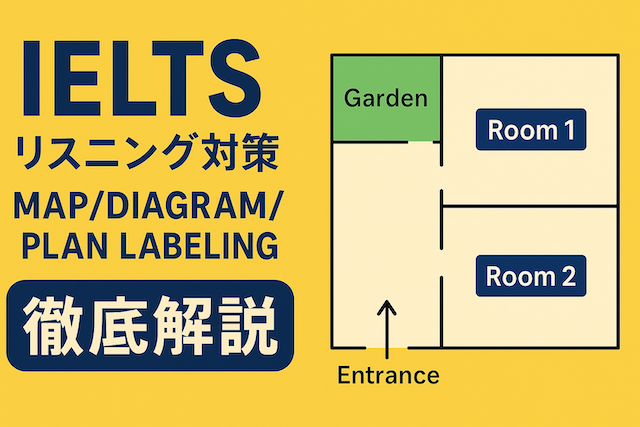
IELTS Listening Preparation
IELTS Listening Preparation: A Thorough Explanation of Map/Diagram/Plan Labeling
01
Introduction
In IELTS Listening, in addition to multiple choice and completion questions, there is a special format called **Map/Diagram/Plan Labeling**. Using a museum floor guide, a university campus map or a building floor plan, you identify the correct location by ear and label it.
This type of question requires a sense of direction, spatial understanding and detailed vocabulary all at once, in addition to simply listening, so many candidates find it difficult. Once you grasp the knack, however, it can actually become a good source of marks.
This article thoroughly explains the features of Map/Diagram/Plan Labeling questions, frequently used expressions, answering steps, pitfalls to watch for and efficient ways to practice. After reading it, even those facing this format for the first time should be able to approach it with confidence.
02
Characteristics of the question format
1. A Visual Is Provided
In this question format, a **map, diagram or plan** is printed in the question paper.
- Map: area guides to a campus, park or town
- Diagram: the structure of a machine or the layout of exhibits
- Plan: a building floor, a room layout or an event venue layout
While listening to the recording, candidates look for the correct answers based on this visual.
2. The Order Follows the Flow of the Recording
Question numbers are generally arranged in the order of the explanation in the recording. For example, since the explanation goes entrance → corridor → room, the structure makes it easy to proceed without skipping questions.
3. Direction and Orientation Expressions Appear Frequently
Expressions such as ‘turn left’, ‘opposite’ and ‘on the north side’ are clues to the answers. In particular, vocabulary such as north / south / east / west and next to, opposite, in front of is tested frequently.
4. Options Are Numbers or Letters
The diagram or map is labeled in advance with 1-10 or A-F, and you choose the correct one from among them based on the recording.
5. The Recording Plays Only Once
As with the Listening test in general, the recording plays only once. It is therefore extremely important to grasp the map quickly beforehand.
03
Frequent Vocabulary and Expressions
In Map/Diagram/Plan Labeling questions, vocabulary about positions, directions and facility names appears frequently. Learning it in advance lets you match what you hear to the diagram instantly.
1. Direction and Compass Expressions
- north / south / east / west
- to the north of ~
- straight ahead
- turn left / right
- go past ~
- at the corner
2. Positional Relationship Expressions
- next to ~
- beside ~
- opposite ~
- in front of ~
- behind ~
- near / close to ~
- at the back of ~
3. Building and Facility Expressions
- entrance / exit
- reception / lobby
- library / lecture hall
- cafeteria / canteen (dining hall)
- toilet / restroom
- junction / crossroads (intersection)
4. Phrases Often Used in Explanations
- “You’ll see it on your left.” (It will be on your left-hand side.)
- “It’s opposite the library.” (It is on the other side from the library.)
- “Continue along the road until you reach…” (Keep following the road until you arrive at ...)
- “It’s located at the far end of the corridor.” (It is at the very end of the corridor.)
If you keep these expressions in mind, you will be able to match the recording to the diagram without hesitation as soon as it plays.
04
Answering Steps (Step by Step)
Step 1: Observe the diagram beforehand
- Before the recording plays, glance over the diagram or map to grasp its structure.
- Check the direction (where north is), the entrance and exit, and the arrangement of numbers and letters, so that it is easier to follow the flow of the recording.
Step 2: Check the order of the question numbers
- In IELTS Listening, in most cases the flow of the recording matches the order of the question numbers.
- It starts at the entrance and proceeds in sequence, for example corridor → room → stairs, so keep in mind that you should follow in numerical order.
Step 3: Listen for keywords
- Pay attention to facility names and features (for example: “the building with a glass roof”).
- Do not miss the verbs of direction (turn, continue, go past, cross and so on).
- Emphasized words (spoken louder or more slowly) are especially strong hints to the answer.
Step 4: Trace the route on the diagram as you listen
- While listening, draw lines or circle things with a pencil to track your current position on the diagram.
- Trying to solve it from memory after the recording ends easily leads to confusion, so get into the habit of taking notes at the same time.
Step 5: Transfer your answers
- After tentatively writing the numbers in the question booklet, transfer them accurately to the answer sheet at the end.
- Transfer mistakes are marked wrong, so always check that the spelling and numbers match.
If you make this routine a habit, you can greatly reduce the risk of getting lost while listening.
05
Common mistakes and countermeasures
Mistake 1: Interpreting directions the wrong way round
- Problem: The top of the diagram is not necessarily north, but candidates answer on that assumption.
- Solution: Always check the position of ‘North’ before the recording starts. It is often written small in a corner of the diagram, so watch for it.
Mistake 2: Confusing ‘next to’ and ‘near’
- Problem: ‘next to’ means immediately adjacent and ‘near’ means close by, but candidates answer without distinguishing them.
- Solution: Understand positional expressions correctly and listen with the nuance of distance in mind.
Mistake 3: Listening without drawing on the diagram
- Problem: If you listen without taking notes, you lose track of where you are partway through and get lost.
- Solution: Make it a habit to trace the route with a pencil. It does not matter if it is a bit messy.
Mistake 4: Panicking and leaving blanks when you miss something
- Problem: Missing one item causes panic, and the effect carries on to the following questions.
- Solution: Question numbers proceed in the order of the recording, so you can recover as long as you keep track of your current position. Do not try to go back; concentrate on the next question.
Mistake 5: Transfer and spelling mistakes
- Problem: Even when you choose the right place, you make a mistake in the number or spelling when copying it to the answer sheet.
- Solution: Always check in the remaining time. In particular, write facility names with accurate spelling.
If you avoid these mistakes, Map/Diagram/Plan Labeling can turn from a question you drop into a source of marks.
06
Effective practice methods
1. Focused Training with Official Practice Books
- Official practice books such as the Cambridge IELTS series include this format every time.
- Pulling out only the Map/Diagram/Plan Labeling questions and practicing them in a row helps you get used to direction expressions and the flow of grasping space.
2. Dictation and Marking on the Diagram
- Pause the recording and write down each sentence, while marking the map at the same time.
- This lets you make ‘reflecting what you heard on the diagram’ a habit, which makes tracking smoother in the real test.
3. Practice with Real Maps
- Use Google Maps in English or tourist guides to get used to English directions.
- For example, picture and relive a sentence like “Turn left at the junction, the museum is opposite the library.”
4. Absorb Direction Expressions with Shadowing
- Listen to phrases such as “Go straight ahead, then turn right.” and say them out loud right away.
- Your audio processing speed goes up, and you will be able to react without hesitation in the real test.
5. Build Time Management with Mini Tests
- Practice in the same environment as the real test, where the recording plays only once.
- Experiencing how to recover when you miss something will reduce panic on test day.
In this way, the key to success is not simply listening practice but training in processing location information using diagrams.
07
Summary
Map/Diagram/Plan Labeling is a special format in IELTS Listening that tests spatial awareness and listening ability at the same time.
- Observe the diagram beforehand to grasp the whole picture
- Keep in mind that the flow of the recording equals the order of the questions
- Thoroughly learn the vocabulary of directions and positions
- Build the habit of drawing lines to track your route as you listen
If you do all of these thoroughly, questions that feel difficult can become a source of marks.
In addition, if you regularly practice reading maps and directions in English, you will be able to handle them naturally on test day. Stay calm, and if you follow the diagram along with the flow of the recording, this is a format you can definitely solve.
08
Frequently Asked Questions (FAQ)
Q1. Does Map/Diagram/Plan Labeling appear every time?
A. Not every time, but it is a standard format that appears frequently. It often appears in Part 2 in particular, so be sure to prepare for it.
Q2. Does the recording really play only once?
A. Yes. In IELTS Listening, the recording plays only once for every question format. Preparation beforehand and concentration are therefore very important.
Q3. Is the top of the diagram always North?
A. No. The top of the diagram is not necessarily North. The golden rule is to check first whether the direction is marked.
Q4. I cannot catch the directions expressions. What should I do?
A. It is effective to memorize **vocabulary expressing direction and position (next to, opposite, at the corner and so on)** as a group. In addition, use English map apps and tourist guides to get used to real expressions.
Q5. What should I do if I miss something?
A. Question numbers proceed in the order of the recording, so do not try to go back; concentrate on the next question. If you keep following the route, you can recover in the later part.
Q6. May I draw lines on the diagram?
A. You may write freely in the question booklet. Notes and lines to track your current position are essential.
Q7. Do I write answers as words or as numbers?
A. It depends on the question format. A format where you choose a number or letter (for example: ‘3’ or ‘B’) A format where you write a word (for example: “library”) Both appear, so you need to be prepared for both.
Q8. What is the most effective way to practice?
A. Focused practice of solving only the Map questions in a row from official practice books is effective. Combining it with dictation and shadowing improves comprehension and reaction speed.
Q9. How difficult is it?
A. The words themselves are often not difficult, but the speed of the directions and the complexity of the diagram confuse candidates. The difficulty drops greatly with familiarity beforehand.
Q10. What is the final point to keep in mind?
A. Observe the diagram → learn the vocabulary → draw lines to track → transfer calmly. If you follow this flow thoroughly, this becomes a format in which you can score consistently.
09
Related article
10
Recommended Course
The first step in IELTS preparation is choosing the right environment
With one-on-one classes and real-format mock exams, we help you reach your target score by the most direct route.