
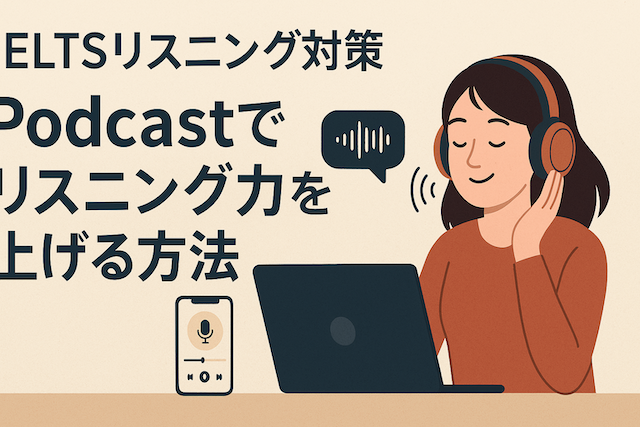
IELTS Listening Preparation
IELTS Listening Prep: How to Improve Your Listening with Podcasts
01
Introduction
IELTS Listening is the section that many candidates struggle with most. The audio ranges from everyday conversations to academic lectures and even complex discussions, and it is spoken in a variety of accents, including British, American, and Australian English. You need more than just "hearing" the words: you need the ability to grasp the key points in a short time and connect them to the correct answers.
One effective and practical way to tackle these challenges is to **use podcasts**. You can access podcasts anytime with just a smartphone, and you can listen to good-quality English audio for free. They also cover a wide range of themes close to what IELTS tends to test, such as news, culture, science, and education, so they make training that connects directly to the exam.
This article explains concrete ways to build your Listening skills with podcasts. It introduces study steps and recommended programs that fit naturally into your daily life and help you develop an ear that is strong on test day.
02
1. Why Podcasts Are Effective for IELTS Listening
1-1. You are exposed to living English
Textbooks and mock tests often use tidy pronunciation and a limited range of expressions. In the real IELTS, however, you encounter more natural speed and phrasing. Podcasts contain everyday conversation and natural intonation, making them ideal material for training a "practical ear."
1-2. You can learn a variety of accents
In IELTS Listening, accents from many English-speaking countries appear, such as the UK, Australia, New Zealand, Canada, and the US. With podcasts, you can easily listen to audio from speakers around the world, so you can build broad listening ability without leaning toward one particular accent.
1-3. You can study for free and with ease
Podcasts are basically free and can be accessed easily from a smartphone or PC. You can use spare moments, such as commuting or between household chores, to build a "habit of learning by ear," which makes them ideal for continuous Listening practice.
1-4. You are exposed to a wide range of topics
IELTS Listening questions cover a wide variety of areas, including education, the environment, science, history, and culture. Podcasts cover a full range of themes, from news programs to science explainers and social issues, so you gain both knowledge and Listening skills that connect directly to the test's trends.
03
2. Tips for Choosing Podcasts
2-1. Choose programs that deal with IELTS-related themes
IELTS Listening covers a wide range of topics, such as education, the environment, science, culture, and social issues. When choosing a podcast, look for programs that touch on these themes, and your study will connect directly to the exam.
2-2. Choose programs where native speakers talk naturally
IELTS does not use unnaturally slow English. Listening to conversation at natural speed and intonation is practical training that is close to the real test.
2-3. About 10 to 30 minutes is ideal
If a program is too long, it is hard to keep your concentration, while if it is too short, the learning effect is weak. A podcast of about 10 to 30 minutes can be fitted in without strain during your commute or a break.
2-4. Choose the difficulty level step by step
If you listen to something highly specialized from the start, you are likely to give up, so it works well to begin with podcasts made for language learners (for example, BBC Learning English) and, once you are used to them, move on to news and documentary programs.
Recommended podcast examples
- BBC Learning English: 6 Minute English - a classic resource you can study in a short time
- The English We Speak (BBC) - lets you learn idioms and colloquial expressions
- TED Talks Daily - covers a wide range of themes such as education, science, and social issues
- The Guardian Audio Long Reads - ideal for serious Listening practice
04
3. Study Steps (How to Use Podcasts)
To use podcasts effectively, simply "letting them play in the background" is not enough. By studying in stages, you can build not only your ear but also your comprehension and test readiness. Keep the following 4 steps in mind.
3-1. Casual listening (warm-up)
First, just listen to the podcast casually and get your ear used to the rhythm of English. "Listening while doing something else," such as during your commute or between household chores, is fine. The goal is not to understand 100% of the content but to increase the time you spend exposed to English.
3-2. Intensive listening (listening with focus)
In the next step, you listen to one episode repeatedly and practice understanding the meaning accurately.
- Note down keywords, numbers, and proper nouns
- Repeat the parts you cannot catch several times
- Check the transcript as needed
This connects directly to "accurate listening" in the real test.
3-3. Shadowing
Speak aloud along with the podcast audio, imitating the pronunciation and intonation. If you keep up shadowing, not only your listening ability but also your speaking ability will improve, and you will be able to handle the speed of Listening questions with room to spare.
3-4. Summary practice
Finally, practice summarizing what you heard in your own words in about 1 to 2 minutes.
- Summarize in Japanese to check your understanding
- Summarize in English to use it for Speaking practice as well
The IELTS test asks for "the ability to grasp the overall flow," so summary practice is especially effective.
05
4. Using Podcasts with IELTS Listening in Mind
When studying with podcasts, it is important not just to get your ear used to English but also to be aware of the question formats specific to IELTS. By adopting the following points, you can do training that connects directly to the real test.
4-1. Listen for numbers, dates, and place names
In IELTS, you are often tested on whether you can correctly catch "detailed information" such as phone numbers, schedules, amounts of money, and place names. When listening to podcasts, always take notes whenever numbers or proper nouns come up, and check whether you can reproduce them correctly.
4-2. Be aware of the question formats
IELTS Listening includes map questions, conversation questions, lecture-style questions, and so on. When you listen to a podcast, ask yourself, "If this were an IELTS question, what would the questions be?" This trains both listening and answering questions at the same time.
4-3. Adjust the playback speed
At first, use 0.75x speed so that details are easier to catch, and as you get used to it, raise the speed step by step to normal speed and then 1.25x. The real test is at normal speed, so aim to be able to follow audio at 1.0 to 1.25x in the end.
4-4. Switch accents deliberately
Multiple English-speaking accents appear in IELTS. By consciously telling American, British, and Australian English apart when choosing podcasts, you can avoid being thrown off by differences in accent on test day.
06
5. Sample Study Schedule
The key to success with podcast study is making it a daily habit. The following is an example of a schedule that even busy learners can keep up without strain.
Weekday study (30 to 40 minutes a day)
- Casual listening (20 minutes during your commute)→ Listen to an episode in a relaxed way and get your ear used to it
- Intensive listening (10 to 15 minutes after getting home)→ Write out keywords and check the transcript
- Shadowing (5 minutes)→ Imitate the pronunciation and rhythm as output practice
Weekend study (1 to 1.5 hours)
- Focused intensive listening (30 minutes)→ Listen to one episode repeatedly and aim for full understanding
- Summary practice (15 to 20 minutes)→ Write up what you heard in a notebook, and if possible summarize it in English
- Discussion (if possible)→ Discuss the topic with study partners or in online English lessons to strengthen Speaking at the same time
Weekly flow at a glance
- Mon to Fri: ear training and short study sessions (about 30 minutes a day)
- Sat and Sun: intensive study, review, and summary practice
By repeating this cycle, you can build up your Listening ability without strain.
07
FAQ: IELTS Listening Prep: How to Improve Your Listening with Podcasts
Does studying with podcasts directly affect my IELTS score?
Yes. The areas tested in IELTS (everyday conversation, lectures, and discussions) match the characteristics of podcasts (natural English, varied accents, and a wide range of topics), and the cycle of intensive listening, shadowing, and summarizing improves your ability to handle the questions.
How much time should I set aside each day for it to be effective?
At least 20 to 30 minutes. Ideally, on weekdays do "20 minutes of casual listening + 5 to 10 minutes of intensive listening + 5 minutes of shadowing," and on weekends do focused practice of 60 minutes or more.
What podcasts do you recommend (beginner to advanced)?
Beginner: BBC Learning English "6 Minute English" Intermediate: TED Talks Daily / The English We Speak Advanced: The Guardian Audio Long Reads / Freakonomics Radio
How should I adjust the playback speed?
Intensive listening at 0.75 to 0.9x, then 1.0x to consolidate, then 1.1 to 1.25x for extra load. Aim to be able to follow audio naturally at 1.0 to 1.25x in the end.
Should I use the transcript?
Yes, but the order matters. It works best to (1) listen once straight through without the transcript, (2) check the transcript only for the parts you could not catch, and (3) listen again without the transcript, repeating the cycle.
How should I take notes?
Limit notes to numbers, proper nouns, and technical terms. Examples: "$45," "May 17," "Baker Street," "renewable energy." Record one keyword per line so you can write quickly.
Do I not need past papers if I use only podcasts?
You do still need them. Podcasts are for "building your ear," while past papers such as the official Cambridge books are for "getting used to the test format." Using both together gives the best results.
How should I work on accents?
Switch your focus week by week: Week 1 British (UK), Week 2 American (US), Week 3 Australian (AU), Week 4 mixed. When selecting programs, rotate them with the speakers' region in mind.
The content is too difficult and I cannot keep going. What can I do?
Choose topics from fields you already know (education, tech, travel, etc.) Split one episode over several days Make summaries in stages, from Japanese to English
How do I combine this with vocabulary study?
For each episode, pick out only "5 frequent words" and review them before you listen next time. Examples: "policy," "survey," "venue," "allocate," "maintenance." Trying to memorize too many lowers retention.
What is the standard for shadowing?
Repeat the same material until you can reproduce each sentence smoothly at 95% or better. Pay attention to where you breathe, the intonation, and the weak forms of function words.
How do I measure progress?
WPM (Words Per Minute): record your comprehension rate at 1.0x once a month Repetition success rate: the share of 30-second sections you could repeat without errors Summary time: whether you can summarize about 150 words in 60 seconds
Which question types does this work well with?
Questions that require "accuracy in detail," such as maps, form completion, table completion, and multiple choice. Practicing focusing on numbers, dates, and place names in podcasts pays off directly.
What note-taking app should I use?
On a smartphone, a standard notes app is enough. Template example: "Date | Episode name | 5 keywords | 3 numbers | Summary (2 sentences each in Japanese and English)." A format that is easy to repeat is the top priority.
Should I listen to a new program every time?
No. Repeating one program improves your "listening accuracy," vocabulary retention, and summary quality. As a guide, aim for a ratio of new to repeated of 1:2 to 3.
What should I do in the last week before the real IELTS test?
Three short episodes of the same program every day (about 10 minutes each) 5 minutes a day of dictation focused on numbers and proper nouns Solve past-paper Sections 2 and 3 every other day (to get used to the format)
Is it okay to rely on a translation app?
It is fine for confirming key points. However, for the first listen use English only and limit checks to the minimum for parts you cannot understand, and return to English-only for re-listening.
Is self-study enough? Do I need online English lessons?
You can build a solid foundation through self-study. If you feel you have plateaued, setting aside one output session a week to talk about the content of a podcast summary will boost your progress dramatically.
What are tips for avoiding a study plateau?
A routine fixed by day of the week (for example: Tue and Thu = intensive listening, Sat = summary) A fixed theme (for one week, only "environment") Visualize your study log (minutes played, number of vocabulary cards)
08
Related article
09
Recommended Course
The first step in IELTS preparation is choosing the right environment
With one-on-one classes and real-format mock exams, we help you reach your target score by the most direct route.