
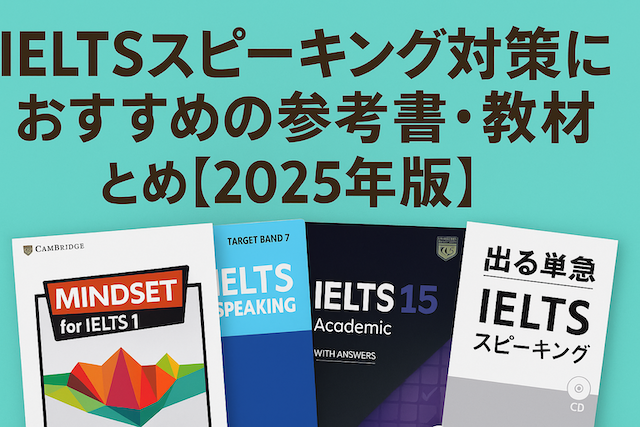
IELTS Speaking Preparation
IELTS Speaking Preparation: Summary of Recommended Reference Books and Materials [2025 Edition]
01
Introduction
The IELTS Speaking test is the part that most tests your practical ability to use English in the whole exam. You have to convey your thoughts logically and fluently within a time limit, and it is also the section many candidates feel uneasy about. In particular, the formats differ across Part 1 (everyday conversation), Part 2 (a speech) and Part 3 (abstract discussion), so you need to be prepared for a wide range of topics.
Meanwhile, learning materials for candidates have become plentiful in recent years, and by choosing textbooks and materials that suit your level and target score you can prepare efficiently. The options are varied, from introductory books with thorough explanations in Japanese, to mock-question books close to the real test, to online speaking practice materials.
This article introduces the latest recommended IELTS Speaking preparation materials as of 2025, for everyone from beginners to advanced learners. Choose the materials that suit you and build your speaking ability efficiently.
02
Points for Choosing IELTS Speaking Textbooks
With so many textbooks and materials available, quite a few candidates are unsure which to choose. To study efficiently, it is important to choose materials that match your level and purpose. Here are the points to consider when choosing.
1. Does it reflect the latest trends in questions?
Topics in IELTS Speaking are updated regularly. Older materials may be out of step with the themes in the actual test, so it is safer to choose the latest question books or materials that explicitly say they are the 2025 edition.
2. Does it have plenty of model answers and sample audio?
It is important not only to read the textbook but also to learn how to answer by ear. Choosing materials with audio or linked to online videos makes it easier to pick up pronunciation and intonation too.
3. Does it cover Part 1, Part 2 and Part 3 in a balanced way?
Speaking has three parts, and each requires different skills. Ideal materials do not lean toward everyday conversation practice but also include practice in speech format and discussion format.
4. Is there explanation in Japanese?
For beginners, materials with careful explanations in Japanese are easier to understand. On the other hand, for advanced learners and candidates aiming for a high score, English-only materials may be more practical and effective.
5. Does it suit your learning style?
Some people want to study carefully with a paper book, while others prefer to study efficiently in short bursts with a smartphone app or online materials. Choosing materials in a format that suits your lifestyle is the key to keeping going.
03
Recommended Textbooks for Beginners
For people just starting IELTS Speaking, it is more important to choose materials that teach the basics properly than to dive straight into difficult question books. Here are recommended textbooks for learners aiming for Band 5.0-6.0.
“A Complete Guide to IELTS Speaking for First-Timers”
- Features: Careful explanations in Japanese, with a structure easy for IELTS beginners to understand.
- Content: Covers the basic format of Parts 1-3, examples of frequently asked questions and simple model answers.
- Benefits: Ideal for "getting the big picture of the test" before you take IELTS.
“Introductory Drills for Aiming at Band 6 in IELTS Speaking”
- Features: Explains, in exercise form, the points where beginners tend to stumble.
- Content: Short phrase practice and training in answering in ways that do not end at Yes/No.
- Benefits: Builds the ability to expand on your own ideas in English.
“Speaking Is Decided in 20 Seconds! A Phrase Book for IELTS Beginners”
- Features: Includes many phrases you can answer with in a short time.
- Content: Teaches how to answer on common everyday topics.
- Benefits: Useful for practicing time management and "not falling silent".
04
Recommended Materials for Intermediate Learners (Aiming for Band 6-7)
For learners who have finished the basics and want to speak more naturally and logically, materials with question formats close to the real test and a wider range of topics are effective. Here are materials recommended for those aiming for Band 6.0-7.0.
The “IELTS Speaking Actual Tests with Answers” series
- Features: Includes many questions in a format close to those asked in the real test.
- Content: You can study with a set of mock-test-style question collections and model answers.
- Benefits: Reflects the latest topics, so you can grasp trends in questions.
“Cambridge IELTS Speaking Masterclass”
- Features: Materials that emphasize pronunciation, intonation and the naturalness of conversation.
- Content: Structured so you can practice through pair work and role-play.
- Benefits: Can be used not only for solo study but also for practice with online English conversation or study partners.
“IELTS Speaking Applied Training (Intermediate)”
- Features: A good balance of Japanese explanation and English-only content, easy to work through in self-study.
- Content: Study by comparing "bad answer examples" and "improved examples" for typical questions.
- Benefits: Helps you understand your weaknesses and learn ways of answering that lead to higher scores.
05
Recommended Materials for Advanced Learners (Aiming for Band 7 or Above)
Learners aiming for Band 7.0 or above need not only "fluency" and "rich vocabulary" but also logical and coherent ways of answering. The key is to acquire advanced expressions and be able to convey your ideas convincingly to the examiner. Here are materials best suited to advanced learners.
“IELTS Speaking High Score Guide”
- Features: Analyzes answer examples from high scorers and explains specifically what was rated well.
- Content: Comes with model answers and commentary from candidates who scored Band 8 or above.
- Benefits: You learn the thought processes and ways of expressing yourself needed for a high score, not just memorization.
“Collins Speaking for IELTS”
- Features: One of the series recommended for IELTS. Especially strong on academic and logical ways of answering.
- Content: Includes topic-based vocabulary lists, practice exercises and discussion practice.
- Benefits: Ideal for preparing for abstract and difficult questions such as those in Part 3.
“Advanced IELTS Speaking: Strategies for Band 8+”
- Features: Strategic materials made for advanced-level candidates.
- Content: Debate-style practice, exercises that build critical thinking, and variations of natural expression.
- Benefits: Lets you level up from "being able to speak English" to "speaking in a way that is rated highly".
06
Using Online Materials and Apps
In recent years, in addition to paper textbooks, online materials and apps you can easily study on a smartphone or computer have also become plentiful. You can use them in spare moments while commuting or going to school, which helps you build speaking ability efficiently.
The British Council official app “IELTS Prep App”
- Features: A free app provided officially for IELTS.
- Content: Includes mock questions, study tips, sample answers and more.
- Benefits: Highly reliable, covering everything from the basics to the latest information.
YouTube “IELTS Liz”
- Features: A popular channel with enormous support from candidates.
- Content: Part-by-part preparation, introductions of model answers, last-minute tips before the test and more.
- Benefits: You can learn from high-quality explanations in video form for free.
IELTS Speaking courses on Udemy
- Features: Video lectures by instructors plus practice exercises.
- Content: Some courses include a feedback service, so you can learn while receiving comments.
- Benefits: You get "assessment of your actual speech", which is hard to get in self-study.
Online English conversation (Cambly, DMM Eikaiwa, etc.)
- Features: You can practice in real time with native-speaker instructors or people with IELTS experience.
- Content: Supports mock-test-style practice and reinforcement of weaknesses.
- Benefits: Greatly increases the amount of "actually speaking aloud" practice.
07
Combining Self-Study with Practical Practice
Simply gaining knowledge from textbooks and online materials will not build speaking ability enough. Actually practicing aloud and building up output is the key to raising your score. Here are practical practice methods to add to self-study.
1. Record yourself and check your speech
Use a smartphone recording app to record your answers and listen back, so you can objectively see your pronunciation habits, grammar mistakes, the length of silences and so on.
2. Shadowing and repeating
Imitating and repeating model answers and native audio is effective for acquiring natural intonation and fluency.
3. Simulated mock interviews
Quiz each other with a friend or study partner and practice Parts 1-3 all the way through to experience the tension of the real test. Having an online English conversation instructor play the examiner is also effective.
4. Increase your English conversation practice
By making speaking English part of your daily routine, it is important to "get used to speaking English itself". English conversation cafes and online English conversation are ideal places to keep producing output.
08
Summary
In IELTS Speaking preparation, the key to success is combining how you choose textbooks and materials with practical practice.
- Beginners should build a foundation with materials that have Japanese explanations.
- Intermediate learners should use question books and model answers close to the real test, and keep practicing speaking logically.
- Advanced learners are expected to analyze answers from high scorers, work on advanced discussion practice, and polish the range and naturalness of their expression.
- Combining apps, YouTube and online English conversation also increases opportunities for study in spare moments and for real practice.
What matters in the end for raising your score is balancing input (studying materials) and output (speaking practice). Use the recommended 2025 materials as a reference, find a study method that suits your level and lifestyle, and go into the real IELTS test with confidence.
09
FAQ: Recommended IELTS Speaking Textbooks and Materials [2025 Edition]
How many books are enough for IELTS Speaking preparation?
A guideline is 2 to 3 books in total: 1 for building your foundation, 1 for practice under exam conditions, and 1 for reinforcing weak points (pronunciation, vocabulary, etc.). Too many will not stick, so limit yourself to an amount you can go through repeatedly.
What is the difference between the 2025 edition and older editions? Can I still use an older edition?
The advantage of the 2025 edition is that topic updates and adjustments to model answers are more likely to be reflected. Basic theory from older editions is still usable, but the latest edition has the advantage in how current the topics are and how natural the answers sound.
Should beginners choose materials with Japanese explanations or English-only ones?
A step-by-step approach is efficient: first use Japanese explanations to quickly absorb the format and basic expressions, then switch to English-only materials once you are comfortable.
Can reference books alone improve my speaking ability?
Reference books are a way to learn 'patterns,' and speaking ability grows through the amount you speak multiplied by feedback. Be sure to combine them with reading aloud, shadowing, recording checks, and mock interviews.
Do I need materials specialized for Part 2 (cue card) preparation?
Structure is the key in Part 2. Rather than just memorizing templates, materials that let you practice the frame of introduction → overview → 2 details → conclusion are effective. Choose books with a dedicated chapter and plenty of task card examples.
What level of pronunciation is needed? Is an accent penalized?
What is evaluated is not the presence of an accent but clarity, consistent intonation, and word stress. Use pronunciation-focused materials or materials with audio to ensure at least a minimum level of intelligibility.
Is it fine to focus on 'difficult words' for vocabulary preparation?
Natural collocations that fit the topic lead to higher marks than heavy use of difficult words. Materials covering vocabulary by theme plus paraphrase expressions are effective.
How should I combine online materials and apps?
A 4-layer approach is best for retention: learn patterns from paper books, repeat with apps, watch real examples on YouTube, and practice in real situations with online English conversation.
Can I aim for Band 7 through self-study?
Yes, it is possible. There are many examples of people reaching it by keeping up full run-throughs (Parts 1 to 3) 3 to 4 times a week plus third-party feedback once a week. Choose materials that include a checklist for self-correction.
Is memorizing model answers effective?
Rote memorization can lead to unnatural answers. The best use is to extract the sentence structures, connectors, and paraphrase patterns and reapply them to your own topics.
How many hours should I study?
Guidelines by band: - 5.5 to 6.0: 30 to 50 hours - 6.0 to 6.5: 40 to 60 hours - 6.5 to 7.0: 60 to 80 hours (Includes speaking practice and recording review; varies by individual)
How many times should I go through one book? Any tips for repeating it?
At least 2 rounds plus extra rounds on weak chapters are recommended. In the 2nd round, always combine reading aloud, timed practice, and recording to measure retention.
How can I get corrections and feedback?
Run a PDCA cycle at least once a week: record, check against a self-scoring checklist, get comments from online English conversation or a teacher, then record again. Automatic evaluation in apps can also be used as a supplement.
What should I prioritize right before the exam?
Prioritize the final adjustment of your scoring templates (introductions, stalling expressions, topic shifts, giving examples) and getting your mouth used to frequent themes. Avoid starting new materials, and instead rapidly review your existing ones.
What causes scores to stall, and what is the remedy?
The causes are mostly 'insufficient development of ideas,' 'poor paraphrasing,' and 'stalled silences.' The remedy is: (1) training to build a 30-second outline, (2) a synonym paraphrase list drill, and (3) recording a 60-second full run-through and improving it.
What is the quickest way to decide how to choose recommended materials?
Decide priorities in this order: level diagnosis, goal (passing score / high score), time available (hours per week), and missing skills (pronunciation, vocabulary, structure). Then narrow your purchase to 1 foundation book, 1 practice book, and 1 for weak points.
10
Related article
11
Recommended Course
The first step in IELTS preparation is choosing the right environment
With one-on-one classes and real-format mock exams, we help you reach your target score by the most direct route.