
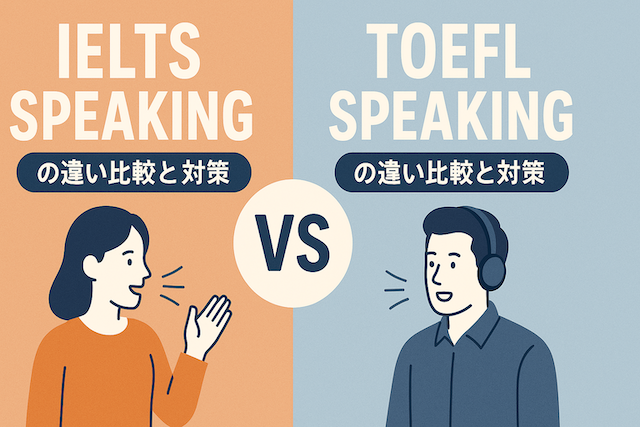
IELTS Speaking Preparation
IELTS Speaking Preparation: Comparing IELTS Speaking and TOEFL Speaking and How to Prepare
01
Introduction
For people aiming to study abroad, emigrate or advance their careers, **IELTS and TOEFL** are the leading choices for proving English ability. Both include a speaking test, but when you actually take them, the format and the skills required are so different that they can feel like 'completely different exams.'
IELTS Speaking is a conversation with an examiner one on one, so natural communication skills, pronunciation and fluency are emphasized. TOEFL Speaking, on the other hand, has you record your answers at a computer, and tests your ability to build a logical structure and organize information in a short time.
So even though both are 'speaking exams in English,' the way you prepare and the skills you need to develop are different. This article thoroughly compares IELTS Speaking and TOEFL Speaking and explains the preparation methods suited to each.
02
Overview of IELTS Speaking and TOEFL Speaking
Features of IELTS Speaking
- Format: One-on-one interview with an examiner
- Duration: About 11-14 minutes
- Structure: Three parts (introduction, individual speech, discussion)
- Features: A format close to real conversation that checks your natural command of English
- Purpose: Measures a wide range of communication skills, from everyday conversation to exchanging opinions
Features of TOEFL Speaking
- Format: Record your answers into a microphone at a computer
- Duration: About 17 minutes in total
- Structure: Four tasks (1 independent + 3 integrated)
- Features: Centered on integrated tasks combined with Reading and Listening
- Purpose: Measures presentation and summarizing skills in an academic setting
Broad Differences
- IELTS: Face-to-face conversation with a person -> emphasis on 'communication skills'
- TOEFL: One-way speaking into a recording -> emphasis on 'logical structuring and summarizing skills'
03
Differences in exam format
IELTS Speaking
IELTS Speaking is conducted as a face-to-face interview with an examiner. It is divided into three main parts.
- Part 1 (Introduction and familiar questions) About 4-5 minutes. Mainly questions about your name, hometown, hobbies and daily life, helping you ease your nerves as you start the conversation.
- Part 2 (Speech task: Cue Card) About 3-4 minutes. You are given a topic card, prepare for 1 minute, and then speak for 1-2 minutes. You need to show your structuring ability and fluency on the spot.
- Part 3 (Discussion) About 4-5 minutes. You discuss abstract and social topics developed from the Part 2 theme with the examiner. Your logical thinking and ability to exchange opinions are tested.
Key point: Continuing a natural conversation and developing your opinions with specific examples are important.
TOEFL Speaking
TOEFL Speaking is a format in which you record your answers into a microphone at a PC. It consists of four tasks in total.
- Task 1 (Independent) State your own opinion on an everyday, familiar topic. 15 seconds of preparation, 45 seconds to answer.
- Task 2 (Integrated: Listening + Reading + Speaking) Read and listen to a short passage and a conversation, and answer by summarizing their content. 30 seconds of preparation, 60 seconds to answer.
- Task 3 (Integrated: Academic Listening + Speaking) Listen to a lecture and explain it by organizing the key points. 20 seconds of preparation, 60 seconds to answer.
- Task 4 (Integrated: Academic Reading + Listening + Speaking) Read an academic passage, listen to a related lecture and explain by integrating them. 30 seconds of preparation, 60 seconds to answer.
Key point: You need the skill to organize information in limited time and answer in a structured way.
Summary
- IELTS is the 'ability to converse with people'
- TOEFL is 'information processing + logical explanation skills'
04
Differences in Scoring Criteria
IELTS Speaking Scoring Criteria
In IELTS Speaking, the examiner evaluates you on four criteria.
- Fluency and Coherence Can you speak without getting stuck? Can you connect ideas logically?
- Lexical Resource Can you use an appropriate and wide range of vocabulary? Can you paraphrase?
- Grammatical Range and Accuracy Can you use tenses and sentence structures correctly? Can you build complex sentences?
- Pronunciation Is your pronunciation clear and easy to understand? Are your stress and intonation natural?
Features: Emphasis on the naturalness of the conversation and how easily you are understood.
TOEFL Speaking Scoring Criteria
In TOEFL Speaking, your recorded answers are evaluated by raters and AI. There are mainly three criteria.
- Delivery Is your pronunciation and intonation easy to listen to? Can you speak smoothly without breaks?
- Language Use Can you use grammar and vocabulary accurately? Can you choose expressions appropriately?
- Topic Development Is your answer logical and coherent? Do you support your claims with reasons and specific examples?
Features: Strong evaluation of the structure of your answer and the richness of its content.
Key Differences
- IELTS: Evaluates natural conversation skills as a whole
- TOEFL: Emphasizes the ability to summarize logically in a short time
05
Differences in Preparation
IELTS Speaking Preparation
- Practice with mock interviews It is important to get used to the conversation format with a real examiner. Do mock interviews with friends or teachers and practice answering on the spot.
- Build your speech skills Part 2 requires a speech of 1-2 minutes. It is effective to practice daily by choosing a topic, preparing for 1 minute and then speaking for 2 minutes.
- Pay attention to natural intonation In IELTS, 'ease of understanding' is valued more than accent, so practice with attention to intonation and phrasing.
- Practice conversation on a variety of themes Get in the habit of stating your own opinion on abstract topics (education, the environment, technology, etc.).
TOEFL Speaking Preparation
- Practice recording under time limits TOEFL has strict limits of 15-30 seconds of preparation and 45-60 seconds to answer. It is essential to practice with a stopwatch.
- Strengthen your note-taking Integrated tasks require the ability to jot down and summarize key points from Reading and Listening. Establishing your own abbreviations and keyword-recording method will give you an advantage.
- Train to answer in a structured way Always keep the framework of 'introduction -> reason 1 -> reason 2 -> conclusion' in mind so you can organize and speak in a short time.
- Get used to academic themes You will need to summarize lectures and explain using specialized terms, so practice with English academic materials and university lecture videos.
Summary of Preparation Directions
- IELTS: Sharpen conversation skills and naturalness -> focus on mock interviews and speech practice
- TOEFL: Train logical structuring and time management -> focus on recording practice and note-taking
06
Study Priorities
Who IELTS Suits
- People who are good at talking with others
- People who enjoy natural conversation and small talk in English
- People who can expand on ideas and speak on the spot Because it evaluates communication skills in an interactive format, it favors 'people who can use English with a conversational feel.'
Who TOEFL Suits
- People who are good at organizing their thoughts logically
- People who can sum up the key points in a short time
- People who are comfortable with academic content Because it emphasizes structured answers and information-processing skills, it favors 'people who can develop logical thinking in English.'
Points for Choosing an Exam
- Studying in the UK or Australia -> IELTS is the mainstream
- Entering a university in the US or Canada -> TOEFL is the mainstream
- Choosing according to your own best speaking style is the most efficient.
07
Summary
IELTS Speaking and TOEFL Speaking both measure 'speaking ability,' but they differ greatly in exam format, scoring criteria and the skills required.
- IELTS Speaking: Face to face with an examiner. Emphasizes natural conversation skills, pronunciation and fluency.
- TOEFL Speaking: Recorded. Emphasizes logical structuring and information organization in a short time.
The skills required of test takers can be summarized as follows.
- IELTS -> conversation skills, spontaneity, naturalness
- TOEFL -> logic, summarizing, time management
Which one to choose depends on the requirements of your study or emigration destination and your own strengths. Understanding the differences between the exams and preparing with a study style that suits you is the shortcut to reaching your target score.
08
FAQ: IELTS Speaking Prep: Comparing IELTS Speaking and TOEFL Speaking and How to Prepare
Which of IELTS and TOEFL Speaking suits me better?
If you are good at natural face-to-face conversation, IELTS suits you; if you are good at building a logical structure in a short time, TOEFL suits you. Be sure to check the requirements of your destination (country and university) as well.
What is the biggest difference in the speaking format?
IELTS is a one-on-one interview with an examiner, while in TOEFL you record your answers at a PC. IELTS is a back-and-forth dialogue; in TOEFL, time management and structuring are the key.
How do the scoring criteria differ?
- IELTS: Fluency and Coherence / Lexical Resource / Grammatical Range and Accuracy / Pronunciation - TOEFL: Delivery (clarity) / Language Use (vocabulary and grammar) / Topic Development (logical development)
How long a preparation period do I need?
As a guide, raising your level by 0.5-1.0 band (IELTS) or 3-5 points (TOEFL Speaking) from where you are now to your target takes about 4-8 weeks of intensive practice (5 days a week, 60-90 minutes a day).
How much is pronunciation emphasized? Is an accent a disadvantage?
In both exams, 'clarity' is emphasized, and no particular accent is penalized. Use intonation, phrasing and stress to make yourself easier to understand.
I struggle with IELTS Part 2 (Cue Card). How should I practice?
- In the 1 minute of preparation, jot down the outline of 'introduction, three key points, summary' - A time guide is 15 seconds for the introduction, 25 seconds for each key point and 15 seconds for the summary - Do three 'one-minute preparation and two-minute speech' rounds every day with daily topics
TOEFL integrated tasks are hard. What is the core of preparing for them?
- Note-taking: use symbols for who claims what, reasons and examples, and contrasts - Template: fit Claim -> Reason 1 -> Example -> Reason 2 -> Wrap into 60 seconds - Assume you can hear the audio only once and record only the key words
How do I fix running out of time or finishing too early?
- Manage 45-60 second answers by number of sentences (5-7 sentences as a guide) - Fix the role of each sentence (claim / reason / example / closing) - Record, transcribe, and cut unnecessary words to optimize the length
What are common penalty patterns?
- IELTS: insufficient paraphrasing, strings of simple sentences, shallow responses to the examiner - TOEFL: unclear claim at the start, examples that are too long, a read-aloud style of Delivery
What are tips for improving through self-study alone?
- A daily 10-minute three-step practice of reading aloud, shadowing and summary speaking - Twice a week, a 'mock exam' (timed, recorded, self-scored) - Invest vocabulary study in 'abstract words + linking expressions' (in terms of, as a result, moreover, etc.)
What is the approximate conversion between IELTS bands and TOEFL Speaking?
As a rough guide, IELTS 6.0 is about TOEFL Speaking 22-24, IELTS 6.5 is about 25-27 and IELTS 7.0 is about 27-29. It varies depending on the actual questions and your strengths and weaknesses.
What is a model study plan (5 days a week, 4 weeks)?
- Week 1: Understand the formats + create templates / fix the pattern for Part 2 and Task 1 - Week 2: Record -> self-scoring loop / drills by weakness (paraphrasing, linking) - Week 3: Two mock tests + apply feedback / strengthen integrated tasks and Part 3 - Week 4: Real-exam simulation (3 times) + rest and adjustment
I get nervous on the day. What mental preparation should I do just before?
- 60 minutes before the start, only re-check your patterns; do not cram memorization - Prepare three opening phrases (e.g., To begin with, I'd say...) - Stabilize your voice with posture, breathing and a smile
How should I use online English conversation lessons and AI?
For IELTS, focus on mock interviews (interactive); for TOEFL, focus on recording plus self-scoring. Have AI point out 'missing structure' and 'wordy expressions,' and finish by fine-tuning naturalness with human feedback.
I plan to take both. Can I share my study?
The common core is 'clear pronunciation, use of linking words and giving examples.' For the differences, strengthen separately: for IELTS, developing the dialogue and handling follow-up questions; for TOEFL, structuring within the time limit and note-taking.
What should I be careful about regarding what to bring and technical points on the day?
- IELTS: ID check; warm up your mouth during the waiting time before entering - TOEFL: check microphone position and volume; get used to the countdown display
What is a checklist for when my score stalls?
- Can you state your claim or theme within the first 10 seconds? - Does each answer include at least one set of 'reason + specific example'? - Do you use at least three paraphrase and linking variations in one answer? - Are you recording yourself at least twice a week and evaluating objectively (yourself or a third party)?
09
Related article
10
Recommended Course
The first step in IELTS preparation is choosing the right environment
With one-on-one classes and real-format mock exams, we help you reach your target score by the most direct route.