
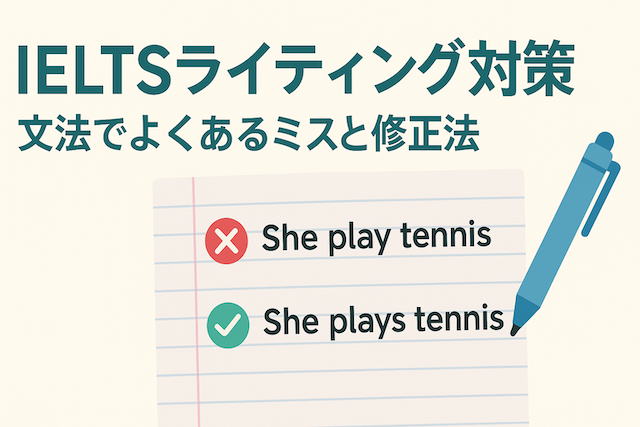
IELTS Writing Preparation
IELTS Writing Prep: Common Grammar Mistakes and How to Fix Them
01
Introduction
In IELTS Writing, in addition to the richness of your ideas and vocabulary, **grammatical accuracy** makes up a large part of the marking criteria. In fact, many candidates can write a reasonable amount of content but find their scores stalling because of basic grammar mistakes. In Task 2 essays in particular, you write at length, so errors such as subject-verb agreement, tense confusion and misused articles pile up and pull down your assessment.
This page organizes the typical grammar mistakes that candidates often make in IELTS Writing and explains the correct usage and how to fix each one, with example sentences. By getting the basics right, you can avoid grammar penalties and move closer to a higher band score.
02
Subject-Verb Agreement
One of the most frequent grammar mistakes in IELTS Writing is a mismatch in number between subject and verb. In English the form of the verb changes depending on whether the subject is singular or plural, so ignoring this rule quickly leads to lost marks.
Examples of common mistakes
- ❌ People likes to travel abroad.
- ❌ The number of students are increasing every year.
Corrected examples
- ✅ People like to travel abroad.
- ✅ The number of students is increasing every year.
Key points
- Be aware of singular and plural He runs fast. (singular) They run fast. (plural)
- The difference between the number of and a number of The number of students is increasing. (The subject is 'the number' = singular) A number of students are studying abroad. (The subject is 'students' = plural)
- Watch collective nouns The team is winning the game. (when the team is seen as one unit -> singular) The team are arguing among themselves. (when emphasizing the individual members -> plural)
Tips for IELTS preparation
- Before building a sentence in your writing, decide clearly whether the subject is singular or plural.
- Even when the subject gets long, make the verb agree with the core noun of the subject.
Just getting this basic right greatly raises the accuracy of your whole text and stabilizes your Grammatical Accuracy assessment.
03
Misused Articles (a, an, the)
English articles are one of the trickiest points for IELTS candidates. If your first language has no concept of articles, it is an area where you are especially likely to make mistakes and lose marks.
Examples of common mistakes
- ❌ The pollution is big problem.
- ❌ She wants to be an teacher.
- ❌ I visited a Philippines last year.
Corrected examples
- ✅ Pollution is a big problem.
- ✅ She wants to be a teacher.
- ✅ I visited the Philippines last year.
Key points
- Use a / an with singular countable nouns a car, a student, an apple If the word begins with a vowel sound -> an apple, an hour
- Use the when referring to something specific the sun, the government, the internet Use it for a noun already mentioned in the text or for a unique object that everyone knows.
- When to use no article Uncountable nouns: Pollution is a serious issue. (❌ not The pollution) Proper nouns: I live in Cebu. (❌ not the Cebu) Plural general nouns: Cars are expensive.
Tips for IELTS preparation
- When you review your sentences, check by asking yourself, 'Is an article really needed?' and 'Should I specify with the?'
- Make it a habit never to put a before uncountable nouns (information, advice, pollution, etc.).
Article errors stand out very easily, and examiners tend to judge that your basic grammar is lacking. Once you learn the correct usage, they are marks you can easily avoid losing.
04
Tense Confusion (Tense Consistency)
In IELTS Writing, it is very important to use tenses correctly. If you write a past event in the present tense or express the future in the past tense, the examiner will judge that your logic is unclear or that you lack understanding of basic grammar, which lowers your score.
Examples of common mistakes
- ❌ In the past, people use bicycles more often.
- ❌ Nowadays, students studied English in many countries.
- ❌ If this trend continues, people live healthier lives.
Corrected examples
- ✅ In the past, people used bicycles more often.
- ✅ Nowadays, students study English in many countries.
- ✅ If this trend continues, people will live healthier lives.
Key points
- Use the past tense for the past In 1990, the population increased rapidly.
- Use the present tense for current habits and facts Nowadays, many people use smartphones daily.
- Use will / be going to for future predictions In the future, more people will work remotely.
- Use the present perfect (have + p.p.) for something continuing from the past to the present The number of users has increased over the last decade.
- Watch the tense in if-clauses If I have time, I will study more. (correct future expression) ❌ If I will have time, I study more. (incorrect)
Tips for IELTS preparation
- When writing an essay, always be aware of whether each sentence refers to the past, present or future.
- In Task 1 (Academic) graph descriptions in particular, switch consistently: past data -> past tense, projected data -> future tense.
Tense mistakes are immediately obvious to the examiner and lower the credibility of the whole text. Keeping consistency is the key to a better grammar score.
05
Singular and Plural Errors (Plural Forms)
English strictly requires a distinction between singular and plural forms of nouns. In IELTS Writing, even basic plural mistakes are marked down without mercy, so be careful.
Examples of common mistakes
- ❌ Many student attend the lecture.
- ❌ There are several problem in the city.
- ❌ People has different opinion about this issue.
Corrected examples
- ✅ Many students attend the lecture.
- ✅ There are several problems in the city.
- ✅ People have different opinions about this issue.
Key points
- Make countable nouns plural one problem -> two problems a student -> many students
- Do not add a plural to uncountable nouns ❌ informations, advices, knowledges ✅ information, advice, knowledge
- Watch irregular plurals child -> children man -> men / woman -> women tooth -> teeth
- Handling collective nouns people is already plural -> ❌ peoples (peoples exists only in the sense of 'ethnic groups') data is formally plural, but it can also be treated as singular in academic writing (The data is reliable.).
Tips for IELTS preparation
- Get into the habit of checking noun + number agreement after you write.
- In particular, when quantifiers such as many, several and a few appear, check that the noun is plural.
Singular and plural errors may look like small mistakes, but they are typical items that make people doubt your grammatical accuracy. Simply being careful to prevent them can raise your score.
06
Misused Prepositions
Prepositions are an element that is often gotten wrong in IELTS Writing. Many prepositions have similar meanings, and using a direct translation from your first language easily leads to misuse, so be careful.
Examples of common mistakes
- ❌ She is married with a doctor.
- ❌ We discussed about the problem.
- ❌ He is good in playing basketball.
Corrected examples
- ✅ She is married to a doctor.
- ✅ We discussed the problem.
- ✅ He is good at playing basketball.
Key points
- Learn collocations interested in, depend on, responsible for It is effective to memorize collocations related to topics that often appear in IELTS.
- Do not use unnecessary prepositions ❌ discuss about -> ✅ discuss ❌ mention about -> ✅ mention
- Watch for confusion among in / at / on in the morning, at night, on Monday at school, in the classroom
- Adjective + preposition combinations famous for, similar to, afraid of, capable of
Tips for IELTS preparation
- In your writing, you can reduce preposition mistakes by using collocations you are familiar with.
- If you are unsure, it is safest to choose a simple, reliable expression.
Preposition errors may look like minor mistakes, but if they occur often they are a factor that greatly lowers your Grammatical Accuracy assessment.
07
Misused Linking Words
In IELTS Writing, it is important to connect your logic using linking words correctly. However, using the wrong linking word and mismatched cause and effect are common mistakes that make the flow of your text unnatural.
Examples of common mistakes
- ❌ He studied hard, because he failed the exam.
- ❌ I like reading books, but also watching movies.
- ❌ Although it was raining, but we went outside.
Corrected examples
- ✅ He studied hard because he had failed the exam.
- ✅ I like reading books and also watching movies.
- ✅ Although it was raining, we went outside.
Key points
- Choose linking words by understanding their meaning because, since -> cause / reason therefore, thus -> result although, even though -> contrast
- Avoid double use ❌ Although ~ but -> ✅ Although ~ ❌ Because ~ so -> ✅ Because ~
- Distinguish coordinating and subordinating conjunctions Coordinating conjunctions (and, but, or, so) -> join clauses at the same level Subordinating conjunctions (because, although, if, while) -> connect in a form subordinate to the main clause
Tips for IELTS preparation
- You do not need to force difficult linking words. Being able to use simple ones accurately leads to a high assessment.
- When you review after writing, check that no linking word is doubled and that cause and effect are expressed correctly.
Misused linking words can lead to your text being judged 'logically unclear' even if your ideas are good. Being aware of natural, accurate connections is the key to raising your band score.
08
Run-on Sentences
In IELTS Writing, it is common for sentences to be treated as 'hard to read' or 'grammatically incorrect' because they are joined too much without being separated. This is called a **run-on sentence**.
Examples of common mistakes
- ❌ Many people go to cities they want better jobs they want better lives.
- ❌ Technology is developing fast it changes the way we live and it makes life easier.
Corrected examples
- ✅ Many people go to cities because they want better jobs and better lives.
- ✅ Technology is developing fast. It changes the way we live, and it makes life easier.
Key points
- One idea per sentence Do not cram too much into a long sentence.
- Use linking words and punctuation correctly Use because, so, and, while and although to separate ideas logically.
- Have the courage to end a sentence with a period In English, writing several short, clear sentences is usually rated more highly.
- Be especially careful in Task 2 The more complex the idea you want to convey, the easier it is to produce a run-on sentence.
Tips for IELTS preparation
- After writing, check 'Is this sentence too long?' and split it if it contains two or more ideas.
- Even when aiming for band 7 or higher, what matters is complex and accurate sentences; a long sentence does not mean a high mark.
By separating sentences appropriately, you produce a clear, easy-to-read essay that makes a good impression on the examiner.
09
Misplaced Modifiers
A mistake sometimes seen in IELTS Writing is a misplaced modifier that changes the meaning. If modifiers are not placed correctly, the text becomes unnatural or can be misunderstood.
Examples of common mistakes
- ❌ He almost wrote 100 essays last month. -> It means he almost started writing, but in the end did not write them.
- ❌ Students who study English quickly improve. -> It is ambiguous whether the students study English quickly or whether they improve quickly.
Corrected examples
- ✅ He wrote almost 100 essays last month. -> It means he wrote nearly 100 essays last month.
- ✅ Students who study English improve quickly. -> It means students who study English improve fast.
Key points
- Watch the position of adverbs The meaning of only, almost, just, even and similar words changes with where you put them. Example: Only she passed the exam. (She was the only one who passed.) She only passed the exam. (All she did was pass the exam.)
- Avoid ambiguity in relative clauses The man who was driving the car that crashed was injured. -> It is hard to tell which noun is being modified, so split the sentence if necessary.
- Put long modifiers as close as possible to what they modify Incorrect: She served sandwiches to the children on paper plates. Correct: She served sandwiches on paper plates to the children.
Tips for IELTS preparation
- Reread your sentences and check which word each modifier describes.
- Sentences that can be read in two ways are easily marked down, so aim to eliminate ambiguity.
If you misplace a modifier, there is a risk that the content itself is misunderstood. Clear, unambiguous expression is an essential condition of a high-scoring essay.
10
Errors in Conditionals
In IELTS Writing, there are many situations where you state causes and results using conditional sentences (if-clauses). However, tense errors in the if-clause and misuse of will are typical mistakes often seen among candidates.
Examples of common mistakes
- ❌ If I will have time, I study more.
- ❌ If people would recycle more, the environment improves.
- ❌ If he studied harder, he will pass the exam.
Corrected examples
- ✅ If I have time, I will study more. (realistic future -> the future form is used only in the main clause)
- ✅ If people recycled more, the environment would improve. (unreal supposition -> past tense + would)
- ✅ If he had studied harder, he would have passed the exam. (supposition contrary to past fact -> past perfect + would have)
Key points
- Zero conditional (universal facts) If you heat water to 100°C, it boils.
- First conditional (realistic future) If it rains tomorrow, we will stay at home.
- Second conditional (unreal present / future) If I were rich, I would travel the world.
- Third conditional (supposition contrary to past fact) If she had studied, she would have passed the test.
Tips for IELTS preparation
- Conditionals appear frequently in Task 2 (topics such as the environment, education and technology).
- As a rule, do not use will in the if-clause (except in emphatic cases).
- After writing, sort out and check: 'Is this supposition realistic, unreal, or about the past?'
If you can use conditionals correctly, you can express yourself logically and in a more advanced way, which is a big weapon for aiming at band 7 or higher.
11
Misused Punctuation
In IELTS Writing, punctuation errors may look like small mistakes, but if they occur often, the structure of your text becomes unclear and gets in the way of the examiner's understanding. Misuse of commas and broken parallel structure in particular are marked down.
Examples of common mistakes
- ❌ Governments should invest in education, health care, and provide jobs.
- ❌ The chart shows the trend of population growth, it is increasing rapidly.
- ❌ Some people think technology is beneficial others believe it is harmful.
Corrected examples
- ✅ Governments should invest in education, health care, and job creation. (parallel structure made consistent)
- ✅ The chart shows the trend of population growth. It is increasing rapidly. (split with a period)
- ✅ Some people think technology is beneficial, while others believe it is harmful. (linking word added)
Key points
- Avoid comma splices ❌ It was raining, we stayed home. ✅ It was raining, so we stayed home. / It was raining. We stayed home.
- Keep parallel structure consistent Example: improving healthcare, providing education, and creating jobs If the forms are inconsistent, it is treated as a grammar error.
- Use linking words Rather than forcing clauses together with a comma, use and, but, while and because correctly.
- Be especially careful when describing figures in Task 1 Incorrect: The number increased from 20,000, to 40,000, in 2010. Correct: The number increased from 20,000 to 40,000 in 2010. (omit the unnecessary commas)
Tips for IELTS preparation
- Do not join sentences too much. It is safe to separate them simply with periods.
- When writing parallel expressions, match the parts of speech, such as verbs and nouns.
- After writing, check 'Have I used too many commas?' and 'Are any sentences joined unnaturally?'
Using punctuation correctly makes your text clearer and more logical, and stabilizes your Grammatical Accuracy score.
12
Summary
In IELTS Writing, not only content and vocabulary but also **grammatical accuracy** is directly linked to your score. The following mistakes in particular are ones that many candidates tend to repeat.
- Subject-verb agreement
- Misused articles
- Tense confusion
- Singular and plural errors
- Misused prepositions
- Misused linking words
- Run-on sentences
- Misplaced modifiers
- Errors in conditionals
- Misused punctuation
These may look like small mistakes at first glance, but they add up to a large loss of marks. Conversely, this means you can reliably raise your score just by following the basic grammar rules.
How to Study to Reduce Grammar Mistakes
- List your own mistakes and practice correcting them repeatedly.
- Analyze model answers and absorb correct grammar patterns.
- When you review after writing, focus on subject and verb, tense, articles and plurals.
- Use grammar-checking tools and correction services to get an objective view of errors you cannot notice yourself.
You do not need perfect grammar, but keeping mistakes to a minimum is the shortest route to a higher band score. By firmly keeping to the basics, you will be able to write more logical, readable essays, which leads to a high score in IELTS Writing.
13
How much does grammar affect the IELTS Writing score?
It is assessed as part of the marking criterion Grammatical Range and Accuracy, and the frequency, seriousness and type of grammar errors are directly linked to the score. A high band is still possible if there are only occasional minor mistakes, but if systematic errors (articles, tense, agreement, etc.) are repeated, you lose a lot of marks.
14
What are the most common grammar mistakes?
Subject-verb agreement, articles, tense inconsistency, mixing up singular and plural, prepositions, misused linking words, run-ons, modifier position, conditionals and punctuation. Start by focusing your prep on these 10 items.
15
I am weak at articles (a / an / the). What is the quickest way to improve?
- Sort nouns into countable and uncountable (advice and information are uncountable).
- A singular countable noun always takes a/an.
- For something already mentioned or specific, use the.
- If unsure, consider no article (general statements with plural or uncountable nouns).
16
What are the tips for keeping tense consistent?
In each paragraph, make clear whether it is present, past or future, and mentally attach a time label to each sentence before writing it. In Task 1, be consistent in using the past tense for past data, the future for projections and the present perfect for long-term trends.
17
What if I am unsure about subject-verb agreement?
- The number of A takes a singular verb (is). A number of A takes a plural verb (are).
- Even with a long subject, match the verb to the core noun.
- For collective nouns, decide singular or plural by meaning (whole = singular, individuals = plural).
18
How can I reduce preposition mistakes?
Memorize them as collocation units (interested in, responsible for, married to). List unnecessary prepositions (such as discuss about) and avoid using them.
19
How do I check for run-on sentences?
As a rule, keep one idea per sentence, and when two or more independent clauses are lined up, separate them with a linking word, a semicolon or a period. If you are unsure, split safely with a period.
20
How can I keep the position of modifiers (adverbs, relative clauses) stable?
Place only, almost, even, just and similar words directly before or after what they modify. Do not leave a gap before a relative clause. If it is ambiguous, split it into two sentences to make it clear.
21
What are the basic rules of conditionals (if-sentences)?
- First conditional: If + present tense, will + verb.
- Second conditional: If + past tense, would + base verb.
- Third conditional: If + past perfect, would have + p.p.
- As a rule, do not put will in the if-clause.
22
How do I fix punctuation and parallel structure mistakes?
Do not join independent clauses with a comma (avoid comma splices). Make items in a list match in part of speech and form (e.g. improving..., providing..., creating...).
23
How can I show a range of vocabulary while strengthening my grammar?
After writing basic structures accurately, bring in a limited number of difficult structures (participle clauses, relative pronouns, inversion, etc.). Put accuracy first and avoid forced complexity.
24
What is the quickest self-editing checklist?
- Subject-verb agreement (identify the core noun).
- Articles (a/an/the/no article).
- Tense (consistency within the paragraph).
- Singular/plural and uncountable nouns.
- Prepositions and linking words (duplication and misuse).
- Punctuation (comma splices).
25
What should I be careful about when checking grammar with AI?
Do not accept suggestions blindly; note the reasoning and the pattern. Distinguish style changes (rephrasing) from grammar corrections, and compare with your original to see that the meaning has not changed.
26
What is a practice menu for improving accuracy in a short time?
- Check only articles for 5 minutes.
- Check only tenses for 5 minutes.
- Check only subject-verb agreement for 5 minutes.
- Once a week, tally your error log by category to identify your weak points.
27
Should grammar priorities differ between Task 1 and Task 2?
In Task 1, accuracy of figures, tense and prepositions is important; in Task 2, clarity of linking words, conditionals and modification that support logical development is important. Change the weight of your checklist items to suit the characteristics of each task.
28
Should I use templates to reduce grammar mistakes?
They are effective, but too many templates tend to sound unnatural. Use a skeleton template for the introduction and conclusion, and write the body in your own sentences suited to the topic, balancing accuracy and variety.
29
At what level should I start attempting complex structures?
Progress in stages: first accuracy in simple sentences, then complex sentences using coordination and subordination, then participle clauses, relative pronouns and noun clauses. If your error rate goes up, drop the difficulty by one level and go for accuracy.
IELTS Writing Preparation: Complete Guide to IELTS Writing [2026 Edition]IELTS Preparation and Complete Guide to Taking the Exam - Full Strategy and How to Study [2026 Edition]30
Related article
31
Recommended Course
The first step in IELTS preparation is choosing the right environment
With one-on-one classes and real-format mock exams, we help you reach your target score by the most direct route.