2026年1月10日
3D ACADEMY offers affordable English study programs in Cebu, Philippines – perfect for beginners, professionals, and exam takers.

3D UNIVERSAL ENGLISH INSTITUTE INC
info.3d-universal.com
8:00-17:00(Mon-Fri)
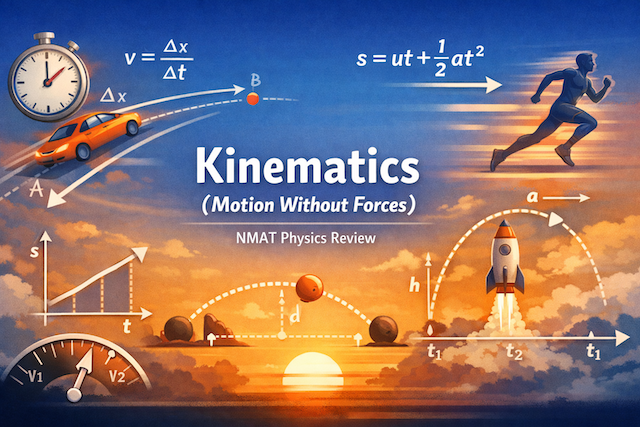
Kinematics (Motion Without Forces): NMAT Physics Review
Contents
- Kinematics (Motion Without Forces): NMAT Physics Review
- What Is Kinematics?
- Scalars and Vectors in Kinematics
- Distance and Displacement
- Speed and Velocity
- Acceleration
- Motion in One Dimension
- Equations of Motion for Constant Acceleration
- Free Fall and Vertical Motion
- Motion in Two Dimensions
- Projectile Motion
- Relative Motion
- Graphs of Motion
- Common Mistakes in NMAT Kinematics
- NMAT Exam Tips for Kinematics
- Summary
- FAQs (Frequently Asked Questions)
- What is kinematics in NMAT Physics?
- What is the difference between distance and displacement?
- How are speed and velocity different, and why does NMAT care?
- What does “constant acceleration” mean, and when can I use the kinematic equations?
- How do I handle sign conventions in vertical motion and free fall?
- Why is projectile motion treated as two separate motions?
- How can I quickly interpret displacement–time, velocity–time, and acceleration–time graphs?
- What is instantaneous velocity, and how is it tested on NMAT?
- How does relative motion appear in NMAT kinematics problems?
- What are the most common kinematics mistakes NMAT examinees make?
Kinematics (Motion Without Forces): NMAT Physics Review
Kinematics is one of the most fundamental topics in NMAT Physics. It focuses on the description of motion without considering the forces that cause it. For NMAT examinees, kinematics serves as a foundation for later topics such as dynamics, work and energy, and rotational motion. A solid understanding of kinematics allows you to analyze motion problems efficiently, interpret graphs accurately, and apply equations correctly under time pressure.
In this NMAT Physics Review, we will cover the essential concepts of kinematics, including displacement, velocity, acceleration, motion in one dimension, motion in two dimensions, projectile motion, and graphical analysis of motion. Emphasis will be placed on conceptual understanding, common NMAT problem patterns, and practical tips for avoiding typical mistakes.
What Is Kinematics?
Kinematics is the branch of mechanics that deals with the motion of objects without reference to the forces causing the motion. In kinematics, we focus on quantities such as position, distance, displacement, velocity, acceleration, and time. The goal is to describe how objects move, not why they move.
For NMAT Physics, kinematics problems often involve:
- Interpreting motion graphs
- Applying equations of motion
- Analyzing relative motion
- Understanding projectile motion
These questions test both mathematical skills and conceptual clarity, making kinematics a high-yield topic.
Scalars and Vectors in Kinematics
Understanding the difference between scalar and vector quantities is essential in kinematics.
Scalar quantities have magnitude only. Examples include:
- Distance
- Speed
- Time
Vector quantities have both magnitude and direction. Examples include:
- Displacement
- Velocity
- Acceleration
NMAT questions often test whether students confuse distance with displacement or speed with velocity. Always pay attention to direction when dealing with vectors.
Distance and Displacement
Distance is the total length of the path traveled by an object, regardless of direction. It is always a positive scalar quantity.
Displacement is the change in position of an object. It is a vector quantity defined by both magnitude and direction.
Key points to remember:
- Distance is always greater than or equal to the magnitude of displacement
- Displacement can be zero even when distance is not zero
- Displacement depends only on initial and final positions
In NMAT problems, scenarios involving round trips or circular paths often test this distinction.
Speed and Velocity
Speed is the rate at which distance is covered. It is a scalar quantity and is given by:
Speed = Distance / Time
Velocity is the rate of change of displacement with respect to time. It is a vector quantity:
Velocity = Displacement / Time
There are two important types of velocity:
- Average velocity: total displacement divided by total time
- Instantaneous velocity: velocity at a specific moment in time
For NMAT Physics, instantaneous velocity is often inferred from the slope of a displacement–time graph.
Acceleration
Acceleration is the rate of change of velocity with respect to time. It is also a vector quantity:
Acceleration = Change in velocity / Time
Acceleration can occur due to:
- A change in speed
- A change in direction
- Both speed and direction changing
Even if an object moves at constant speed, it can still be accelerating if its direction changes, such as in circular motion.
Motion in One Dimension
Motion in one dimension refers to motion along a straight line, such as along the x-axis. Most introductory NMAT kinematics problems involve one-dimensional motion with constant acceleration.
Common examples include:
- A car moving along a straight road
- An object falling vertically
- An elevator moving up or down
Equations of Motion for Constant Acceleration
When acceleration is constant, the following kinematic equations are used:
- v = u + at
- s = ut + ½at²
- v² = u² + 2as
Where:
- u = initial velocity
- v = final velocity
- a = acceleration
- t = time
- s = displacement
NMAT problems typically require selecting the correct equation based on the given variables. Memorization is useful, but understanding how the equations relate to motion is even more important.
Free Fall and Vertical Motion
Free fall refers to motion under the influence of gravity alone. Near the Earth’s surface, gravitational acceleration is approximately constant.
Key characteristics of free-fall motion:
- Acceleration is constant and directed downward
- Objects of different masses fall at the same rate (ignoring air resistance)
- Upward motion and downward motion can be analyzed using the same equations
In NMAT Physics, sign convention is critical in vertical motion problems. Always define upward or downward as positive consistently throughout the solution.
Motion in Two Dimensions
Two-dimensional motion involves movement in both the x- and y-directions. The most common example tested in NMAT is projectile motion.
In two-dimensional motion:
- Horizontal and vertical motions are independent
- Horizontal motion typically has constant velocity
- Vertical motion typically has constant acceleration due to gravity
Projectile Motion
Projectile motion occurs when an object is launched into the air and moves under the influence of gravity alone.
Important aspects of projectile motion:
- Initial velocity can be resolved into horizontal and vertical components
- Time of flight depends on vertical motion
- Range depends on both horizontal velocity and time of flight
- Maximum height occurs when vertical velocity becomes zero
NMAT questions may involve calculating time of flight, maximum height, or horizontal range using component analysis.
Relative Motion
Relative motion involves analyzing the motion of one object as observed from another moving object.
Key idea:
Velocity of A relative to B = Velocity of A − Velocity of B
NMAT problems may involve boats crossing rivers, cars moving in opposite directions, or people walking on moving platforms.
Graphs of Motion
Graphical interpretation is a critical skill for NMAT Physics.
Displacement–time graphs:
- Slope represents velocity
- Straight line indicates constant velocity
- Curve indicates changing velocity
Velocity–time graphs:
- Slope represents acceleration
- Area under the graph represents displacement
Acceleration–time graphs:
- Area under the graph represents change in velocity
NMAT often tests conceptual understanding of these relationships rather than complex calculations.
Common Mistakes in NMAT Kinematics
Students often lose points due to simple but avoidable errors. Common mistakes include:
- Confusing distance with displacement
- Ignoring direction in velocity and acceleration
- Using incorrect sign conventions
- Applying equations without checking assumptions
Careful reading of the question and consistent use of symbols can significantly improve accuracy.
NMAT Exam Tips for Kinematics
To perform well in kinematics questions:
- Draw simple diagrams whenever possible
- List known and unknown variables before solving
- Use graphs to visualize motion
- Focus on conceptual understanding rather than rote memorization
Since NMAT emphasizes reasoning and speed, mastering kinematics can give you a strong advantage in the Physics section.
Summary
Kinematics is a core topic in NMAT Physics that lays the groundwork for more advanced concepts. By understanding motion in one and two dimensions, mastering equations of motion, interpreting graphs, and avoiding common pitfalls, you can confidently tackle kinematics questions in the exam.
A strong command of kinematics not only boosts your Physics score but also enhances your overall problem-solving ability for the NMAT.
FAQs (Frequently Asked Questions)
What is kinematics in NMAT Physics?
Kinematics is the part of physics that describes how objects move without discussing the forces that cause the motion. In NMAT Physics, kinematics usually means working with displacement, velocity, acceleration, and time, and using these to analyze motion in one dimension (straight-line motion) or two dimensions (like projectile motion). Many NMAT questions test whether you can translate a story problem into the correct variables and relationships, interpret motion graphs, and apply constant-acceleration equations correctly. If you build a strong kinematics foundation, later topics such as dynamics and energy become much easier because you already understand how motion is measured and represented.
What is the difference between distance and displacement?
Distance is the total length of the path traveled, regardless of direction, so it is a scalar and always nonnegative. Displacement is the change in position from the starting point to the ending point, so it is a vector with both magnitude and direction. A classic NMAT trap is a round-trip scenario: you can travel a large distance yet have zero displacement if you return to the start. Another common trap is assuming displacement depends on the path. It does not; displacement depends only on the initial and final positions. When a question asks “how far,” it might mean distance, but if it asks for “change in position” or gives directions (east, west, up, down), it is almost always displacement.
How are speed and velocity different, and why does NMAT care?
Speed is the rate of covering distance and is a scalar. Velocity is the rate of change of displacement and is a vector, meaning it includes direction. NMAT cares because many questions require you to recognize direction-based changes. For example, an object moving in a circle can have constant speed but changing velocity because its direction changes continuously. Also, average speed and average velocity are not the same unless the motion is in one direction without turning back. Average speed is total distance divided by total time, while average velocity is total displacement divided by total time. If displacement is zero, average velocity is zero, but average speed may still be nonzero.
What does “constant acceleration” mean, and when can I use the kinematic equations?
Constant acceleration means the acceleration does not change with time. Under that condition, the standard kinematic equations apply (such as v = u + at, s = ut + 1/2 at^2, and v^2 = u^2 + 2as). In NMAT problems, constant acceleration is commonly assumed for straight-line motion, free fall near Earth’s surface, and simple projectile motion (ignoring air resistance). You should not blindly use these equations when acceleration changes, when motion is not along a straight line (unless you analyze each direction separately), or when the problem implies varying acceleration. A quick check is to ask: “Is acceleration stated as constant, or can it reasonably be treated as constant?” If yes, use the equations; if not, the problem likely needs graph interpretation or conceptual reasoning.
How do I handle sign conventions in vertical motion and free fall?
Sign convention is one of the biggest sources of mistakes. Choose a positive direction first (usually upward or downward), then keep it consistent. If you take upward as positive, gravity is negative (a = -g). If you take downward as positive, gravity is positive (a = +g). Both approaches are valid as long as you stay consistent. For objects thrown upward, the velocity decreases linearly until it becomes zero at the highest point, but acceleration remains constant (gravity still acts). Many NMAT questions test whether you understand that acceleration is not zero at the top of the motion; only velocity is zero there. Always label u, v, a, s, and t with signs and units before substituting into equations.
Why is projectile motion treated as two separate motions?
Projectile motion is analyzed by separating it into horizontal (x) and vertical (y) components because gravity acts only vertically (again, assuming air resistance is negligible). That means horizontal acceleration is zero, so horizontal velocity remains constant, while vertical motion has constant acceleration due to gravity. The key link between the two directions is time: the projectile has one time of flight, and that same time applies to both horizontal and vertical equations. NMAT problems often ask for range, time of flight, maximum height, or the velocity components at some point. If you clearly resolve the initial velocity into components and write separate equations for x and y, the problem becomes systematic instead of confusing.
How can I quickly interpret displacement–time, velocity–time, and acceleration–time graphs?
For a displacement–time graph, the slope gives velocity. A straight line means constant velocity; a changing slope means velocity is changing. For a velocity–time graph, the slope gives acceleration, and the area under the curve gives displacement. For an acceleration–time graph, the area under the curve gives the change in velocity. NMAT often uses graphs to test concepts rather than heavy computation. For example, a horizontal line on a velocity–time graph indicates zero acceleration, while a line sloping upward indicates positive acceleration. If the velocity–time graph crosses the time axis, the object changes direction. Train yourself to read slope and area relationships quickly, because this is one of the fastest ways to earn points in kinematics questions.
What is instantaneous velocity, and how is it tested on NMAT?
Instantaneous velocity is the velocity at a specific moment in time. Conceptually, it is what a speedometer shows at an instant (but remember velocity also includes direction). On a displacement–time graph, instantaneous velocity corresponds to the slope of the tangent line at a point. On a velocity–time graph, the value of the graph at a given time is the instantaneous velocity. NMAT may describe a situation like “at t = 3 s, what is the velocity?” and provide a graph or an equation. If a graph is given, read the value or slope properly. If a motion equation is given (like x(t)), differentiate conceptually: velocity is the rate of change of position. Even without calculus, NMAT usually keeps it interpretable using slopes and differences.
How does relative motion appear in NMAT kinematics problems?
Relative motion problems ask you to measure one object’s motion from the perspective of another moving object. The core idea is that relative velocity equals the difference of velocities (with direction). NMAT examples include two cars moving toward each other or away from each other, a person walking inside a moving vehicle, or a boat crossing a river with current. A practical tip is to choose a reference frame and define directions clearly. If two objects move in opposite directions, the relative speed is the sum of their speeds; if they move in the same direction, it is the difference. Many mistakes happen when students ignore direction and simply subtract magnitudes.
What are the most common kinematics mistakes NMAT examinees make?
The most common mistakes are mixing up distance and displacement, speed and velocity, and inconsistent sign conventions. Another frequent error is using a kinematic equation that does not match the given variables (for example, choosing an equation that needs time when time is not provided). Students also misread graphs by confusing slope with area, or by assuming a curved line automatically means “faster” without checking slope values. In projectile motion, many forget that horizontal velocity stays constant (in ideal conditions) and mistakenly apply gravity to the horizontal direction. To avoid these errors, write down what is given, pick a sign convention, and confirm whether acceleration is constant before applying equations.
NMAT Study Guide: Complete Preparation Guide for Medical School in the Philippines

How to Register for eTravel Philippines (2025 Guide)
Step-by-step guide to completing your eTravel registration before arriving in the Philippines, with images and tips.

Night Market in Cebu – Things You Don’t Know About Cebu Life
Discover the hidden charm of Cebu’s night markets, from street food stalls to local life tips you won’t find in tourist guides.

How to Use ChatGPT for IELTS Preparation: A Complete Guide
Learn how to prepare for IELTS using ChatGPT — including strategies for Writing, Reading, Listening, Speaking, and grammar support.

How to Build a Website Without Coding Using ChatGPT
Discover how to build your own website using AI—no coding skills needed. From structure planning to SEO and design, let ChatGPT guide you.