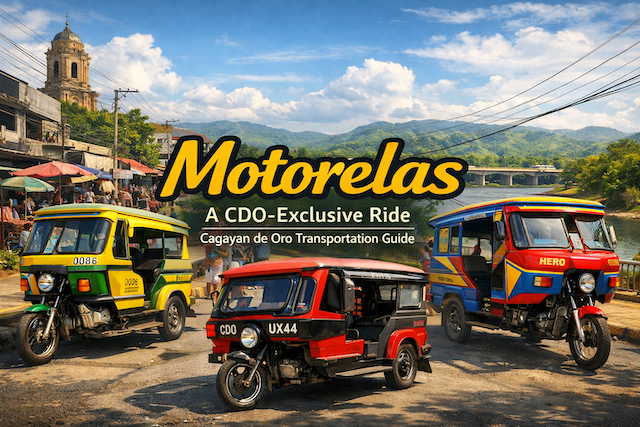
Motorelas: A CDO-Exclusive Ride
Cagayan de Oro Transportation Guide
Introduction: What Makes Motorelas Unique to Cagayan de Oro
When traveling or living in Cagayan de Oro (CDO), one of the first things you will notice on the roads—aside from jeepneys and motorcycles—is a distinctive local vehicle called the motorela. Found almost exclusively in CDO and nearby areas of Misamis Oriental, motorelas are a defining feature of the city’s transportation culture.
A motorela is essentially a motorcycle with a sidecar, similar in concept to a tricycle in other Philippine cities. However, motorelas in CDO are larger, boxier, and designed to carry more passengers. For locals, motorelas are a practical, affordable, and familiar way to get around short to medium distances. For visitors, they are both a transportation option and a cultural experience.
This guide explains everything you need to know about motorelas in Cagayan de Oro—how they work, where they operate, fares, safety considerations, and when they are the best transport choice.
What Is a Motorela?
A motorela is a locally developed public transport vehicle unique to Cagayan de Oro. It consists of a motorcycle attached to a covered sidecar that can seat up to six passengers, depending on the design.
Unlike standard tricycles found in Manila, Cebu, or other cities, motorelas are:
-
Larger and more enclosed
-
Designed for higher passenger capacity
-
Often custom-built by local mechanics
-
Operated on fixed routes rather than door-to-door service
Motorelas are licensed and regulated by the city government and are recognized as an official mode of public transportation in CDO.
History and Origin of Motorelas in CDO
Motorelas emerged in Cagayan de Oro several decades ago as a response to the city’s growing population and limited public transport options. Jeepneys were available but could not always access smaller roads or serve lower-density residential areas efficiently.
Local innovators modified motorcycles with extended sidecars to carry more people safely and affordably. Over time, these vehicles evolved into standardized motorelas, becoming deeply integrated into CDO’s transport system.
Today, motorelas are not just a convenience—they are a symbol of the city’s adaptability and local ingenuity.
How Motorelas Differ from Tricycles and Jeepneys
Understanding the difference between motorelas and other Philippine transport modes helps travelers choose the right option.
Motorelas vs. Tricycles
-
Capacity: Motorelas carry more passengers (4–6) than typical tricycles (2–4).
-
Routes: Motorelas usually operate on fixed routes; tricycles are often point-to-point.
-
Structure: Motorelas are more enclosed and sturdier.
-
Availability: Motorelas are mainly found only in CDO.
Motorelas vs. Jeepneys
-
Size: Motorelas are smaller and more agile.
-
Accessibility: They can navigate narrower streets and inner barangays.
-
Fare: Usually similar or slightly cheaper for short distances.
-
Comfort: Jeepneys offer more space but can be more crowded during rush hours.
Where Motorelas Commonly Operate in CDO
Motorelas operate on specific routes approved by the city. You will commonly see them in:
-
Downtown CDO (Divisoria and Cogon areas)
-
Residential barangays
-
Areas with narrow or secondary roads
-
Near public markets and schools
-
Connecting zones between jeepney routes
They are especially common in areas where jeepneys are less practical due to road width or traffic flow.
Motorelas generally do not operate on major highways or long-distance routes. For inter-city travel, buses and vans are used instead.
Typical Motorela Routes and Destinations
While routes can change over time, motorelas often serve:
-
Barangay-to-city center connections
-
Short loops within residential districts
-
Routes linking markets, schools, and terminals
Unlike taxis or tricycles-for-hire, motorelas follow shared routes, picking up and dropping off passengers along the way.
For visitors, the best way to confirm a route is to:
How Much Does a Motorela Ride Cost?
Motorela fares are regulated and affordable, making them popular among students, workers, and daily commuters.
Typical Fare Range
-
Short trips: PHP 10–15
-
Longer routes: PHP 15–20
Fares may vary slightly depending on distance, route, or updated city regulations. Drivers usually collect payment during or after the ride.
Unlike taxis, motorelas do not use meters, but fares are standardized, so bargaining is generally unnecessary.
How to Ride a Motorela: Step-by-Step
For first-time riders, the process is simple:
-
Flag one down along its route or board at a common stop.
-
Confirm the destination by asking the driver if they pass your area.
-
Take a seat inside the sidecar. Seating is shared.
-
Pay the fare when prompted or upon arrival.
-
Signal when getting off by politely telling the driver.
Motorela drivers are accustomed to both locals and visitors, and most are patient with questions.
Safety and Comfort Considerations
Motorelas are generally safe for short city trips, but passengers should keep a few things in mind.
Safety Tips
-
Sit properly and keep hands inside the vehicle.
-
Hold onto support bars when roads are uneven.
-
Avoid riding during heavy rain if possible.
-
Do not overload—if it looks too full, wait for the next one.
Comfort Tips
-
Seating can be tight during peak hours.
-
Ventilation varies; some units can feel warm.
-
Travel light if possible, as space is limited.
For travelers with large luggage, taxis or Grab are more comfortable alternatives.
Who Should Use Motorelas?
Motorelas are ideal for:
-
Short-distance travel within CDO
-
Budget-conscious travelers
-
Students and daily commuters
-
Visitors wanting a local experience
They may not be ideal for:
-
Travelers with bulky luggage
-
Those needing air-conditioned transport
-
Long-distance or late-night travel
Motorelas and Students in Cagayan de Oro
Motorelas play a major role in student transportation. Many schools and universities in CDO are located within residential areas where motorelas are the most practical option.
Their affordability and frequent availability make them a daily staple for students commuting to:
Environmental and Traffic Impact
Compared to larger vehicles, motorelas:
However, because they are motor-powered and often older models, emissions and noise can be concerns. The city has discussed modernization and regulation efforts to improve efficiency and safety while preserving their role.
Motorelas vs. Modern Transport Options (Grab, Taxis)
In recent years, CDO has seen the rise of:
Despite this, motorelas remain competitive because:
For locals, motorelas are still the fastest way to move through neighborhood-level traffic.
Cultural Significance of Motorelas
Motorelas are more than transportation—they are part of CDO’s identity. Seeing rows of colorful motorelas lined up near markets or terminals is a familiar sight for residents.
For visitors, riding a motorela offers insight into:
They represent a balance between tradition and necessity in an evolving urban environment.
Future of Motorelas in CDO
As transport modernization continues across the Philippines, the future of motorelas is a topic of discussion. Possible developments include:
-
Improved safety standards
-
Cleaner engines or electric conversions
-
Route optimization and regulation updates
Despite these changes, it is likely that motorelas will continue to exist in some form due to their deep integration into CDO’s transport system.
Final Thoughts: Should You Try a Motorela?
If you are visiting or living in Cagayan de Oro, riding a motorela is highly recommended—at least once. It is affordable, practical, and uniquely local.
While it may not offer luxury or air-conditioning, it provides something just as valuable: a genuine experience of how people move around the city every day.
For short trips, local exploration, and cultural immersion, motorelas remain one of the most distinctive and useful transportation options in CDO.
Frequently Asked Questions (FAQs)
What is a motorela in Cagayan de Oro?
A motorela is a motorcycle with a large, enclosed sidecar that functions as a shared public transport vehicle in Cagayan de Oro (CDO). While many Philippine cities use tricycles, CDO’s motorelas are typically bigger, boxier, and designed to carry more passengers. They operate like mini-public vehicles, picking up and dropping off riders along recognized routes. For many locals, motorelas are a daily commuting option, especially for short to medium distances within the city.
Why are motorelas considered CDO-exclusive?
Motorelas are strongly associated with Cagayan de Oro because the vehicle type developed locally and became standardized as part of the city’s transport system. Other cities may have tricycles or similar motorcycle-sidecar vehicles, but the motorela style—especially its capacity, shape, and route-based operation—is most common in CDO and nearby parts of Misamis Oriental. For visitors, this “only in CDO” feeling is one reason motorelas are often mentioned as a local transportation highlight.
How many passengers can a motorela carry?
Passenger capacity varies by unit design, but many motorelas can carry around four to six passengers in the sidecar, sometimes more if people squeeze in. The driver sits on the motorcycle portion, while passengers ride in the enclosed cabin. Because comfort and safety decrease when overloaded, it is better to wait for the next motorela if the cabin is already crowded. During peak hours, expect fuller vehicles and less personal space.
Do motorelas follow fixed routes or can they take you anywhere?
Most motorelas operate on fixed or semi-fixed routes, functioning as shared rides rather than private hire. They generally pick up passengers along their route and drop them off when requested, as long as the destination is within their operating area. This differs from some tricycles in other cities that can be hired for point-to-point travel. If you need a direct trip to a specific address outside common motorela paths, a taxi or app-based ride is usually more suitable.
How do I know if a motorela is going to my destination?
The easiest method is to ask the driver before boarding. You can say the place name or barangay, and the driver will confirm if they pass nearby. In busy areas, locals may also guide you to the correct vehicle line. Some motorelas display small route signs, but these can be hard to read quickly if you are unfamiliar with local place names. When in doubt, ask politely—this is normal for public transport in CDO.
How much does a motorela ride cost in CDO?
Motorela fares are generally low and regulated, making them popular with students and daily commuters. Typical fares often fall in the range of short-distance minimum fares up to slightly higher rates for longer routes. Exact amounts can change depending on local policies, inflation adjustments, and route distance. If you are unsure, you can ask the driver or observe what other passengers pay. Keeping small bills and coins helps speed up payment and reduces the chance of needing change.
When should I pay the fare—before or after the ride?
Payment practices vary, but many riders pay during the ride or upon arrival. In some cases, the driver or a helper (if present) collects fares after passengers are seated. If you are uncertain, you can ask “Pay now?” before the vehicle starts moving. To avoid confusion, prepare the expected fare in advance and hand it over calmly. Paying with exact change is appreciated and helps keep the ride efficient for everyone.
Are motorelas safe for tourists and first-time riders?
Motorelas are widely used by locals, which is a good indicator of everyday practicality. However, as with any small vehicle, safety depends on driver behavior, road conditions, weather, and passenger load. For first-time riders, choose motorelas that do not look overloaded and avoid riding during heavy rain if you can. Sit properly, keep your arms and belongings inside, and hold onto support bars when the road is uneven. If you feel uncomfortable, it is always okay to choose a taxi or other alternative.
Can I ride a motorela with luggage or shopping bags?
Small bags and backpacks are usually fine, but large suitcases or bulky items can be difficult because motorela cabin space is limited. If you are traveling from a terminal with heavy luggage, a taxi or private ride will be more comfortable and less stressful. For medium shopping bags, keep them on your lap and avoid blocking other passengers. If your items take too much space, consider making two trips or using a larger vehicle option.
Do motorelas operate late at night?
Motorelas are most reliable during daytime and early evening. Late-night availability depends on area demand, driver schedules, and local safety conditions. In quieter neighborhoods, motorelas may become scarce after a certain hour. If you are planning to travel late—especially if you are unfamiliar with the city—it is safer to arrange a taxi, a trusted driver, or an app-based ride if available. For nightlife or late arrivals, having a backup plan is recommended.
What is the best etiquette when riding a motorela?
Basic courtesy goes a long way. Speak politely when asking about routes, make space for other passengers, and avoid loud phone calls inside the cabin. If the ride is crowded, keep your knees and bags tucked in. When you need to get off, tell the driver clearly but calmly a few seconds before your drop-off point. Also, respect local norms: do not force boarding if it is already full, and avoid arguing about small fare differences—ask first if something seems unclear.
How do motorelas compare with jeepneys in CDO?
Jeepneys are larger and often cover major routes, while motorelas are smaller and can navigate tighter inner roads and barangays. Motorelas can feel faster for short neighborhood trips because they are easier to maneuver and can stop more flexibly. Jeepneys may be more comfortable for longer distances due to more space, but they can also be crowded. Many locals use both, choosing based on convenience, destination, and time of day.
What should I do if I don’t want to ride a motorela?
If motorelas do not fit your comfort level or travel needs, you have alternatives. Taxis are a straightforward choice, especially for direct trips, late-night travel, or carrying luggage. Depending on availability, app-based ride services may also work in certain parts of the city. For budget travel on major routes, jeepneys remain a common option. If you are staying at a hotel, the front desk can often help you arrange a reliable ride or explain the best transport choice for your destination.