
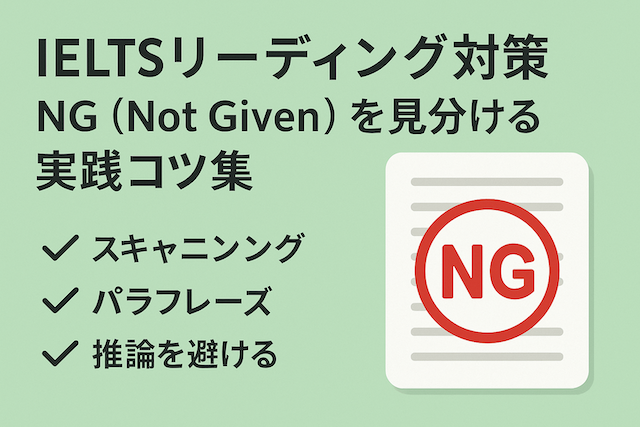
IELTS Reading Preparation
IELTS Reading Preparation: Practical Tips for Identifying NG (Not Given)
01
Introduction
Among IELTS Reading question types, the one that confuses test takers most is True / False / Not Given. Within it, Not Given (NG) means that the information is not written in the text, but many people cannot tell it apart from False and lose marks on it.
The reason NG is hard is that we unconsciously fill the gaps with common sense and background knowledge. When we read a statement, we think 'the text must say so too', and we choose an answer even though there is no evidence for it in the text.
In IELTS Reading, however, you must base your judgment only on information stated explicitly in the text. In other words, the criterion for choosing an answer comes down to a single point: is there evidence in the text or not?
This article summarizes practical tips for identifying NG with confidence and explains it so that the difference from False is clear. Improving your NG judgment will also greatly raise your score across True / False / Not Given questions as a whole.
02
Basic Understanding of NG (Not Given)
First, let us review the basic rules of True / False / Not Given questions.
- True (T): The statement matches the information in the text.
- False (F): The statement is the opposite of, or contradicts, the information in the text.
- Not Given (NG): The text does not mention the information in the statement at all.
The important point here is the difference between False and Not Given.
- False is when the text has an answer but says the opposite.
- Not Given is when the answer is not written in the text in the first place.
For example, suppose the statement says: 'All students are required to take the exam.'
- If the text says 'All students must take the exam' -> True
- If the text says 'Only some students take the exam' -> False
- If the text does not mention the exam at all -> Not Given
In short, the key to spotting NG is whether the information exists in the text, and you must judge only by the facts written in the text, not by guesswork or common sense.
03
Practical Tips for Identifying NG
1. Check whether the keywords are there
If the keywords or theme in the statement do not appear in the text at all, it is likely to be NG. However, the text may use a paraphrase rather than the same words, so carefully check whether there is an expression with a similar meaning.
2. If the text gives only partial information, it is NG
Suppose the statement says 'All tourists receive a free map', and the text says only 'Some tourists receive a free map'. This is not False but NG. This is because the text lacks information to support the claim of 'all'.
3. Pay attention to absolute expressions
If the statement contains strong expressions such as all, always, never, only or must, it is more likely to be NG when the text does not state it that definitely. In IELTS, the difference between an absolute claim and a limited one often decides the answer, so take particular care.
4. Do not fill gaps with background knowledge
The most common NG mistake is judging that something must be true based on your own common sense or knowledge. For example, even if the statement says 'The United States is the country with the most English speakers in the world', if the text does not mention this, it is NG. Whether it is correct as common sense is irrelevant; the criterion is only the information in the text.
5. Consciously sort out the difference from False
- False -> the text clearly states the opposite
- Not Given -> the information does not exist in the text
Mixing up False and NG leads to big losses, so make it a habit to draw the line by always asking whether the text contains opposite information.
04
Practice methods
1. Build the habit of always looking for evidence
When solving True / False / Not Given questions, always check where in the text the evidence is.
- If you can clearly find evidence -> True or False
- If you really cannot find evidence -> very likely Not Given
Making this evidence line a habit makes it much easier to tell False and NG apart.
2. How to review when you confuse False and NG
If you mix up False and NG during practice, always check the following two points.
- Did the text contain opposite information?
- Or was the information simply missing?
Repeating this reflection naturally builds the awareness of 'in the text vs. not in the text'.
3. Check the statement by focusing on absolute expressions
During practice, highlighting words such as always, never, all and must makes it easier to spot NG. You will come to notice that if the text does not go that far, the answer is likely NG.
4. Practice only NG
Pulling out and solving only the questions that contain NG from commercial workbooks or past papers sharpens your judgment criteria. It feels difficult at first, but as you do more, your sense of False versus NG becomes clearer.
5. Solve under time limits in a real-test format
On test day, the biggest risk is wasting time by hesitating too much. From the practice stage, be aware of how long you spend on one question, and get used to deciding that if you cannot find it, no evidence means NG.
05
Summary
Among IELTS Reading True / False / Not Given questions, NG (Not Given) in particular is a hurdle for many test takers. But the point of judgment is simple, and if you focus only on whether the information is in the text, you will hesitate less.
- True: matches the text
- False: the text has opposite information
- Not Given: the information does not exist in the text
Organizing your understanding with particular attention to the difference between False and NG is the key to raising your score. And if you consistently judge based on evidence in the text rather than guesswork or background knowledge, your accuracy will definitely improve.
If you become good at NG questions, you will be steadier across True / False / Not Given as a whole, which lifts your entire Reading score. Build the habit of always checking whether there is evidence in your daily practice, so that you can choose NG with confidence on test day.
06
FAQ: Practical Tips for Identifying NG (Not Given)
What is the difference between Not Given (NG) and False?
False is when the text has opposite information or a clear contradiction. NG is when the text does not mention the content at all. Judge by where the evidence is.
What is the fastest checklist for spotting NG?
The statement's keywords (or their paraphrases) do not appear in the text The text touches on the topic but lacks information that meets the statement's scope, quantity or conditions There is no claim in the text that matches an absolute word (all/always/never/only/must, etc.) You cannot judge without filling in gaps with your own common sense or assumptions
What is the tip when the statement contains absolute expressions (all/always/never)?
If the text does not make a claim at the same level, it is likely NG. If the text describes only some examples or a tendency, the statement can be NG because its scope is too broad.
What if the text has related words but does not state the conclusion?
Even if it touches on a related topic, if the statement's conclusion (cause and effect, comparison, quantity, condition) is missing, it is NG. Only partial information is a signal for NG.
How can I avoid missing things because of paraphrasing?
Watch for synonyms of nouns and verbs and changes in degree of adjectives (significant <-> major, etc.) Expect part-of-speech changes such as active/passive and nominalization (decide <-> decision) If you still cannot find the core meaning in the text, consider NG
What should I do when background knowledge comes to mind and I hesitate?
Use only one criterion: is there evidence in the text? If the evidence is outside the text (in your own knowledge), it is NG. Go back to the text and check by drawing the evidence line.
I often confuse False and NG. How should I review?
Underline the candidate evidence in the text Sort whether there is opposite information there (= False) or the information is missing (= NG) Note which words (quantity, scope, tense, condition) were lacking
Does the order of the statements follow the order of information in the text?
In most T/F/NG sets, the statements roughly follow the flow of the text. The order hint is useful for locating information, but note that it is not always strictly matched.
How should I handle NG when I am short of time?
Cut off your search for evidence after a set time (e.g., 40-60 seconds), and mark the question as an NG candidate if you cannot find it. Checking again later if you have time is an efficient approach.
How should I treat quantity words such as some, many and most?
If the quantity in the statement (all/most/some) does not match the quantity in the text, it is False; if no quantity is given at all, it is NG.
What can I do when I fail to notice exception phrases (except/unless/however)?
Highlight signal words for contrast and conditions (however, whereas, unless, except) Check the statement's absolute claim against whether an exception exists. If the text does not mention exceptions, it may be NG
How do I judge NG when there are figures or notes?
The whole of the text, figures and captions counts as evidence. If none of them contains the relevant information, it is NG. Information that appears only in a figure is valid evidence.
What if the text has general statements but not the specific condition?
If the statement asks for a conclusion about a specific period, region or group, and the text gives only general statements, it is NG. Focus on the missing condition.
What is a concrete practice menu for building NG judgment?
Sprint practice: pull out only the statements containing NG from past papers and judge at once whether evidence exists In your mistake notebook, classify the type of information that was missing (quantity, period, cause, comparison) Make highlighting absolute words and condition words a habit
07
Related article
08
Recommended Course
The first step in IELTS preparation is choosing the right environment
With one-on-one classes and real-format mock exams, we help you reach your target score by the most direct route.