2026年4月3日
3D ACADEMY offers affordable English study programs in Cebu, Philippines – perfect for beginners, professionals, and exam takers.

3D UNIVERSAL ENGLISH INSTITUTE INC
info.3d-universal.com
8:00-17:00(Mon-Fri)
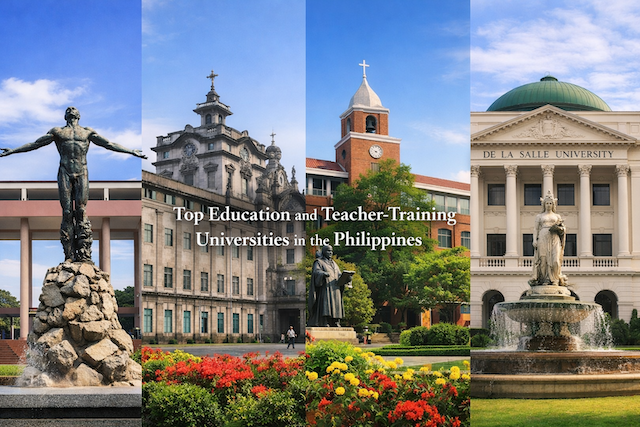
Top Education and Teacher-Training Universities in the Philippines
Contents
- Top Education and Teacher-Training Universities in the Philippines
- University of the Philippines – College of Education (Diliman)
- Philippine Normal University (PNU) – The National Center for Teacher Education
- De La Salle University (DLSU) – Br. Andrew Gonzalez College of Education
- Ateneo de Manila University – School of Education and Learning Design (SELD)
- University of Santo Tomas (UST) – College of Education
- Miriam College – Department of Education
- University of San Carlos (USC) – School of Education (Cebu)
- West Visayas State University (WVSU) – College of Education
- Cebu Normal University (CNU)
- Mindanao State University – College of Education
- Philippine Women’s University (PWU) – School of Education
- Best Teacher-Training Universities in the Philippines (Summary Table)
- Why Choose a Teacher-Training University in the Philippines?
- Final Thoughts
- FAQs
- What makes a university “top” for teacher training in the Philippines?
- How do CHED Centers of Excellence and Centers of Development differ?
- Which test should graduating education majors prepare for?
- What undergraduate degrees are common for aspiring teachers?
- How important is practicum or student teaching?
- Do top schools emphasize research for teacher education majors?
- What skills beyond content knowledge should teacher candidates develop?
- Are there programs for Early Childhood and Special Needs Education?
- How can I evaluate a program’s technology integration?
- What financial aid or scholarships are typically available?
- Are teacher-training graduates employable outside K–12 classrooms?
- What should international students or returning Filipinos consider?
- How do faith-based or mission-driven universities shape teacher formation?
- What is the value of graduate programs like MEd, MA, EdD, or PhD?
- How can I check a school’s performance and reputation?
- What does a strong mentoring system look like?
- How do universities support inclusive and culturally responsive teaching?
- What should I prepare for admission to competitive colleges of education?
- How can teacher candidates build a standout portfolio?
- What trends are shaping teacher education in the Philippines?
Top Education and Teacher-Training Universities in the Philippines
The Philippines has long been recognized as a country that values education as a key driver of national development. This is reflected in the strong demand for qualified teachers and education professionals across all levels — from preschool to higher education. As the education system evolves, so does the need for institutions that produce competent, compassionate, and globally competitive educators.
This article explores the top education and teacher-training universities in the Philippines, their specializations, teaching philosophies, and the impact they make on both local and international education.
University of the Philippines – College of Education (Diliman)
The University of the Philippines College of Education (UPCEd) in Diliman stands as the country’s premier institution for teacher education. It is recognized as a Center of Excellence (COE) by the Commission on Higher Education (CHED) and consistently produces top-performing graduates in the Licensure Examination for Teachers (LET).
Key Programs
-
Bachelor of Elementary Education (BEEd)
-
Bachelor of Secondary Education (BSEd)
-
Master of Arts in Education
-
Doctor of Philosophy in Education
Strengths
UPCEd emphasizes research-based teaching, inclusive education, and critical thinking. Its graduates often become policymakers, education reform advocates, and professors in top universities in the Philippines and abroad.
Philippine Normal University (PNU) – The National Center for Teacher Education
Widely regarded as the “Teachers’ University” of the Philippines, the Philippine Normal University (PNU) is the country’s flagship institution dedicated solely to teacher training and education.
Key Programs
-
Bachelor of Science in Education (BSEd)
-
Bachelor of Early Childhood Education
-
Master of Education (MEd)
-
Doctor of Education (EdD)
Highlights
PNU is designated by CHED as the National Center for Teacher Education, which means it leads in curriculum design, teacher standards, and teacher certification research. Its multiple campuses (Manila, North Luzon, South Luzon, Visayas, and Mindanao) allow it to reach educators nationwide.
De La Salle University (DLSU) – Br. Andrew Gonzalez College of Education
De La Salle University (DLSU), through the Br. Andrew Gonzalez College of Education, is a top-tier private university known for its academic rigor and values-based approach. The college was named after Br. Andrew Gonzalez FSC, a former Secretary of Education who championed educational reform in the Philippines.
Key Programs
-
Bachelor of Early Childhood Education
-
Bachelor of Secondary Education major in English, Math, or Science
-
Master of Education
-
Ph.D. in Educational Leadership and Management
Distinct Features
DLSU integrates Lasallian core values with modern pedagogy. The school produces graduates who are both academically excellent and socially responsible, with many assuming leadership positions in schools and education organizations.
Ateneo de Manila University – School of Education and Learning Design (SELD)
Ateneo de Manila University offers teacher-training programs through its School of Education and Learning Design (SELD). This institution focuses on transformative education, leadership in education policy, and the use of technology in learning.
Key Programs
-
Bachelor of Elementary Education
-
Master in Basic Education Teaching (MBET)
-
Master in Education (MEd)
-
Doctor of Philosophy in Education
Academic Approach
Ateneo emphasizes the formation of teacher-leaders who not only teach but also drive social change. Courses integrate Jesuit educational philosophy — “forming men and women for others.”
University of Santo Tomas (UST) – College of Education
The University of Santo Tomas (UST), the oldest existing university in Asia, houses a College of Education that has been producing educators since 1926. The college has been recognized as a Center of Excellence by CHED.
Key Programs
-
Bachelor of Secondary Education
-
Bachelor of Elementary Education
-
Bachelor of Special Needs Education
-
Master of Arts in Education
Key Strengths
UST’s education program is known for its balance of tradition and innovation. The college nurtures students to become morally upright and professionally competent educators. It also boasts high LET passing rates and active participation in community extension projects.
Miriam College – Department of Education
Miriam College (formerly Maryknoll College) has built a strong reputation for producing women educators with a focus on social awareness, innovation, and leadership.
Key Programs
-
Bachelor of Early Childhood Education
-
Bachelor of Elementary Education
-
Bachelor of Secondary Education
-
MA in Education
Institutional Edge
The program emphasizes peace education, gender equality, and environmental awareness — areas where Miriam has been a pioneer. It also integrates community-based teaching practices to prepare students for real-world challenges.
University of San Carlos (USC) – School of Education (Cebu)
In the Visayas region, the University of San Carlos (USC) in Cebu stands as one of the leading teacher-training institutions. It offers a strong foundation in both pedagogy and educational research.
Key Programs
-
Bachelor of Elementary Education
-
Bachelor of Secondary Education
-
Master of Education
-
Doctor of Philosophy in Education
Notable Strengths
USC combines academic excellence with missionary service, reflecting its Catholic roots. Many of its graduates become respected teachers and administrators across Central and Southern Philippines.
West Visayas State University (WVSU) – College of Education
West Visayas State University (WVSU), located in Iloilo City, is consistently ranked among the top-performing schools in the LET. It has been recognized by CHED as a Center of Excellence in Teacher Education.
Key Programs
-
Bachelor of Elementary Education
-
Bachelor of Secondary Education
-
Master of Education
-
Doctor of Education
Academic Strength
WVSU emphasizes teaching innovation and research, producing graduates with both academic depth and teaching passion. It also maintains partnerships with local schools to enhance practical training.
Cebu Normal University (CNU)
Cebu Normal University (CNU) is one of the country’s most respected regional universities for teacher education. Like PNU, it originated as a normal school, specializing in teacher training.
Key Programs
-
Bachelor of Elementary Education
-
Bachelor of Secondary Education
-
Master of Arts in Education
-
Doctor of Education
Strengths
CNU is known for producing top LET performers and has been awarded as a CHED Center of Excellence. The university continues to lead research and innovation in basic education.
Mindanao State University – College of Education
The Mindanao State University (MSU) system plays a vital role in teacher education, especially in promoting multicultural and peace-oriented learning in Mindanao.
Key Programs
-
Bachelor of Science in Education
-
Bachelor of Elementary Education
-
Master of Arts in Education
-
Doctor of Education
Special Role
MSU integrates Islamic and Christian values, encouraging educators to become agents of peace and community empowerment. Graduates are well-prepared to teach in diverse cultural settings.
Philippine Women’s University (PWU) – School of Education
Philippine Women’s University (PWU), established in 1919, has a long-standing tradition of promoting education and leadership among women.
Key Programs
-
Bachelor of Elementary Education
-
Bachelor of Secondary Education
-
Master of Arts in Education
Strengths
PWU emphasizes holistic education, combining classroom teaching with community development and creative learning. Its education graduates are highly regarded in both public and private institutions.
Best Teacher-Training Universities in the Philippines (Summary Table)
| University | CHED Status | Region | Key Strengths |
|---|---|---|---|
| University of the Philippines – Diliman | Center of Excellence | NCR | Research and policy leadership |
| Philippine Normal University | National Center for Teacher Education | Nationwide | Specialized in teacher education |
| De La Salle University | Center of Excellence | NCR | Leadership and educational innovation |
| Ateneo de Manila University | Center of Excellence | NCR | Jesuit transformative education |
| University of Santo Tomas | Center of Excellence | NCR | Tradition and academic rigor |
| Miriam College | Center of Development | NCR | Peace and gender-focused education |
| University of San Carlos | Center of Development | Visayas | Research and missionary teaching |
| West Visayas State University | Center of Excellence | Visayas | Top LET performance |
| Cebu Normal University | Center of Excellence | Visayas | Strong teacher-training legacy |
| Mindanao State University | Center of Development | Mindanao | Multicultural education and peace studies |
| Philippine Women’s University | Center of Development | NCR | Women’s education leadership |
Why Choose a Teacher-Training University in the Philippines?
-
Global Recognition – Filipino educators are in demand abroad due to their English proficiency and strong pedagogical background.
-
Affordable and Quality Education – Tuition in Philippine universities remains accessible compared to Western institutions.
-
Cultural Relevance – Programs are designed to respond to Philippine educational realities while integrating global best practices.
-
Strong Alumni Networks – Graduates from these universities often occupy influential positions in education departments and international schools.
Final Thoughts
Choosing the right teacher-training university in the Philippines means investing in a future that shapes minds and communities. Whether you aspire to teach in local schools, pursue academic research, or work in international education settings, the institutions listed above provide world-class training and transformative learning experiences.
By blending traditional values with modern teaching techniques, these universities ensure that the next generation of Filipino educators are competent, compassionate, and globally competitive — truly living up to the country’s legacy as a nation that values education above all.
FAQs
What makes a university “top” for teacher training in the Philippines?
Leading teacher-training universities combine strong licensure (LET) outcomes, CHED recognition (Centers of Excellence/Development), rigorous practicum partnerships with basic education schools, research productivity, faculty with advanced degrees, and robust support services such as mentoring, assessment labs, and career placement. They also embed values formation, inclusive education, and technology integration to prepare graduates for diverse classrooms.
How do CHED Centers of Excellence and Centers of Development differ?
A Center of Excellence (COE) is recognized for sustained exemplary performance in instruction, research, and extension, while a Center of Development (COD) demonstrates high potential to reach COE standards. Both signals help students gauge program quality, but a COE typically has longer track records, stronger research culture, and more competitive admissions.
Which test should graduating education majors prepare for?
Most graduates must pass the Licensure Examination for Teachers (LET) to practice in public schools and many private schools. Programs with high LET performance often provide structured review courses, mock boards, and content diagnostics across General Education, Professional Education, and Specialization domains.
What undergraduate degrees are common for aspiring teachers?
Typical routes include Bachelor of Elementary Education (BEEd), Bachelor of Secondary Education (BSEd) with majors (e.g., English, Math, Science, Social Studies), and specialized programs like Early Childhood Education or Special Needs Education. Some institutions also offer ladderized or flexible curricula for career shifters through post-baccalaureate teacher certificate programs.
How important is practicum or student teaching?
Practicum is essential. Quality universities maintain formal partnerships with laboratory schools and public or private basic education institutions. Expect supervised classroom hours, detailed observation rubrics, lesson study cycles, and feedback conferences. Strong placements help graduates transition smoothly into their first year of teaching.
Do top schools emphasize research for teacher education majors?
Yes. Beyond action research in practicum, many colleges require capstone research or thesis work on pedagogy, assessment, curriculum development, and inclusive practices. Graduate programs (MA, MEd, EdD, PhD) expand this with empirical studies, policy analysis, and program evaluation—useful for those pursuing leadership or academic careers.
What skills beyond content knowledge should teacher candidates develop?
In-demand competencies include classroom management, differentiated instruction, formative assessment design, digital pedagogy and LMS use, data literacy, culturally responsive teaching, and social-emotional learning facilitation. Communication, collaboration with parents, and ethical professionalism are equally vital for long-term success.
Are there programs for Early Childhood and Special Needs Education?
Many leading institutions offer dedicated majors in Early Childhood Education and Special Needs/Inclusive Education. These programs cover developmental psychology, play-based learning, individualized education plans (IEPs), assistive technologies, and family-school partnerships—preparing graduates for mainstream and specialized settings.
How can I evaluate a program’s technology integration?
Look for courses in educational technology, microteaching studios, access to learning management systems, exposure to digital content creation, and opportunities to design technology-enhanced lessons. Programs that integrate ICT across courses—not just in a single elective—tend to produce graduates ready for blended and online modalities.
What financial aid or scholarships are typically available?
Options may include government scholarships, university merit aid, need-based assistance, and private foundation grants. Some institutions provide service scholarships tied to teaching service after graduation. Ask about teaching assistantships for graduate students and fee discounts for public school teachers pursuing advanced degrees.
Are teacher-training graduates employable outside K–12 classrooms?
Absolutely. Alumni work in curriculum design, edtech, publishing, assessment services, NGO education programs, HR training and development, corporate learning, and education policy. Graduate-level credentials open doors to academic posts, research roles, and school leadership (e.g., department heads, principals, supervisors).
What should international students or returning Filipinos consider?
Confirm admission timelines, English proficiency requirements, credential evaluation for prior degrees, visa support, and tuition policies. If you plan to teach abroad, check reciprocity or additional credentialing steps in your destination country, such as QTS (UK), state licensure (US), or IB training for international schools.
How do faith-based or mission-driven universities shape teacher formation?
Many leading colleges integrate values formation, service learning, and community engagement. Expect outreach teaching in underserved communities, reflection courses, and alignment of pedagogy with institutional charisms (e.g., Lasallian, Jesuit). This strengthens ethical decision-making and a service orientation in professional practice.
What is the value of graduate programs like MEd, MA, EdD, or PhD?
Master’s degrees deepen pedagogical content knowledge, assessment literacy, and leadership readiness. Professional doctorates (EdD) focus on solving practical problems through applied research, while PhDs emphasize theory building and advanced scholarship. These credentials boost opportunities in supervision, curriculum leadership, higher education, and policy.
How can I check a school’s performance and reputation?
Review CHED COE/COD listings, LET performance statistics, faculty profiles, accreditation results (e.g., PAASCU, ALCUCOA), research center outputs, and alumni placements. Campus visits—virtual or on-site—plus conversations with current students and partner schools provide additional ground truth on culture and support.
What does a strong mentoring system look like?
Expect assigned faculty mentors, peer coaching, lesson study groups, and structured observation-feedback cycles. Programs may run induction support for first-year teachers, including communities of practice, pedagogical clinics, and classroom coaching to reduce attrition and improve early-career growth.
How do universities support inclusive and culturally responsive teaching?
Look for required courses on special and inclusive education, modules on multicultural pedagogy, language-aware strategies for multilingual classrooms, and partnerships with schools serving diverse learners. Assessment accommodations and Universal Design for Learning (UDL) principles are hallmarks of inclusion-ready programs.
What should I prepare for admission to competitive colleges of education?
Prepare a solid academic record, a reflective personal statement highlighting your teaching motivation, letters of recommendation, and—where required—aptitude or placement tests and interviews. Demonstrating volunteer tutoring, youth work, or leadership in learning communities strengthens your application.
How can teacher candidates build a standout portfolio?
Compile sample lesson plans with learning objectives and assessments, classroom management frameworks, differentiated materials, video-taped microteaching, action research briefs, technology-integrated activities, and reflections on practice. Tie each artifact to professional standards to show growth and impact.
What trends are shaping teacher education in the Philippines?
Key trends include outcomes-based education, competency-based assessments, stronger school-university partnerships, data-informed instruction, edtech-enabled learning, mental health and well-being support, and expanded pathways for career shifters. Programs are also aligning more closely with international frameworks to enhance mobility.
Philippines University Guide: Top Universities, Admissions, Scholarships, and Student Life

How to Register for eTravel Philippines (2025 Guide)
Step-by-step guide to completing your eTravel registration before arriving in the Philippines, with images and tips.

Night Market in Cebu – Things You Don’t Know About Cebu Life
Discover the hidden charm of Cebu’s night markets, from street food stalls to local life tips you won’t find in tourist guides.

How to Use ChatGPT for IELTS Preparation: A Complete Guide
Learn how to prepare for IELTS using ChatGPT — including strategies for Writing, Reading, Listening, Speaking, and grammar support.

How to Build a Website Without Coding Using ChatGPT
Discover how to build your own website using AI—no coding skills needed. From structure planning to SEO and design, let ChatGPT guide you.