
Student Voices
A total reset of work and life! Michelle, a former nurse, tells us about her 3 months of study on Cebu Island
Chapter 1
The limits of my time as a nurse | The unease of “Am I going to end up like this for my whole life?”
“Before I knew it, I had been working for four years, thinking the whole time: ‘I’m going to quit, I’m going to quit.’”
The days when Michelle worked as a nurse were not easy at all. Ward work meant day and night shifts that repeated endlessly, pushing her to the limit both physically and mentally. On top of that, relationships in the workplace weren’t exactly good either, and every time someone resigned, the burden on those who stayed grew heavier and heavier: within that negative spiral, she says she was always thinking “I just want to quit.”
Even so, she says that, because it was the nursing profession, she always felt that “it wasn’t so easy to resign.” “After working so hard to get my national license,” “It would be disrespectful to the patients,” “The others are working even harder than I am”... Bound by that kind of “obligations,” her days went by suppressing what she really felt.
“But one day, looking at myself in the mirror all of a sudden, I thought: ‘this way, I might end up spending my whole life without anything changing.’ A life of only work, going back and forth every day between work and home, with nothing changing. When I thought this could go on for ten, twenty more years, it sent a chill down my spine.”
Being a nurse is a profession you can feel proud of. But when it came to the question of whether it “made my own life happy,” she couldn’t answer clearly. While she kept living “for others,” she had the feeling of being worn down more and more.
At that moment, an intense wish arose in her heart: “I want to change the person I am now, no matter what” and “I want to restart my life completely.” But at that moment she had absolutely no plan for what to do after resigning. “The only thing I could think about was ‘getting out of the environment I was in.’”
And that “escape” would end up becoming the great turning point that studying on Cebu Island turned out to be.
Chapter 2
The turning point came with an ad on the train | The idea of studying abroad crosses my mind
“I was just riding the train, not thinking about anything in particular. But I still remember that moment.”
Although Michelle had already decided to leave her job as a nurse, she had no clear vision of what she would do after resigning. It wasn’t that she had something specific she wanted to do; she only had in her heart the wish to “get away from where I am now.”
One day, on her way home from work, an ad inside the train she was riding caught her attention. It said the following:
“Why not change your life abroad?”
“Huh? Abroad? Studying overseas?” She says that sentence, strangely, went straight to her heart.
“Until then I thought studying abroad had nothing to do with me. I believed it was a world for people who spoke English fluently, something foreign to me. But that day, I don’t know why, I thought: ‘ah, maybe it is possible...’”
As soon as she got home, Michelle began searching on her phone for things like “studying abroad as a working adult” or “studying English abroad.” Before she knew it, she had been reading blogs and testimonials about studying abroad for hours. And the more she read, the stronger the feeling became that “this could be a realistic challenge.”
“Actually, since my student days I always had the dream of ‘being able to speak English.’ But nursing school was very demanding, and as soon as I started working there was no time for that... I had completely forgotten that feeling, but I thought: ‘maybe now I can do it.’”
From then on, her phone’s search history filled up with the words “study abroad.” Destination, costs, school, daily life, safety... she had many worries, but the excitement of “wanting to start something new” weighed far more.
And at some point, a keyword suddenly appeared: “study on Cebu Island.”
“Huh? Is English spoken in the Philippines? And it’s cheap too?”
From there, Michelle’s “serious study abroad mode” began.
Chapter 3
Why I chose Cebu Island and 3D ACADEMY
“At first I thought: ‘does something this good really exist, one-on-one classes at a cheap price?’”
While her desire to study abroad grew day by day, what began to catch Michelle’s attention was “studying in the Philippines, on Cebu Island.”
Until then, her image of “studying abroad” was mostly Western countries: the United States, Canada, Australia... The Philippines was a total blind spot. But as she researched, she discovered that “the cost is overwhelmingly lower,” “one-on-one classes are the foundation” and “there are many schools with Japanese staff,” among other things, which made it an ideal environment for a first experience abroad.
“When I first researched it, I honestly thought: ‘it’s so cheap it makes me suspicious.’ But after seeing testimonials on blogs and on YouTube, I ended up thinking: ‘maybe the Philippines is just ideal for beginners.’”
And, among the numerous language schools, the one Michelle chose was “3D ACADEMY.”
She says that, honestly, the reasons for her choice were “good value for money” and “a feeling of reassurance.”
“3D ACADEMY appeared in many people’s testimonials: that ‘the food is designed for Japanese people and is delicious,’ that ‘there is always Japanese staff on hand, so it gives you peace of mind.’ Since it was my first time abroad, those kinds of small details that give you a sense of security were very important to me.”
Also, the fact that the class style was mainly one-on-one was a deciding factor too. For Michelle, who wasn’t good at speaking in public and was afraid of falling behind in group classes, an environment where she could practice English calmly in a one-on-one format was ideal.
“To be honest, the price was the number one deciding factor (laughs). But it wasn’t just the price: there was also a sense of trust that made me think ‘everything is surely going to be fine here.’”
Before she knew it, that “simple interest” of searching for information online had turned into a concrete plan of action.
“I’ll go to this school. I’ll go and see with my own eyes a landscape different from the usual one.”
That is how Michelle finally made the decision to “study English for three months at 3D ACADEMY.” For her, that was also the first step toward a new beginning in her life.
Chapter 4
My first life abroad | The first month, a succession of culture shocks
“The first month was really hard. It was a succession of culture shocks every day.”
What awaited Michelle on arriving on Cebu Island was not only the cheerful, tropical air. Her first life abroad began in the midst of a mix of anticipation and anxiety. She says that during the first week all she could do was try her best to “get used to it.”
The first thing that disconcerted her was the difference in matters of hygiene.
“In hospitals in Japan, cleanliness is taken for granted, right? Precisely because I had worked as a nurse, I was very sensitive about hygiene... The water pressure in the bathroom and shower of the dorm, or not being able to drink tap water... at first those things made me very nervous.”
Another surprise was the different sense of time. In the Philippines, as the well-known “Filipino time” says, it’s an everyday thing for things not to go as planned. Teachers arrived a few minutes late, repairs to the facilities were delayed... “Things that in Japan would become a complaint, in the Philippines just happen with a ‘nothing can be done about it’ (laughs). But if I got upset about every little thing, it would never end. Little by little I learned to think ‘well, that’s fine.’”
The language barrier was also bigger than she had imagined. The classes were, of course, in English. Although she understood it with her head, when it came to actually communicating in English, at first the words wouldn’t come out. “I couldn’t understand what they were saying to me or convey what I wanted to say. I felt very helpless. Even though the teacher waited patiently, after every class I would fall into self-criticism thinking ‘I should have said this another way...’.”
Even so, little by little, slowly, something began to change inside Michelle.
That at the end of class the teacher would say “Good job!” to her with a smile. That she chatted late into the night, in clumsy English, with the roommate she met in the dorm. The small achievement of being able to say “Thank you!” naturally at a nearby cafe.
“Here there were moments when I could acknowledge ‘the me who is making an effort,’ something I had never felt in Japan.”
As the end of the first month approached, she gradually got used to both life on Cebu Island and 3D’s style of classes. And, little by little, the moments when she thought “this is fun” began to increase.
Chapter 5
My English got through! My first success experience and the real feeling of having grown
“When the teacher told me ‘your English has improved a lot,’ I almost started crying.”
As Michelle gradually got used to life in Cebu, her relationship with English also began to change. The English classes that at first were “I don’t understand anything, I can’t say anything” gradually had more and more moments when “the words come” and “the feelings get across.”
“One day, during a free conversation with the teacher, there was a moment when I spoke so fluently that I surprised myself. ‘Wait, am I really having a conversation in English?’ I thought, and I felt very happy.”
She wasn’t just memorizing English phrases, she could already “use” them. And, besides, she had the feeling that they came out naturally: that was a “real growth” that no exam could measure.
“At first, after every class I felt frustrated. ‘But I knew that expression!’, ‘if I had said it like this, they would have understood...’. So that same night I always looked it up, and the next day I brought up the same topic with the teacher again to get my revenge (laughs).”
That constant effort, over time, began to bear fruit. The phrases she could use in class increased and the conversation became more fluid. In listening comprehension too, relying on the other person’s expressions and intonation, she came to understand around 80% of the content. That gave her confidence, and she says both her expression and her voice became more and more cheerful.
“I thought that getting myself understood in English was such a joyful thing. Being able to say what I want to say, laughing together, truly getting understood. That joy gave me the motivation to ‘want to speak more’ and ‘want to learn more.’”
Also, Michelle’s effort was noticed by the teachers too. She says that one day, at the end of class, the teacher said the following to her:
“Michelle, your English has really improved. I’m so proud of you.”
She remembers that, on hearing those words, her eyes involuntarily watered. That someone told her “you’re working really hard.” It was a moment when she felt, once again, how much strength that can give.
“The effort that in Japan was ‘something normal,’ in Cebu is truly valued. I feel that, through that experience of ‘being recognized,’ I myself was able to become more positive.”
From this moment on, Michelle began to see her life of studying abroad in an increasingly positive way. From days when language was a barrier, she moved on to days when language became a “bridge.” Speaking English had, without her realizing it, become a “pleasure.”
Chapter 6
Days off were “a reward for life” | Tropical life with my classmates
“Studying is important, but I think the charm of Cebu Island is also, without a doubt, in the ‘free time.’”
During the week, Michelle devoted herself to intensive classes from morning to afternoon, but weekends became completely “reward time.” The cheerful tropical air of the Philippines and Cebu Island, together with the time shared with the classmates who gathered there, became an irreplaceable moment of rest for her.
“When Saturday comes, we all get excited about ‘where are we going?’ (laughs). At first I thought that, since I didn’t understand the language, it would be impossible to go very far, but it turns out you can, and quite well.”
Together with Japanese students who were studying with her and with students from Taiwan, Korea and Vietnam, they formed small groups to go out to—
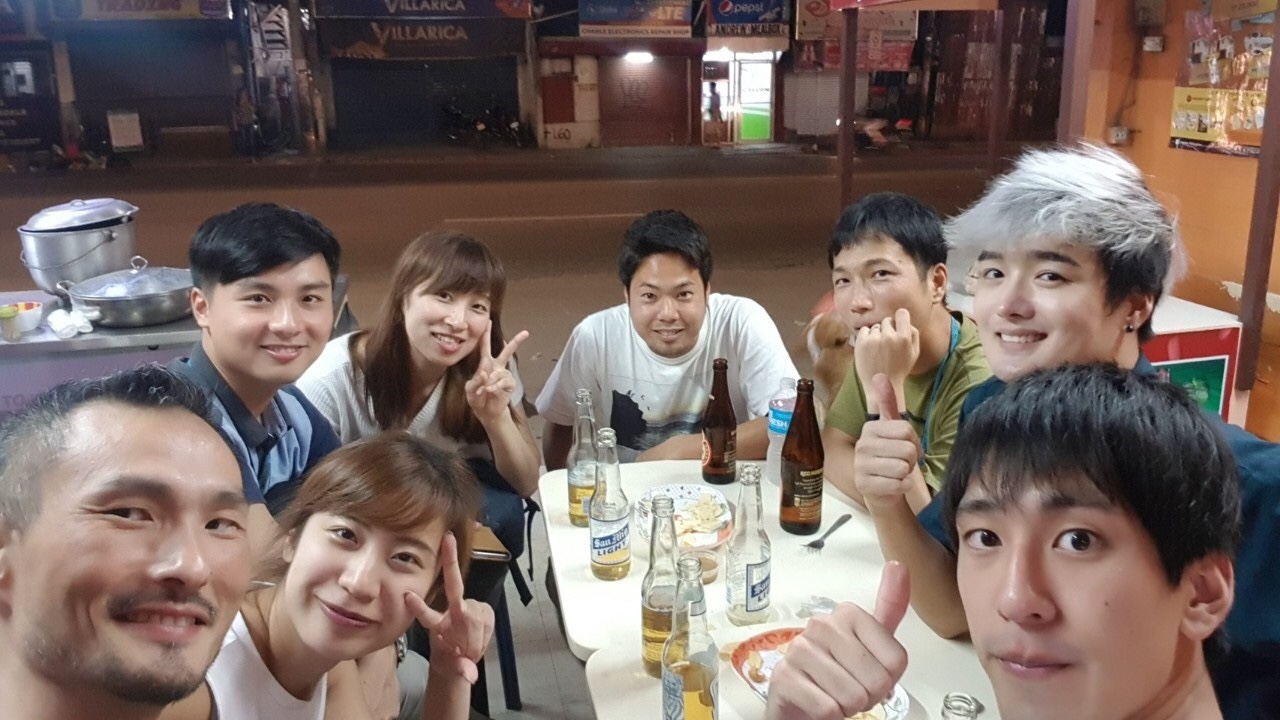
Kawasan Falls and Moalboal, with their transparent blue sea. Shopping and exploring local food in the big shopping malls. A San Miguel beer at sunset on the beach, with conversations that never ended.
“As I started to speak a little more English, when going out with everyone, the ‘let’s speak English!’ also came up naturally. At first it was clumsy, but just by trying to communicate while laughing, the distance between us shrank enormously.”
At the language school, ages and nationalities were very varied. But, precisely because of that, she says she was able to relate to people without any strange reservations, being herself just as she was. “Taking off that armor of ‘I must do this because I’m a working adult’ or ‘I must behave this way because I’m a nurse’ was a great relief. The younger ones teasing me, classmates from other countries making me notice cultural differences... it was all very fresh for me.”
The memories of days off with nothing special are now a treasure. Even if they weren’t special tourist spots, the moments of eating and laughing together, the instants when photos were taken, the nights talking while watching the sunset: all of that, says Michelle, was “a time that gave her life back to her.”
“In Japan I felt that ‘time = work,’ but in Cebu I felt that ‘time = connection with people.’ Ah, so you can live time this way too, I thought.”
Days not of just working nonstop, but of loosening your shoulders and living with laughter. The “calm” and “joy” of Cebu Island gently relaxed Michelle’s heart.
Chapter 7
My way of thinking changed | Valuing “my own voice” more than “the gaze of others”
“Since I arrived in Cebu, I stopped worrying so much about ‘the gaze of others.’ That was an enormous change for me.”
When she worked as a nurse in Japan, Michelle was always worried about “how others saw her.” At work, the looks of her younger colleagues, her superiors’ evaluation, the patients’ reactions... In her private life too, she kept pressuring herself with thoughts like “I have to do things right” or “I’m already an adult.”
“But the people of Cebu, in a good way, ‘live being themselves.’ There are people who suddenly start singing in the street, teachers who laugh out loud during class (laughs). Seeing those scenes, I began to think: ‘hey, I don’t have to try so hard either.’”
She says that, being in contact with the joy and generosity of Filipinos, little by little she was able to move away from “the me who tried to meet other people’s expectations.”
For example, not feeling embarrassed even if she made a mistake in class. Not minding making funny faces when taking photos during weekend activities. If she wasn’t understood in English at a cafe, communicating by laughing and using gestures.
“Things that the old me would have avoided, thinking ‘how embarrassing, better not,’ in Cebu I came to do naturally. Because I could feel that, even if I wasn’t ‘a perfect person,’ everyone accepted me just as I was.”
This change was, even more than her progress in English, an enormous treasure for Michelle. More than “what is right,” what mattered was “whether she felt comfortable.” More than “being evaluated,” what mattered was “whether she herself could agree.”
“When I was in Japan, the most important thing was ‘not to fail,’ but since I arrived in Cebu, I feel that what matters has become ‘enjoying’ and ‘daring to try things.’”
As a result, Michelle feels that life is now much easier than before. The moments of discouragement from comparing herself with others decreased, as did freezing up from worrying about what others would think.
“My goal was to study English, but before I knew it, even my ‘habits of life’ had changed. I think the three months in Cebu were, more than a time for ‘English,’ a time to recover ‘being myself.’”
Chapter 8
No plans after graduating? The reason the anxiety disappeared anyway
“To be honest... I still haven’t decided anything about after graduating (laughs).”
When her three-month stay studying abroad was nearing its end, when Michelle was asked “what are you going to do after you graduate?”, that was the answer she gave. The Michelle of before might have answered: “a situation like this would only make me anxious.” But, after her experience in Cebu, she could now see that “no plan” in a positive way.
“Of course, I think how I’ll live after returning to my country is important. But now I’ve come to think that ‘it’s fine even if it’s not decided.’”
Behind this is having gained “an axis of her own” in Cebu. “I came to speak English,” “I was able to live abroad,” “I was able to laugh together with my classmates”: those experiences became a small self-affirmation of “it turns out I can do it.”
“Before, I used to agonize thinking ‘I have to become something’ or ‘I have to decide quickly,’ but in Cebu I was able to think that ‘even the me of now already has enough value.’ Just from that, I feel my heart became much lighter.”
Maybe in the future she will do a working holiday program. Maybe she will come back to Cebu again. Or maybe she will open a completely different door in her life.
“I came to think that no option is ‘the right one,’ but that all of them are ‘valid.’”
And, above all, there was another big change.
“That feeling from before that ‘I have to become a nurse again’ disappeared. I thought there is no need to go back by force just because I have the qualification or because it would be a waste not to use it. Now I can think from my heart that ‘it’s okay to choose what I really want to do.’”
That feeling that used to be “no plan = anxiety” had, without her realizing it, turned into “no plan = freedom.” Perhaps that was precisely the “life option” that the place called Cebu and the people she met at 3D ACADEMY taught her.
“In life, ‘deciding’ is important, but I think there is also ‘the strength to leave things undecided.’ I feel that now I’ve started to understand that, even if only a little.”
Chapter 9
For nurses who feel the same | A message from Michelle
“If there is someone now who works as a nurse and wonders ‘is it okay to go on like this...?’, I want to tell them that ‘it’s okay to stop for a moment.’”
Michelle spoke to us calmly but firmly, addressing the nurses who, just as she once was, are exhausted from chasing after daily work.
“Being a nurse is a job where you hold people’s lives in your hands, and the responsibility and pressure are enormous. On top of that, there is an atmosphere where it’s hard to say ‘I’m going to quit’ or ‘I’m going to take a break.’ That’s precisely why I think there are many people who hold on until their mind and body reach their limit.”
But, before reaching that limit, it is also okay to choose to “run away.” In fact, Michelle says that this is “a brave act to protect oneself.”
“By studying abroad, I was finally able to think that ‘it’s okay to use my own life for myself.’ Until then, I always made an effort for the patients, for work, for the gaze of others... but with only that, I felt I ended up emptying myself inside.”
Of course, studying abroad is not necessarily “the right answer” for everyone. But there is no doubt that there are landscapes you can only see by “changing your environment.”
“By going abroad, I had many moments when, for the first time, I discovered things about myself, like ‘this is what makes me laugh’ or ‘this is the kind of person I like.’ That’s why I would like you, first, to dare to take ‘a step for yourselves.’”
What Michelle gained on Cebu Island was not only her English level. More than that, it was being able to face herself, accept herself and come to feel excited about her own future. That was, precisely, her “greatest achievement.”
“Even if it’s hard now, there’s no need to agonize. If it’s a path you yourself have truly chosen, I think that, wherever it leads, there will surely be no regret.”
Finally, Michelle, a little shy but smiling, said the following:
“In life, even without a plan, everything ends up working out somehow (laughs).”
Chapter 10
Epilogue | Life can be restarted at any time
Three months studying on Cebu Island. For Michelle, that was not simply a time to learn English. I think it was a major turning point, a moment to stop the course of her life for once and ask herself again: “how do I really want to live?”
“My life in Japan, working nonstop every day. Days when, even thinking ‘I want to quit,’ I couldn’t move for fear of ‘what would happen if I quit.’ But that ad I saw on the train gradually changed the course of my life.”
By daring to change her environment, the outlines of herself became defined more clearly. The feeling of living as “the real Michelle,” neither “a nurse” nor “an exemplary working adult.” Perhaps that experience was, for her, the greatest “reset button.”
“If I had stayed in Japan, I think I would have kept working my whole life saying ‘I want to quit.’ But by coming to Cebu, and living in an unfamiliar land, with unfamiliar people and in an unfamiliar language... for the first time I was able to think that ‘you can live even if nothing is decided.’”
During this interview, Michelle repeated phrases like “it was fun,” “I’m glad I went” and “it was a truly important time” many times. And she fondly recalled, one by one, the memories with her teachers, the trips with her classmates, every conversation and every smile. Through that attitude, it came across how much she had managed to “recover herself” on Cebu Island.
When we hear “life without a plan,” we tend to associate it with anxiety and risk. But, like Michelle, by “living true to your own emotions,” new doors can also open: that is what it made us feel again.
In life there is no such thing as “too late.” If Michelle’s story serves as a gentle push for someone, somewhere, who is thinking “I want to start over,” we will be very happy.
Live your own study experience at 3D ACADEMY.
Consultation about choosing a course, costs and dates is free. We normally reply within 1 to 2 business days.