
Student Voices
A study in Cebu decided on intuition | Shota, a very curious person, tells us about his 7 weeks of adventure and growth
Chapter 1
: Shaping curiosity | The reason that led him to decide to study abroad
Shota was studying international relations at university, but he felt that “theory classes alone were not enough”. His interest in studying abroad arose when he was thinking about how to spend the summer vacation.
“I had a long vacation ahead of me and wanted to try something new. That was when the option of ‘studying abroad’ suddenly occurred to me.”
Although there is a lot you can learn while in Japan, he thought that if he could really speak English with foreigners, his world would expand even more. That intuition is what pushed Shota to act.
In fact, he had friends who had gone to Australia, but nobody around him had studied in the Philippines, so he thought: “precisely because it's different from what everyone else does, it sounds interesting”.
What finally convinced him was a book he happened to pick up in the university library, titled “The Era of Learning English in Asia Has Arrived! Studying in the Philippines”. It presented language schools on Cebu Island, and among them appeared the name 3D ACADEMY.
“I thought: ‘ah, this is the one’, and I signed up right away (laughs). Although, of course, I compared it carefully with other schools. The fact that it was described as having ‘good value for money’ and ‘a good balance between one-on-one and group classes’ was also decisive.”
That is how Shota's experience of studying on Cebu Island, trusting his intuition, began. In the next chapter we will go deeper into his first impression of the Philippines, so different from what he had imagined, and what life at 3D ACADEMY was like.
Chapter 2
: His first time on Cebu Island | The gap between imagination and reality
Shota left Japan and finally arrived on Cebu Island. The moment he set foot in the airport, he felt a kind of “culture shock”.
“Honestly, I thought Cebu would be more rural, like a sort of Amazon jungle (laughs). I even believed there would be giraffes walking around...”
That imagination was easily disproved by the real scenery of the place. Cebu City had many urban areas with skyscrapers and car traffic, a convenience similar to Japan's, and at the same time it was a unique place where local culture was still very much present.
“The city center is very lively, there are convenience stores and also shopping malls. It's not all the image of ‘Cebu = resort’.”
On the other hand, Shota enjoyed this “gap in a good way”. He quickly adapted to the new place and blended naturally into local life.
“Since I was already living on my own in Japan, I didn't feel any anxiety. Basically, I have the feeling of being ‘down to earth’ wherever I am.”
Walking through local markets, getting around the city by tricycle... he actively enjoyed experiences “from the perspective of someone who lives there”, something a tourist could hardly experience.
“Whether or not you enjoy a new environment depends on how you interpret it,” says Shota. In the next chapter we will present the content of the classes he actually took and the learning style typical of 3D ACADEMY.
Chapter 3
: A hybrid experience of one-on-one and group classes
At 3D ACADEMY, various courses are offered depending on each student's English level and goals, and Shota chose the “ESL Course”, a popular course for learning English comprehensively. During his 7 weeks of study, he combined one-on-one classes and group classes.
Intensively strengthening his “speaking ability” in one-on-one classes
“The one-on-one classes were almost every day, focused on speaking. In free conversation we talked a lot about everyday topics, such as delicious restaurants or travel destinations the teachers recommended, and it was a lot of fun.”
Depending on the teacher, elements of reading and writing were sometimes included, and the content of the class was flexibly adapted to Shota's curiosity.
“I'm not good with being taught in a one-sided way, but at 3D the classes are ‘built’ together with the teacher, so it suited me really well.”
Absorbing “diverse points of view” in group classes
The group classes covered a wide variety of topics, such as TOEIC, pronunciation correction and debates. Among them all, the one that left the biggest mark on him was the class of the American teacher Isaac.
“In that class there were many interns who had a very good command of English, and every session was hugely stimulating. The topics, such as music or cultural comparisons, were always interesting.”
By learning alongside people with English levels different from his own, he received constant stimulation and, naturally, a desire to “be able to speak even better” grew in him.
A result reflected in numbers: improvement in his TOEIC score
“On the TOEIC practice test my score went up by about 130 points. I clearly felt that my listening comprehension and the speed at which I processed the questions had improved.”
Having many opportunities to speak English even outside of class drove that growth. In particular, the days when he kept chatting in English with his Taiwanese friends were Shota's best “practice space”.
In the next chapter we will present how he spent his time outside of class and the “muay thai boom” he started himself. You will get a glimpse of a study abroad life typical of 3D ACADEMY that is not limited to learning English.
Chapter 4
: Muay thai, diving and cosplay | Weekends that were almost too active
When people talk about studying abroad, some might imagine “studying English every day sitting at a desk”. However, Shota's life as a student abroad was completely different from that image.
“Honestly, I tried everything! I traveled to islands, went to the Cebu garbage dump, visited local markets and talked with Filipinos. I even did cosplay (laughs).”
Shota moved around simply following his curiosity and explored every corner of Cebu. Among all that, the most emblematic part of his life as a student abroad was his encounter with a “muay thai school”.
Muay thai twice a week: a Dutch teacher and classmates from very diverse backgrounds
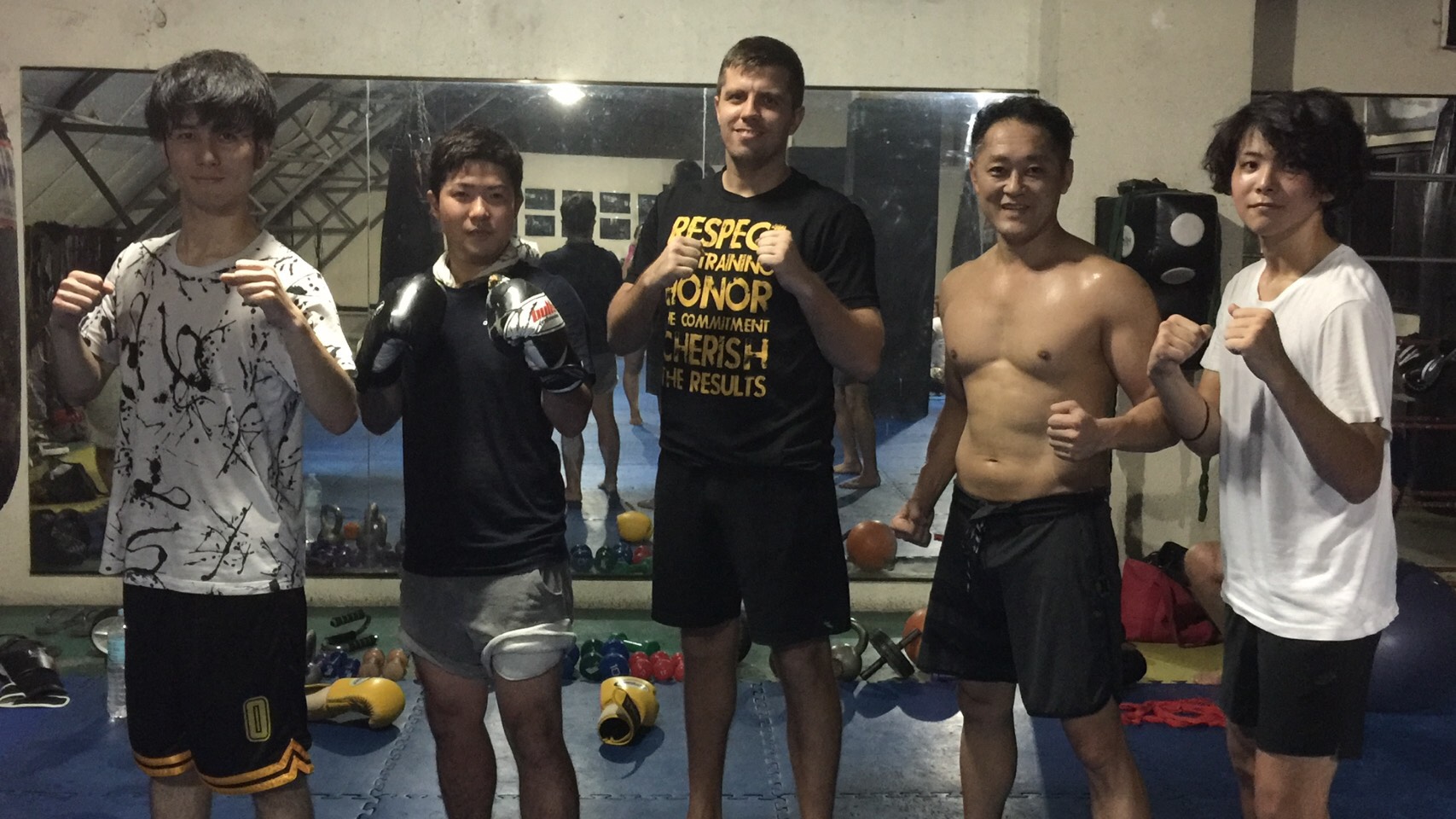
“The muay thai teacher was Dutch, and the students were Filipinos and, from time to time, Japanese. I started from the second week, and in the end other students ended up coming with me too.”
Although at first he had no particular interest in martial arts, he simply signed up at a muay thai school he found by chance there. From then on, he began training 2 to 3 times a week after class.
“It was so much fun that I kept inviting more and more people, and it ended up looking like a small ‘3D muay thai club’ (laughs).”
His initiative and ability to take action pulled in the other Japanese students around him, creating a small trend. Even the school's teacher laughed and asked him: “Did you bring another new student?”.
Days full of experiences among the sea, the mountains and the city
Shota's weekends were, without a doubt, very intense. He snorkeled on islands near Cebu, visited facilities linked to local NGOs and immersed himself completely in the reality of the local culture and life.
“I really wanted to do things you can't experience with normal tourism. So I asked locals for recommendations and went without hesitation to places that don't appear in travel guides.”
Through those activities, he naturally made more Filipino and Taiwanese friends, and all his time outside of class became an “opportunity to use English”.
“It wasn't just fun: I had an environment where I was constantly using English. That may have been the main factor in my progress.”
In the next chapter we will see how this accumulation of practical experiences translated into an improvement in his English level, and we will present his real learning style, which even included “days when he didn't speak any Japanese”.
Chapter 5
: English really improves with “practice” | Learning secrets, Shota style
Many students abroad want to “improve their English level”, but Shota's growth stood out both for its speed and for its results. The reason is that, in addition to desk study, he naturally built “practice spaces” into his daily life.
Creating an environment where you have no choice but to speak English
“At first I didn't have any Japanese friends, so I naturally ended up spending all my time with Taiwanese guys. So if I didn't speak in English, I couldn't communicate (laughs).”
While he worked hard to overcome the language barrier by using English nonstop, Shota gradually shifted into an “English mindset”. He immediately wrote down the words that came up in conversations and looked up their meanings on his own: that independent learning is what strengthened his vocabulary and his listening comprehension.
“Every day was like practicing English against a wall: I spoke, made mistakes, spoke again, and so I kept absorbing more and more.”
An attitude without fear of making mistakes that speeds up growth
One of the reasons many Japanese people stumble when learning English is the “fear of making mistakes”. But Shota managed to let go of that mindset early on.
“To be honest, I've never been shy around people (laughs). Even if I make a mistake in English, I don't mind. In fact, I thought ‘it's more comfortable if they laugh at me’.”
This positive attitude had a good effect both on free conversations with teachers and on debates in group classes, and became the ability to express his own opinions proactively.
A learning style of “discovering for yourself” rather than “being taught”
“Honestly, I don't really like being taught. I'm the type who prefers to research on my own what I want to know. In class too, I concentrate more when I'm the one saying ‘I want to do this’.”
The classes at 3D ACADEMY fit Shota's style perfectly. Since the relationship with the teachers was close, he could communicate his requests and what he wanted to learn directly, which made possible a class “built together” instead of simply “receiving instruction”.
“I felt that here I was developing more ‘practical ability’ than at university in Japan. I realized that just sitting at a desk doesn't get you to the point of really being able to use English.”
In the next chapter we will present Shota's future goals and his desire to “use English to expand his world”. His experience of studying abroad was not an ending, but the first step toward his “next challenge”.
Chapter 6
: His next challenge: a working holiday and becoming a pizza maker!? | The “strength to live” that studying abroad gave him
Although it was only 7 weeks, a limited period, Shota achieved great growth both in his language level and in his personal abilities. Now that his experience abroad has ended, we asked him what his next goal is.
“What I plan to do now is take a leave of absence from university and go on a working holiday. In the end, I want to keep polishing my English in a country where it is spoken natively.”
In his view of the future there were not only English-speaking countries such as Canada or Australia, but also a surprising destination.
“To be honest, I absolutely love pizza (laughs). I also have a dream of going to Italy and training as a real pizza maker.”
Studying international relations, perfecting his languages and, on top of that, expanding into a new interest like “gastronomy”. This is precisely Shota's greatest strength: the ability to trust his intuition and make his way as he acts.
The “courage to challenge himself” that studying abroad gave him
“I think that precisely thanks to the experience in Cebu, the barrier to ‘going to an unfamiliar place’ dropped. Now I have the feeling that wherever I go, I'll be able to get by.”
The experience of immersing himself in a different culture, facing the language barrier and making his way with his own strength from there: all of that changed, inside Shota, his “way of facing life”.
“In the end, it all comes down to ‘doing it or not doing it’. If something catches my attention, I try it first. Because by doing it, there are things you come to see.”
Although his life as a student in Cebu has ended, Shota's adventure is only just beginning. Without a doubt, from now on he will keep trusting his intuition and diving again and again into new worlds.
Epilogue: the value of trusting your own intuition and taking a step forward
“More than knowledge, I wanted to acquire an ability I could really use”: with that thought Shota's experience on Cebu Island began, a truly “intense” journey in which, in just 7 weeks, he notably grew his language level, his practical ability and his capacity for action.
His figure, accumulating experiences such as the muay thai school, local experiences and encounters with friends of different nationalities — things that are hard to get in a conventional study abroad — will without a doubt give many people the strength to think “I'm going to try it”.
If you are thinking about studying abroad, we invite you, like Shota, to trust your own “intuition” and take that step forward. That decision could change the landscape of your life enormously.
We sincerely wish that Shota keeps flying even higher in the future!
Live your own study experience at 3D ACADEMY.
Consultation about choosing a course, costs and dates is free. We normally reply within 1 to 2 business days.