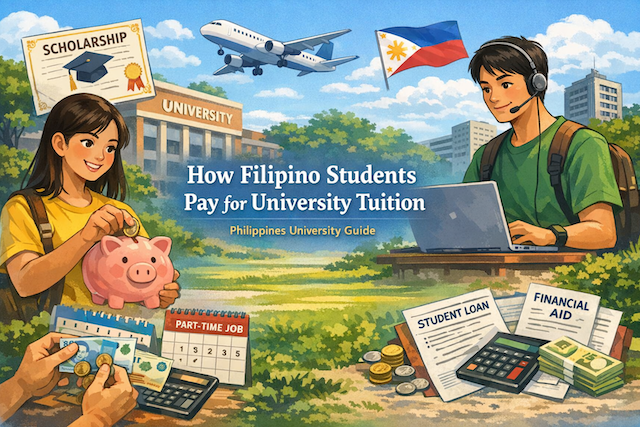
How Filipino Students Pay for University Tuition: Philippines University Guide
Paying for university tuition in the Philippines is a major concern for many families. While higher education is often seen as the key to better job opportunities and long-term financial stability, the cost of tuition, fees, and living expenses can be a heavy burden—especially for middle- and low-income households. Unlike some countries where student loans are the default option, Filipino students rely on a mix of family support, installment plans, scholarships, government programs, and alternative financing solutions.
This guide explains how Filipino students actually pay for university tuition, based on real practices commonly used across public and private institutions. It also highlights recent trends and changes in the Philippine higher education financing landscape.
Tuition Costs in the Philippines: An Overview
University tuition fees in the Philippines vary widely depending on the type of institution, location, and program of study.
Public universities and colleges (SUCs or State Universities and Colleges) generally offer lower tuition, and in many cases, tuition is fully subsidized under government programs. Private universities, on the other hand, charge significantly higher fees, particularly for specialized programs such as medicine, engineering, aviation, and international business.
On average:
-
Public universities: PHP 0–30,000 per year (often free under government subsidy)
-
Private colleges: PHP 40,000–120,000 per year
-
Top private universities / medical schools: PHP 150,000–500,000+ per year
Because of this wide range, families adopt different payment strategies depending on where and what the student studies.
Family Support as the Primary Source of Tuition Payments
For most Filipino students, family support remains the primary source of tuition funding. Parents, guardians, or extended family members often cover education costs directly from household income or savings.
In Filipino culture, education is viewed as a long-term family investment rather than an individual responsibility. It is common for parents to prioritize tuition payments even if it requires lifestyle adjustments, multiple jobs, or financial sacrifices.
Extended family support is also common. Grandparents, aunts, uncles, or relatives working overseas may contribute partially or fully to a student’s tuition.
Government-Funded Free Tuition Programs
One of the biggest changes in Philippine higher education financing came with the introduction of the Universal Access to Quality Tertiary Education Act (RA 10931).
Under this law:
-
Tuition and miscellaneous fees are free for eligible students in State Universities and Colleges (SUCs) and Local Universities and Colleges (LUCs).
-
Students must meet academic requirements and must not exceed the allowed number of years in their program.
This program significantly reduced the financial burden for students enrolled in public institutions and has become one of the most important tuition payment mechanisms in the country.
However, students still need to cover:
Scholarships and Grants
Scholarships play a crucial role in helping Filipino students afford university education. These can be divided into several categories.
Government Scholarships
Government agencies such as CHED (Commission on Higher Education), DOST (Department of Science and Technology), and local government units offer merit-based and need-based scholarships.
These scholarships often cover:
-
Tuition fees
-
Monthly stipends
-
Book allowances
-
Graduation incentives
DOST scholarships are especially popular among STEM students due to their comprehensive financial coverage.
Private and University-Based Scholarships
Many private universities offer:
-
Academic merit scholarships
-
Athletic scholarships
-
Talent-based grants (arts, music, leadership)
-
Financial aid programs
These scholarships may cover partial or full tuition, depending on the student’s performance and financial background.
Tuition Installment Plans Offered by Universities
Rather than requiring full upfront payment, many Philippine universities allow tuition installment plans, making payments more manageable.
Common installment structures include:
While installment plans make tuition more accessible, they may include:
For many families, installment plans are the most practical short-term solution when savings are limited.
Part-Time Work and Student Employment
Some Filipino students help pay for tuition through part-time jobs, although this is less common compared to Western countries.
Typical student jobs include:
However, balancing work and academic performance can be challenging, especially for demanding programs. As a result, part-time work often supplements rather than replaces family support.
Education Loans from Government Institutions
Government-backed education loans are available but are less widely used compared to scholarships and installment plans.
Key government loan providers include:
-
Social Security System (SSS)
-
Government Service Insurance System (GSIS)
-
LandBank of the Philippines
-
Development Bank of the Philippines (DBP)
These loans typically offer:
However, eligibility requirements and limited awareness mean many students do not rely heavily on government loans.
Private Education Loans and Tuition Financing Companies
In recent years, private tuition financing platforms have emerged as an alternative for students who cannot pay tuition upfront and do not qualify for scholarships or government loans.
These companies partner with universities to offer:
Private education loans usually come with:
-
Higher interest rates than government loans
-
Shorter repayment periods
-
Co-signer or guarantor requirements
They are often used by students in private universities, professional programs, or international schools.
Support from Overseas Filipino Workers (OFWs)
Remittances from Overseas Filipino Workers play a major role in education financing.
Many Filipino students rely on:
Education is one of the most common uses of OFW remittances, alongside housing and healthcare. In many cases, tuition is fully covered by overseas income, allowing students to focus entirely on their studies.
Community, Church, and NGO Assistance
In some cases, students receive financial support from:
These sources usually provide:
While not a primary funding source, community-based support can help students bridge temporary financial gaps.
Budgeting and Lifestyle Adjustments
For families without access to scholarships or loans, careful budgeting is essential.
Common strategies include:
-
Choosing schools closer to home to avoid rent
-
Enrolling in less expensive programs initially
-
Transferring from private to public universities
-
Taking lighter course loads to spread tuition over more years
These decisions often involve trade-offs but are widely practiced to make education affordable.
Differences Between Public and Private University Financing
The way Filipino students pay for tuition often depends on whether they attend a public or private institution.
Public university students typically rely on:
Private university students more commonly depend on:
Understanding these differences helps families plan realistically before enrollment.
Emerging Trends in Tuition Payment Methods
Several trends are shaping how Filipino students pay for university tuition today:
-
Increased reliance on digital payment platforms
-
Growing popularity of private tuition financing
-
Expansion of government scholarship programs
-
More flexible installment options from universities
-
Greater awareness of financial literacy among students and parents
These changes reflect the evolving needs of Filipino families amid rising education costs.
Final Thoughts: How Filipino Students Manage University Costs
There is no single way Filipino students pay for university tuition. Instead, most rely on a combination of family support, government programs, scholarships, installment plans, and alternative financing.
While challenges remain—especially for students in private institutions—the Philippine education system offers multiple pathways to make higher education accessible. Understanding these options early allows families and students to choose the most sustainable and realistic approach to funding a university education.
As tuition costs continue to rise, informed financial planning will become even more important for Filipino students pursuing higher education.
FAQs (Frequently Asked Questions)
Do Filipino students usually pay tuition in full upfront?
In many Philippine universities, paying tuition in full upfront is optional rather than required. A large number of students and families prefer installment plans because full payment can be difficult at the start of the semester. Schools commonly offer monthly, quarterly, or per-term payment schedules. However, some institutions provide discounts for full cash payment, while others may require an initial down payment before a student can finalize enrollment. Policies vary by school, so students should confirm deadlines, minimum down payments, and any penalties for late payments before choosing a plan.
Is college really free in public universities in the Philippines?
For many students, tuition in state universities and colleges can be free due to the Universal Access to Quality Tertiary Education Act. This program generally covers tuition and certain school fees for eligible students enrolled in public institutions. However, “free tuition” does not mean “free college.” Students still need to budget for transportation, meals, projects, uniforms (if required), devices for online learning, books, and living expenses if they study away from home. Some courses also have lab fees, fieldwork costs, or professional requirements that are not fully covered.
What is the most common way Filipino students pay for university?
The most common approach is family support combined with flexible payment arrangements. Many parents pay directly from monthly income, savings, or bonuses, then use installment plans to spread costs across the semester. In some households, relatives contribute, especially if the student is the first in the family to attend university. Scholarships and grants are also widely used, but not everyone qualifies. Because of this, families often mix multiple sources—partial scholarship plus parent support, or free tuition plus a living allowance from relatives, for example.
Are scholarships only for top students?
No. While academic merit scholarships are popular, there are many other categories. Some scholarships are need-based, supporting students from lower-income families. Others are offered for athletics, arts, leadership, community service, or specific degree programs. There are also local government scholarships and private foundation grants that focus on residency, financial need, or priority sectors. The key is to apply early and prepare documents such as transcripts, proof of income, recommendation letters, and any required essays or interviews.
What government scholarships are available in the Philippines?
Several government agencies provide scholarship options depending on the student’s course and background. Some programs focus on STEM fields, teacher education, health-related courses, or priority development areas. Benefits may include tuition coverage, monthly stipends, book allowances, and sometimes internship or return-service requirements after graduation. Students should check eligibility criteria carefully, because some scholarships require maintaining a certain GPA, full-time enrollment status, and completion within the standard program length.
Can students work part-time to pay for tuition?
Yes, but it depends on the student’s schedule and the demands of their course. Some students work in BPO or call center jobs, do online freelancing, tutor younger students, or take weekend service jobs. Part-time work can help with transportation, meals, and small school expenses, but it may not always be enough to cover full tuition—especially in private universities. Students should also consider the risk of burnout and ensure that work hours do not harm academic performance, which could affect scholarship eligibility.
Do Philippine universities charge interest for installment plans?
Most schools do not describe installment plans as “interest-bearing” like a loan, but many charge administrative fees or apply penalties for late payments. Some institutions may also remove early-payment discounts when a student chooses installments. The total cost can increase if a family frequently pays after deadlines. To avoid surprises, students should ask for a breakdown of fees, due dates, and consequences such as blocked enrollment, delayed release of grades, or restrictions on taking exams if balances remain unpaid.
Are student loans common in the Philippines?
Student loans exist, but they are less common than scholarships, family funding, and installment plans. Many Filipino families prefer to avoid debt if possible, and some students have limited access to loan products. Government-related education loans and bank loans may require a co-borrower, proof of stable income, or other documentation that some families cannot provide. Because of these barriers, loans are usually a secondary option used when scholarships and family resources are not enough.
What is the difference between government education loans and private tuition financing?
Government education loans often aim to provide more affordable borrowing terms, sometimes with lower interest rates and more flexible repayment options. Private tuition financing companies typically offer faster approval and simpler application processes, especially when partnered with certain universities, but may charge higher rates or fees. Private options may also be stricter about repayment schedules and require a guarantor or co-signer. Students should compare total repayment cost, penalties, and repayment timing before signing any agreement.
Do OFW remittances play a big role in paying tuition?
Yes. Remittances from overseas family members are a major source of education funding for many Filipino students. In some cases, a parent working abroad covers tuition directly, while the household income in the Philippines pays for day-to-day expenses. OFW support can make private education more accessible, but families should still plan carefully in case remittance amounts change due to job transitions, exchange-rate shifts, or emergencies abroad.
What happens if a student cannot pay tuition on time?
Consequences depend on the institution. Some schools allow short grace periods, while others apply late fees quickly. Unpaid balances may lead to temporary restrictions such as not being allowed to take exams, delayed access to online portals, blocked enrollment for the next term, or holding the release of records. If a family expects difficulty, it is often better to contact the school’s accounting office early. Some universities may offer restructuring options or allow a revised installment schedule under certain conditions.
How can families reduce the overall cost of university?
Families often manage costs by choosing public universities when possible, applying widely for scholarships, and selecting schools closer to home to reduce living expenses. Some students start at a lower-cost institution and transfer later. Others take advantage of early-payment discounts, buy secondhand books, share housing with roommates, or use student meal plans. Building a realistic semester budget—including non-tuition costs like transportation, printing, and projects—helps prevent financial stress and reduces the risk of missed payments.