
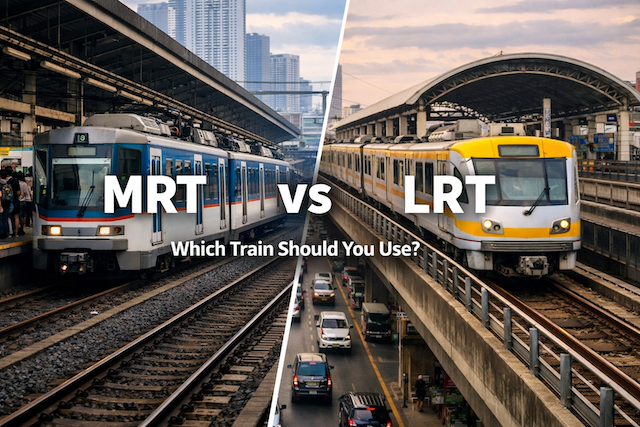
Manila’s rail system can be confusing for first-time visitors, expats, and even locals who do not commute daily. The city has multiple train lines operated by different agencies, with overlapping routes, different fare systems, and varying levels of comfort and reliability.
Among these, MRT-3 and LRT (Line 1 and Line 2) are the most commonly used urban railways.
This guide explains the differences between MRT and LRT in Manila, compares routes, fares, comfort, reliability, and ideal use cases, and helps you decide which train you should use based on your travel needs.
Contents
- Overview of MRT and LRT in Manila
- MRT vs LRT: Route and Coverage Comparison
- MRT vs LRT: Train Size and Comfort
- MRT vs LRT: Crowding and Rush Hour Experience
- MRT vs LRT: Fare System and Ticket Prices
- MRT vs LRT: Ticketing and Payment Options
- MRT vs LRT: Station Facilities and Accessibility
- MRT vs LRT: Reliability and Maintenance
- MRT vs LRT: Safety and Security
- MRT vs LRT: Best Use Cases
- MRT vs LRT for Tourists and First-Time Visitors
- MRT vs LRT: Which Train Is Better Overall?
- Final Verdict: Which Train Should You Use?
- Frequently Asked Questions (FAQs)
- Is MRT or LRT better for tourists in Manila?
- Which line is more crowded: MRT or LRT?
- Can I use one card for both MRT and LRT?
- How do transfers work between MRT and LRT?
- Which is cheaper, MRT or LRT?
- Which train is best if I’m staying in Makati, BGC, or Ortigas?
- What is the best option if I’m traveling with luggage?
- Is MRT or LRT safer at night?
- What should I do if there is a long line or a service delay?
Overview of MRT and LRT in Manila
Before comparing them directly, it’s important to understand what MRT and LRT actually are in the context of Metro Manila.
What Is MRT-3?
MRT-3 (Metro Rail Transit Line 3) runs along EDSA, Metro Manila’s main highway. It primarily serves commuters traveling between major business districts and transport hubs.
-
Route: North Avenue (Quezon City) to Taft Avenue (Pasay)
-
Main corridor: EDSA
-
Operator: Department of Transportation (DOTr)
-
Known for: Heavy crowding during rush hours
MRT-3 is often the fastest way to travel across EDSA, which is notorious for traffic congestion.
What Is LRT?
LRT stands for Light Rail Transit and consists of two main lines in Metro Manila.
LRT Line 1
-
Route: Fernando Poe Jr. Station (Quezon City) to Baclaran (Pasay)
-
Coverage: North–South route along Taft Avenue and Rizal Avenue
-
Oldest rail line in the Philippines
LRT Line 2
-
Route: Recto (Manila) to Antipolo (Rizal)
-
Coverage: East–West route
-
Known for wider trains and better comfort
LRT lines mainly serve residential areas, universities, shopping districts, and central Manila.
MRT vs LRT: Route and Coverage Comparison
Route coverage is one of the biggest factors when choosing between MRT and LRT.
MRT Route Coverage
MRT-3 runs strictly along EDSA and connects major areas such as:
-
North Avenue / Trinoma
-
Quezon Avenue
-
Cubao
-
Ortigas (Shaw Boulevard, Ortigas Station)
-
Bonifacio Global City access points (Ayala, Guadalupe)
-
Taft Avenue (connection to LRT-1)
If your destination is near EDSA or a major business district, MRT is usually the most direct option.
LRT Route Coverage
LRT covers areas that MRT does not.
LRT Line 1 Areas
-
Monumento
-
Caloocan
-
Blumentritt
-
Doroteo Jose
-
UN Avenue
-
Vito Cruz
-
Baclaran
This line is ideal for trips within Manila City and nearby northern or southern areas.
LRT Line 2 Areas
-
Recto
-
Legarda
-
Pureza
-
V. Mapa
-
Cubao
-
Marikina
-
Antipolo
LRT-2 is especially useful for students and commuters traveling between Manila and eastern Metro Manila.
MRT vs LRT: Train Size and Comfort
Comfort varies significantly between MRT and LRT, especially during peak hours.
MRT Comfort Level
-
Narrower train cars
-
Limited seating
-
Extremely crowded during rush hours
-
Standing room often becomes very tight
During weekday mornings and evenings, MRT trains can be uncomfortable for first-time riders, especially if carrying luggage.
LRT Comfort Level
-
LRT Line 2 has the widest and most spacious trains
-
LRT Line 1 trains are older but less cramped than MRT
-
Generally smoother rides than MRT
If comfort is a priority, LRT Line 2 is usually the best choice among Manila’s train lines.
MRT vs LRT: Crowding and Rush Hour Experience
MRT Crowding
MRT is widely considered the most crowded train line in Metro Manila.
-
Peak hours: 7:00–9:00 AM and 5:00–7:00 PM
-
Long queues at stations
-
Platform congestion is common
-
Trains often arrive already full
If possible, avoid MRT during rush hours, especially if you are unfamiliar with the system.
LRT Crowding
-
LRT Line 1 can be crowded but is more manageable
-
LRT Line 2 is usually less congested
-
Queues are generally shorter than MRT
For a less stressful commute, LRT—especially Line 2—is usually preferable.
MRT vs LRT: Fare System and Ticket Prices
Both MRT and LRT are affordable compared to taxis and ride-hailing services.
MRT Fares
-
Minimum fare: around PHP 13
-
Maximum fare: around PHP 28
-
Distance-based pricing
MRT uses single-journey tickets and stored-value cards.
LRT Fares
LRT Line 1
-
Minimum fare: around PHP 15
-
Maximum fare: around PHP 35
LRT Line 2
-
Minimum fare: around PHP 15
-
Maximum fare: around PHP 35+
LRT fares are slightly higher than MRT, especially for longer distances.
MRT vs LRT: Ticketing and Payment Options
MRT Ticketing
-
Single-journey tickets
-
Stored-value Beep card
-
Ticket counters and vending machines
Queues at MRT ticket counters can be long during peak hours.
LRT Ticketing
-
Single-journey tickets
-
Stored-value Beep card
-
More ticket machines available at some stations
Using a Beep card is highly recommended for both MRT and LRT to avoid long lines.
MRT vs LRT: Station Facilities and Accessibility
MRT Stations
-
Mostly elevated stations
-
Limited elevators and escalators
-
Older infrastructure
-
Can feel cramped during busy hours
Accessibility for seniors and people with disabilities is limited at some MRT stations.
LRT Stations
-
LRT Line 2 stations are newer and more accessible
-
Wider platforms
-
Better lighting and ventilation
-
More elevators in newer stations
LRT Line 2 generally offers a better station experience.
MRT vs LRT: Reliability and Maintenance
MRT Reliability
-
History of breakdowns and delays
-
Improvements in recent years
-
Still prone to service interruptions
MRT can be unpredictable, especially during extreme weather or technical issues.
LRT Reliability
-
LRT Line 1 experiences occasional issues due to older trains
-
LRT Line 2 is the most reliable line overall
-
Fewer major disruptions compared to MRT
For consistent service, LRT Line 2 is often the most dependable choice.
MRT vs LRT: Safety and Security
MRT Safety
-
Security personnel present
-
Bag inspections at station entrances
-
Crowding increases pickpocket risk
Extra caution is needed during peak hours.
LRT Safety
-
Similar security measures
-
Slightly calmer environment
-
Easier to monitor belongings
Overall safety levels are comparable, but LRT feels less chaotic.
MRT vs LRT: Best Use Cases
When You Should Use MRT
-
Traveling along EDSA
-
Commuting between business districts
-
Avoiding heavy EDSA traffic
-
Short to medium-distance trips during off-peak hours
When You Should Use LRT
-
Traveling within Manila City
-
Going east toward Marikina or Antipolo
-
Prioritizing comfort over speed
-
Traveling with light luggage
MRT vs LRT for Tourists and First-Time Visitors
For tourists unfamiliar with Manila:
-
LRT Line 2 is the easiest to navigate
-
MRT can be overwhelming during busy hours
-
LRT Line 1 is useful for historical and cultural areas
If you are carrying luggage or traveling during rush hour, consider using Grab instead.
MRT vs LRT: Which Train Is Better Overall?
There is no single “better” option—it depends on your route and priorities.
-
Fastest along EDSA: MRT
-
Most comfortable: LRT Line 2
-
Best for Manila City: LRT Line 1
-
Least crowded: LRT Line 2
-
Most central business access: MRT
Final Verdict: Which Train Should You Use?
Choose MRT if:
-
Your destination is along EDSA
-
You are traveling outside rush hours
-
Speed matters more than comfort
Choose LRT if:
-
You want a smoother, less crowded ride
-
You are traveling within Manila or eastward
-
Comfort and reliability are important
Understanding these differences will help you move around Metro Manila more efficiently and avoid unnecessary stress. With the right choice between MRT and LRT, commuting in Manila becomes far more manageable—even for first-time riders.
Frequently Asked Questions (FAQs)
Is MRT or LRT better for tourists in Manila?
For most tourists, LRT is usually easier and less stressful, especially LRT Line 2. Stations on LRT-2 tend to feel more spacious, the trains are wider, and crowding is often lighter compared with MRT-3 on EDSA. LRT Line 1 is also useful if you plan to visit areas in Manila City such as Rizal Park (via UN Avenue station) or nearby university zones. MRT can still be helpful for tourist trips, but it is best used outside rush hours and when your destination is clearly near an MRT station (for example, Cubao for shopping connections or Ayala for access points toward Makati). If you are carrying luggage or traveling during peak commuting times, a ride-hailing option may be more comfortable.
Which line is more crowded: MRT or LRT?
In general, MRT-3 is the most crowded major rail line in Metro Manila because it runs along EDSA and connects major business districts. Expect heavy lines during weekday mornings and evenings. LRT Line 1 can also be crowded, especially in central Manila and during school and office rush periods, but it is often more manageable than MRT. LRT Line 2 is typically the least crowded of the three main lines (MRT-3, LRT-1, LRT-2). That said, crowd levels can change depending on the station, time of day, service disruptions, and weather. If you want to minimize crowding, travel mid-morning or mid-afternoon, and avoid Mondays and Fridays when commuter volume can be higher.
Can I use one card for both MRT and LRT?
Yes. The Beep card is designed to work across MRT and LRT lines, making transfers and repeated rides easier than buying single-journey tickets every time. Using a stored-value card usually helps you avoid long ticket-counter lines, especially at busy MRT stations. You can tap in at the entrance gates and tap out at the exit gates, and the fare is deducted automatically based on distance traveled. In practice, the card is accepted across MRT-3, LRT-1, and LRT-2, but you should still keep a little extra balance on the card in case you need to re-enter or adjust your route.
How do transfers work between MRT and LRT?
The most common and practical MRT–LRT transfer is at the southern end of MRT-3: MRT Taft Avenue station connects to LRT Line 1 via EDSA station. This is a major interchange for people traveling between EDSA and Taft Avenue corridors. Another common transfer is between LRT Line 2 and LRT Line 1 in the Recto–Doroteo Jose area. While these stations are connected, the walk can feel busy and confusing for first-time riders, so follow signs carefully and keep your belongings secure. Transfers often involve walking through corridors or footbridges, and at peak times you may encounter queues at gates or stairways. If you are unsure, ask station staff or security personnel.
Which is cheaper, MRT or LRT?
MRT fares are often slightly cheaper than LRT fares for comparable distances, although the exact amount depends on your origin and destination. Both systems are affordable, especially compared with taxis or ride-hailing for the same route during traffic. LRT Line 1 and Line 2 pricing is also distance-based, and longer trips can cost more than a shorter MRT ride. If cost is your main concern, use rail rather than road transport when possible, and plan your trip so you do not pay for unnecessary transfers. Using a stored-value card can also reduce the hassle of queuing, which indirectly saves time even if the fare difference is small.
Which train is best if I’m staying in Makati, BGC, or Ortigas?
MRT is usually the best option for these business districts because it runs along EDSA and has stations that serve access points toward Makati (Ayala and Buendia areas), Ortigas (Ortigas station and nearby options), and routes that connect to transport links for BGC (often via stations like Ayala or Guadalupe depending on your onward transport). However, MRT does not go inside BGC, so you typically need a bus, jeepney, or short ride-hailing trip after getting off. For Ortigas, MRT is often the quickest way to avoid EDSA traffic. If your hotel is closer to an LRT corridor instead, LRT may still be more practical depending on walking distance and transfers.
What is the best option if I’m traveling with luggage?
If you have large luggage, trains can be challenging, especially MRT during rush hours. MRT stations can become very crowded, and train cars may have limited space to stand comfortably with bags. LRT Line 2 is generally the most luggage-friendly because trains are wider and station layouts feel more open. Still, stairs and long walks between platforms can be difficult. For airport transfers or trips with heavy luggage, consider ride-hailing, especially if you are traveling at peak times, in heavy rain, or with multiple bags. If you must use the train, travel outside rush hour, keep your luggage in front of you, and avoid blocking door areas.
Is MRT or LRT safer at night?
Both MRT and LRT have security checks at entrances, visible guards, and controlled access through fare gates. Safety is generally similar across the systems, but your experience can depend on station location, crowd level, and time of night. Late at night, trains can be less frequent, and some areas around stations may be quieter. Use common-sense precautions: keep your phone and wallet secure, avoid flashing valuables, and stay in well-lit areas. If you feel uncomfortable, wait near security or station staff. Also consider that station surroundings may vary—some areas feel more secure than others—so plan your route with safe walking paths in mind.
What should I do if there is a long line or a service delay?
If you arrive and see long queues, consider adjusting your timing or switching lines if possible. Using a stored-value card helps you pass ticket lines faster, but platform queues may still be long. If the delay is significant, you may be better off using a bus or ride-hailing service for that segment of the trip. Watch station announcements, look for posted notices, and follow staff instructions. For commuters, delays often happen during technical issues or bad weather. For visitors, the best strategy is flexibility: build extra travel time into your schedule and avoid planning tight connections around rush hour. If you have an urgent appointment, leaving early is the safest approach.



