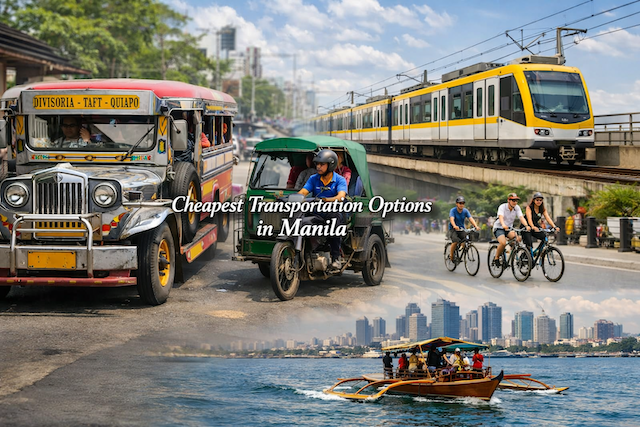
Cheapest Transportation Options in Manila
Getting around Manila does not have to be expensive. Despite its heavy traffic and complex road network, the city offers many transportation options that are extremely affordable if you know how to use them properly. For budget travelers, students, expats, and even long-term residents, understanding the cheapest transportation options can significantly reduce daily expenses while still allowing efficient mobility across Metro Manila.
This guide explains the cheapest ways to travel in Manila, how each option works, typical costs, and when each mode makes the most financial sense. The focus is on real-world practicality rather than comfort or luxury.
Understanding What “Cheapest” Really Means in Manila
In Manila, the cheapest transportation is not always about the lowest single fare. It often depends on:
-
Distance traveled
-
Number of transfers required
-
Time of day and traffic conditions
-
Whether you can walk part of the route
A ₱15 ride that replaces two ₱13 rides is cheaper in practice. Likewise, avoiding traffic delays can prevent you from switching to more expensive alternatives out of frustration. Keeping this mindset will help you consistently choose the lowest-cost option.
Jeepneys: The Cheapest Paid Transportation in Manila
Jeepneys are the backbone of Manila’s public transportation system and are generally the cheapest paid transport option available.
Why Jeepneys Are So Cheap
Jeepneys operate on fixed routes with flexible boarding and drop-off points. They are privately operated, highly competitive, and designed for short-to-medium distances. Because they run constantly and rely on high passenger volume, fares remain low.
Typical Cost
Jeepney fares are usually the lowest among all motorized transport options. The minimum fare covers short distances, and incremental increases apply for longer routes, but costs remain minimal compared to other modes.
When Jeepneys Make the Most Sense
-
Short trips within a neighborhood or between nearby districts
-
Routes with heavy jeepney traffic and frequent service
-
Situations where you can walk a short distance to your destination
Limitations
Jeepneys are often crowded, not air-conditioned, and can be confusing for first-time users because routes are displayed on signboards rather than digital maps. Despite this, they remain unbeatable in terms of price.
City Buses: Cheap for Longer Road-Based Routes
Buses in Manila are another very affordable option, especially for longer distances along major roads.
Cost Advantage
While slightly more expensive than jeepneys on short trips, buses can be cheaper overall for long rides because they reduce the need for multiple transfers. Paying one bus fare is often cheaper than taking two or three jeepneys.
Best Use Cases
-
Traveling along major corridors such as EDSA
-
Trips that would require multiple jeepney rides
-
When you prefer fewer stops and a more direct route
Budget Strategy
Choose ordinary buses rather than premium or point-to-point buses if your goal is to minimize cost. Air-conditioning does not necessarily mean high prices, but premium services should be avoided when budgeting.
LRT and MRT: Cheap and Time-Efficient
Manila’s rail systems are among the best-value transportation options when balancing cost and speed.
Why Trains Are Cost-Effective
Train fares are distance-based but remain affordable even for long trips. More importantly, trains bypass road traffic, saving time and reducing the likelihood of needing additional paid transfers.
Ideal Situations for Train Use
Budget Tip
Pair trains with walking or a single short jeepney ride for the last mile. This combination is often cheaper than staying entirely on road transport.
Walking: The True Cheapest Option
Walking is often overlooked, but it is the cheapest transportation option possible.
When Walking Saves the Most Money
-
Short distances under one kilometer
-
Areas with sidewalks and pedestrian-friendly streets
-
Combined with trains or buses to reduce paid transfers
Practical Advice
Manila’s heat and uneven sidewalks can be challenging, but walking early in the morning or late in the afternoon makes it manageable. Even a 10-minute walk can eliminate the need for an extra ride.
UV Express: Cheap Only When Replacing Multiple Rides
UV Express vans are not the cheapest by default, but they can become cost-effective in certain scenarios.
When UV Express Makes Financial Sense
-
When one UV Express ride replaces multiple jeepney or bus rides
-
For longer point-to-point routes with no direct cheap alternatives
-
When carrying bags and trying to avoid multiple transfers
When to Avoid UV Express
If your only goal is the lowest fare, UV Express usually ranks behind jeepneys, buses, and trains.
Pasig River Ferry: Cheap and Underused
The Pasig River Ferry is one of Manila’s most underrated budget transportation options.
Why It Can Be Cheap
Ferry fares are affordable, and the route avoids road traffic entirely. This can save both money and time, especially during peak congestion.
Limitations
Coverage is limited to areas near the river, and operating hours are restricted. However, if your route aligns with ferry stations, it can be one of the smartest low-cost choices.
Tricycles: Cheap but Inconsistent
Tricycles are common in certain districts but are not always the cheapest option.
Cost Reality
Tricycle fares vary widely depending on area and negotiation. Locals often pay low rates, while visitors may be charged more.
Best Use
Always agree on the price before boarding to avoid overpaying.
Ride-Hailing Apps: Rarely the Cheapest
Ride-hailing services are convenient but generally not cheap.
When Ride-Hailing Can Be Cost-Effective
-
Splitting the fare among multiple passengers
-
Late-night travel when public transport is limited
-
When avoiding multiple paid transfers
Budget Warning
Traffic delays and surge pricing can quickly turn ride-hailing into the most expensive option. Use it sparingly if your goal is saving money.
Combining Transportation for Maximum Savings
The cheapest way to travel in Manila often involves combining multiple modes intelligently.
Example Budget Combinations
Planning routes that minimize transfers and paid segments is more important than choosing the lowest single fare.
Daily Budget Commuting Strategy
To keep transportation costs consistently low:
-
Learn one or two main jeepney routes near your area
-
Use trains during peak hours
-
Walk whenever distances are reasonable
-
Avoid impulse ride-hailing during traffic jams
-
Carry small bills to avoid payment issues
These habits make a noticeable difference over time.
Cheapest Transportation Options Ranked
From cheapest to more expensive (general ranking):
-
Walking
-
Jeepney
-
City Bus
-
LRT / MRT
-
Pasig River Ferry
-
UV Express
-
Tricycle
-
Ride-hailing / Taxi
Actual cost depends on distance and route efficiency, but this ranking reflects typical daily use.
Final Thoughts
Manila offers some of the cheapest urban transportation options in Southeast Asia if you are willing to use public transport and walk strategically. Jeepneys, buses, and trains form a powerful low-cost network that can take you almost anywhere in the city for minimal expense.
The key is not just choosing the cheapest vehicle, but choosing the smartest route. By minimizing transfers, walking short distances, and using trains to avoid traffic, you can travel efficiently while keeping your transportation budget extremely low.
With the right approach, navigating Manila cheaply is not only possible—it quickly becomes routine.
FAQs (Frequently Asked Questions)
What is the single cheapest way to get around Manila?
For most day-to-day trips, the cheapest paid option is usually a traditional jeepney or a modern e-jeepney on a short route. These modes are designed for short-to-medium distances and local commuting, so the minimum fare is typically lower than air-conditioned point-to-point options. That said, “cheapest” depends on your exact route: if an LRT or MRT line takes you close to your destination with minimal transfers, the train can be the cheapest overall because it reduces the need for multiple rides. For ultra-short distances, walking is the cheapest option of all, and pairing a short walk with one public ride is often the best budget strategy.
Are buses cheaper than jeepneys in Manila?
It depends on the operator, route length, and whether the bus is ordinary or air-conditioned. Jeepneys are often cheapest for short hops because the minimum fare is low and stops are flexible. Buses can be cost-effective for longer rides along major corridors, especially if you can take one bus instead of multiple jeepneys. In practice, you should choose the option that reduces transfers. Two or three cheap rides can become more expensive (and slower) than one slightly higher fare that takes you closer to your final stop.
Is the LRT/MRT affordable for budget travelers?
Yes. Manila’s rail lines are generally affordable compared with taxis and ride-hailing, and they can be the best value when traffic is heavy. Trains often help you save money indirectly too, because you spend less time stuck in congestion and can avoid surge pricing in ride-hailing apps. The key is last-mile planning: you may still need a short jeepney, tricycle, or walk from the station to your destination. If you can manage that last segment cheaply, rail becomes one of the best low-cost choices for cross-city trips.
What is the cheapest way to pay for trains and buses?
For trains, using a stored-value card (such as a reloadable transit card where available) is often the most convenient and can reduce the hassle of buying single-journey tickets repeatedly. For buses and jeepneys, cash is still common, so carrying small bills and coins is usually the easiest. The “cheapest” payment method is the one that prevents overpaying or getting stuck without change. Keep a small pocket of exact fare money so you do not have to break large bills during rush hour.
How can I keep my daily commute cost as low as possible?
Start by building a route that minimizes transfers. Every transfer is another fare and another chance to lose time. Next, use rail lines when they align with your route, then connect to a jeepney or short walk for the last mile. If your trip is fully on-road, look for a single bus or UV Express route that is direct, but compare the fare with combining a jeepney plus train. Finally, travel slightly outside peak rush hours when possible, because heavy traffic can tempt you into expensive alternatives like ride-hailing just to “escape” congestion.
Is UV Express considered “cheap” in Manila?
UV Express is usually not the cheapest option, but it can be “cheap for the comfort” because it is typically air-conditioned and more direct than many jeepney routes. If UV Express replaces multiple rides, it may be a good value even if the base fare is higher. Budget travelers often use UV Express strategically: for example, when the weather is harsh, when you are carrying bags, or when you need a simpler, more predictable ride. For purely lowest cost, jeepneys, buses, and trains usually win.
When does ride-hailing become the cheapest option?
Ride-hailing is rarely the cheapest for solo travelers, but there are cases where it can be cost-effective. If you are splitting the fare with two or three people, the per-person cost can approach (or sometimes beat) the cost of multiple public transport fares, especially late at night when public options are limited. It can also be cheaper if it prevents multiple transfers and long detours. However, surge pricing, traffic, and long distances can quickly make it expensive, so it is best reserved for specific situations rather than as a daily budget method.
Are tricycles a cheap option inside Manila?
Tricycles can be convenient for short distances in certain neighborhoods, but pricing can be inconsistent, especially for visitors. In some areas they follow local fare norms; in others, you may be quoted a higher price if you do not know the typical rate. If you use tricycles, agree on the fare before getting in, keep the trip short, and treat them as a last-mile connector rather than a primary mode. For strict budget travel, you will usually spend less using jeepneys, buses, or walking when safe and practical.
Is the Pasig River Ferry a cheap way to move around Manila?
The Pasig River Ferry can be a budget-friendly alternative when your origin and destination are near ferry stations. The real value is time and stress savings, because it avoids road congestion and offers a calmer ride. The limitation is coverage: it will not help if you are far from the river route, and you may still need a short connection ride on land. If the ferry fits your route, it can be a smart low-cost option that also gives you a unique view of the city.
What are the best safety tips when using cheap public transport?
Affordable transport in Manila is widely used, but you should stay alert, especially in crowded areas and during peak hours. Keep your phone and wallet in a front pocket or a closed bag worn in front. Avoid flashing cash, and prepare small bills before boarding. If you are carrying a backpack, consider wearing it in front on trains and in tightly packed vehicles. At night, choose well-lit stops and consider safer alternatives for the last mile if streets are quiet. Saving money is great, but prioritize safe routes and common-sense precautions.
What should I do if I do not know which jeepney or bus to take?
If you are unsure, start with rail lines for the main part of your trip if a station is nearby, then ask for help for the last mile. For on-road routes, ask your hotel staff, a guard, or a shop clerk rather than relying only on guesswork. When you ask, state both your destination and a major landmark near it (a mall, station, or intersection). You can also check route guidance in mapping apps, but always compare with what locals say because real-world routes and loading points can change. When in doubt, choose a route that is simple and direct, even if it costs a little more.