2026年3月30日
3D ACADEMY offers affordable English study programs in Cebu, Philippines – perfect for beginners, professionals, and exam takers.

3D UNIVERSAL ENGLISH INSTITUTE INC
info.3d-universal.com
8:00-17:00(Mon-Fri)
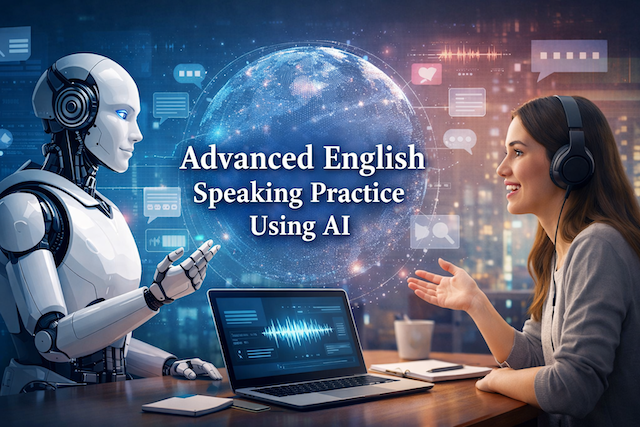
Advanced English Speaking Practice Using AI
Contents
- Advanced English Speaking Practice Using AI
- Introduction
- Why Advanced Learners Need a Different Approach
- Key Benefits of Using AI for Advanced Speaking Practice
- Effective AI-Based Speaking Practice Techniques
- Building a Daily Advanced Speaking Routine
- Advanced Strategies for Faster Progress
- Common Mistakes Advanced Learners Should Avoid
- Best AI Prompts for Advanced Speaking Practice
- The Future of English Learning with AI
- Conclusion
- FAQs (Frequently Asked Questions)
- What is advanced English speaking practice using AI?
- How can AI help advanced learners improve spoken English?
- Is AI conversation practice enough to become fluent in English?
- What kinds of topics should advanced learners practice with AI?
- Can AI correct pronunciation and help me sound more natural?
- What is the best way to use AI every day for speaking practice?
- What are the biggest mistakes advanced learners make when using AI?
- How do I make AI conversations more realistic?
- Can AI help with business English and professional communication?
- How long does it take to see improvement with AI speaking practice?
Advanced English Speaking Practice Using AI
Introduction
In today’s rapidly evolving digital landscape, artificial intelligence (AI) has transformed the way people learn languages—especially English. For advanced learners, traditional study methods such as textbooks, passive listening, or basic conversation practice are often no longer enough. At this stage, learners need nuanced, dynamic, and highly personalized speaking practice to achieve true fluency.
This is where AI becomes a powerful tool. Unlike human conversation partners who may not always be available, AI offers unlimited, on-demand interaction. More importantly, it allows advanced learners to simulate real-world conversations, refine complex expressions, and receive instant feedback.
In this guide, you will learn how to use AI effectively for advanced English speaking practice. We will explore strategies, tools, and structured routines designed specifically for learners who already have a strong foundation but want to reach near-native fluency.
Why Advanced Learners Need a Different Approach
At the advanced level, the goal is no longer just communication—it is precision, naturalness, and confidence.
Many advanced learners face challenges such as:
- Speaking fluently but lacking natural phrasing
- Using correct grammar but sounding unnatural
- Struggling with idioms, tone, or cultural nuance
- Hesitating during complex discussions
Basic conversation practice does not address these issues. Instead, learners need:
- Deep conversations on abstract topics
- Real-time correction of subtle mistakes
- Exposure to different speaking styles (formal, casual, professional)
- Practice in thinking directly in English
AI can address all of these needs simultaneously.
Key Benefits of Using AI for Advanced Speaking Practice
1. Unlimited Practice Opportunities
One of the biggest advantages of AI is availability. You can practice anytime, anywhere, without scheduling constraints.
This allows you to:
- Practice daily without interruption
- Repeat difficult conversations multiple times
- Focus on specific weak areas
Consistency is critical at the advanced level, and AI makes it easier to maintain.
2. Personalized and Adaptive Learning
AI can adapt to your level and goals. Whether you want to improve business English, academic speaking, or casual conversation, AI can adjust accordingly.
You can ask AI to:
- Use advanced vocabulary
- Simulate specific situations (job interviews, debates, meetings)
- Correct your tone or style
This level of personalization is difficult to achieve with traditional methods.
3. Instant Feedback and Correction
Advanced learners benefit greatly from immediate feedback.
AI can:
- Correct grammar and word choice
- Suggest more natural expressions
- Improve sentence structure
- Explain subtle differences in meaning
This helps you refine your speech in real time rather than repeating mistakes.
4. Safe Environment for Experimentation
Many advanced learners hesitate to speak because they fear making mistakes. AI provides a judgment-free environment where you can experiment freely.
You can:
- Try new vocabulary
- Practice complex sentences
- Explore different speaking styles
This builds confidence and encourages risk-taking, which is essential for growth.
Effective AI-Based Speaking Practice Techniques
1. Deep Conversation Practice
Instead of simple topics like “daily routine,” focus on complex and abstract discussions.
Examples:
- The impact of AI on society
- Climate change policies
- Cultural differences in communication
- Ethical dilemmas
Ask AI to challenge your opinions and ask follow-up questions. This forces you to think critically and express ideas clearly.
2. Role-Playing Real-Life Scenarios
Role-playing is one of the most effective ways to simulate real-world communication.
Examples:
- Job interviews
- Business meetings
- Negotiations
- Presentations
You can instruct AI like this:
“Act as a hiring manager and ask me difficult interview questions.”
This helps you prepare for high-pressure situations and improve professional communication.
3. Shadowing and Imitation
Shadowing involves listening to natural English and repeating it immediately.
With AI, you can:
- Generate advanced dialogues
- Practice pronunciation and rhythm
- Compare your speech with native-like responses
This improves fluency, intonation, and natural flow.
4. Paraphrasing Practice
Paraphrasing is a key skill at the advanced level.
Ask AI to:
- Give you a sentence or paragraph
- Ask you to rephrase it in different ways
For example:
AI: “The company experienced significant growth last year.”
You: “The company saw substantial expansion over the past year.”
This builds flexibility in language use.
5. Debate and Argument Training
Engaging in debates is one of the fastest ways to improve advanced speaking skills.
Ask AI to:
- Take an opposing viewpoint
- Challenge your arguments
- Ask for clarification
This helps you:
- Organize thoughts quickly
- Use persuasive language
- Improve logical structure
Building a Daily Advanced Speaking Routine
Consistency is key. Here is a structured 30–60 minute daily routine using AI.
Step 1: Warm-Up (5–10 minutes)
- Speak freely about your day or thoughts
- Focus on fluency, not accuracy
- Try to think in English
Step 2: Topic Discussion (10–20 minutes)
- Choose a complex topic
- Discuss it with AI
- Answer follow-up questions
Focus on:
- Clarity
- Depth of ideas
- Natural phrasing
Step 3: Targeted Practice (10–15 minutes)
Choose one specific skill:
- Pronunciation
- Vocabulary expansion
- Sentence structure
Ask AI for corrections and improvements.
Step 4: Role-Play (10–15 minutes)
Simulate a real-life situation:
- Business meeting
- Interview
- Presentation
Practice speaking clearly and confidently.
Step 5: Feedback and Reflection (5–10 minutes)
Ask AI:
- What mistakes did I make?
- How can I sound more natural?
- What vocabulary should I improve?
Review and take notes.
Advanced Strategies for Faster Progress
1. Think Directly in English
Stop translating from your native language. Instead, train your brain to think in English.
Use AI prompts like:
“Help me express this idea naturally in English.”
Over time, this reduces hesitation and improves fluency.
2. Focus on Collocations and Natural Phrases
Advanced learners often know many words but struggle with natural combinations.
For example:
- “Make a decision” (not “do a decision”)
- “Take responsibility”
Ask AI to:
- Correct unnatural phrases
- Suggest better alternatives
3. Practice Different Speaking Styles
Fluency includes flexibility.
Practice:
- Formal English (presentations, emails)
- Casual English (daily conversation)
- Professional English (meetings, negotiations)
AI can simulate all of these contexts.
4. Record and Review Your Speech
Even when using AI, recording yourself is powerful.
Listen for:
- Hesitation
- Repetition
- Pronunciation issues
Then ask AI to help improve specific parts.
5. Use AI for Vocabulary Expansion
Instead of memorizing random words, learn vocabulary in context.
Ask AI:
- “Give me advanced expressions for this topic”
- “How can I say this more naturally?”
Practice using new words immediately in conversation.
Common Mistakes Advanced Learners Should Avoid
1. Over-Focusing on Grammar
At this level, communication is more important than perfection.
Aim for:
- Natural flow
- Clear expression
- Confidence
2. Avoiding Difficult Conversations
Growth happens when you challenge yourself.
Do not stay in your comfort zone. Choose:
- Complex topics
- Unfamiliar subjects
- Fast-paced discussions
3. Not Using Feedback Effectively
Feedback is only useful if you apply it.
After each session:
- Review corrections
- Practice improved sentences
- Repeat until natural
4. Practicing Without Structure
Random practice leads to slow progress.
Follow a structured routine and set clear goals.
Best AI Prompts for Advanced Speaking Practice
Here are some useful prompts you can use daily:
- “Correct my English and make it sound natural.”
- “Ask me challenging questions about this topic.”
- “Act as a business partner in a meeting.”
- “Help me improve my pronunciation and fluency.”
- “Give me more natural alternatives to this sentence.”
These prompts make your practice more focused and effective.
The Future of English Learning with AI
AI is not just a temporary trend—it is shaping the future of language learning.
For advanced learners, this means:
- More realistic conversation simulations
- Better pronunciation feedback
- More personalized learning paths
As AI continues to evolve, learners will have access to near-human interaction quality, making it possible to achieve fluency faster than ever before.
Conclusion
Advanced English speaking is not just about knowing the language—it is about using it naturally, confidently, and effectively in any situation.
AI provides a powerful platform to:
- Practice consistently
- Receive instant feedback
- Simulate real-world conversations
- Push beyond your comfort zone
By combining structured routines, targeted practice, and smart use of AI tools, you can accelerate your journey toward true fluency.
The key is simple: practice daily, challenge yourself, and use AI not just as a tool, but as your personal speaking partner.
With the right approach, achieving advanced-level English fluency is no longer a distant goal—it is a realistic and attainable outcome.
FAQs (Frequently Asked Questions)
What is advanced English speaking practice using AI?
Advanced English speaking practice using AI refers to using artificial intelligence tools such as chatbots, voice assistants, pronunciation apps, and conversation simulators to improve high-level spoken English skills. Unlike beginner practice, advanced practice focuses less on basic grammar and more on fluency, precision, natural phrasing, tone, and confidence. AI can simulate realistic conversations, ask follow-up questions, correct unnatural wording, and help learners practice more complex topics such as business, travel, academic discussions, and opinion-based speaking. This makes it especially useful for learners who already understand English well but want to sound more fluent and natural in real conversations.
How can AI help advanced learners improve spoken English?
AI helps advanced learners by offering instant, personalized, and unlimited speaking practice. It can respond at any time, which means learners do not need to wait for a tutor or language partner. More importantly, AI can help refine subtle parts of spoken English, such as sentence rhythm, word choice, and natural expressions. For example, if a learner says something grammatically correct but slightly unnatural, AI can suggest a more native-like alternative. It can also challenge learners with deeper questions, role-play interviews or meetings, and help them explain opinions more clearly. This kind of active correction and repetition is extremely valuable at the advanced stage.
Is AI conversation practice enough to become fluent in English?
AI conversation practice can play a major role in building fluency, but it works best as part of a wider learning routine. Fluency develops through repeated speaking, listening, thinking in English, and using the language in different situations. AI is excellent for daily conversation practice, pronunciation drills, vocabulary expansion, and confidence building. However, advanced learners should also combine AI with real-world exposure such as listening to podcasts, watching interviews, joining discussions, or speaking with real people when possible. AI is a powerful practice partner, but long-term fluency improves faster when learners use English in many forms and contexts.
What kinds of topics should advanced learners practice with AI?
Advanced learners should move beyond simple daily topics and practice speaking about more complex and meaningful subjects. Good topics include current trends, technology, education, career goals, business situations, social issues, cultural differences, travel experiences, and personal opinions. Learners can also practice abstract topics such as success, leadership, communication, or ethical decisions. These topics require more detailed vocabulary and stronger speaking organization. AI is especially useful here because it can ask follow-up questions, challenge your ideas, and help you explain yourself more clearly. This kind of deep practice improves both fluency and critical thinking in English.
Can AI correct pronunciation and help me sound more natural?
Yes, many AI tools can support pronunciation improvement and help learners sound more natural. Some AI speaking tools analyze speech and give feedback on pronunciation, stress, rhythm, and clarity. Even text-based AI can still help by showing more natural sentence patterns and conversational phrases. For example, if your sentence is correct but sounds stiff or translated, AI can rewrite it in a smoother and more natural way. Over time, repeating these improved versions helps learners build a more native-like speaking style. If your goal is to sound more natural, it is important to ask AI not only for correction, but also for alternatives used in everyday English.
What is the best way to use AI every day for speaking practice?
The best approach is to follow a simple daily routine. Start with a short warm-up where you speak freely about your day, plans, or thoughts. Then move into a focused conversation with AI on one topic, such as work, travel, or an opinion question. After that, do a role-play session such as a job interview, presentation, or meeting. Finally, ask AI to review your mistakes and suggest better vocabulary or more natural phrasing. Even 20 to 30 minutes a day can create strong progress if you practice consistently. The key is not just using AI often, but using it with structure and clear goals.
What are the biggest mistakes advanced learners make when using AI?
One common mistake is using AI only for passive learning, such as reading answers instead of speaking actively. Another mistake is staying with easy topics that do not challenge vocabulary or sentence structure. Some learners also focus too much on grammar perfection and become afraid to speak freely. Others ask AI for corrections but never review or apply the feedback. Advanced learners grow faster when they actively speak, repeat improved sentences, and practice difficult topics on purpose. AI is most effective when it becomes an interactive training partner, not just a source of information or example sentences.
How do I make AI conversations more realistic?
To make AI conversations more realistic, give clear instructions and create a specific context. Instead of saying “Let’s practice English,” say something like “Act as a hiring manager and interview me for an international sales position” or “Pretend we are having a casual conversation at a networking event.” You can also ask AI to respond naturally, interrupt occasionally, ask follow-up questions, or disagree with your opinions. This makes the conversation feel more dynamic and closer to real-life interaction. The more specific your prompt is, the more useful and realistic the practice becomes for advanced speaking development.
Can AI help with business English and professional communication?
Yes, AI is very effective for business English and professional speaking practice. Advanced learners can use it to prepare for meetings, presentations, negotiations, interviews, and networking conversations. AI can help learners practice formal tone, persuasive language, polite disagreement, and industry-specific vocabulary. For example, you can ask AI to simulate a client meeting, help you explain a project update, or improve your response to difficult questions from a manager. Because professional communication often requires clarity and confidence, AI provides a safe space to rehearse and improve before using English in real business situations.
How long does it take to see improvement with AI speaking practice?
The timeline depends on your current level, goals, and consistency, but many learners notice improvements within a few weeks of regular practice. Advanced learners often see faster results in confidence, fluency, and sentence flexibility because they already have a strong language base. If you practice with AI for 20 to 30 minutes a day and review corrections carefully, you may begin to notice smoother speaking, better vocabulary recall, and less hesitation. Larger improvements, such as sounding more natural in complex discussions, usually take longer and require steady practice over several months. The most important factor is consistency, not intensity.
How to Improve English Speaking Using AI Apps (Complete Guide 2026)

How to Register for eTravel Philippines (2025 Guide)
Step-by-step guide to completing your eTravel registration before arriving in the Philippines, with images and tips.

Night Market in Cebu – Things You Don’t Know About Cebu Life
Discover the hidden charm of Cebu’s night markets, from street food stalls to local life tips you won’t find in tourist guides.

How to Use ChatGPT for IELTS Preparation: A Complete Guide
Learn how to prepare for IELTS using ChatGPT — including strategies for Writing, Reading, Listening, Speaking, and grammar support.

How to Build a Website Without Coding Using ChatGPT
Discover how to build your own website using AI—no coding skills needed. From structure planning to SEO and design, let ChatGPT guide you.