
AI Study Abroad Guide
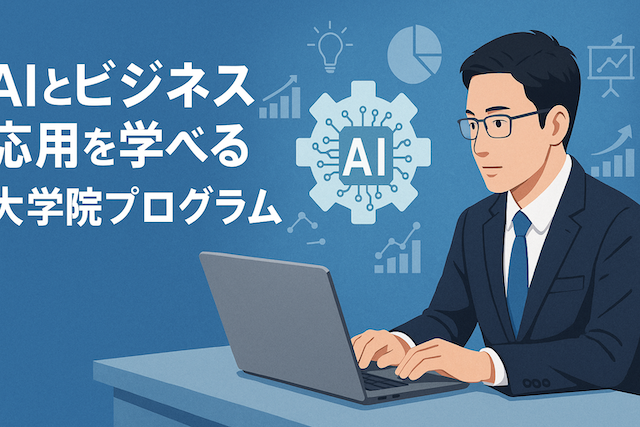
Graduate Programs for Learning AI and Business Applications
01
Introduction
AI (artificial intelligence) is no longer the exclusive domain of research labs and engineers. It has spread into marketing, finance, healthcare, manufacturing, logistics and even management strategy itself, and is used in every area of business. By adopting AI, companies are creating new revenue models and dramatically improving operational efficiency.
What is in demand in this trend is **people who understand AI technology and can apply it to business**. They are neither engineers who can only program nor businesspeople who only draw up strategy, but bridge-builders connecting the two.
To develop such people, top graduate schools around the world are launching master’s and MBA programs specialized in “AI x business applications” one after another. This article introduces in detail the features of these programs, what you can learn, and the career possibilities.
02
Why a Graduate Program in AI x Business?
1. There is a shortage of people who connect technology and management
The number of AI engineers is growing worldwide, but people who can link AI to “business results” are still limited. The skill to understand algorithms and also apply them to generating profit and market strategy is extremely valuable to companies.
2. Demand from global companies is expanding
Not only tech companies such as Google and Amazon but also traditional industries such as finance, healthcare and manufacturing are actively hiring AI talent. AI programs with a focus on business applications offer career paths directly connected to these companies.
3. A direct link to entrepreneurship and innovation
Many startups are launching new services that use AI technology. By studying AI and business together in graduate school, you can refine your startup ideas and connect them directly to fundraising and business expansion.
4. Literacy that future executives will need
With digital transformation (DX) advancing, this is an era in which even CEOs and executives are expected to have AI knowledge. Leaders who understand the technology have a major advantage in management decisions.
03
Main Types of Programs
Graduate programs that teach AI and business applications in an integrated way fall broadly into the following types.
1. Master in AI Management
Programs that combine AI fundamentals with management skills. The curriculum is similar to an MBA, but with richer technology-oriented courses.
- Example: **IE Business School (Spain)** - Master in Business Analytics & Big Data
- Example: **HEC Paris x École Polytechnique (France)** - MSc Data Science for Business
2. MBA x AI / Data Science Concentration
A style that integrates AI and data science courses into a traditional MBA. You can learn leadership education and technical understanding in good balance.
- Example: **MIT Sloan (USA)** - MBA Analytics Track
- Example: **University of Chicago Booth School of Business (USA)** - MBA Concentration in Business Analytics
3. Professional Master in AI & Business
Short, intensive programs for engineers and those from science and engineering backgrounds to add business skills. They include many practical projects and corporate partnerships, and one-year programs are typical.
- Example: **NUS (Singapore)** - Master of Computing (AI specialization + Business courses)
- Example: **The University of Hong Kong** - MSc in Business Analytics (AI Applications)
04
Curriculum Features
Graduate programs for learning AI and business applications are structured to emphasize both theory and practice. Typical curriculum features are as follows.
1. AI Fundamentals
- Machine Learning
- Deep Learning
- Natural Language Processing (NLP)
- Computer Vision (CV)
2. Data Analysis and Technology
- Big data analysis
- Statistical modeling
- Cloud computing and distributed processing
- Data visualization and decision support
3. Business Applications and Strategy
- Digital transformation (DX) strategy
- Marketing analytics and customer behavior prediction
- Supply chain optimization
- Financial AI (FinTech applications)
- AI ethics and governance
4. Practical Projects (Capstone / Internship)
Many programs include problem-solving projects in partnership with companies.
- Case studies using real company data
- AI implementation projects through internships
- New AI business proposals by student teams
05
Admission Requirements
Graduate programs for learning AI and business applications accept a wide range of students from both technical and business backgrounds. However, the requirements differ depending on the nature of the program.
1. Educational Background
- A bachelor’s degree is required (a wide range of fields is accepted, including business administration, engineering, information science, mathematics and economics)
- Some MBA programs place weight on work experience in addition to a bachelor’s degree
2. English Proficiency
English proficiency is essential at international graduate schools.
- TOEFL iBT: 90 or higher
- IELTS: 6.5 to 7.0 or higher
- Some European programs have English proficiency waivers (for example, for those who earned a degree taught in English)
3. Test Scores
- MBA-type programs: **GMAT or GRE** required
- Professional master’s and science/engineering master’s programs: GRE scores may be recommended
4. Work Experience
- MBA and management-oriented programs often require **2 to 5 years of work experience**
- Technically oriented master’s programs can also accept new graduates and early-career students
5. Other
- Letters of recommendation (from a professor or a supervisor at work)
- Statement of Purpose
- CV/Resume
06
Careers After Graduation
After completing a graduate program in AI and business applications, you can open a wide range of career paths as someone strong in both technology and management.
1. AI Consultant
A role that plans and carries out companies’ AI adoption and data utilization strategies. There are many opportunities to lead projects in positions close to executive management.
2. Business Analyst / Data Analyst
Analyzes markets and predicts customer behavior to support decision-making. Makes full use of AI tools to provide analysis that connects directly to practical work.
3. Product Manager (AI Products)
Oversees the planning and development of new services and products that use AI. Works as a bridge between technical teams and executives.
4. Startup Founder
Many graduates build on the knowledge gained in graduate school to launch new AI-based businesses. There are abundant opportunities for fundraising and global expansion.
5. DX Leaders such as CDO / CIO
As Chief Data Officer or Chief Information Officer, leads a company’s overall data strategy and DX.
07
Summary
Graduate programs for learning AI and business applications go beyond mere research or technical skill acquisition, aiming to develop **people who use AI strategically and turn it into business results**.
Whereas the traditional MBA was “centered on management skills,” these programs combine **AI literacy and data analysis ability**, so you acquire the skill set that future business leaders need.
After graduation, the path leads directly to ready-to-work careers such as consultant, analyst and product manager, and also opens the way to launching a startup or serving as a company’s DX leader.
Given that AI will play an ever more central role in society, **investing in an “AI x business” graduate program will be a major advantage in building your career**.
08
What is a graduate program in AI and business applications?
It is a master’s or MBA program that teaches AI technology (machine learning and data analysis) together with management, strategy and product management, developing people who can create value in practice.
09
What is the difference between an MBA and a science/engineering master’s (MS)?
An MBA centers on management and leadership, and AI is often studied as an applied subject. An MS tends to go deeper technically, with coding and modeling being essential.
10
What educational background is required for application?
A bachelor’s degree is the basic requirement. A wide range of fields is accepted, including business, information, engineering, mathematics and economics. Depending on the program, technical course credits or basic statistics coursework may be expected.
11
What are the English requirements?
As a guide, TOEFL iBT 90 or higher and IELTS 6.5 to 7.0. Holders of degrees taught in English may be exempt.
12
Are the GMAT/GRE required?
MBA-type programs often require the GMAT/GRE, while for MS/professional master’s programs it is optional or recommended. Some schools have score waivers.
13
Is work experience required?
MBA programs value 2 to 5 years of work experience. Technically oriented master’s programs accept new graduates, but internship or project experience is an advantage.
14
How much coding is needed?
For MS/professional master’s programs, analysis and modeling in Python/R is practically essential. Even for MBA-type programs that center on no-code/low-code, basic data handling skills are expected.
15
What are typical courses in the curriculum?
Machine learning, deep learning, statistics, cloud, data visualization, product management, digital strategy, and AI ethics and governance.
16
Are there practical projects or internships?
Many programs offer corporate-partnered capstones and internships, where you work on solving problems with real data.
17
How long do the programs take?
1 to 2 years is typical. MBAs are 1 to 2 years full-time, and many MS/professional master’s programs are one year.
18
What Are the Approximate Tuition and Scholarships?
It varies by country and school. At top schools in the US and Europe, it starts from several million yen per year. Support is available through merit-based scholarships, corporate sponsorship, and TA/RA positions.
19
What are the main careers after graduation?
AI consultant, data/business analyst, AI product manager, DX promotion, entrepreneurship and more. Industries are wide-ranging, including tech, finance, healthcare, manufacturing and logistics.
20
Can I expect a return on investment (ROI)?
The practicality of the curriculum, the school’s brand and network, and the quality of internship and career support determine the ROI. The more work experience you have, the greater the effect tends to be.
21
Can I study online or in a hybrid format?
Yes. You can study while working, though networking and internship opportunities may be more limited than in person.
22
How do countries and regions differ?
The US has abundant industry partnerships and job openings. Europe has lower tuition, many one-year programs and a multinational environment. Asia’s strengths are cost-effectiveness and proximity to growth markets.
23
Should I choose a research-oriented or practice-oriented program?
If you are research-oriented, choose a program with academic depth and a strong emphasis on papers; if practice-oriented, choose one rich in industry-academia partnerships and product/commercialization courses.
24
Do I need a portfolio or preparatory study?
GitHub / data analysis notebooks, Kaggle results and organized outcomes from work projects are effective. Strengthening statistics, linear algebra and Python basics beforehand gives peace of mind.
25
Will I study AI ethics and regulation?
Many programs cover AI ethics, privacy, governance and generative AI risk management as required or elective courses.
26
What about visas and work authorization (for example, OPT)?
It depends on each country’s system. In the US, STEM-designated programs may allow an OPT extension. Check the system in your destination country and the school’s support structure.
27
How should I compare schools?
Compare them on (1) practicality of the curriculum, (2) corporate partnerships and job placement record, (3) strengths of faculty and labs, (4) tuition and scholarships, (5) location and visa system, and (6) alumni network.
28
What Is the Approximate Application Timeline?
Start gathering information 12 to 18 months before departure, prepare for exams and documents 9 to 12 months before, apply 6 to 9 months before, and arrange your visa and housing after acceptance.
AI Study Abroad Guide [2025 Latest Edition]: How to Study Machine Learning, Generative AI, and Data Science Overseas29
Related article
30
Recommended Courses
Course
Business English Course
A course for intensively learning practical business English: presentations, meetings, emails, negotiations, and more. You can build English skills useful in the global business scene after AI study abroad, matched to your level across 6 levels.
See moreCourseOne-on-One Intensive Course
A fully one-on-one system with no group classes. English preparation before AI study abroad and discussion practice on technical topics can be intensively trained to match your level.
See moreThe first step in IELTS preparation is choosing the right environment
With one-on-one classes and real-format mock exams, we help you reach your target score by the most direct route.