
AI Study Abroad Guide
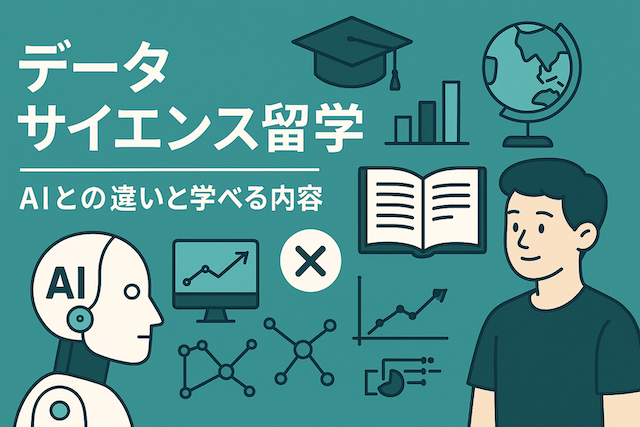
Studying Data Science Abroad: How It Differs from AI and What You Learn
01
Introduction
Introduction
In an age when data is called "the oil of the 21st century," universities and companies around the world are competing on their ability to put data to use. At the center of this is the academic field of "data science." Like AI (artificial intelligence), it is highly popular, yet many people wonder, "How are AI and data science different?"
Studying data science abroad lets you systematically learn, on a foundation of mathematics and statistics, the skills to collect and analyze large amounts of data and create new value from it. This article clarifies the differences from AI and explains what you can learn in a data science study-abroad program and the career outlook afterward.
The Difference Between AI and Data Science
AI (artificial intelligence) and data science are often treated as the same field, but they actually differ in approach and purpose.
What Is AI (Artificial Intelligence)?
- **Purpose**: To build systems that learn, judge and reason like humans.
- **What you study**: Machine Learning Deep Learning Natural Language Processing (NLP) Computer Vision
- **Application examples**: Self-driving cars, AI assistants, image recognition systems, translation apps.
What Is Data Science?
- **Purpose**: To collect, organize and analyze huge amounts of data and draw valuable insights from it.
- **What you study**: Statistics, mathematical modeling Data analysis, visualization Big data processing technologies (Hadoop, Spark, etc.) Business intelligence
- **Application examples**: Marketing analysis, financial risk prediction, medical data analysis, demand forecasting.
The Difference in One Sentence
- **AI**: The field that creates intelligent "technology"
- **Data science**: The field that uses data to draw out "value"
The major difference is that AI emphasizes "building the technology," while data science emphasizes "using data to support decision-making."
What You Can Learn Studying Data Science Abroad
Studying data science abroad lets you acquire a wide range of skills, from theory to practice. The following areas are especially central to the curriculum.
1. Fundamentals of Mathematics and Statistics
- Probability theory, statistical estimation, regression analysis
- Develop the mathematical thinking that underlies predictive models
2. Programming Skills
- Data processing and preprocessing with **Python** and **R**
- Database operations using **SQL**
- Code implementation needed for real business and research
3. Data Analysis and Machine Learning
- Analysis methods such as clustering, classification and regression
- Application of machine learning algorithms (random forests, neural networks, etc.)
- The area with the greatest overlap with the AI field
4. Big Data Technologies
- Large-scale data processing with **Hadoop** and **Spark**
- Practical analysis in cloud environments (AWS, Google Cloud, Azure)
5. Data Visualization and Decision Support
- BI tools such as **Tableau** and **Power BI**
- Visualization using **Matplotlib and Seaborn**
- The ability to present analysis results clearly and connect them to decisions
6. Applied Field Projects
- Practical case studies in marketing analysis, medical data analysis, financial engineering and more
- Working in teams to solve problems builds skills that suit real-world workplaces
Studying data science abroad goes beyond simply acquiring knowledge: it comprehensively builds **"the ability to turn data into value."**
Popular Countries and Universities for Study Abroad
Demand for data science is high worldwide, and specialized programs are offered in many countries. The following countries and universities are especially popular for their quality of education, research environment and employment opportunities.
United States
- **Stanford University**: Strong in education that blends AI and data science.
- **UC Berkeley**: Has a world-famous data science division and leads the way in big data research.
- **MIT (Massachusetts Institute of Technology)**: Lets you study statistics, machine learning and data engineering across disciplines. Strong ties with industry give graduates a wide range of career options.
United Kingdom
- **University of Oxford**: Strong in data analysis education grounded in statistics and computational science.
- **Imperial College London**: Emphasizes practical projects, with many programs run in partnership with companies. Advantageous for building a career in the European market.
Canada
- **University of Toronto**: Pairs AI research (especially deep learning) with data science education.
- **McGill University**: A traditional university strong in statistics and applied data science. Its immigrant-friendly policies and abundant job opportunities are attractive.
Singapore
- **NUS (National University of Singapore)**: A leading Asian university focusing on education in data science and business applications.
- **NTU (Nanyang Technological University)**: Increasingly integrated with engineering, and strong in IoT and smart city research. Ideal for students aiming to develop a career in Asia.
The Appeal of Studying Data Science Abroad and Career Outlook
The Appeal of Studying Data Science Abroad
- **Acquiring skills that lead to immediate contribution** By studying mathematics, statistics, programming and business analysis across disciplines, you can apply your skills in a wide range of industries.
- **A global learning environment** Abroad, you interact with students from many nations and learn how to use data from different perspectives.
- **Strong connections with industry** Many universities offer joint research with companies and internships. This connects directly to building your career after graduation.
- **Learning combined with AI** Because data science overlaps heavily with AI, you also naturally acquire AI application skills.
Career Prospects After Graduation
Specialists in data science are in short supply worldwide, and careers after graduation are varied.
- **Data scientist**: A specialist who leads data analysis within a company.
- **Business analyst**: A role that applies data to decision-making.
- **Machine learning engineer**: Implements AI models and builds them into products and services.
- **Data engineer**: Responsible for designing the foundations for large volumes of data and developing pipelines.
- **Consultant (data strategy)**: Helps connect the use of data to management strategy.
Future Prospects and Market Value
- Companies around the world are focused not only on "how to use AI" but also on "how to use their huge volumes of data."
- With the advance of DX (digital transformation), demand for data science talent is rising steadily.
- You can expect a high-income career with international opportunities.
The major appeal of studying data science abroad is that **it connects more directly to practical work than AI research, and graduates can be active in the global market right after graduation**.
Summary
- **The difference between AI and data science**: AI is the field of "building intelligent technology." Data science is the field of "using data to draw out value."
- **What you can learn studying data science abroad**: A wide range of skills including mathematics and statistics, programming, machine learning, big data processing, data visualization and applied projects.
- **Popular study destinations**: United States (Stanford, UC Berkeley, MIT), United Kingdom (Oxford, Imperial), Canada (Toronto, McGill), Singapore (NUS, NTU).
- **Career outlook**: You can work in diverse roles such as data scientist, business analyst, machine learning engineer and data engineer. Because of a worldwide talent shortage, high demand and income can be expected.
Studying data science abroad is the best choice for those who aim to be immediately effective in a data-driven society through learning that combines theory and practice. Choosing the path that fits your own career aspirations while comparing it with AI will be the first step to success.
02
Frequently Asked Questions
What is the difference between data science and AI?
AI leans toward technology development, "building intelligent systems," while data science leans toward decision-making, "drawing value from data." In practice the two overlap, and the fundamentals of machine learning are studied in common.
What are the main subjects you can study abroad?
Probability and statistics, linear algebra, optimization / Programming (Python/R/SQL) / Machine learning and applied statistical modeling / Big data processing (Spark/Hadoop) / Visualization and BI (Tableau/Power BI/Matplotlib) / Cloud (AWS/GCP/Azure) and MLOps basics / Domain-specific projects (finance/healthcare/marketing, etc.)
What is required for admission (at the time of application)?
A bachelor's degree (CS/statistics/mathematics/engineering/economics, etc. are welcome) / Transcripts, resume, statement of purpose (SOP) / Letters of recommendation (2 to 3) / English scores (TOEFL/IELTS). GRE is recommended or required at some schools / Some universities also ask for coding exercises, assignment submissions or a portfolio
Is it OK if I am not good at math?
It is possible, but your foundation in **calculus, linear algebra, and probability and statistics** determines how fast you understand material after enrolling. We recommend reinforcing it before admission with bridge courses or MOOCs.
Which programming languages should I prepare?
For both work and classes, **Python + SQL** is the top priority. R is also useful if you emphasize statistical modeling. If you will be involved in building infrastructure, basics of Scala/Java are helpful.
What jobs are available after graduation compared with an AI major?
Data scientist / Analytics scientist / Machine learning engineer (more applied) / Data analyst / Product analyst / Data engineer (infrastructure, ETL, DWH) / Data consultant / Analytics translator
Does the curriculum include research?
Many programs center on **practical projects / capstones**, but some courses allow research-oriented assignments or joining a faculty lab. If you are aiming for a research career, consider a research-based master's or a PhD pathway.
Are There Internship or Industry-Academia Collaboration Opportunities?
In North America, the UK and Singapore, **capstones on real company problems** and in-term internships are common. Make use of work-permit schemes such as OPT and the support of the university career center.
What is a guide to costs, and how can I save?
Tuition: varies widely by country and university (on the order of several million yen per year) / Living costs: higher in cities. Reduce them by sharing housing or living in the suburbs / Make use of scholarships, TA/RA positions, tuition waivers and corporate sponsorship programs / Shorten the opportunity cost with one-year programs
Which is better, online or on-campus?
On-campus is strong in **networking and career support**. Online has the advantage in cost and flexibility. If you plan to change careers, prioritize a local network; for reskilling, online is also a strong option.
Which program should I choose? What should I look for?
Balance of required courses (statistics x ML x data engineering x business) / Share of capstone projects with real companies and whether deliverables can be made public / Faculty, labs and research areas, and employment record (industry, job type, region) / Career services (interview preparation, job partners) / How active the alumni community is
What should I build for a portfolio?
Show the full flow from data cleansing through visualization and modeling to interpretation / Metrics and impact evaluation that connect to business decisions (A/B tests, etc.) / Reproducible code (GitHub) and readable reports (notebooks/articles) / Diversity of domain applications (finance/healthcare/retail/manufacturing, etc.)
What tools and platforms are essential?
Python ecosystem (NumPy/Pandas/Scikit-learn) / Notebooks (Jupyter) and experiment management (MLflow) / SQL/DWH (BigQuery/Redshift/Snowflake) / Visualization (Tableau/Power BI/Matplotlib) / Distributed processing (Spark) and cloud (AWS/GCP/Azure)
Can I learn MLOps and generative AI?
In recent years many programs have expanded their electives in **model operations (MLOps)** and **LLM applications**. From a data science viewpoint they cover prompt design, evaluation metrics and data governance.
When should I start job hunting?
Start gathering information right after you enroll. A typical pattern is to build your portfolio in the first term, network and apply for internships during the terms, and apply for full-time roles toward the end.
What are the characteristics of each country?
US: diverse companies, high salaries, schemes such as OPT / UK: mainly one-year programs, which makes it easier to keep opportunity cost down / Canada: relatively well-developed immigration system, with plenty of AI/DS job openings / Singapore: many Asian headquarters, strong in finance and tech
How do I decide if I am torn between this and an AI major?
If you are drawn to research and developing new algorithms, choose AI; if you prioritize decision support and business impact, choose data science. A hybrid path that covers the fundamentals of both is also effective.
Can I be admitted and change careers even without experience?
Yes. To prepare, we recommend reinforcing basic mathematics, practicing Python/SQL, building 3 to 5 mini projects, and gaining internship or side-job experience in a related field.
03
Related article
04
Recommended Courses
Course
Business English Course
A course for intensively learning practical business English: presentations, meetings, emails, negotiations, and more. You can build English skills useful in the global business scene after AI study abroad, matched to your level across 6 levels.
See moreCourseOne-on-One Intensive Course
A fully one-on-one system with no group classes. English preparation before AI study abroad and discussion practice on technical topics can be intensively trained to match your level.
See moreThe first step in IELTS preparation is choosing the right environment
With one-on-one classes and real-format mock exams, we help you reach your target score by the most direct route.