
AI Study Abroad Guide
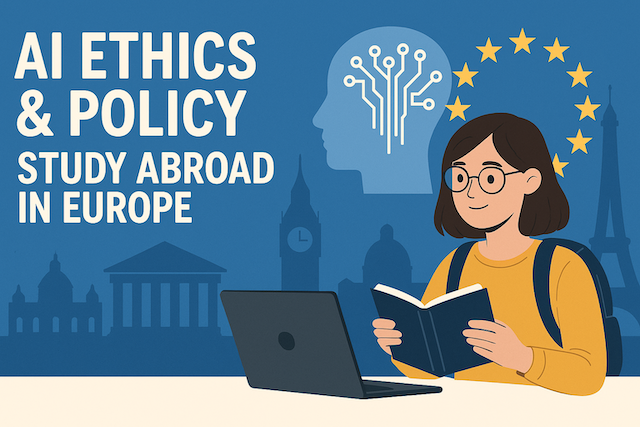
Studying AI Ethics and Policy in Europe
01
Introduction
The evolution of artificial intelligence (AI) is transforming our society, including healthcare, education, finance and public administration. Behind its benefits, however, lie challenges such as privacy violations, algorithmic discrimination, effects on employment and differences in regulation between countries. To address these issues, it has become essential to study not only the technical side of AI but also its "ethics" and "policy" dimensions.
Europe in particular is a region leading the world in AI ethics and policy. The EU has already drawn up a comprehensive AI regulation, the "AI Act," setting out a framework that emphasizes transparency and safety. In addition, universities and research institutes in each country offer a rich range of programs that cross technology and the social sciences, allowing you to gain knowledge and skills directly relevant to international policymaking and corporate governance.
This article explains in detail the significance of studying AI ethics and policy in Europe, notable universities and programs, and career paths after studying abroad.
02
Why Study AI Ethics and Policy in Europe?
As AI technology develops, regulations and guidelines are being drawn up around the world. Among these regions, Europe emphasizes a human-centered approach and has a major international influence. The significance of studying in Europe lies in the following points.
1. EU leadership
The European Union (EU) is the first region in the world to enact a comprehensive AI regulation, the "AI Act." Built on safety, transparency and ethics, and managing the scope of AI use on a risk basis, this law is becoming a global norm. Studying at the center of it leads to a direct understanding of the latest policy trends.
2. A culture that values human rights and ethics
In Europe, a culture that respects individual rights and social justice is firmly rooted. In the development and operation of AI as well, there is a strong emphasis on ethical principles such as fairness, explainability and privacy protection, and these are studied in depth academically.
3. International influence
EU regulations and guidelines have a major impact on companies and countries outside the region. The GDPR (General Data Protection Regulation), for example, is a representative case that affected companies around the world. By studying in Europe, you can understand global standards and build a foundation for working on the international stage.
4. A diverse educational environment
Universities across Europe offer programs that link not only AI technology but also fields such as philosophy, sociology and law. This lets you develop expertise that combines an understanding of technology with the ability to tackle ethical and social issues.
03
What You Can Study
At universities and research institutes in Europe, there are rich programs that go beyond simply "building" AI technology to teach how to apply it in society, how to regulate it, and what ethical challenges to solve. Specifically, the focus is on the following fields.
1. Ethics of AI
- **Fairness**: methods to prevent algorithmic discrimination and bias
- **Transparency & Explainability**: approaches that present AI decisions in a form humans can understand
- **Privacy Protection**: the handling of personal data and ethical considerations
- **Accountability**: clarifying responsibility when AI causes erroneous decisions or harm
2. Policy & Regulation
- **Understanding and practicing the EU AI Act**: the framework of the world's first comprehensive AI regulation
- **Data protection law (relationship with the GDPR)**: protecting personal information in the age of AI
- **The policymaking process**: coordination with diverse stakeholders such as governments, companies and civil society organizations
- **International cooperation**: trends in AI policy at international organizations such as the OECD and the UN
3. Practical Application
- **Drafting corporate ethics guidelines**: creating standards for AI use at tech companies and financial institutions
- **AI auditing and governance design**: verifying algorithm transparency and assessing risk
- **Linkage with public policy**: analyzing the social impact of introducing AI in healthcare and public administration
- **Participation in international projects**: involvement in research and policymaking projects of the EU and international organizations
Through this learning, students can develop the perspective of "AI professionals who bear responsibility to society," rather than "engineers who merely know technology."
04
Notable Universities and Programs for Study Abroad
Universities across Europe have curricula that cover AI ethics and policy across disciplines, and many programs accept international students. Representative universities and their features are introduced below.
United Kingdom
- **University of Oxford** Centered on the Oxford Internet Institute, it conducts cross-disciplinary research on AI ethics, data governance and social impact. You can explore AI in depth from the perspectives of philosophy and public policy.
- **University of Cambridge** Based at the Leverhulme Centre for the Future of Intelligence, it examines the future of AI and society. Policy research and international cooperation programs are also rich.
Netherlands
- **University of Amsterdam** Strong in data ethics and governance research. Practical learning is possible that draws on legal frameworks such as the GDPR and the AI Act.
Belgium
- **KU Leuven** Strong ties to EU institutions, offering education directly linked to policymaking and AI regulation. It trains people to bridge European legal systems and technology.
Estonia
- **University of Tartu** Abundant practical examples of e-government and digital policy. Although a small country, it lets you study a model of a digital society that draws worldwide attention.
Other Notable Programs
- **Sciences Po, France**: a program integrating international relations and public policy with AI ethics
- **Free University of Berlin, Germany**: AI ethics research in collaboration with law and philosophy
- **University of Helsinki, Finland**: an educational program on AI and social responsibility
At these universities there are many opportunities to build networks with practitioners and policymakers, and a major feature is that they connect directly not only to academics but also to career building.
05
Career Prospects
Studying AI ethics and policy in Europe goes beyond acquiring academic knowledge and expands your career possibilities as a ready-to-work professional in international society. Possible paths after completion include the following fields.
1. International organizations and public policy
- Policy advisors and researchers at the **EU, OECD, UNESCO and UN agencies**
- Specialist officers in AI regulation and digital strategy in national governments
- AI ethics and human rights projects at NGOs and think tanks
2. Companies and industry
- **AI ethics roles at technology companies**: designing in-house guidelines to ensure transparency and fairness
- **Compliance departments in finance, healthcare and education**: risk assessment and governance design for AI use
- **Consulting firms**: support for corporate AI risk management and regulatory compliance
3. Academic research and education
- AI ethics and policy researchers at universities and research institutes
- Lecturers in AI ethics and technology policy at educational institutions
- Participation in international joint research projects
4. Emerging fields and specialist roles
- **AI Auditor**: a new occupation that verifies the transparency of algorithms and systems
- **Data Protection Officer (DPO)**: an essential specialist role for GDPR and AI Act compliance
- **AI-and-law bridge professionals**: rare experts who understand both technology and legal regulation
AI is a field in which international debate on regulation and ethics will advance further, and experts in this area are in short supply worldwide. The knowledge and network you gain from studying in Europe will be a major asset for your career.
06
Summary
While AI's development brings great benefits to society, it also highlights ethical challenges and the need for regulation. How to ensure elements such as transparency, fairness and explainability is one of the most important themes of the coming AI society.
Europe has led the world by introducing regulations such as the AI Act and the GDPR early, promoting human-centered use of AI. It is therefore the ideal region to study AI ethics and policy systematically, with a learning environment that is rich in both academics and practice.
What you gain from studying abroad is not only knowledge. It is an international network, access to policy settings, and a broad perspective that connects AI and society. These will be a strong foundation for working at international organizations, companies and research institutes in the future.
For those interested in learning not "how to build" AI technology but "how it should be used," studying in Europe can be called an ideal choice.
07
FAQ
What are the benefits of studying AI ethics and policy?
You develop the ability to implement principles such as transparency, fairness, explainability and shared responsibility in practice, beyond technology alone. Expertise directly tied to building corporate AI governance and to regulatory compliance centered on the EU (AI Act/GDPR) is in high demand, which is advantageous for careers at international organizations, companies and research institutes.
Can I enroll without a science background?
Yes. Many programs accept applications from a variety of fields such as philosophy, law, public policy and sociology. Basics of statistics, data and programming can sometimes be made up through supplementary classes and bridging courses.
Is Programming Required?
It is not required, but the basics of Python and data analysis are useful for policy evaluation and algorithm auditing. Being able to at least read data and understand the assumptions and limits of models will make your studies smoother.
How Much English Do You Need?
Classes and papers are in English as a rule. A rough guide is IELTS 6.5 to 7.0 or TOEFL iBT 90 to 100. Because policy and ethics are discussion-centered, expressive ability in speaking and writing is important.
What are the main subjects?
AI ethics (fairness, transparency, explainability), AI governance, the EU AI Act, the GDPR and data protection, risk and impact assessment (AIA/HRIA), algorithm auditing, technology and human rights, policy design and evaluation, and more.
How long is the master's program?
Most are 1 to 2 years. One-year programs are more intensive, while two-year programs tend to make it easier to fit in internships and research.
Are there internships or practical projects?
Programs often offer internships at EU institutions, NGOs, regulators and corporate ethics governance departments, as well as project-based courses working on real policy recommendations and AI audit cases.
What Are the Career Options After Graduation?
Typical paths include policy analyst at international organizations and governments, corporate AI ethics and compliance, algorithm auditing, consulting, research positions and progression to doctoral study.
When Should You Start Preparing Your Application?
If you aim for autumn enrollment (September to October), applying in the autumn to winter of the previous year is typical. It is safe to allow 3 to 6 months to prepare your statement of purpose, research plan, recommendation letters and language scores.
What Are the Approximate Tuition and Scholarships?
Tuition varies by country and university. Public universities in English-, Dutch-, French- and German-speaking regions may be relatively low. Because tuition categories can differ for students from inside and outside the EU, it is effective to check early and consider combining scholarships (university, government and external foundations).
Is it a disadvantage not to have a background in law or philosophy?
No. The ability to cross technical understanding and the social sciences is emphasized. Curricula generally let you systematically learn the basics of legal ethics and research methods after enrollment.
How do the EU AI Act and the GDPR differ?
The GDPR is a comprehensive regulation on personal data protection, while the AI Act is a framework that sets requirements according to the risk of AI systems. The two are complementary, and the design and operation of AI use may require compliance with both at the same time.
Should I choose research (a master's thesis) or a practice orientation?
If you are research-oriented, a research track is advantageous for academic and policy research and doctoral study; if you are practice-oriented, a professional track that emphasizes internships and consulting projects is suitable.
Can I study online or in a hybrid format?
Some programs offer online courses or modules, but attending in person is advantageous for networking with policy stakeholders and for internships.
What Do Admissions Committees Emphasize in Application Documents?
Clarity of your motivation (which ethics or policy issue you want to contribute to), relevant experience (research, work, volunteering), logical writing ability and the specificity of recommendation letters. Writing samples or a portfolio may also be requested.
Do I need the local language?
Many programs are completed in English alone, but knowing the local language (French, German, Dutch and so on) widens your options for internships and jobs.
Are visas and residence permits difficult?
Requirements differ by country. Admission, proof of funds and insurance coverage are common conditions, and the university's international office often supports the procedures.
What preparation is useful before studying?
Foundational literature on AI ethics, EU policy documents (guidelines, impact assessments), a refresher on Python and statistics, strengthening logical writing, and organizing case studies in your area of interest.
What are the checkpoints for choosing a program?
Compare the curriculum balance (ethics/law/policy/technology), internship opportunities, the track record of faculty and research centers, graduates' career paths, and partners (regulators, international organizations, companies).
AI Study Abroad Guide [2025 Latest Edition]: How to Study Machine Learning, Generative AI, and Data Science Overseas08
Related article
09
Recommended Courses
Course
Business English Course
A course for intensively learning practical business English: presentations, meetings, emails, negotiations, and more. You can build English skills useful in the global business scene after AI study abroad, matched to your level across 6 levels.
See moreCourseOne-on-One Intensive Course
A fully one-on-one system with no group classes. English preparation before AI study abroad and discussion practice on technical topics can be intensively trained to match your level.
See moreThe first step in IELTS preparation is choosing the right environment
With one-on-one classes and real-format mock exams, we help you reach your target score by the most direct route.