2025年12月15日
3D ACADEMY offers affordable English study programs in Cebu, Philippines – perfect for beginners, professionals, and exam takers.

3D UNIVERSAL ENGLISH INSTITUTE INC
info.3d-universal.com
8:00-17:00(Mon-Fri)
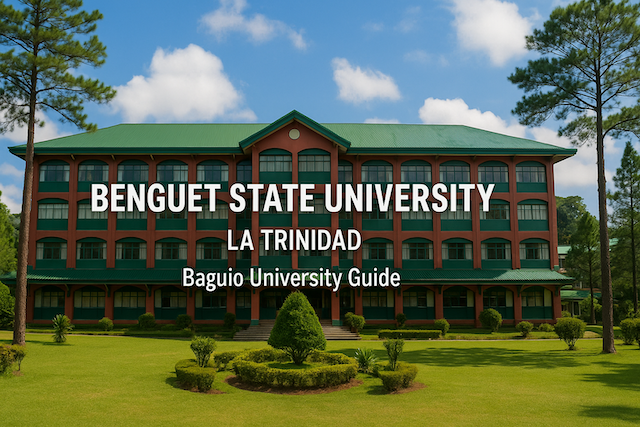
Benguet State University (BSU) – La Trinidad: Baguio University Guide
Contents
- Benguet State University (BSU) – La Trinidad: Baguio University Guide
- Overview of Benguet State University (BSU)
- Location and Campus Environment
- Academic Colleges and Programs
- Admission Requirements
- Tuition and Fees
- Scholarships and Financial Assistance
- Campus Facilities and Student Services
- Dormitories and Housing Options
- Student Life and Culture
- Why Choose BSU?
- Tips for Prospective Students
- FAQs (Frequently Asked Questions)
- 1. Where is Benguet State University (BSU) located?
- 2. What programs and courses does BSU offer?
- 3. Is BSU a public or private university?
- 4. Is tuition free at Benguet State University?
- 5. How do I apply for admission to BSU as a freshman?
- 6. Can transferees and second coursers enroll at BSU?
- 7. Are there scholarships or financial assistance options at BSU?
- 8. What is campus life like at Benguet State University?
- 9. Are there dormitories or boarding houses near BSU?
- 10. How do I travel between Baguio City and BSU?
- 11. Is BSU a good choice for international students?
- 12. Why should I consider studying at Benguet State University?
Benguet State University (BSU) – La Trinidad: Baguio University Guide
Benguet State University (BSU) stands as one of the most respected public universities in Northern Luzon, known for its strong academic programs, emphasis on research, and deep community involvement. Located in La Trinidad, Benguet—just minutes away from Baguio City—BSU attracts thousands of students from across the Philippines who want high-quality, affordable education in a cool mountain environment.
This guide provides a comprehensive overview of BSU, including its programs, campus life, admissions, facilities, and reasons why many students choose it as their academic home.
Overview of Benguet State University (BSU)
Benguet State University began as the La Trinidad Farm School in 1916 before evolving into the Mountain State Agricultural College and eventually becoming a university in 1986. Its strong foundation in agriculture remains evident today, but BSU has expanded into a wide array of academic fields, making it one of the most diversified universities in the Cordillera region.
BSU is known for:
-
High-quality and affordable education
-
Strong agriculture, forestry, and environmental programs
-
Expansion into business, teacher education, engineering, and health sciences
-
A culture of research and community service
-
Beautiful campus with a cool mountain climate
The university has multiple campuses in Benguet, but its main campus—La Trinidad—is the center of academic and administrative activity.
Location and Campus Environment
BSU’s campus is located in La Trinidad Valley, a municipality known for strawberry farms, vegetable trading posts, and its relaxing climate. Students enjoy a peaceful environment that encourages learning while still being close to Baguio City’s commercial areas.
Key advantages of BSU’s location include:
-
10–15 minutes from Baguio City
-
Cooler weather year-round
-
Safe and student-friendly surroundings
-
Accessible transportation options
The campus features open green spaces, research farms, modernized buildings, and cultural landmarks that reflect the Cordilleran identity.
Academic Colleges and Programs
BSU offers a wide range of undergraduate and graduate programs designed to prepare students for both local and international careers. Below is a breakdown of its major colleges and the typical programs they offer.
College of Agriculture
One of the flagship colleges of BSU, widely recognized across the Philippines.
Programs typically include:
-
BS Agriculture (major options available)
-
BS Agribusiness
-
BS Agricultural Engineering
College of Forestry
A leader in sustainable environmental studies.
Programs include:
-
BS Forestry
-
MS Forestry
-
PhD Forestry
College of Arts and Sciences
Offers diverse academic disciplines such as:
-
BS Biology
-
BS Development Communication
-
BA in English
-
BA in Social Sciences
College of Engineering
A growing and in-demand department.
Common programs:
-
BS Civil Engineering
-
BS Electrical Engineering
-
BS Computer Engineering
College of Teacher Education
Known for producing high-performing LET takers.
Programs:
-
Bachelor of Elementary Education
-
Bachelor of Secondary Education (various majors)
-
Early Childhood Education
College of Nursing
Highly competitive and reputable.
Programs:
-
BS Nursing
-
Continuing nursing education and training
College of Management
Offers business and leadership-oriented degrees.
Programs:
-
BS Business Administration (various majors)
-
Hospitality Management
-
Tourism Management
College of Home Economics and Technology
Focuses on practical, community-oriented fields such as:
-
Nutrition and Dietetics
-
Food Technology
-
Home Economics Education
Graduate School
BSU has a strong postgraduate community with master’s and doctoral degrees in education, agriculture, management, development studies, and more.
Admission Requirements
Admission to BSU is competitive, especially in popular programs like Nursing, Agriculture, and Engineering. Requirements may vary slightly per program, but the general process includes:
For Incoming Freshmen
-
Accomplished BSU application form
-
High school report card (Form 138)
-
Certificate of Good Moral Character
-
PSA Birth Certificate
-
Entrance examination (where required)
-
Interview (for selective programs)
For Transfer Students
-
Transcript of Records
-
Honorable Dismissal
-
Evaluation of completed credits
For Graduate Studies
-
College diploma
-
Transcript of Records
-
Entrance exam or interview (depending on program)
BSU also implements quotas in programs with limited slots, so early application is highly recommended.
Tuition and Fees
One major advantage of BSU is its affordability. As a state university, it participates in the Universal Access to Quality Tertiary Education Act, meaning many programs have free tuition for eligible Filipino students.
However, students typically still pay for:
-
Miscellaneous fees
-
Laboratory fees (for applicable courses)
-
Uniforms and required books
-
Practicum and fieldwork expenses
International students pay different rates and must inquire directly with the BSU admissions office.
Scholarships and Financial Assistance
BSU offers several scholarship opportunities for academically strong or financially challenged students.
Common types include:
-
Academic scholarships
-
Government-funded assistance (CHED, DOST, DA, LGUs)
-
Private organizations and foundations
-
Grants-in-Aid programs
Some scholarships provide full tuition coverage, while others include monthly allowances.
Campus Facilities and Student Services
BSU provides a wide range of facilities to support students academically and socially.
Academic and Research Facilities
-
Modern laboratories
-
Computer centers
-
Research farms and experimental stations
-
Libraries with digital resources
-
Forestry and agricultural research units
Student Support Services
-
Guidance and counseling
-
Student affairs offices
-
Medical and dental clinic
-
Career placement services
Sports and Recreation
-
Gymnasium
-
Track and field facilities
-
Open grounds for intramurals
Campus life at BSU is active, with celebrations such as Adivay Festival, student organization activities, and regular academic events.
Dormitories and Housing Options
BSU offers limited on-campus dormitory spaces, typically prioritizing students from distant provinces. Rooms are affordable and secure.
For those who prefer off-campus housing, boarding houses and apartments are widely available within walking distance. Many are budget-friendly and cater specifically to students.
Student Life and Culture
BSU fosters a culture of community engagement, environmental stewardship, and academic discipline. Students often join organizations focused on:
-
Culture and the arts
-
Agriculture and environmental conservation
-
Leadership and public service
-
Sports and recreational activities
BSU’s student population includes locals from Benguet and nearby Cordillera provinces, plus students from the lowlands and international enrollees. This diversity enriches student life and learning experiences.
Why Choose BSU?
Here are the top reasons why many students choose Benguet State University:
-
Affordable education thanks to state university policies
-
Strong reputation in agriculture, environmental sciences, and teacher education
-
Excellent climate and peaceful study environment
-
Wide variety of programs for different career paths
-
Active community involvement and research culture
-
Strategic location near Baguio City
BSU is ideal for students seeking quality education without the high cost of private institutions.
Tips for Prospective Students
Before applying, consider the following advice:
-
Apply early, especially to high-demand programs.
-
Prepare for entrance exams and interviews.
-
Research your preferred program’s curriculum.
-
Visit the campus if possible to check facilities and boarding options.
-
Look into scholarships to reduce financial burden.
FAQs (Frequently Asked Questions)
1. Where is Benguet State University (BSU) located?
Benguet State University is located in La Trinidad, Benguet, in the Cordillera region of Northern Luzon in the Philippines.
The main campus sits in La Trinidad Valley, which is only about 10–15 minutes away from Baguio City by jeepney or private vehicle.
The area is known for its cool climate, strawberry farms, and vegetable terraces, creating a peaceful and refreshing study environment.
Because of its proximity to Baguio City, students can easily access malls, hospitals, restaurants, and other urban conveniences while still enjoying a quieter provincial setting.
2. What programs and courses does BSU offer?
BSU offers a wide range of undergraduate and graduate programs across various fields.
Its flagship offerings are in Agriculture, Forestry, and related environmental sciences, but it also provides degrees in Teacher Education, Engineering, Arts and Sciences, Business and Management, Home Economics and Technology, and Nursing.
In addition, BSU has a Graduate School that offers master’s and doctoral programs in fields such as Education, Agriculture, and Management.
Specific course offerings may change over time, so it is best to check the official BSU website or admissions office for the latest list of programs.
3. Is BSU a public or private university?
Benguet State University is a public, state-run university.
This means it is funded by the Philippine government and is part of the country’s state university and college (SUC) system.
As a public institution, BSU aims to provide accessible, quality education to students, especially those from the Cordillera Administrative Region and neighboring areas.
Being a state university also allows BSU students to benefit from national policies on free tuition for eligible Filipino students in many undergraduate programs.
4. Is tuition free at Benguet State University?
For many Filipino students enrolled in regular undergraduate programs, tuition and some other school fees may be covered by the
Philippine government under the Universal Access to Quality Tertiary Education Act.
However, students still usually pay for miscellaneous fees, laboratory fees, uniforms, and other personal expenses.
Some specialized, non-regular, or graduate programs may not be fully covered and could have different fee structures.
It is important to confirm the exact costs with the BSU Cashier’s Office, Registrar, or official announcements before enrollment.
5. How do I apply for admission to BSU as a freshman?
To apply as an incoming freshman, you typically need to accomplish the BSU application form and submit it along with your senior high school report card (Form 138),
a Certificate of Good Moral Character, your PSA Birth Certificate, and other documents required by your chosen program.
Most programs require you to take and pass a BSU entrance examination, while some may also require an interview or additional screening.
Application periods and procedures can change, so always refer to official BSU admission guidelines and announcements for the updated process and deadlines.
6. Can transferees and second coursers enroll at BSU?
Yes, BSU accepts transferees and second coursers, subject to space availability and program-specific requirements.
Transferees usually need to submit a Transcript of Records, a Certificate of Honorable Dismissal, and course descriptions for evaluation of credited subjects.
Second coursers, or those who already hold a degree and wish to pursue another, may undergo a similar process and sometimes have fewer general education subjects to complete.
Each college sets its own policies for credit evaluation, so it is advisable to coordinate directly with the department offering your desired program.
7. Are there scholarships or financial assistance options at BSU?
BSU offers several forms of scholarships and financial assistance for qualified students.
These include academic scholarships for high-performing students, government-funded scholarships from agencies like CHED, DOST, and local government units,
as well as private grants from organizations or partner institutions.
Some scholarships may cover full or partial tuition, while others provide monthly stipends or allowances.
Requirements usually include maintaining a certain grade point average and good moral standing.
Students are encouraged to visit the Scholarship or Student Affairs Office to explore available options and application schedules.
8. What is campus life like at Benguet State University?
Campus life at BSU is a blend of academic focus, community engagement, and cultural diversity.
Students can join many organizations, including academic clubs, cultural groups, sports teams, and community service organizations.
Because BSU is located in the Cordillera region, there is a strong emphasis on indigenous culture, environmental protection, and sustainable development.
Throughout the year, students participate in activities such as intramurals, cultural festivals, seminars, and outreach programs.
The cool climate and scenic surroundings also make outdoor activities and campus walks enjoyable.
9. Are there dormitories or boarding houses near BSU?
Yes, there are both on-campus and off-campus housing options for BSU students.
The university maintains dormitories or residence halls, usually with limited slots that prioritize students from distant provinces or those with special circumstances.
These on-campus dorms are generally more affordable and are located within or very close to academic buildings.
In addition, many privately operated boarding houses, apartments, and bedspaces can be found around La Trinidad, especially along main roads near the campus.
Students can choose accommodations based on their budget, privacy needs, and preferred distance from the university.
10. How do I travel between Baguio City and BSU?
Travel between Baguio City and BSU in La Trinidad is convenient and relatively quick.
Public jeepneys regularly ply routes such as Baguio–La Trinidad or Baguio–Trancoville–La Trinidad, dropping passengers near or in front of the BSU campus.
Travel time is usually around 10–20 minutes, depending on traffic.
Taxis and ride-hailing services, if available, can also be used for more comfortable transport.
Because of this easy access, many students prefer to live in either La Trinidad or Baguio and commute daily to and from the university.
11. Is BSU a good choice for international students?
BSU can be a good option for international students who want affordable education, a cooler climate, and a campus that values agriculture, environment, and community.
The university occasionally accepts foreign enrollees, especially in fields like Agriculture, Forestry, and Development Studies.
However, international applicants need to comply with additional requirements set by Philippine immigration and the university, such as student visas, English proficiency, and proof of financial capacity.
It is important for foreign students to coordinate early with the BSU International Relations or Admissions Office for detailed guidance.
12. Why should I consider studying at Benguet State University?
You should consider BSU if you are looking for a university that combines academic quality, affordability, and a refreshing environment.
Its strong reputation in agriculture, forestry, teacher education, and community-based programs makes it ideal for students who want practical, socially relevant training.
The cool climate of La Trinidad helps many students study more comfortably compared to lowland heat.
With its diverse programs, active student organizations, and commitment to regional development, BSU offers a well-rounded university experience that prepares you for both local and global opportunities.
Baguio University Guide
Baguio Province All Universities Lists
Philippines University Guide

How to Register for eTravel Philippines (2025 Guide)
Step-by-step guide to completing your eTravel registration before arriving in the Philippines, with images and tips.

Night Market in Cebu – Things You Don’t Know About Cebu Life
Discover the hidden charm of Cebu’s night markets, from street food stalls to local life tips you won’t find in tourist guides.

How to Use ChatGPT for IELTS Preparation: A Complete Guide
Learn how to prepare for IELTS using ChatGPT — including strategies for Writing, Reading, Listening, Speaking, and grammar support.

How to Build a Website Without Coding Using ChatGPT
Discover how to build your own website using AI—no coding skills needed. From structure planning to SEO and design, let ChatGPT guide you.