2026年3月30日
3D ACADEMY offers affordable English study programs in Cebu, Philippines – perfect for beginners, professionals, and exam takers.

3D UNIVERSAL ENGLISH INSTITUTE INC
info.3d-universal.com
8:00-17:00(Mon-Fri)
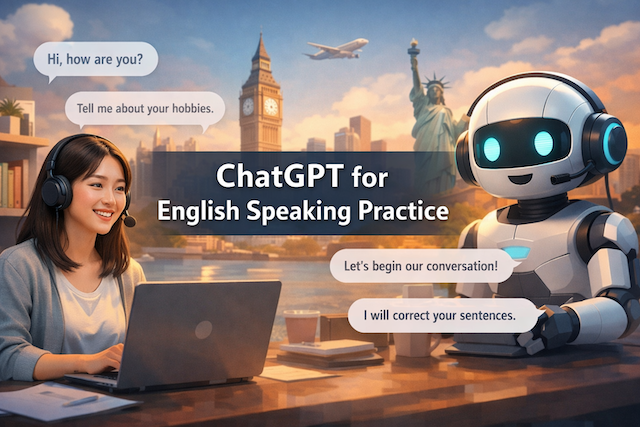
ChatGPT for English Speaking Practice (Complete Guide)
Contents
- ChatGPT for English Speaking Practice (Complete Guide)
- Introduction
- Why Use ChatGPT for English Speaking Practice
- How ChatGPT Helps Improve Speaking Skills
- Setting Up ChatGPT for Speaking Practice
- Basic Conversation Practice Method
- Role-Play Practice for Real-Life Situations
- Shadowing and Repetition Technique
- Error Correction and Feedback Strategy
- Building Fluency with Daily Practice Routine
- Advanced Techniques for Faster Progress
- Using ChatGPT with Voice Tools
- Common Mistakes to Avoid
- Benefits Compared to Traditional Learning
- Who Should Use ChatGPT for Speaking Practice
- Future of AI in Language Learning
- Conclusion
- FAQs (Frequently Asked Questions)
- Can ChatGPT really help with English speaking practice?
- Is ChatGPT better than practicing with a real English teacher?
- How should beginners use ChatGPT for speaking practice?
- What is the best way to practice speaking instead of just typing?
- Can ChatGPT correct grammar and make my English sound more natural?
- Can ChatGPT help with pronunciation too?
- How often should I use ChatGPT for English speaking practice?
- What kinds of speaking activities can I do with ChatGPT?
- What are the biggest mistakes learners make when using ChatGPT for speaking?
- Who can benefit most from using ChatGPT for speaking practice?
ChatGPT for English Speaking Practice (Complete Guide)
Introduction
Improving English speaking skills has always been one of the most challenging aspects of language learning. Many learners struggle not because they lack vocabulary or grammar knowledge, but because they simply do not have enough opportunities to speak. Traditional methods—such as classroom learning or language exchange—can be effective, but they are often limited by time, location, and cost.
This is where ChatGPT and AI-powered tools have changed the game.
ChatGPT provides a flexible, accessible, and highly customizable way to practice English speaking anytime, anywhere. Whether you are a beginner trying to build confidence or an advanced learner aiming to refine fluency, ChatGPT can function as a conversation partner, tutor, and feedback provider—all in one.
In this complete guide, you will learn exactly how to use ChatGPT for English speaking practice, including practical methods, structured routines, and advanced strategies to maximize your progress.
Why Use ChatGPT for English Speaking Practice
One of the biggest advantages of ChatGPT is availability. Unlike human partners, ChatGPT is always accessible. You can practice at any time without scheduling or waiting for someone else.
Another key benefit is personalization. You can adjust the difficulty level, conversation topic, and speaking style based on your needs. For example, you can simulate a job interview, casual conversation, or academic discussion.
Additionally, ChatGPT creates a safe environment. Many learners feel anxious or embarrassed when speaking English in front of others. With AI, there is no fear of judgment, which allows you to practice more freely and consistently.
Finally, ChatGPT offers instant feedback. You can ask for corrections, explanations, and alternative expressions, making it a powerful learning tool beyond simple conversation.
How ChatGPT Helps Improve Speaking Skills
ChatGPT improves speaking in several ways:
First, it encourages active output. Speaking is a productive skill, meaning you must actively produce language. ChatGPT prompts you to respond, which helps build fluency.
Second, it reinforces vocabulary and grammar in context. Instead of memorizing isolated words, you use them in real conversations, which improves retention.
Third, it enhances thinking speed in English. Regular practice trains your brain to respond more quickly, reducing the need to translate from your native language.
Fourth, it helps with pronunciation when combined with voice tools. By reading responses aloud or using voice mode, you can practice speaking physically, not just mentally.
Setting Up ChatGPT for Speaking Practice
To get started, you need a clear setup.
If possible, use voice mode or a speech-to-text tool. This allows you to simulate real speaking rather than just typing. If voice is not available, you can still type but should read your responses aloud.
Next, define your level. Are you beginner, intermediate, or advanced? This helps you control the complexity of conversations.
You should also set a goal. For example:
-
Improve daily conversation skills
-
Prepare for interviews
-
Practice travel English
-
Build confidence speaking
Once you have a goal, you can instruct ChatGPT accordingly.
For example:
“Let’s have a simple conversation. I am a beginner. Please use easy English and correct my mistakes.”
Clear instructions lead to better practice sessions.
Basic Conversation Practice Method
The simplest way to use ChatGPT is through daily conversation.
Start by asking ChatGPT to be your speaking partner. Then choose a topic such as hobbies, food, travel, or daily routine.
Example prompt:
“Let’s practice English conversation. Ask me simple questions about my daily life.”
ChatGPT will respond with questions, and you answer them. After each response, you can request corrections.
Example follow-up:
“Please correct my sentence and show a natural way to say it.”
This method is highly effective because it combines speaking, feedback, and repetition.
Role-Play Practice for Real-Life Situations
Role-playing is one of the most powerful ways to practice speaking.
You can simulate real-life scenarios such as:
-
Ordering food at a restaurant
-
Checking into a hotel
-
Job interviews
-
Business meetings
-
Airport conversations
Example prompt:
“Let’s do a role-play. You are a hotel receptionist, and I am a guest checking in.”
This approach helps you prepare for specific situations and builds practical communication skills.
You can also increase difficulty over time by adding complexity or changing scenarios.
Shadowing and Repetition Technique
Shadowing is a proven method for improving speaking fluency and pronunciation.
With ChatGPT, you can generate natural sentences and practice repeating them.
Steps:
-
Ask ChatGPT to provide short dialogues or sentences
-
Read them aloud
-
Repeat them multiple times
-
Try to mimic rhythm and intonation
Example prompt:
“Give me 5 natural English sentences for daily conversation.”
By repeating these sentences, you train your mouth and brain to produce English more smoothly.
Error Correction and Feedback Strategy
One of ChatGPT’s strongest features is its ability to provide corrections.
After speaking or typing, always ask for feedback.
Example:
“Please correct my grammar and explain my mistakes.”
You can also request:
-
More natural expressions
-
Simpler alternatives
-
Formal vs informal versions
For example:
“How can I say this more naturally?”
This helps you move beyond textbook English and sound more like a native speaker.
Building Fluency with Daily Practice Routine
Consistency is more important than intensity.
A simple daily routine could look like this:
10 minutes – Warm-up conversation
Talk about your day or answer simple questions.
10 minutes – Role-play practice
Focus on a specific scenario.
10 minutes – Feedback and correction
Review mistakes and learn improved expressions.
Even 30 minutes a day can lead to significant improvement over time.
Advanced Techniques for Faster Progress
Once you reach an intermediate level, you can use more advanced strategies.
Debate Practice
Ask ChatGPT to discuss topics such as technology, education, or travel.
Example:
“Let’s have a debate about online learning vs traditional learning.”
This improves critical thinking and advanced vocabulary.
Storytelling Practice
Try describing events or telling stories.
Example:
“Let me tell you about my weekend. Please correct me and ask follow-up questions.”
This builds narrative skills and fluency.
Paraphrasing Practice
Ask ChatGPT to give you a sentence, then try to say it differently.
Example:
“Give me a sentence and ask me to rephrase it.”
This strengthens flexibility in speaking.
Using ChatGPT with Voice Tools
To fully develop speaking skills, you should combine ChatGPT with voice technology.
Options include:
-
ChatGPT voice mode
-
Speech-to-text tools
-
Text-to-speech playback
By speaking out loud, you improve pronunciation, rhythm, and confidence.
Even if you make mistakes, the physical act of speaking is essential.
Common Mistakes to Avoid
While ChatGPT is powerful, there are some common mistakes learners should avoid.
Only Reading, Not Speaking
If you only read or type, you are not fully practicing speaking. Always read aloud.
Not Asking for Feedback
Without correction, mistakes become habits. Always review your errors.
Practicing Without Structure
Random conversations are helpful, but structured practice leads to faster improvement.
Giving Up Too Early
Progress in speaking takes time. Consistency is key.
Benefits Compared to Traditional Learning
Compared to traditional methods, ChatGPT offers several advantages:
-
No scheduling required
-
Unlimited practice time
-
Personalized learning
-
Instant feedback
-
Wide range of topics
However, it should not completely replace human interaction. Real conversations with people are still important for developing natural communication skills.
The best approach is to combine both.
Who Should Use ChatGPT for Speaking Practice
ChatGPT is suitable for:
-
Beginners who need confidence
-
Intermediate learners aiming for fluency
-
Advanced learners refining accuracy
-
Busy professionals with limited time
-
Students preparing for exams or interviews
It is especially useful for learners who do not have access to native speakers.
Future of AI in Language Learning
AI tools like ChatGPT are transforming how people learn languages.
In the future, we can expect:
-
More advanced voice interaction
-
Real-time pronunciation correction
-
Personalized learning paths
-
Integration with virtual reality environments
This means learning English will become even more immersive and accessible.
Conclusion
ChatGPT has become one of the most powerful tools for English speaking practice. It provides flexibility, personalization, and immediate feedback—three elements that are essential for effective learning.
By using structured methods such as conversation practice, role-play, shadowing, and feedback analysis, you can significantly improve your speaking skills in a relatively short time.
However, the key to success is consistency. Even the best tools will not help unless you use them regularly.
Start with simple conversations, build your confidence, and gradually challenge yourself with more advanced tasks. Over time, you will notice improvements not only in your fluency but also in your ability to think and communicate in English naturally.
If used correctly, ChatGPT can act as your personal English speaking coach—available anytime you need it.
FAQs (Frequently Asked Questions)
Can ChatGPT really help with English speaking practice?
Yes, ChatGPT can be a very useful tool for English speaking practice when you use it actively. It can simulate conversations, ask follow-up questions, correct grammar, suggest more natural expressions, and help you build confidence. While it is not exactly the same as speaking with a real person, it gives learners a safe and flexible environment where they can practice every day. This is especially helpful for students who do not have regular access to native speakers, tutors, or language exchange partners.
The biggest advantage is consistency. Many learners improve slowly because they do not practice speaking often enough. ChatGPT removes that barrier by being available anytime. You can practice short daily conversations, role-plays, interviews, travel English, or even debate-style speaking sessions. The more frequently you speak, the more comfortable and fluent you become.
Is ChatGPT better than practicing with a real English teacher?
ChatGPT is helpful, but it should not always be seen as a complete replacement for a real English teacher. A human teacher can notice subtle pronunciation issues, emotional tone, hesitation patterns, and communication habits in a way that AI may not fully capture. Teachers can also adapt to your personality, motivation, and long-term learning needs with more nuance.
However, ChatGPT has strengths that many learners find extremely valuable. It is available 24/7, costs less than regular lessons in many cases, and gives unlimited opportunities for practice. For daily speaking drills, vocabulary review, role-play, and confidence building, ChatGPT can be excellent. The best approach for many learners is to use both: ChatGPT for daily practice and a teacher for deeper feedback and real human interaction.
How should beginners use ChatGPT for speaking practice?
Beginners should keep things simple and structured. The most effective way to start is by telling ChatGPT your level clearly. For example, you can say, “I am a beginner. Please use easy English, ask short questions, and correct my mistakes.” This helps create a conversation that matches your ability and prevents frustration.
Beginners should focus on common topics such as self-introduction, family, hobbies, food, daily routine, shopping, and travel. It is also helpful to speak out loud even if you are typing your answers. Reading your responses aloud helps connect thinking, vocabulary, and pronunciation. Instead of trying to sound advanced, focus on making clear, correct sentences. Once you feel comfortable, you can slowly move to longer answers and more difficult topics.
What is the best way to practice speaking instead of just typing?
The best method is to use voice mode if it is available. If you can speak directly to ChatGPT, the practice feels closer to real conversation. You can work on speed, confidence, and spoken flow more naturally than with typing alone. Voice interaction also helps reduce the habit of overthinking every sentence.
If voice mode is not available, you can still practice speaking effectively. Type your answer, then read it aloud clearly. After that, ask ChatGPT to correct your sentence and show you a more natural version. Then repeat the corrected sentence several times. This method may seem simple, but it works well because it combines speaking, correction, and repetition. The key is not to stay silent while learning. Even if the conversation starts in text, your mouth should still be involved.
Can ChatGPT correct grammar and make my English sound more natural?
Yes, this is one of its most useful features. ChatGPT can correct grammar mistakes, improve sentence structure, and show you how native or fluent speakers might say the same idea more naturally. This is important because many learners can communicate basic meaning, but their English may sound unnatural, too direct, too formal, or too textbook-like.
You can ask for different types of feedback depending on your goal. For example, you can say, “Correct my grammar,” “Make this sound more natural,” “Give me a simpler version,” or “Show me a more professional version.” This flexibility helps learners understand not only what is wrong, but also how English changes depending on context. Over time, this makes your speaking more flexible and more natural in real situations.
Can ChatGPT help with pronunciation too?
It can help with pronunciation practice, but with some limits. ChatGPT can provide example sentences, phonetic guidance, stress patterns, and tips for difficult sounds. If you use voice features, speech tools, or text-to-speech support, it becomes even more useful. You can ask for short sentences to repeat, minimal pair examples, or common phrases used in daily life.
Still, pronunciation improvement depends on actually speaking aloud and listening carefully. ChatGPT can guide the practice, but you need to do the physical repetition yourself. A smart routine is to ask for five short example sentences, listen if possible, repeat them several times, and then record yourself if you can. This kind of repeated oral practice helps much more than reading silently.
How often should I use ChatGPT for English speaking practice?
Daily practice is usually the most effective. Even 15 to 30 minutes a day can make a big difference when done consistently. Long sessions once a week are less effective than shorter sessions every day because speaking improves through repeated use, not occasional effort. Your brain needs frequent exposure and regular output to become faster and more comfortable in English.
A balanced daily routine could include a short warm-up conversation, one focused role-play, and a correction review at the end. For example, you might spend 10 minutes answering simple questions, 10 minutes practicing a real-life situation like a job interview or restaurant conversation, and 10 minutes reviewing your mistakes. This keeps practice focused without becoming overwhelming.
What kinds of speaking activities can I do with ChatGPT?
You can do many types of speaking activities depending on your level and goals. Common examples include casual conversation, self-introduction practice, travel English, interview simulation, customer service role-play, storytelling, picture description, debate, presentation practice, and question-and-answer drills. You can also ask ChatGPT to act as a teacher, friend, interviewer, customer, manager, or hotel receptionist.
This variety is one of the reasons ChatGPT is useful. Instead of repeating the same textbook exercise, you can build practice around situations that matter in your real life. If you are preparing for work, focus on meetings and introductions. If you want travel confidence, practice airports, hotels, and restaurants. If you need exam speaking support, ask for timed questions and model answers. The more relevant the activity, the more effective the practice becomes.
What are the biggest mistakes learners make when using ChatGPT for speaking?
The most common mistake is using it only for reading or writing practice. If your goal is speaking, you need to speak aloud as much as possible. Another common problem is not asking for corrections. Learners sometimes enjoy the conversation but forget to review mistakes, which slows improvement. Practice without feedback can reinforce weak habits.
Some learners also jump into difficult topics too early and lose confidence. It is better to start with manageable conversations and increase difficulty gradually. Another mistake is inconsistency. Using ChatGPT once or twice will not change your speaking level much. Progress comes from repeated practice over time. A simple, realistic routine is usually more effective than an ambitious plan that you cannot maintain.
Who can benefit most from using ChatGPT for speaking practice?
Almost any English learner can benefit from it, but it is especially useful for people who need flexibility. Busy professionals, students, self-learners, shy speakers, and learners living in places with limited English-speaking environments often find it extremely helpful. It also works well for learners who want extra speaking practice between classes.
ChatGPT is particularly good for building confidence. Many learners know more English than they think, but they hesitate because they are afraid of making mistakes. A private AI conversation removes much of that pressure. Once confidence grows, learners often become more willing to speak with teachers, classmates, coworkers, or new people in real life.
How to Improve English Speaking Using AI Apps (Complete Guide 2026)

How to Register for eTravel Philippines (2025 Guide)
Step-by-step guide to completing your eTravel registration before arriving in the Philippines, with images and tips.

Night Market in Cebu – Things You Don’t Know About Cebu Life
Discover the hidden charm of Cebu’s night markets, from street food stalls to local life tips you won’t find in tourist guides.

How to Use ChatGPT for IELTS Preparation: A Complete Guide
Learn how to prepare for IELTS using ChatGPT — including strategies for Writing, Reading, Listening, Speaking, and grammar support.

How to Build a Website Without Coding Using ChatGPT
Discover how to build your own website using AI—no coding skills needed. From structure planning to SEO and design, let ChatGPT guide you.