2026年1月5日
3D ACADEMY offers affordable English study programs in Cebu, Philippines – perfect for beginners, professionals, and exam takers.

3D UNIVERSAL ENGLISH INSTITUTE INC
info.3d-universal.com
8:00-17:00(Mon-Fri)
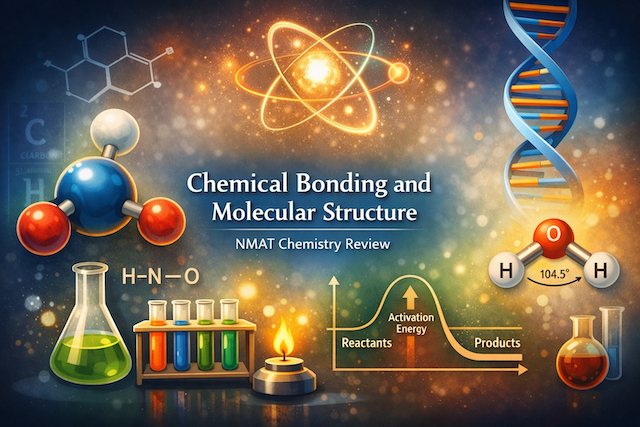
Chemical Bonding and Molecular Structure: NMAT Chemistry Review
Contents
- Chemical Bonding and Molecular Structure: NMAT Chemistry Review
- Importance of Chemical Bonding in NMAT
- Types of Chemical Bonds
- Ionic Bonding
- Covalent Bonding
- Metallic Bonding
- Electronegativity and Bond Polarity
- Lewis Structures
- Resonance Structures
- Valence Shell Electron Pair Repulsion (VSEPR) Theory
- Molecular Geometry vs Electron Geometry
- Hybridization
- Sigma and Pi Bonds
- Intermolecular Forces
- Types of Intermolecular Forces
- Molecular Polarity
- Applications to NMAT and Medical Sciences
- Study Tips for NMAT
- Conclusion
- Chemical Bonding and Molecular Structure: NMAT Chemistry Problem Set with Answer Key
- Problem Set
- Answer Key (with Brief Explanations)
Chemical Bonding and Molecular Structure: NMAT Chemistry Review
Chemical bonding and molecular structure are core topics in NMAT Chemistry, forming the foundation for understanding how substances are formed, how they interact, and why they exhibit specific physical and chemical properties. Questions from this area often test conceptual clarity rather than rote memorization, focusing on bond types, molecular geometry, polarity, hybridization, and intermolecular forces. A strong grasp of these concepts is essential not only for NMAT success but also for medical-related fields such as biochemistry, pharmacology, and molecular biology.
Importance of Chemical Bonding in NMAT
Chemical bonding explains how atoms combine to form molecules and compounds. In the NMAT, this topic is frequently integrated with other areas such as stoichiometry, gas laws, thermodynamics, and organic chemistry. Understanding bonding helps explain reaction mechanisms, molecular polarity, solubility, boiling points, and biological interactions such as enzyme–substrate binding.
NMAT questions typically assess your ability to:
- Identify bond types and predict properties
- Analyze Lewis structures and molecular shapes
- Apply VSEPR and hybridization concepts
- Compare intermolecular forces
- Determine molecular polarity
Types of Chemical Bonds
A chemical bond is the force that holds atoms together in a molecule or compound. The three primary types of chemical bonds are ionic, covalent, and metallic bonds.
Ionic Bonding
Ionic bonds form through the transfer of electrons from one atom to another, usually between a metal and a nonmetal. The atom that loses electrons becomes a positively charged cation, while the atom that gains electrons becomes a negatively charged anion. The electrostatic attraction between oppositely charged ions holds the compound together.
Key characteristics of ionic compounds include:
- High melting and boiling points
- Formation of crystalline lattice structures
- Electrical conductivity when molten or dissolved in water
- Solubility in polar solvents
Examples include sodium chloride (NaCl), potassium bromide (KBr), and calcium oxide (CaO).
Covalent Bonding
Covalent bonds form when atoms share one or more pairs of electrons. This type of bonding usually occurs between nonmetals with similar electronegativities. Covalent bonds allow atoms to achieve stable electron configurations without complete electron transfer.
Covalent bonds can be classified as:
- Nonpolar covalent bonds: Equal sharing of electrons (e.g., H₂, O₂)
- Polar covalent bonds: Unequal sharing due to electronegativity differences (e.g., H₂O, NH₃)
Most biological molecules such as proteins, carbohydrates, lipids, and nucleic acids are held together by covalent bonds, making this concept particularly important for NMAT examinees pursuing medicine.
Metallic Bonding
Metallic bonding occurs between metal atoms and involves a “sea of delocalized electrons” surrounding positively charged metal ions. These mobile electrons account for the characteristic properties of metals.
Properties explained by metallic bonding include:
- Electrical and thermal conductivity
- Malleability and ductility
- Metallic luster
Electronegativity and Bond Polarity
Electronegativity is the ability of an atom to attract electrons toward itself in a chemical bond. Differences in electronegativity determine the type and polarity of a bond.
General guidelines:
- Difference < 0.4: Nonpolar covalent
- Difference between 0.4–1.7: Polar covalent
- Difference > 1.7: Ionic character
Bond polarity leads to partial charges (δ⁺ and δ⁻) within molecules, which play a major role in intermolecular interactions and solubility.
Lewis Structures
Lewis structures represent the arrangement of valence electrons in a molecule. They show bonding pairs and lone pairs of electrons and help predict molecular geometry and reactivity.
Steps to draw Lewis structures:
- Count total valence electrons
- Determine the central atom
- Connect atoms with single bonds
- Distribute remaining electrons to satisfy the octet rule
- Form multiple bonds if needed
Exceptions to the octet rule include hydrogen (duet rule), expanded octets (e.g., sulfur, phosphorus), and odd-electron molecules.
Resonance Structures
Some molecules cannot be represented accurately by a single Lewis structure. Instead, they exist as resonance hybrids, where electrons are delocalized over multiple atoms.
Common examples include:
- Ozone (O₃)
- Nitrate ion (NO₃⁻)
- Benzene (C₆H₆)
Resonance increases molecular stability and is frequently tested conceptually in NMAT questions.
Valence Shell Electron Pair Repulsion (VSEPR) Theory
VSEPR theory predicts the three-dimensional shape of molecules by minimizing repulsion between electron pairs around a central atom. Electron pairs include both bonding and lone pairs.
Common molecular geometries:
- Linear (180°)
- Trigonal planar (120°)
- Tetrahedral (109.5°)
- Trigonal bipyramidal
- Octahedral
Lone pairs increase repulsion, leading to deviations from ideal bond angles, as seen in water (bent shape) and ammonia (trigonal pyramidal).
Molecular Geometry vs Electron Geometry
Electron geometry considers all electron pairs, while molecular geometry considers only bonded atoms. This distinction is important when lone pairs are present.
For example:
- Water (H₂O): Electron geometry is tetrahedral, molecular geometry is bent
- Ammonia (NH₃): Electron geometry is tetrahedral, molecular geometry is trigonal pyramidal
Hybridization
Hybridization describes the mixing of atomic orbitals to form new hybrid orbitals that accommodate bonding. It helps explain molecular shape and bond angles.
Common hybridizations include:
- sp: Linear geometry
- sp²: Trigonal planar geometry
- sp³: Tetrahedral geometry
For NMAT, it is important to relate hybridization to the number of sigma bonds and lone pairs around the central atom.
Sigma and Pi Bonds
A sigma (σ) bond is formed by head-on overlap of orbitals and is the strongest type of covalent bond. A pi (π) bond is formed by sideways overlap of p orbitals.
Bond types:
- Single bond: 1 σ
- Double bond: 1 σ + 1 π
- Triple bond: 1 σ + 2 π
Multiple bonds restrict rotation and affect molecular geometry and reactivity.
Intermolecular Forces
Intermolecular forces (IMFs) are attractions between molecules. Although weaker than covalent or ionic bonds, they significantly influence physical properties such as boiling point, melting point, and solubility.
Types of Intermolecular Forces
- London dispersion forces: Present in all molecules; weakest but dominant in nonpolar substances
- Dipole–dipole interactions: Occur between polar molecules
- Hydrogen bonding: Strong dipole interaction involving H bonded to N, O, or F
Hydrogen bonding is crucial in biological systems, influencing the structure of DNA, proteins, and water.
Molecular Polarity
Molecular polarity depends on both bond polarity and molecular geometry. A molecule with polar bonds may still be nonpolar if the bond dipoles cancel out due to symmetry.
Examples:
- CO₂: Nonpolar (linear and symmetric)
- H₂O: Polar (bent geometry)
- NH₃: Polar (trigonal pyramidal)
Applications to NMAT and Medical Sciences
Understanding bonding and molecular structure is essential for interpreting biochemical interactions, drug–receptor binding, solubility of medications, and acid–base behavior in physiological systems.
NMAT questions often integrate:
- Molecular shape with polarity
- Intermolecular forces with boiling points
- Hybridization with reactivity
Study Tips for NMAT
To master chemical bonding and molecular structure:
- Practice drawing Lewis structures
- Memorize common VSEPR geometries
- Relate hybridization to molecular shape
- Compare intermolecular forces conceptually
- Focus on reasoning rather than formulas
Conclusion
Chemical bonding and molecular structure form the backbone of chemistry and play a vital role in NMAT preparation. By understanding how atoms bond, how molecules are shaped, and how they interact with one another, students can confidently tackle NMAT chemistry questions and build a strong foundation for future medical studies. Mastery of these concepts not only improves exam performance but also enhances scientific thinking essential for a career in healthcare.
Chemical Bonding and Molecular Structure: NMAT Chemistry Problem Set with Answer Key
Problem Set
- Which statement best describes an ionic bond?
A. Electrons are shared equally between atoms
B. Electrons are transferred from one atom to another
C. Protons are transferred between nuclei
D. Orbitals overlap sideways to form pi bonds - Which pair is most likely to form an ionic compound?
A. C and H
B. Na and Cl
C. O and O
D. N and H - A covalent bond is generally formed when:
A. A metal reacts with a nonmetal
B. Two nonmetals share electrons
C. Two metals transfer electrons
D. A noble gas gains electrons easily - Which bond is most polar?
A. H–H
B. C–H
C. H–F
D. Cl–Cl - Which molecule is nonpolar despite having polar bonds?
A. H2O
B. NH3
C. CO2
D. SO2 - The central atom in a Lewis structure is usually the atom that:
A. Has the highest electronegativity
B. Is hydrogen
C. Has the lowest electronegativity (excluding H)
D. Always has a complete octet in the free state - How many valence electrons are in the nitrate ion, NO3−?
A. 18
B. 23
C. 24
D. 26 - Which species is best represented by resonance structures?
A. CH4
B. H2O
C. NO3−
D. NaCl - According to VSEPR, the shape of BF3 is:
A. Linear
B. Trigonal planar
C. Tetrahedral
D. Trigonal pyramidal - The molecular geometry of NH3 is:
A. Trigonal planar
B. Trigonal pyramidal
C. Tetrahedral
D. Bent - Water (H2O) has a bent shape primarily because:
A. Oxygen forms an ionic bond with hydrogen
B. Oxygen has two lone pairs that repel bonding pairs
C. Hydrogen has lone pairs that repel oxygen electrons
D. Water has resonance structures - Which has the greatest bond angle around the central atom?
A. CH4
B. NH3
C. H2O
D. CO2 - Hybridization of the central carbon atom in CO2 is:
A. sp
B. sp2
C. sp3
D. dsp3 - How many sigma (σ) and pi (π) bonds are in a double bond?
A. 2 σ, 0 π
B. 1 σ, 1 π
C. 0 σ, 2 π
D. 1 σ, 2 π - A triple bond contains:
A. 3 σ and 0 π
B. 2 σ and 1 π
C. 1 σ and 2 π
D. 1 σ and 1 π - Which intermolecular force is present in all molecules?
A. Hydrogen bonding
B. Dipole–dipole interactions
C. Ion–dipole forces
D. London dispersion forces - Which compound is most likely to exhibit hydrogen bonding between its molecules?
A. CH4
B. HCl
C. NH3
D. CO2 - Among the following, which is expected to have the highest boiling point?
A. CH4
B. NH3
C. CO2
D. Ne - Which molecule is polar?
A. CCl4
B. CO2
C. SO2
D. BF3 - Which statement about bond length is correct?
A. Triple bonds are longer than single bonds between the same atoms
B. Double bonds are longer than single bonds between the same atoms
C. Bond length generally decreases as bond order increases
D. Bond length is independent of bond strength - Which statement about bond strength is correct?
A. Single bonds are strongest between the same atoms
B. Bond strength generally increases as bond order increases
C. Polar bonds are always weaker than nonpolar bonds
D. Pi bonds are stronger than sigma bonds - Which best describes metallic bonding?
A. Electrons are localized between pairs of atoms
B. Electrons are transferred and locked in a lattice
C. A sea of delocalized electrons surrounds metal cations
D. Hydrogen bonds form a network between metal atoms - Which property is most characteristic of ionic compounds?
A. Low melting point and nonconductive in solution
B. High melting point and conductive when dissolved
C. Soft and malleable, conductive as solids
D. Always insoluble in water - A molecule has polar bonds but is overall nonpolar. The best explanation is:
A. The molecule contains ions
B. The molecule has symmetric geometry causing dipole cancellation
C. The molecule has only single bonds
D. The molecule contains hydrogen bonding
Answer Key (with Brief Explanations)
- B — Ionic bonding involves electron transfer and electrostatic attraction.
- B — Na (metal) + Cl (nonmetal) typically forms NaCl via electron transfer.
- B — Covalent bonds form from electron sharing, usually between nonmetals.
- C — H–F has a large electronegativity difference, making it highly polar.
- C — CO2 is linear; polar bond dipoles cancel, so it’s nonpolar.
- C — The least electronegative (non-H) atom is usually central (can form more bonds).
- C — NO3−: N (5) + 3O (18) + 1 extra = 24.
- C — Nitrate has delocalized pi electrons; resonance structures apply.
- B — BF3 has 3 electron groups around B → trigonal planar.
- B — NH3 has 3 bonds + 1 lone pair → trigonal pyramidal.
- B — Lone pair–bond pair repulsions bend the molecule.
- D — CO2 is linear with a 180° bond angle (largest listed).
- A — CO2 has 2 electron domains around C → sp hybridized.
- B — A double bond is composed of 1 σ and 1 π bond.
- C — A triple bond contains 1 σ and 2 π bonds.
- D — London dispersion forces occur in all atoms/molecules.
- C — NH3 can hydrogen bond via N–H and lone pair on N.
- B — NH3 has hydrogen bonding, increasing boiling point.
- C — SO2 is bent, so it has a net dipole (polar).
- C — Higher bond order → shorter bond length and stronger bond.
- B — Bond strength increases with bond order (triple > double > single).
- C — Metallic bonds involve delocalized electrons around metal ions.
- B — Ionic compounds often have high mp and conduct in molten/aqueous states.
- B — Symmetry cancels dipoles, producing an overall nonpolar molecule.

How to Register for eTravel Philippines (2025 Guide)
Step-by-step guide to completing your eTravel registration before arriving in the Philippines, with images and tips.

Night Market in Cebu – Things You Don’t Know About Cebu Life
Discover the hidden charm of Cebu’s night markets, from street food stalls to local life tips you won’t find in tourist guides.

How to Use ChatGPT for IELTS Preparation: A Complete Guide
Learn how to prepare for IELTS using ChatGPT — including strategies for Writing, Reading, Listening, Speaking, and grammar support.

How to Build a Website Without Coding Using ChatGPT
Discover how to build your own website using AI—no coding skills needed. From structure planning to SEO and design, let ChatGPT guide you.