2026年1月5日
3D ACADEMY offers affordable English study programs in Cebu, Philippines – perfect for beginners, professionals, and exam takers.

3D UNIVERSAL ENGLISH INSTITUTE INC
info.3d-universal.com
8:00-17:00(Mon-Fri)
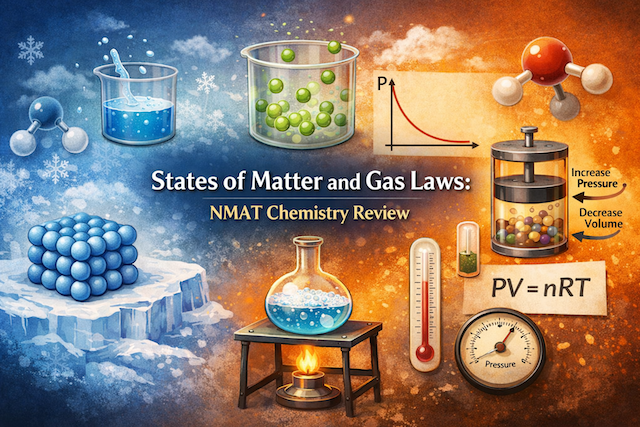
States of Matter and Gas Laws: NMAT Chemistry Review
Contents
- States of Matter and Gas Laws: NMAT Chemistry Review
- States of Matter: Particle View and Key Properties
- Intermolecular Forces and Their Role in Phases
- Phase Changes and Heating Curves
- Pressure, Temperature, and Units You Must Know
- Kinetic Molecular Theory (KMT): The Ideal Gas Model
- Boyle’s Law, Charles’s Law, and Gay-Lussac’s Law
- Combined Gas Law
- Avogadro’s Law and Molar Volume
- Ideal Gas Law: PV = nRT
- Dalton’s Law of Partial Pressures
- Real Gases: When the Ideal Model Fails
- High-Yield Problem-Solving Strategy for NMAT
- Quick NMAT Mini-Review Summary
- Problem Sets
- Set 1: States of Matter and Phase Changes (Conceptual)
- Set 2: Gas Law Relationships (Boyle/Charles/Gay-Lussac/Combined)
- Set 3: Ideal Gas Law (PV = nRT)
- Set 4: Dalton’s Law and Gas Over Water
- Set 5: Real vs Ideal Gases (Concept + Quick Reasoning)
- Answer Keys
- Set 1 Answer Key
- Set 2 Answer Key
- Set 3 Answer Key
- Set 4 Answer Key
- Set 5 Answer Key
States of Matter and Gas Laws: NMAT Chemistry Review
Understanding the states of matter and gas laws is a high-yield topic for the NMAT because it connects microscopic particle behavior to macroscopic properties you can measure (pressure, volume, temperature, and moles). Many NMAT questions test whether you can interpret particle motion, phase changes, and apply gas-law relationships quickly and correctly. This review builds a strong foundation: how solids, liquids, and gases differ; how phase transitions work; and how to solve common gas-law problems, including ideal and real gas behavior.
States of Matter: Particle View and Key Properties
Matter is classified into states based on how particles are arranged and how strongly they interact. The major states for NMAT chemistry are solid, liquid, and gas (with plasma sometimes mentioned conceptually).
Solids have particles packed closely in fixed positions (especially in crystalline solids). They have:
- Definite shape and definite volume
- Low compressibility (particles are already tightly packed)
- High density relative to liquids and gases
- Small particle motion: mainly vibrations around fixed points
Liquids have particles close together but not fixed; they slide past one another. They have:
- Definite volume but no definite shape (take the shape of the container)
- Low compressibility
- Moderate density
- Fluidity because particles can move around
Gases have particles far apart with minimal intermolecular attraction in most conditions. They have:
- No definite shape and no definite volume (expand to fill container)
- High compressibility
- Low density
- Rapid, random motion with frequent collisions
Plasma is an ionized gas with free electrons and ions. It appears in stars, lightning, and neon signs. For NMAT, plasma is usually conceptual rather than computational.
Common NMAT trick: If you increase temperature, particle kinetic energy increases. This affects gas pressure, liquid evaporation, and solid vibration intensity, but compressibility trends remain: gas >> liquid ≈ solid.
Intermolecular Forces and Their Role in Phases
Intermolecular forces (IMFs) are attractions between molecules and strongly influence melting/boiling points, viscosity, and surface tension. Stronger IMFs typically mean higher boiling points and lower vapor pressures.
- London dispersion forces: present in all substances; strongest in larger, more polarizable molecules.
- Dipole–dipole forces: between polar molecules; moderate strength.
- Hydrogen bonding: a strong dipole–dipole interaction when H is bonded to N, O, or F; leads to unusually high boiling points (e.g., water).
Link to states of matter: solids and liquids exist when IMFs can hold particles near each other. Gases dominate when kinetic energy (temperature) overcomes IMFs.
Phase Changes and Heating Curves
Phase changes occur when matter transitions between solid, liquid, and gas. Key transitions include:
- Melting (fusion): solid → liquid
- Freezing: liquid → solid
- Vaporization: liquid → gas (includes boiling and evaporation)
- Condensation: gas → liquid
- Sublimation: solid → gas
- Deposition: gas → solid
In a heating curve, temperature changes during warming within a phase, but stays constant during phase changes because energy goes into overcoming IMFs rather than increasing kinetic energy.
Energy and heat terms:
- Endothermic (absorbs heat): melting, vaporization, sublimation
- Exothermic (releases heat): freezing, condensation, deposition
Boiling vs evaporation: evaporation occurs at the surface at any temperature; boiling occurs throughout the liquid at the boiling point when vapor pressure equals external pressure.
Pressure, Temperature, and Units You Must Know
Gas laws rely heavily on correct units. NMAT frequently tests unit conversions and understanding of what pressure and temperature represent.
Temperature: Use Kelvin for gas laws.
- K = °C + 273 (more precisely +273.15)
Pressure commonly appears in:
- atm
- mmHg (or torr)
- kPa
Useful equivalences:
- 1 atm = 760 mmHg = 760 torr
- 1 atm ≈ 101.3 kPa
Volume is typically in liters (L) or milliliters (mL). Remember: 1 L = 1000 mL.
What is pressure? It is force per unit area caused by gas particle collisions with container walls. Higher temperature increases collision frequency/force; smaller volume increases collision frequency.
Kinetic Molecular Theory (KMT): The Ideal Gas Model
Kinetic Molecular Theory describes how ideal gases behave. The ideal gas is a simplified model that works best at high temperature and low pressure.
Key assumptions of an ideal gas:
- Gas particles have negligible volume compared to the container.
- No intermolecular attractions or repulsions exist between particles.
- Particles move randomly in straight lines and collide elastically (no net energy loss).
- Average kinetic energy depends only on absolute temperature.
High-yield implication: If two gases are at the same temperature, their particles have the same average kinetic energy, even if their molar masses differ. However, lighter molecules move faster on average (greater speed), because kinetic energy is (1/2)mv².
Boyle’s Law, Charles’s Law, and Gay-Lussac’s Law
These laws describe relationships between two variables while holding the others constant.
Boyle’s Law (P–V relationship): At constant temperature and moles, pressure is inversely proportional to volume.
P₁V₁ = P₂V₂
If volume decreases, pressure increases (assuming T and n constant).
Charles’s Law (V–T relationship): At constant pressure and moles, volume is directly proportional to absolute temperature.
V₁/T₁ = V₂/T₂
Temperature must be in Kelvin. Heating a gas expands it at constant pressure.
Gay-Lussac’s Law (P–T relationship): At constant volume and moles, pressure is directly proportional to absolute temperature.
P₁/T₁ = P₂/T₂
Heating a gas in a rigid container increases its pressure.
NMAT speed tip: For direct relationships (V–T, P–T): increase one → increase the other. For inverse (P–V): increase one → decrease the other.
Combined Gas Law
The combined gas law merges Boyle’s, Charles’s, and Gay-Lussac’s laws when moles are constant:
(P₁V₁)/T₁ = (P₂V₂)/T₂
This is common in NMAT problems where pressure, volume, and temperature change simultaneously. Always convert temperatures to Kelvin before solving. Be careful with consistent units (e.g., both pressures in atm, both volumes in liters).
Avogadro’s Law and Molar Volume
Avogadro’s Law: At constant temperature and pressure, volume is directly proportional to the number of moles.
V₁/n₁ = V₂/n₂
Key idea: If you double the moles of gas (at same T and P), the volume doubles.
Molar volume at STP: In many exam contexts, STP is defined as 1 atm and 0°C (273 K), where 1 mole of an ideal gas occupies approximately 22.4 L.
Some sources define “standard” conditions slightly differently (e.g., 1 bar), but NMAT-style problems typically use the classic 22.4 L at 1 atm and 0°C unless specified otherwise.
Ideal Gas Law: PV = nRT
The most powerful single equation for gases is the ideal gas law:
PV = nRT
Where:
- P = pressure
- V = volume
- n = moles
- T = temperature (Kelvin)
- R = gas constant
Common R values (use the one that matches your units):
- R = 0.0821 L·atm·mol⁻¹·K⁻¹
- R = 62.4 L·torr·mol⁻¹·K⁻¹
- R = 8.314 J·mol⁻¹·K⁻¹ (when using energy units)
NMAT pattern: If given grams of gas, you often need to convert to moles first using molar mass. Then solve for the missing variable.
Density form (very useful): From PV = nRT and n = m/M (mass/molar mass), you can derive:
Density (d) = (PM)/(RT)
This helps compare densities of gases at the same T and P: density is proportional to molar mass.
Dalton’s Law of Partial Pressures
For a mixture of non-reacting gases in the same container, the total pressure equals the sum of individual partial pressures:
Ptotal = P₁ + P₂ + P₃ + …
The partial pressure of a gas is the pressure it would exert if it alone occupied the container at the same temperature.
Mole fraction relationship:
Pi = Xi · Ptotal
where Xi = ni / ntotal.
Collection of gas over water: A classic problem type. If a gas is collected over water, the measured pressure includes water vapor.
Pgas = Ptotal − PH2O
You must subtract the vapor pressure of water (given in a table or in the problem) to find the dry gas pressure.
Real Gases: When the Ideal Model Fails
Real gases deviate from ideal behavior when the ideal assumptions fail—mainly when particle volume and intermolecular forces are no longer negligible.
Greatest deviations occur at:
- High pressure (particles are closer together; volume matters)
- Low temperature (particles move slower; attractions matter more)
How deviations happen conceptually:
- Attractions between particles can reduce measured pressure because particles pull each other away from the walls.
- Finite particle volume reduces the free space available for motion, effectively altering volume.
For NMAT, you are usually not required to use advanced real-gas equations, but you should know when ideal assumptions are least valid and why.
High-Yield Problem-Solving Strategy for NMAT
Many gas-law mistakes come from avoidable errors. Use this checklist:
- Convert temperature to Kelvin before plugging into formulas.
- Keep units consistent (don’t mix atm with kPa unless converting).
- Identify what is held constant (T? P? V? n?) to choose the simplest law.
- Use ratios (Boyle/Charles/Gay-Lussac/Combined law) when moles are constant and you’re comparing two states.
- Use PV = nRT when you have a single state and can compute moles.
- Watch significant information: “collected over water,” “rigid container,” “piston moves freely,” “sealed container,” and “same conditions.”
Common conceptual questions:
- If temperature increases in a sealed rigid container, what happens to pressure? (It increases.)
- At the same temperature, which gas has faster molecules: He or O₂? (He, because lower molar mass.)
- Which conditions favor ideal behavior? (Low pressure, high temperature.)
- Why does water have a high boiling point? (Strong hydrogen bonding.)
Quick NMAT Mini-Review Summary
- Solids: fixed shape/volume, low compressibility; particles vibrate.
- Liquids: fixed volume, variable shape; particles flow.
- Gases: variable shape/volume, high compressibility; particles move randomly.
- Phase changes: temperature constant during melting/boiling; energy breaks/form IMFs.
- Boyle: P inversely with V (T constant).
- Charles: V directly with T (P constant).
- Gay-Lussac: P directly with T (V constant).
- Combined: (PV)/T constant (n constant).
- Ideal gas law: PV = nRT.
- Dalton: total pressure is sum of partial pressures.
- Real gas deviations: high P, low T.
Mastering these ideas gives you both conceptual strength and computational speed—exactly what NMAT chemistry questions reward.
Problem Sets
Set 1: States of Matter and Phase Changes (Conceptual)
- Which state of matter has a definite volume but no definite shape?
- Which state of matter is most compressible?
- Which phase change is endothermic: condensation or vaporization?
- During a phase change on a heating curve, why does temperature remain constant?
- Which intermolecular force is strongest in typical molecular substances: London dispersion, dipole–dipole, or hydrogen bonding?
- Which has stronger intermolecular forces: CH4 or C4H10?
- Boiling occurs when the vapor pressure of a liquid equals what external quantity?
- What phase change is the reverse of sublimation?
- Which generally has higher surface tension: a liquid with stronger IMFs or weaker IMFs?
- Which statement is true at the particle level for gases (choose the best): particles are closely packed, particles move randomly and are far apart, particles vibrate in fixed positions?
Set 2: Gas Law Relationships (Boyle/Charles/Gay-Lussac/Combined)
- A gas has P1 = 2.00 atm and V1 = 3.00 L at constant temperature. If the pressure changes to P2 = 1.20 atm, what is V2?
- A balloon has V1 = 2.50 L at T1 = 300 K (constant pressure). If the temperature increases to 360 K, what is V2?
- A sealed rigid container holds a gas at P1 = 0.80 atm and T1 = 250 K. If heated to 400 K, what is P2?
- A gas is compressed from V1 = 5.0 L to V2 = 2.0 L at constant temperature. If P1 = 1.0 atm, what is P2?
- Use the combined gas law: A gas has P1 = 1.50 atm, V1 = 4.00 L, T1 = 300 K. It changes to P2 = 1.00 atm and T2 = 350 K. What is V2?
- A gas sample is cooled from 27°C to -33°C at constant pressure. If V1 = 3.60 L, what is V2? (Use Kelvin.)
- A gas in a rigid tank has its temperature doubled (in Kelvin). What happens to its pressure (assume ideal behavior)?
- A piston allows volume to change freely while pressure stays constant. If the gas temperature decreases from 500 K to 400 K, does the volume increase, decrease, or stay the same?
Set 3: Ideal Gas Law (PV = nRT)
- How many moles of gas are in a 10.0 L container at 2.00 atm and 300 K? (Use R = 0.0821 L·atm·mol-1·K-1.)
- What is the pressure of 0.750 mol of gas in a 5.00 L container at 298 K?
- What volume does 1.20 mol of gas occupy at 1.00 atm and 273 K?
- A 4.00 g sample of He is placed in a 2.00 L container at 300 K. What is the pressure? (Molar mass He = 4.00 g/mol.)
- At constant T and V, moles of gas are tripled. What happens to pressure?
- Using the density relation d = (PM)/(RT): At 1.00 atm and 300 K, which has higher density, N2 or CO2, and why?
Set 4: Dalton’s Law and Gas Over Water
- A mixture contains O2 at 0.40 atm and N2 at 0.55 atm. What is the total pressure?
- The total pressure of a gas mixture is 1.20 atm. The mole fraction of CO2 is 0.25. What is PCO2?
- A gas is collected over water at a total pressure of 760 mmHg. If the vapor pressure of water is 24 mmHg, what is the dry gas pressure?
- A mixture contains 2.0 mol He and 1.0 mol Ne at the same T and V. What is the mole fraction of He?
- In the mixture in Q4, if Ptotal = 3.00 atm, what is PHe?
Set 5: Real vs Ideal Gases (Concept + Quick Reasoning)
- Under which conditions do gases deviate most from ideal behavior: high T/low P or low T/high P?
- Give one reason measured pressure of a real gas can be lower than ideal pressure under the same conditions.
- Which gas is expected to deviate more from ideal behavior at the same T and P: NH3 or He? (Explain briefly.)
- True or False: At the same temperature, all gases have the same average kinetic energy.
- At STP (1 atm, 273 K), what is the approximate molar volume of an ideal gas?
Answer Keys
Set 1 Answer Key
- Liquid
- Gas
- Vaporization (endothermic); condensation is exothermic
- Heat energy is used to overcome intermolecular forces (change potential energy), not increase kinetic energy
- Hydrogen bonding
- C4H10 (larger molecule → stronger London dispersion)
- External (atmospheric) pressure
- Deposition
- Stronger IMFs
- Particles move randomly and are far apart
Set 2 Answer Key
- V2 = (P1V1)/P2 = (2.00 × 3.00)/1.20 = 5.00 L
- V2 = V1(T2/T1) = 2.50(360/300) = 3.00 L
- P2 = P1(T2/T1) = 0.80(400/250) = 1.28 atm
- P2 = P1(V1/V2) = 1.0(5.0/2.0) = 2.5 atm
- V2 = (P1V1T2)/(P2T1) = (1.50×4.00×350)/(1.00×300) = 7.00 L
- Convert: T1 = 27°C = 300 K; T2 = -33°C = 240 K
V2 = V1(T2/T1) = 3.60(240/300) = 2.88 L - Pressure doubles (P ∝ T when V is constant)
- Volume decreases (V ∝ T when P is constant)
Set 3 Answer Key
- n = PV/RT = (2.00×10.0)/(0.0821×300) = 20.0/24.63 ≈ 0.812 mol
- P = nRT/V = (0.750×0.0821×298)/5.00
= (0.750×24.466)/5.00 = 18.35/5.00 ≈ 3.67 atm - V = nRT/P = (1.20×0.0821×273)/1.00
= 1.20×22.413 ≈ 26.9 L - n = 4.00 g / (4.00 g/mol) = 1.00 mol
P = nRT/V = (1.00×0.0821×300)/2.00 = 24.63/2.00 = 12.3 atm - Pressure triples (P ∝ n when T and V are constant)
- CO2 has higher density because it has a larger molar mass (44 g/mol vs 28 g/mol), so d ∝ M at fixed P and T
Set 4 Answer Key
- Ptotal = 0.40 + 0.55 = 0.95 atm
- PCO2 = XCO2·Ptotal = 0.25×1.20 = 0.30 atm
- Pgas = 760 − 24 = 736 mmHg
- XHe = 2.0/(2.0+1.0) = 2/3 ≈ 0.667
- PHe = XHe·Ptotal = (2/3)×3.00 = 2.00 atm
Set 5 Answer Key
- Low T / High P
- Intermolecular attractions pull particles inward, reducing wall-collision force and lowering measured pressure
- NH3 (polar, can hydrogen bond) deviates more than He (very weak attractions)
- True
- Approximately 22.4 L/mol

How to Register for eTravel Philippines (2025 Guide)
Step-by-step guide to completing your eTravel registration before arriving in the Philippines, with images and tips.

Night Market in Cebu – Things You Don’t Know About Cebu Life
Discover the hidden charm of Cebu’s night markets, from street food stalls to local life tips you won’t find in tourist guides.

How to Use ChatGPT for IELTS Preparation: A Complete Guide
Learn how to prepare for IELTS using ChatGPT — including strategies for Writing, Reading, Listening, Speaking, and grammar support.

How to Build a Website Without Coding Using ChatGPT
Discover how to build your own website using AI—no coding skills needed. From structure planning to SEO and design, let ChatGPT guide you.