2026年4月5日
3D ACADEMY offers affordable English study programs in Cebu, Philippines – perfect for beginners, professionals, and exam takers.

3D UNIVERSAL ENGLISH INSTITUTE INC
info.3d-universal.com
8:00-17:00(Mon-Fri)
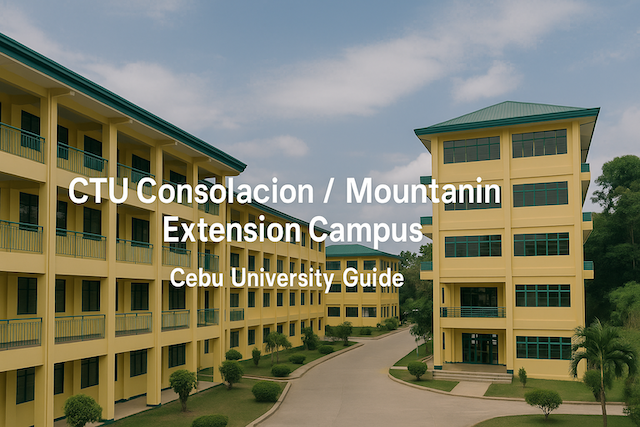
CTU Consolacion / Mountain Extension Campus
Contents
- CTU Consolacion / Mountain Extension Campus: Cebu University Guide
- Overview of CTU Consolacion / Mountain Extension Campus
- Academic Programs Offered
- Campus Facilities and Learning Environment
- Admission Requirements and Application Process
- Tuition Fees and Financial Assistance
- Student Life and Campus Culture
- Career Opportunities for Graduates
- Why Choose CTU Consolacion / Mountain Extension Campus?
- FAQs (Frequently Asked Questions)
- Where is CTU Consolacion / Mountain Extension Campus located?
- What types of programs are offered at CTU Consolacion / Mountain Extension Campus?
- Is tuition really free at this campus?
- What are the basic admission requirements for new students?
- Does the campus require an entrance exam?
- Are there dormitories or on-campus housing options?
- What facilities can students expect on campus?
- What is student life like at CTU Consolacion / Mountain Extension Campus?
- What career opportunities are available for graduates?
- Can working students or non-traditional learners enroll here?
- How can students get updated information about the campus?
CTU Consolacion / Mountain Extension Campus: Cebu University Guide
The Cebu Technological University (CTU) Consolacion / Mountain Extension Campus serves as one of the university’s developing satellite learning sites in northern Metro Cebu. Positioned to support local communities in Consolacion, Liloan, and nearby highland barangays, this extension campus aims to extend technical, vocational, and higher education access to students who may not have the means to travel daily to Cebu City or other major campuses.
While not as large as CTU’s main campuses, the Consolacion / Mountain Extension Campus plays an important role in regional educational development. It provides accessible programs in technology, education, agriculture, community development, and technical-vocational training, helping bridge academic opportunities between urban and rural communities.
This guide provides a complete overview for prospective students, parents, and working professionals who want to learn more about the academic offerings, facilities, admissions process, tuition fees, and student life at CTU Consolacion.
Overview of CTU Consolacion / Mountain Extension Campus
CTU Consolacion / Mountain Extension Campus was developed to address the increasing demand for inclusive education in Northern Cebu. Its mission aligns with the CTU system’s mandate to promote technological advancement, workforce development, and community empowerment through accessible and industry-aligned programs.
Because the campus is positioned near upland barangays, many of its students come from local farming families, working individuals, or youth pursuing affordable higher education options. The campus offers flexible scheduling, practical training, and community-based programs, making it suitable for students who balance schooling with work or household responsibilities.
Although still expanding, CTU Consolacion offers a selection of degree programs, extension activities, research initiatives, and outreach projects that reflect CTU’s commitment to serving rural and semi-urban communities.
Academic Programs Offered
The specific offerings may vary year to year, but CTU Consolacion / Mountain Extension Campus typically focuses on programs that are feasible for satellite campuses and relevant to local industries. These include bachelor’s programs, diploma courses, and TESDA-aligned technical-vocational training.
Bachelor’s Degree Programs
Common undergraduate offerings for CTU extension campuses include:
-
Bachelor of Science in Industrial Technology (BSIT)
Concentrations may include automotive, electrical technology, electronics, or refrigeration and air-conditioning. -
Bachelor of Science in Agriculture (BSA)
A program suited for upland communities, with training in crops, soil science, and agricultural innovation. -
Bachelor of Secondary Education (BSEd)
Majors may include Science, English, or Mathematics, supporting the need for future educators in the region. -
Bachelor of Technology and Livelihood Education (BTLEd)
Prepares students for teaching roles in TLE and vocational subjects.
Technical-Vocational and Short Courses
To support immediate employability, the campus often provides:
-
Automotive Servicing NC I–II
-
Electrical Installation and Maintenance NC II
-
Welding courses (SMAW)
-
Bread and Pastry Production NC II
-
Agricultural crop production training
These short courses are particularly valuable for working adults, out-of-school youth, and individuals seeking upskilling without committing to a four-year program.
Community-Based Extension Programs
The campus regularly hosts:
-
Livelihood workshops
-
Farming and agri-tech demonstrations
-
Digital literacy training
-
Seminars on entrepreneurship and cooperatives
These programs strengthen CTU’s engagement with local communities in Consolacion and surrounding areas.
Campus Facilities and Learning Environment
While smaller than CTU’s major campuses, CTU Consolacion / Mountain Extension still provides essential academic and training facilities to support practical learning.
Classrooms and Lecture Facilities
The campus features standard classrooms equipped with whiteboards, projectors, and seating suitable for small to medium-sized classes. The environment remains conducive to focused learning, especially for students who prefer less-crowded settings.
Laboratories and Workshops
Depending on program offerings, the campus may have:
-
Tech-Voc workshops for welding, automotive, and electrical work
-
Agriculture demonstration areas for basic crop training
-
Computer labs for ICT subjects
These facilities ensure that students receive hands-on experience aligned with industry needs.
Library and Learning Resource Center
A small campus library provides academic references, textbooks, and research materials. Students also have access to CTU’s digital library resources, which offer journals, e-books, and databases.
Community and Outdoor Spaces
The campus includes open areas used for community events, student gatherings, and agricultural activities. These spaces support outdoor learning, especially for agriculture and extension programs.
Admission Requirements and Application Process
Admission to CTU Consolacion / Mountain Extension Campus follows the general CTU system guidelines. Requirements and procedures may change annually, but the following outline provides a reliable overview.
General Admission Requirements
For first-year college applicants:
-
Fully accomplished CTU online admission form
-
Senior High School Report Card (Form 138)
-
Certificate of Good Moral Character
-
PSA Birth Certificate
-
2×2 ID pictures
-
Barangay clearance (sometimes required)
For transfer students:
-
Transcript of Records (TOR) or Certified True Copy of Grades
-
Honorable Dismissal
Entrance Examination
Some CTU campuses require an entrance exam or screening. Depending on capacity and program demand, the extension campus may conduct:
-
A general academic aptitude test
-
A program-specific skills assessment for technical-vocational courses
Enrollment Process
-
Submit online or on-campus application.
-
Attend orientation or interview (if required).
-
Take entrance exam (if applicable).
-
Wait for the admission results.
-
Proceed to registration and payment of minimal fees.
-
Receive class schedule and start of classes.
Tuition Fees and Financial Assistance
As part of the CTU system, CTU Consolacion benefits from the Free Higher Education Law (RA 10931). This means tuition fees for undergraduate programs in state universities are fully covered.
What Students Still Need to Pay
While tuition is free, students may pay minimal fees such as:
-
ID fee
-
Laboratory fees (depending on course)
-
Miscellaneous fees
-
Uniform costs for some programs
These payments remain significantly lower compared to private institutions.
Scholarships and Grants
Students may apply for:
-
TES scholarships
-
CHED programs such as UniFAST
-
LGU scholarships from Consolacion and nearby municipalities
-
Private sector grants for academic achievers
Working students may also choose to take flexible schedules to manage education costs.
Student Life and Campus Culture
Though smaller in size, CTU Consolacion / Mountain Extension fosters a close-knit community atmosphere. Students often develop strong bonds through shared experiences, extracurricular activities, and community involvement.
Organizations and Clubs
Depending on the programs offered, students may join:
-
Technology clubs
-
Agriculture and environmental groups
-
Education and leadership organizations
-
Arts and culture groups
These organizations help build confidence, leadership skills, and a sense of belonging.
Community Involvement
Because of its location, the campus is deeply connected with local barangays. Students regularly participate in:
-
Clean-up drives
-
Food production activities
-
Livelihood seminars
-
Outreach missions
The campus’ community-oriented culture is well-suited for students who value hands-on contribution to society.
Safety and Accessibility
CTU Consolacion is generally located in a peaceful area accessible via local transportation routes. Many students commute daily, while some stay with relatives in nearby barangays.
Career Opportunities for Graduates
Graduates of CTU Consolacion / Mountain Extension Campus enter various industries depending on their field of study.
Possible Career Paths
-
Technicians and skilled workers (automotive, electrical, welding)
-
Agriculture and livestock specialists
-
Junior engineers or technical assistants
-
TLE and secondary school teachers
-
Community development workers
-
Entrepreneurs and small business owners
Because CTU focuses on technical and practical training, graduates are often job-ready and equipped with applicable skills for both local and overseas employment.
Why Choose CTU Consolacion / Mountain Extension Campus?
This extension campus is a strong choice for students seeking accessible, practical, and affordable education. Key advantages include:
-
Free tuition for undergraduate programs
-
Close proximity to northern Cebu communities
-
Hands-on technical and vocational training
-
Student-centered and community-focused environment
-
Opportunities for research, extension, and innovation
-
Affordable schooling with flexible schedules
Its small campus size provides a more personalized learning experience, especially for students who thrive in friendly and supportive academic settings.
FAQs (Frequently Asked Questions)
Where is CTU Consolacion / Mountain Extension Campus located?
CTU Consolacion / Mountain Extension Campus is situated in the northern part of Metro Cebu, serving students from Consolacion, nearby mountain barangays, and neighboring towns. While it is not as large as the main Cebu City campus, it is positioned to be accessible by local jeepneys, tricycles, and motorcycles-for-hire. Exact directions, landmarks, and transport routes may vary, so it is best to check the latest details from the campus or CTU system’s official channels before your visit.
What types of programs are offered at CTU Consolacion / Mountain Extension Campus?
The campus generally offers a mix of bachelor’s degree programs and technical-vocational courses. Common areas include Industrial Technology, Agriculture, Education, and Technology and Livelihood Education, along with short-term TESDA-aligned courses such as automotive servicing, electrical installation, welding, and bread and pastry production. Specific programs may change over time depending on demand, faculty availability, and CHED or TESDA approvals, so applicants should always confirm the current list of offerings with the campus.
Is tuition really free at this campus?
Yes, as a campus under the Cebu Technological University system, CTU Consolacion / Mountain Extension Campus is covered by the Free Higher Education Law (RA 10931) for qualified Filipino students enrolled in approved undergraduate programs. This means that tuition and standard instructional fees are shouldered by the government. However, students still need to budget for other expenses such as ID fees, uniforms, laboratory fees, transportation, and personal learning materials. International students or those in certain non-subsidized programs may have different fee structures.
What are the basic admission requirements for new students?
New first-year applicants are usually asked to submit a completed application form (often online), their Senior High School Report Card (Form 138), a Certificate of Good Moral Character, a PSA Birth Certificate, recent ID photos, and sometimes a barangay clearance. Requirements for transferees generally include a Transcript of Records or certified copy of grades and an Honorable Dismissal from the previous school. Because policies can change, it is advisable to verify the updated admission checklist for the current academic year.
Does the campus require an entrance exam?
Many CTU campuses conduct some form of entrance exam or screening to manage enrollment and match students to appropriate programs. CTU Consolacion / Mountain Extension Campus may administer a general academic aptitude test, a short interview, or a skills-based assessment for technical-vocational courses. In some years or programs, capacity and local conditions may affect whether a formal exam is required. Applicants should carefully follow the instructions on the official CTU admission announcements for the latest procedure.
Are there dormitories or on-campus housing options?
Because CTU Consolacion / Mountain Extension Campus is a smaller extension campus, on-campus dormitories may be limited or unavailable. Most students either commute from their homes or stay with relatives and boarding houses within the municipality or nearby areas. For students coming from farther barangays or towns, it is common to look for affordable room rentals, bed spaces, or shared housing near the campus. It is wise to visit the area and compare options for safety, convenience, and budget before committing.
What facilities can students expect on campus?
The campus typically offers standard classrooms, basic laboratories, and workshops aligned with its programs, such as tech-voc workshops for automotive, electrical, or welding, and small agriculture or demonstration areas for field-based subjects. A modest library or learning resource center is usually available, sometimes complemented by digital resources from the CTU system. There may also be computer laboratories, open grounds for activities, and multi-purpose spaces used for seminars or community extension programs.
What is student life like at CTU Consolacion / Mountain Extension Campus?
Student life at this campus tends to be close-knit and community-oriented. Because of its smaller population, students often know one another across programs and year levels. Campus organizations may include academic clubs, agriculture or environment groups, leadership councils, and arts or cultural organizations. Activities often emphasize community participation, such as outreach work, livelihood trainings, environmental projects, and local celebrations. The atmosphere is generally practical and down-to-earth, ideal for students who appreciate a friendly and less crowded environment.
What career opportunities are available for graduates?
Graduates from CTU Consolacion / Mountain Extension Campus can pursue careers depending on their field of study. Industrial Technology and tech-voc graduates often work as technicians, skilled workers, or maintenance personnel in automotive, electrical, or manufacturing industries. Agriculture graduates may engage in farm management, agribusiness, local government agricultural projects, or extension work. Education graduates can become teachers or trainers in TLE and related subjects. Some graduates also choose to start small businesses or use their skills as freelancers locally or abroad.
Can working students or non-traditional learners enroll here?
Yes, many extension campus students are working individuals, parents, or first-generation college students from farming or low-income households. CTU Consolacion / Mountain Extension Campus often strives to be flexible by offering schedules that consider the realities of commuting, part-time work, and family responsibilities. Depending on program and semester, there may be morning, afternoon, or occasionally weekend classes. Prospective working students should consult the campus registrar or program chairs for advice on the best load and schedule.
How can students get updated information about the campus?
Because program offerings, admission schedules, and policies can change, students should rely on official sources for accurate information. The primary channels include CTU’s official website, verified social media pages of the CTU system or the specific campus, and announcements posted on campus bulletin boards. When in doubt, students and parents can contact the campus registrar’s office or guidance office directly by phone, email, or in-person visits during office hours to clarify requirements, deadlines, and new programs.
Cebu Technological University (CTU) Guide: Courses, Campuses, and Admissions
Cebu University Guide: Top Universities and Programs for Local and International Students
Philippines University Guide: Top Universities, Admissions, Scholarships, and Student Life

How to Register for eTravel Philippines (2025 Guide)
Step-by-step guide to completing your eTravel registration before arriving in the Philippines, with images and tips.

Night Market in Cebu – Things You Don’t Know About Cebu Life
Discover the hidden charm of Cebu’s night markets, from street food stalls to local life tips you won’t find in tourist guides.

How to Use ChatGPT for IELTS Preparation: A Complete Guide
Learn how to prepare for IELTS using ChatGPT — including strategies for Writing, Reading, Listening, Speaking, and grammar support.

How to Build a Website Without Coding Using ChatGPT
Discover how to build your own website using AI—no coding skills needed. From structure planning to SEO and design, let ChatGPT guide you.