
MBA Study Abroad Guide
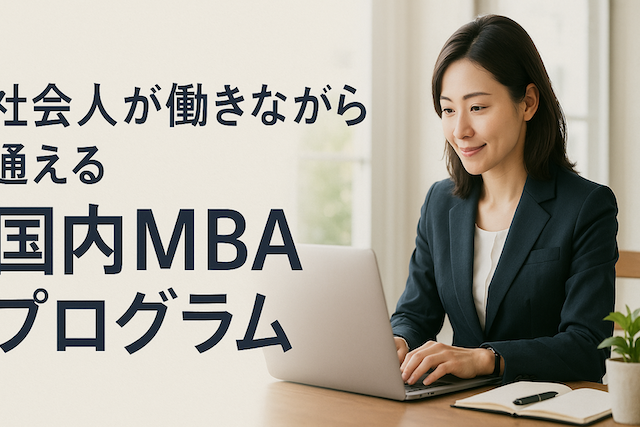
Domestic MBA Programs Working Adults Can Attend While Working
01
Introduction
In recent years, the number of working adults earning an MBA (Master of Business Administration) in Japan has been growing. Many people use MBA study for career advancement, job changes, and strengthening their management skills, and the style of studying while working is especially popular.
Compared with studying abroad, a domestic MBA places less burden on cost and time, and offers the advantages of studying in Japanese and building a network in Japan. In addition, many graduate schools provide flexible schedules that working adults can attend easily, such as evenings, weekends, intensive courses, and online. This makes it possible to bring practical work experience directly into class and put what you learn to use in business right away.
This article introduces the features and benefits of domestic MBA programs that working adults can attend while working, along with representative university options, and offers tips for balancing study and career.
02
Benefits of earning an MBA while working
1. Synergy between study and practice
A major appeal of attending an MBA as a working adult is that you can put what you learn into practice at work right away. Because you can apply topics such as management strategy, accounting, marketing, and organizational management to your own duties as you study them, understanding deepens and results are more likely to follow directly.
2. An advantage for career advancement and job changes
The MBA is a degree valued in Japan and abroad, and it is a strong selling point in promotions and job searches. Domestic MBAs in particular deal with case studies matched to Japanese corporate culture and the market environment, so they connect directly to practice and are a strength for working adults aiming for management or corporate planning roles.
3. Expanding your network
MBA programs enroll diverse working adults from different industries and job types. Building connections you could not make in everyday work becomes a great asset for your future career. For those aiming to start a business or a new venture, it can also lead to meeting partners and investors.
4. Studying while maintaining your income
Full-time study abroad carries the risk of losing income, but with a domestic MBA using evenings, weekends, or online study, you can learn while earning a salary. Being able to build your career while keeping the financial burden down is a major advantage for working adults.
03
Main MBA styles for working adults in Japan
1. Evening and weekend programs
This is the most common form of MBA for working adults. Classes are held on weekday evenings and on weekends, so you can keep working normally during the weekdays while studying. Universities in urban areas in particular have well-developed programs of this type, and they are popular with business people who want to attend while working.
2. Modular (short intensive) programs
In this style, intensive lectures are held over a block of several days to several weeks. Because you can plan your attendance to avoid busy periods, it suits working adults with business trips or irregular work schedules. Another feature is that students with practical experience can deepen their learning all at once.
3. Online and hybrid programs
Increasingly common in recent years are online classes and hybrid (on-campus plus online) MBAs. They are easy to join for people living in rural areas and for busy executives, with the advantage of taking international lectures while reducing the burden of travel.
4. Company-sponsored and partnership programs
Some universities have arrangements in which companies send employees to study. Participants receive support for tuition, and after completion are expected to play an active role in the company as management talent. This is a form suited to those who aim to become future executive candidates.
04
MBA programs for working adults at major universities
Waseda Business School (WBS)
- **Features**: Has evening and weekend programs, popular with working adults.
- **Learning style**: Case study-centered curriculum that makes it easy to connect theory and practice.
- **Strengths**: A broad alumni network and instruction by faculty with practical experience.
Keio Business School (KBS), Keio University Graduate School of Business Administration
- **Features**: Has an Executive MBA course held on weekday evenings and Saturdays.
- **Learning style**: A practical curriculum aimed at executives and managers.
- **Strengths**: A powerful alumni network spread across Japan and overseas.
Hitotsubashi University Graduate School, International Corporate Strategy (ICS)
- **Features**: A part-time MBA is also available, along with programs taught in English.
- **Learning style**: Studying with an international student body gives you a global perspective.
- **Strengths**: You can experience an environment close to an overseas MBA within Japan.
Kobe University MBA
- **Features**: Offers programs held on evenings and weekends. As a national or public university, tuition is relatively reasonable.
- **Learning style**: Abundant research projects that bridge theory and practice.
- **Strengths**: Active joint research with companies, which connects directly to practice.
Nagoya University of Commerce & Business (NUCB) Business School
- **Features**: An MBA specialized entirely for working adults. Campuses in Tokyo, Nagoya, and Osaka.
- **Learning style**: Weekend-intensive and online courses can be chosen.
- **Strengths**: Flexibility that makes it easy to attend while working, and triple international accreditation (AACSB, AMBA, and EQUIS).
05
How to choose
1. Flexibility of the class schedule
Schedules differ by university, such as evening and weekend, modular, and online. It is important to choose a program that fits your own way of working and lifestyle rhythm.
2. Practical focus of the faculty and curriculum
Placing importance on how learning connects to practice, through case studies and project-based learning rather than theory alone, makes your study more effective.
3. Strength of the alumni network
One of the values of an MBA is its connections. The strength of alumni organizations and industry networks differs by university, so choosing a university strong in your own career field is advantageous.
4. Tuition and return on investment
A domestic MBA requires several million yen in tuition; national and public universities are relatively cheaper, while private universities tend to be higher. You should also consider what kind of return you can expect from future career advancement or job changes.
5. Language of study (Japanese or English)
Programs taught in English are advantageous for globally oriented careers, but the burden also increases. It is important to choose between Japanese-centered and English-centered programs according to your career direction.
06
Summary
The paths for working adults to earn an MBA while working have broadened dramatically compared with before. Flexible styles such as evenings, weekends, intensive courses, and online have been developed, making it easier to balance study and career.
A domestic MBA has the strength not only of lower cost and lifestyle burden compared with studying abroad, but also of teaching practical knowledge suited to Japanese companies and the market environment. In addition, meeting peers from diverse backgrounds and expanding your network is also a major attraction.
An MBA is a place to gain skills and a network directly tied to practice, more than a degree. Choosing a program that fits your career goals and lifestyle and making the most of your studies will lead to a leap in your future.
07
Frequently Asked Questions
What is a domestic MBA that working adults can attend while working?
It is an MBA (Master of Business Administration) in a format you can complete while continuing to work, such as evening, weekend, intensive courses, or online and hybrid. A feature is that what you learn can be applied to your work right away.
What are the admission requirements? (education, work experience, English)
Education: bachelor's degree (or equivalent). Work experience: work experience as a working adult is emphasized (the required number of years varies by school). English: for programs taught in English or for some subjects, you may need to submit scores such as TOEIC, TOEFL, or IELTS.
Are the GMAT and GRE required?
They are often not required for domestic MBAs for working adults, but programs taught in English or research-focused programs may ask you to submit them. Check the application guidelines.
How much is tuition? What is the cost guideline?
A general guideline is about JPY 1,000,000 to 3,000,000 at national and public universities, and about JPY 3,000,000 to over JPY 6,000,000 at private universities. In addition to the registration fee, tuition, and learning materials, also expect travel and accommodation costs for training camps and intensive courses.
How long is the program?
The standard is 1 to 2 years. For working adults a 2-year program is the mainstream, but modular systems and extended-enrollment systems may allow flexible adjustment.
How often are classes? Can I keep going even if I am busy?
It varies: weekday evenings (2 to 3 times a week), Saturday intensives, every other weekend, or short intensive courses. Some programs let you adjust your course load to match your busy seasons.
Are There Online or Hybrid Options?
They are increasing. Some or most lectures can be taken online, and hybrid formats where exercises and networking are held in person are also common.
Can I receive company support (tuition assistance or dispatch)?
Some companies' education systems include tuition assistance or dispatch slots. Check in advance the personnel system, internal regulations, and whether permission to study is required.
What are concrete tips for balancing study with work?
Make your course plan by quarter and take a lighter course load in busy seasons; fix study time in early weekday mornings, commutes, and weekends; and share important dates such as deadlines and presentation days with your supervisor at work.
What is the return on investment (ROI) of earning an MBA?
In the short term it takes tuition and time, but in the medium to long term it contributes to returns such as promotion, job change, value in the job market, and a network supporting entrepreneurship. Draw up a payback plan based on your target job and salary curve.
Is there an age limit? When is the best stage of one's career?
There is often no upper age limit, and entrants in their early 30s to 40s are common. The point just before becoming a manager or before and after a change of job type tends to be a turning point.
What does the curriculum cover?
Required subjects (accounting, finance, marketing, strategy, organization, statistics and data analysis) plus electives (DX, new business, international management, healthcare, and so on). There are many case, project, and corporate partnership courses.
Is a master's thesis or project required?
It differs by school: research paper type, practical project type, case or exam type, and so on. Some programs let you link it to your work theme.
Are qualifications and accreditations (AACSB, AMBA, EQUIS) important?
International accreditation is one indicator of educational quality. Refer to it if you place importance on compatibility with overseas schools and future international job changes.
Should I study in Japanese or English?
If your career is mainly in Japan, a mainly Japanese program is sufficient. If you aim for a global job change or foreign-affiliated companies, a program with a high proportion of English is advantageous.
What is a checklist for choosing?
Schedule design (evening, weekend, online, intensive) / practical relevance (cases, corporate partnerships, projects) / strength of the alumni network and affinity with your industry / cost and scholarship or support systems / the balance of practice and research among faculty
Can I use scholarships or education loans?
Options include university scholarships, the Japan Student Services Organization, education loans from financial institutions, and company assistance. Check the application periods and repayment terms in advance.
When should I start preparing to apply? What is needed?
6 to 12 months before: choose schools, attend information sessions, plan for English and aptitude tests. 3 to 6 months before: prepare the statement of purpose, research or study plan, resume, and recommendation letters. Just before applying: interview preparation and gaining internal agreement on work adjustments.
Can I change jobs or departments while enrolled?
Yes. Check the effect on your studies and the school's enrollment rules (such as notification of a change in employment status), and redesign your course plan.
What is the effect on family and private life?
Study time on weekday evenings and weekends increases. Share busy periods such as exams, presentations, and training camps, and adjust the division of housework and childcare in advance.
Is it possible to withdraw, take a leave of absence, or extend enrollment?
These systems are often available. Check the requirements in the school rules (period, credit limits, tuition) and choose in a planned way.
How do I make use of networking?
Actively take part in alumni associations, seminars, projects, and industry study groups. Through cross-industry exchange, it becomes easier to seize turning points (job changes, starting a business, generating projects).
How do I bring what I learn back to my work?
Reflect issues from your duties in course assignments, and carry them through to proposals, P/L improvement, and the implementation of new initiatives, which leads to results and recognition.
08
Related article
09
Recommended Courses
The first step in IELTS preparation is choosing the right environment
With one-on-one classes and real-format mock exams, we help you reach your target score by the most direct route.