
MBA Study Abroad Guide
What Is a Double Degree Program Between a Domestic MBA and an Overseas MBA?
01
Introduction
As business becomes increasingly globalized, the MBA (Master of Business Administration) is becoming an essential degree for working adults in Japan seeking career advancement or a career change. A domestic MBA offers knowledge and networks suited to the Japanese business environment, while an overseas MBA is valued for teaching world-standard management theory and diverse perspectives.
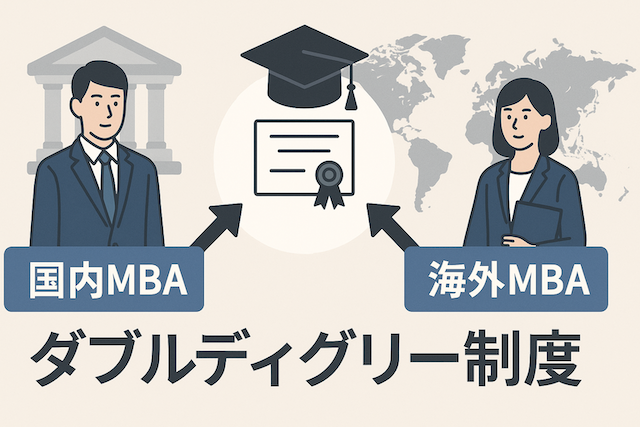
In recent years, the **“double degree program” that combines a domestic MBA and an overseas MBA** has been drawing attention as a way to efficiently take in the strengths of both. With this program, you can earn degrees from two graduate schools in Japan and abroad, making it possible to aim to become a globally competitive business professional in a short time.
02
What Is a Double Degree Program?
A double degree program is **a system in which you enroll in two partner universities or business schools and, by meeting the completion requirements of each, earn two degrees**.
Normally, earning one MBA requires one to two years of full-time study, but a double degree program has a mechanism for mutually recognizing coursework and credits, and its major feature is that **you can efficiently earn two MBAs**.
In the case of a joint program between a domestic MBA and an overseas MBA, the flow is generally as follows.
- **Study the first half at a university in Japan**: Learn management fundamentals and case studies suited to the Japanese business environment.
- **Study the second half at an overseas university**: Experience global management, leadership, and case studies in multinational teams.
- **Meet the completion requirements of both and receive degrees from both universities**.
In this way, the appeal of the double degree program is that you can gain **domestic and international knowledge, experience, and personal networks** at the same time, which a single degree cannot provide.
03
Pros
1. Earn Two Degrees Efficiently
What would normally take 3 to 4 years can be done in **about 2 years to earn both a domestic MBA and an overseas MBA** through coordinated curricula. The ability to raise your credentials and expertise efficiently in a short time is a major attraction.
2. Build Networks in Japan and Abroad
In a domestic MBA you connect with executive candidates and practitioners at Japanese companies, and in an overseas MBA you build networks with multinational students and professors. As a result, **your career options and personal connections expand internationally**.
3. Broaden Your Perspective and Skills
In addition to the management theory studied in Japan and challenges specific to Japanese companies, overseas you can sharpen global skills through **world-standard case studies, discussions, and cross-cultural communication**.
4. Broader Career Options
A domestic MBA is strong for Japanese companies, government agencies, and entrepreneurship, while an overseas MBA is advantageous for working at foreign-affiliated companies and in global markets. A major benefit of a double degree is that **you can keep both career paths in view**.
04
Disadvantages and Challenges
1. Heavy Financial Burden
Because you are enrolled at two universities, **the total including tuition, travel, and living costs is usually higher than a regular MBA**. Scholarship systems may be available, but financial preparation is essential.
2. Heavy Study Load
Because you complete two programs in a short time, **the volume of classes, assignments, and case studies is enormous**. If you take the program while working, strong self-management skills are especially required.
3. Adapting to Different Educational Styles
Domestic MBAs center on lectures and classroom learning, while overseas MBAs center on discussion and the case method. **Flexibility to adapt to differences in educational culture** is needed.
4. Career Design Can Be Difficult
Your strategy differs depending on whether you return to Japan after earning your degrees or aim to work overseas. **If you enroll without a clear purpose, you may not be able to make full use of your investment.**
05
Major Examples of Domestic MBA x Overseas MBA Partnerships
Major MBA programs in Japan partner with leading business schools in Asia, Europe, and the United States and offer double degree programs. Here are some representative examples.
Waseda Business School x Hong Kong University of Science and Technology (HKUST)
- A program in which you study one year in Tokyo and another year in Hong Kong.
- You can experience both the Japanese business environment and Hong Kong, one of Asia's leading international financial cities.
- Popular with students aiming to build a career in Asian markets.
Keio University (KBS) x ESSEC Business School (France)
- Partnering with a prestigious European school, you can develop both Japanese and European perspectives.
- You can study areas of strength such as international business and luxury management.
Hitotsubashi University MBA x Multiple Overseas Schools (United States, Europe, etc.)
- Making use of a global partnership network, you can choose your study destination according to your preferences.
- Covers a wide range of themes including public policy and international management.
Kobe University MBA x Business Schools in Asia, Europe, and the United States
- Strongly practice-oriented and actively partnering with emerging Asian countries.
- Many opportunities to gain international experience through overseas training and joint research.
In this way, top domestic MBA programs partner with leading overseas schools and have set up systems for studying **“Japan's strengths x the global business environment”** at the same time.
06
Summary
The double degree program combining a domestic MBA and an overseas MBA is a very attractive system for **the efficiency of earning two degrees in a short time** and **the ability to gain personal networks, knowledge, and experience in Japan and abroad at the same time**.
On the other hand, the cost and study load are significant, and flexibility to adapt to differences in educational style is also required. For that reason, when considering enrollment, it is important to be clear about “what kind of career you want to build in the future” and to choose a program that suits your purpose.
A double degree is not just an academic title but **an investment in building the practical ability and connections to succeed globally**. For those who want to widen their opportunities to take on challenges in Japan and abroad, it will be a major career asset.
07
Frequently Asked Questions
What is a double degree program?
It is a system in which you enroll in two partner universities or business schools and, by meeting the completion requirements of both, earn two degrees (e.g., a domestic MBA + an overseas MBA). Through credit transfer, you can aim for two degrees in a shorter time than usual.
What is the standard duration?
About 2 years is the guideline for many programs. A common pattern is to study the first half at the domestic school and the second half at the overseas school.
What are the admission requirements and required scores?
Bachelor's degree (or equivalent) / work experience (guideline: 2 to 5 years or more) / language requirements (e.g., TOEFL/IELTS, and in some cases GMAT/GRE) / statement of purpose, letters of recommendation, and interview
How much language ability is needed?
Classes at overseas schools are mainly in English. You need scores and working proficiency sufficient to handle academic discussion and case studies.
How much does it cost?
In addition to tuition, travel and living expenses are needed. The total tends to be higher than a single MBA, but there is room to use scholarships, tuition reductions, education loans, and the like.
Is the study load heavy? Is it possible while working?
Because you meet two sets of requirements in a short time, the volume of assignments, cases, and group work is on the heavier side. Many programs assume full-time study, and taking one while employed requires strict time management.
What are the career benefits?
Expanded personal networks in Japan and abroad / acquiring both Japanese management knowledge and global standards / broader options such as Japanese companies, foreign-affiliated firms, and overseas employment
What disadvantages or risks should I be aware of?
The scale of investment in cost and time is large / you need to adapt to differences in educational style and culture / if your career goals are unclear, it is hard to recoup the investment
How does a double degree differ from an exchange program or a joint degree?
An exchange program mainly involves earning credits at your home school and yields one degree, and a joint degree often has two schools jointly award one degree, whereas a double degree awards **two degrees**.
How is credit transfer handled?
Courses and credits set in advance between the partner schools are mutually recognized. The breakdown of required and elective courses and the limits differ by program.
Are there internship or project opportunities?
Many overseas schools offer practical projects and internships. Duration and whether you may work depend on the country and visa conditions.
Are visa and travel procedures difficult?
You need to obtain a student visa, take out insurance, and arrange housing. Work backward from your start date and check the required documents and processing times.
Which combination of schools should I choose?
Compare them by your target career (industry, job type, region), curriculum strengths, alumni network, cost-effectiveness, language requirements, and city environment.
What is the application schedule?
Application deadlines are generally set in multiple rounds. Taking exam preparation, essays, letters of recommendation, and financial planning into account, start preparing at least 6 to 12 months in advance.
What Are the Ways to Get Scholarships or Funding?
University-specific scholarships and fellowships / external foundation and corporate scholarships / education loans and company-sponsored study abroad programs
What Are the Career Paths After Graduation?
Options are diverse, including major Japanese companies, foreign-affiliated consulting / investment banking / tech firms, corporate planning at operating companies, entrepreneurship, and overseas employment. You can use the career centers and alumni associations of both schools.
Are There Online or Hybrid Options?
Some programs allow a mix of online courses, but double degree programs are mainly in-person oriented. Check the latest requirements in the application guidelines.
How can I tell whether it suits me?
You have clear career goals and a plan to recoup the investment / you can adapt positively to a high-workload study and cross-cultural environment / adjustments for cost, time, and family or work are realistic
How to Avoid Failure
Put “why a double degree” into words and keep it consistent across selection, study, and job hunting / check curriculum details (required, elective, credit transfer) and deadlines early / get practical matters such as scholarships, visas, and housing in order ahead of time
08
Related article
09
Recommended Courses
The first step in IELTS preparation is choosing the right environment
With one-on-one classes and real-format mock exams, we help you reach your target score by the most direct route.