
MBA Study Abroad Guide
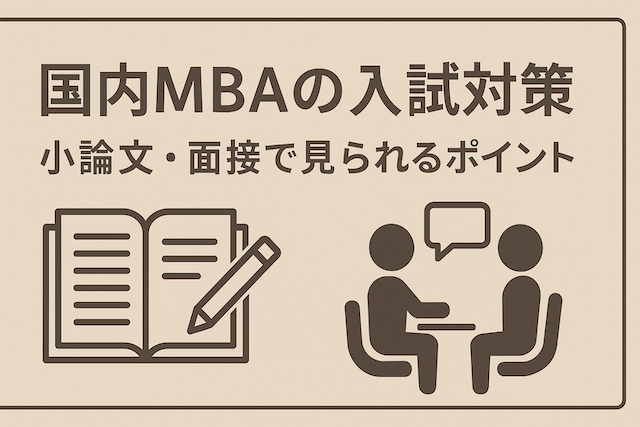
Preparing for Domestic MBA Entrance Exams: What Is Evaluated in the Essay and Interview
01
Introduction
For working adults and students aiming at a domestic MBA (in Japan), the entrance exam is not merely an academic test but an important process in which your “qualities as a business leader” are evaluated from many angles. At many business schools in particular, in addition to written exams and proof of English ability, the essay and interview are major factors that decide success or failure.
In the essay, your “ability to think logically and derive solutions” is tested using current affairs and management issues as themes. In the interview, on the other hand, your character is probed in depth, including “the clarity of your purpose in studying for an MBA,” “consistency with your career plan,” and “leadership qualities.”
In other words, in domestic MBA admissions, what is asked is **not only whether you have knowledge and skills, but how well you can put your own experiences and values into words and explain them in connection with your future vision.**
This article organizes the role of the essay and interview in domestic MBA admissions and explains the evaluation points and specific preparation methods for each. It should help practical preparation for anyone considering applying for an MBA.
02
Essay Preparation: Logic and Problem-Solving Ability Are Tested
The essay in domestic MBA admissions is not just a writing test; it is an important evaluation criterion that measures your understanding of business issues, analytical ability and logical thinking. The key is whether you can develop your own thinking in an orderly way on a given theme within a limited time.
Trends in Essay Topics
Essays often feature themes grounded in the real business and economic environment. For example:
- Strategies to strengthen the international competitiveness of Japanese companies
- The impact of DX (digital transformation) on organizations
- A leadership challenge you have experienced in the past and how you overcame it
- The role of companies in sustainability management
Themes like these are intended to confirm not simply that applicants can show off knowledge, but their ability to show **“how you grasp a problem and how you derive a solution.”**
What Is Evaluated
- **Logical consistency** Is your claim clear, and are the grounds and conclusion consistent? A contradiction-free structure is valued.
- **Ability to identify issues** Do you go beyond superficial answers and see the essence of the problem? Is there deep insight?
- **Specificity and use of work experience** Do you argue concretely, weaving in your own work experience and familiar examples rather than abstract debate?
- **Writing ability** Can you explain complex content simply and clearly? MBA exams require “business-document clarity.”
Effective Preparation Methods
- **Build a habit of engaging with current affairs** Read the Nikkei and the Harvard Business Review, and make a habit of organizing your own opinions on business issues.
- **Practice structuring with the PREP method** Using the pattern “conclusion (Point) -> reason (Reason) -> example (Example) -> restated conclusion (Point)” makes the flow of logic natural.
- **Train to finish writing within the time limit** Because the actual exam has a time limit, repeatedly practice completing an essay in 60 or 90 minutes.
- **Get your writing reviewed** Have others read it, and objectively improve leaps in logic and vague expressions.
The more you practice the essay, the more surely your skills grow. Connect logic with work experience, and prepare so that you can write persuasively from your own perspective.
03
Interview Preparation: Emphasis on Personal Assessment and Aptitude
In domestic MBA admissions, the interview is not just a place for questions and answers but an important process that checks **“whether you have the makings of a future business leader.”** Because it greatly affects the outcome, it requires careful preparation alongside the essay.
Elements Emphasized in the Interview
- **Clarity of motivation** Can you explain logically “why you want an MBA”? Whether it is a necessity in your career is examined.
- **Consistency with your career vision** Is your post-MBA career plan realistic and persuasive? Vague answers are hard to rate well.
- **Depth of self-understanding** Do you understand your strengths and weaknesses, and can you explain how you want to overcome or develop them through the MBA?
- **Communication skills** Can you answer logically and concisely? An attitude of responding precisely to the questions asked is also important.
- **Leadership and cooperation** Because an MBA is a place of learning centered on group work, interviewers also check whether you are a person who can produce results while collaborating with others.
Examples of Common Questions
- Why do you want to pursue an MBA?
- Why did you choose our MBA?
- What is your career goal after earning the MBA?
- How did you overcome a difficulty you faced in a team?
- Please explain your leadership experience concretely.
Tips for Preparation
- **Summarize your motivation in one minute** Prepare a concise, persuasive “self-introduction + motivation” and practice so that you can deliver it smoothly.
- **Organize your experiences with the STAR method** Explaining an episode in the order Situation, Task, Action, Result makes it easy to follow.
- **Get used to it with mock interviews** Simulate the real interview format and check your posture, tone of voice and consistency of content.
- **Research the school thoroughly** Understand the features of the MBA program you are applying to, and be ready to talk about where it connects with your career plan.
Interviews are nerve-racking, but if you prepare carefully beforehand you can face them with confidence. What matters is to appeal logically and sincerely without losing your “own personality.”
04
Summary
The essay and interview in domestic MBA admissions are not a check of mere knowledge or academic ability but an important process for discerning your **“potential as a future business leader.”**
- In the essay, **logical thinking, the ability to identify issues, and the ability to derive solutions** are evaluated. Rather than a list of knowledge, concrete reflection based on experience and an easy-to-follow structure are required.
- In the interview, **clarity of motivation, consistency of your career plan, self-understanding and leadership qualities** are examined. Being able to speak about your vision in persuasive words is the key to success.
What matters in both is being able to explain **“why an MBA” and “what you are aiming for”** in your own words. Deepening your self-analysis through preparation and making the business school think “this person has a promising future” leads to acceptance.
Domestic MBA admissions are by no means easy, but with appropriate preparation you can surely make the most of your strengths. Through the essay and interview, prepare so that you can confidently tell the story of your own growth.
05
Frequently Asked Questions
Is an essay always required in domestic MBA admissions?
Many domestic MBA programs require an essay. It is regarded as an important exam that measures logical thinking and problem-solving ability regarding business issues.
How should I study for the essay?
It is effective to build a habit of organizing current affairs from newspapers and business magazines, and to repeatedly practice writing past and predicted questions within the time limit. Training to structure your writing logically with the PREP method is also useful.
What kinds of questions are common in the interview?
Typical questions are “why do you want an MBA,” “your career plan after earning it,” “leadership experience,” and “why you chose the school.” Consistency of your motivation and future vision is emphasized.
How should I go about interview preparation?
It is effective to summarize your self-promotion and motivation concisely and practice in mock interviews. Explaining your experiences using the STAR method (Situation, Task, Action, Result) also adds persuasiveness.
What points are important in both the essay and the interview?
What matters in both is being able to clearly state “why an MBA” and “what you are aiming for.” The shortcut to acceptance is to be prepared to explain, with logic and specifics, how your experience and vision connect.
06
Related article
07
Recommended Courses
The first step in IELTS preparation is choosing the right environment
With one-on-one classes and real-format mock exams, we help you reach your target score by the most direct route.