
MBA Study Abroad Guide
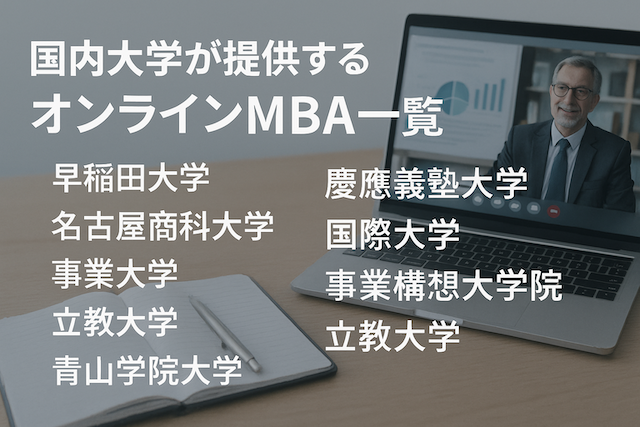
List of Online MBAs Offered by Japanese Universities
01
Introduction
The MBA (Master of Business Administration) is attracting attention from many working adults as a qualification that lets you systematically learn the core of business, including management strategy, leadership and finance. Classroom-based programs used to be the norm, but as the number of people who want to study while working, or who live in rural areas or overseas and find it hard to attend campus, has grown, online MBA offerings have expanded at universities in Japan as well.
The greatest appeal of an online MBA is the **flexibility to study without being tied to a specific time or place**. You can join classes from home or while on a business trip, and pursue a degree without interrupting your career. In addition, some universities offer programs with international accreditation or practical curricula that draw on a global network.
This article lists the online MBA programs offered by universities in Japan and summarizes the study style and features of each. It should help anyone considering an MBA find the option that suits them best.
02
Waseda University Graduate School of Business and Finance (WBS)
Waseda Business School (WBS) is highly regarded as one of Japan's leading MBA programs. In recent years it has also built up its online learning environment, creating a system in which working adults in Japan and overseas can study flexibly.
- **Study format**: Live online classes + on-demand streaming Real-time interactive discussions are combined with recorded lectures that can be watched later, making it easy to study while working.
- **Curriculum features**: In addition to management strategy, marketing and finance, the program puts strong emphasis on global management and leadership education.
- **Completion period**: Standard 2 years (can be adjusted flexibly depending on the combination of courses taken)
- **Who it suits**: Working adults who want to earn an MBA while continuing full-time work, expatriates and others
WBS's online MBA is not simply lecture streaming; it is distinctive for its emphasis on dialogue and case studies. Its alumni network, active in Japan and overseas, is also a strength, and it is valued for being directly useful for career building and job changes.
03
Keio Business School (KBS), Keio University Graduate School of Business Administration
Keio Business School (KBS) is one of the oldest MBA programs in Japan and is known for practical education through the case method. It basically emphasizes in-person classes, but in recent years some courses can be taken online, giving working adults greater flexibility.
- **Study format**: Centered on in-person classes, with some courses available online (hybrid format)
- **Curriculum features**: Based on case studies, covering a wide range of areas including strategy, organization, human resource management and entrepreneurship
- **Completion period**: 2 years (flexible course selection for working adults is also possible compared with the full-time program)
- **Who it suits**: Working adults aiming for management positions in Japanese companies, people with executive aspirations, and those who value building a close in-person network
KBS's strengths are its small-class education and case discussions. It is not a fully online MBA, but as it becomes more hybrid, people living in rural areas or overseas can participate to a certain extent, and its future developments are drawing attention.
04
Globis Graduate School of Management (MBA)
Globis Graduate School of Management is one of the graduate schools in Japan most specialized in online MBA delivery. It is characterized by a flexible learning environment for working adults, and business people from a wide range of backgrounds in Japan and overseas take its courses.
- **Study format**: Fully online (live classes + on-demand streaming) You can join real-time discussions and also study at your own pace using recorded lectures.
- **Curriculum features**: In addition to management strategy, marketing and finance, it also focuses on leadership development and entrepreneurship education.
- **Completion period**: Minimum 2 years (extended study system available)
- **Who it suits**: Working adults who want to earn an MBA while working, people aiming to start a business, and those who live in rural areas or overseas and find it hard to attend campus
Globis's greatest strengths are **one of Japan's largest communities of working-adult MBA students** and a curriculum directly connected to real work. Even online, interactivity is emphasized, and you can deepen your learning through discussion and networking. It is an attractive option for those who want to acquire practice-oriented management skills efficiently.
05
Nagoya University of Commerce & Business Graduate School of Management (NUCB)
Nagoya University of Commerce & Business (NUCB) Business School is one of the few business schools in Japan to hold international accreditation (the AACSB, EQUIS and AMBA triple crown). Its major feature is that you can earn a globally recognized MBA within Japan, and it also offers an online MBA program.
- **Study format**: Online MBA (live streaming + on-demand)
- **Curriculum features**: Fully adopts the case method, emphasizing discussion in the same style as Harvard Business School. Faculty and students are internationally diverse, and many courses are taught in English.
- **Completion period**: 2 years (flexible study plans also possible)
- **Who it suits**: Working adults who want an internationally accredited MBA, people aiming for a global career, and those expecting an overseas assignment
NUCB's stated goal is to provide a world-standard MBA education even when fully online, and case discussions are lively even in online classes. It is a very attractive option for those who want a learning environment connected to the world while staying in Japan.
06
Hosei University Graduate School of Innovation Management
Hosei University's Graduate School of Innovation Management offers a practical MBA program that lets working adults study management while working. It is a hybrid program combining online learning with short on-campus sessions, and it accommodates people living in rural areas and busy business people.
- **Study format**: E-learning (online lectures) + intensive on-campus sessions (several times a year)
- **Curriculum features**: Strong in innovation and new business development, with broad coverage from strategy, organization and human resources to IT management.
- **Completion period**: Standard 2 years
- **Who it suits**: Working adults interested in new business or entrepreneurship, and those who live in rural areas or overseas and find it hard to attend campus
Hosei University's distinguishing feature is that, as a **practice-oriented MBA**, it deals with cases and projects themed on real business challenges. You can also build a network with peers through the on-campus sessions, which suits people who want both the flexibility of online learning and in-person interaction.
07
Kyoto University Graduate School of Management
Kyoto University's Graduate School of Management is a business school known for a curriculum that blends theory and practice. It is not a fully online MBA, but some lectures are offered online, and an environment has been set up in which you can study flexibly while working.
- **Study format**: Primarily in-person classes, with some online lectures introduced (hybrid format)
- **Curriculum features**: In addition to management strategy, finance and organizational management, it emphasizes Kyoto University's distinctive interdisciplinary approach. You can learn both the research-oriented and the practical-application sides.
- **Completion period**: Standard 2 years
- **Who it suits**: Working adults based in the Kansai area, and those seeking research-oriented or theory-focused study
The strengths of the Kyoto University MBA are **its interdisciplinary nature and theoretical depth**. Many classes are run jointly with other fields such as science and engineering and public policy, making it an attractive option for working adults who want to understand management in a broader context. With the introduction of online learning, the door has opened wider to students who find it hard to attend campus.
08
Ritsumeikan University Graduate School of Business Administration
Ritsumeikan University's graduate MBA program offers an evening and weekend-focused schedule that is easy for working adults to follow, along with an online learning environment that makes use of ICT. It is not fully online, but flexible hybrid study is possible.
- **Study format**: In-person classes + online streaming (hybrid format)
- **Curriculum features**: Covers the basic areas of management such as strategy, organization, accounting and marketing, while emphasizing case learning directly connected to corporate practice.
- **Completion period**: Standard 2 years
- **Who it suits**: Working adults employed full-time, and business people based in the Kansai area
The Ritsumeikan MBA promotes **management education grounded in real-world practice**, and its classes include many case studies led by current executives and faculty with practical experience. With the introduction of online learning, working adults who find it hard to attend campus can join more easily, and it is attractive for the chance to interact with students from a wide range of backgrounds.
09
Other Universities and Professional Graduate Schools
Beyond the major universities in Japan, MBA programs that incorporate online classes and remote attendance are gradually expanding. Although they are not fully online, a growing number of universities let you choose a flexible study style.
- **Meiji University Graduate School of Global Business** Introduces online attendance for some courses. The curriculum is mainly designed for working adults who attend while working.
- **Hitotsubashi University Graduate School of Business Administration (HUB)** Basically in-person classes, but remote attendance and online streaming have been introduced for some. Many students are working adults sent by their companies.
- **Kobe University Graduate School of Business Administration** A prestigious Kansai business school. It is gradually expanding online courses and can be taken in a hybrid format.
- **Kyushu University Business School (QBS)** An MBA institution based in Kyushu. It uses online classes to accommodate students from rural areas and overseas.
These universities are not yet fully online MBAs, but they are **evolving in the direction of widening hybrid (on-campus + online) options**. In particular, ICT environments have improved since the COVID-19 pandemic, and online offerings are expected to expand further.
10
Summary
Online MBA options at universities in Japan are widening year by year, and an environment is emerging in which you can systematically study management even while working.
- **Fully online**: Globis Graduate School of Management, Nagoya University of Commerce & Business Business School (NUCB) and others, where you can study from anywhere.
- **Hybrid**: Waseda, Keio, Hosei, Ritsumeikan, Kyoto University and others, where you can study flexibly by combining some online classes.
- **Universities expanding**: Meiji, Hitotsubashi, Kobe, Kyushu University and others, where online options are expected to grow further.
When choosing, keeping the following points in mind will make it easier to find a program that suits you.
- **Fully online, or combined with on-campus sessions**
- **Whether it has international accreditation (AACSB, EQUIS, etc.)**
- **Class style (case method, lecture-based, discussion-based)**
- **Opportunities for networking**
An online MBA is an effective way to advance your career without being tied to time or place. Because each university's programs are expected to keep evolving, it is a good idea to consider the best choice for your own career goals.
11
Frequently Asked Questions
What is an online MBA? How does it differ from a campus-based MBA?
An online MBA is a degree program in which lectures, discussions, assignment submission and exams can all be completed online. The main differences from a campus-based program are the freedom of study location and the flexibility of time management, but the requirements for learning outcomes, such as case discussions and group work, are designed to be equivalent.
Are the online MBAs offered by universities in Japan fully online? Is there any on-campus schooling?
It depends on the university. Globis and NUCB are mainly fully online, while Waseda, Hosei, Ritsumeikan, Kyoto University and others are hybrid and may include some on-campus intensive sessions.
What are the admission requirements? Are GMAT/GRE or English tests required?
Many MBAs in Japan place weight on a bachelor's-equivalent degree and work experience. GMAT/GRE scores are increasingly not required, but courses taught in English and English-language MBAs may require proof of English proficiency (TOEFL/IELTS, etc.).
What is the standard completion period and study pace? Is it possible while working?
The standard is mainly 2 years. Online programs are designed on the premise that you study while working, using evenings, weekends and on-demand content. Some universities also offer extended study and leave-of-absence systems.
What is the class style? Are the case method and group work used?
Case method, live discussions, group work in breakout rooms and practical project assignments are also carried out online. The mainstream design emphasizes interactivity rather than just watching recordings.
What Are the Approximate Tuition and Additional Costs?
Total tuition for an online MBA in Japan is roughly JPY 2,000,000 to 5,000,000 as a guide (varying by university). In addition, there may be costs such as teaching materials, travel and accommodation for on-campus sessions, and proctoring fees for online exams.
Is international accreditation (AACSB/EQUIS/AMBA) important?
Accreditation is an international indicator of educational quality and helps improve recognition overseas and versatility in the job market. It is not mandatory, but it is an important criterion for comparison.
Can you gain the value of networking and an alumni association even online?
You can build a network through live classes, team assignments, student communities, career events and in-person on-campus sessions. After graduation you can also make use of alumni associations and graduate networks.
Is career support (job change and startup support) available online?
A growing number of universities offer career interviews, job information, career seminars and startup mentoring online. Some also have referral systems through alumni and current students.
Is a master's thesis (or practical project) required?
Requirements differ by university, such as a master's thesis, research project or practice-based capstone. Even online, meetings with supervisors and progress management are conducted using online tools.
Can I take the program and complete it even if I live overseas? How are time differences handled?
Many programs can be taken from overseas, and some accommodate time differences through recorded viewing or classes in multiple time slots. Exams may use online proctoring (remote proctoring).
What is the admission selection process? Can it be completed online?
Application (documents, essay, recommendation letters, work history) -> written test (depending on the university) -> online interview is typical. In most cases everything from application to notification of the result can be completed online.
What IT environment and equipment are needed?
You need a stable high-speed connection, a PC with camera and microphone, an up-to-date browser, and an environment compatible with the learning management system (LMS). A quiet space and a headset are recommended.
Is credit transfer or transfer after taking courses as a non-degree student possible?
Some universities recognize credits earned as a non-degree course student and have credit transfer systems with other universities. There are credit limits and grade requirements, so check in advance.
Can I combine a double degree or English-taught courses?
Depending on the university and specialization, double degrees with overseas partner schools or courses taught in English may be possible. Places and requirements are often limited.
What is the difference from an EMBA (Executive MBA)?
An EMBA is aimed at managers and executives, often with intensive weekend sessions and short stays, and tuition tends to be higher. An MBA generally targets a wider range of job levels and is designed to teach fundamentals through advanced topics systematically.
What is the social standing of the degree, and what is its effect on promotion and job changes?
The university's brand, accreditation, learning outcomes, results achieved at work and use of the network are the keys to how it is valued. What you learned and how you applied it matters more than whether the program was online or on campus.
Is there a checklist for choosing a program?
(1) Fully online or hybrid (2) Class style and interactivity (3) Whether it has international accreditation (4) Tuition and total study cost (5) Completion requirements (thesis/capstone) (6) Time-difference and work-style fit (7) Career support and alumni network (8) Faculty and class quality (9) English/Japanese ratio (10) Admission requirements and application schedule.
What Is the Approximate Application Timeline?
Ideally, start gathering information a year before enrollment, prepare your application (essay, recommendations) 6 to 9 months before, apply and interview 3 to 5 months before, and after acceptance proceed with course registration, financial planning and work adjustments.
What Are Common Mistakes and How Can You Avoid Them?
Typical pitfalls are insufficient information, an overloaded schedule and an unprepared study environment. You can avoid them by attending a trial class, establishing a weekly study routine, gaining the agreement of your family and workplace, and testing your IT environment in advance.
12
Related article
13
Recommended Courses
The first step in IELTS preparation is choosing the right environment
With one-on-one classes and real-format mock exams, we help you reach your target score by the most direct route.