
MBA Study Abroad Guide
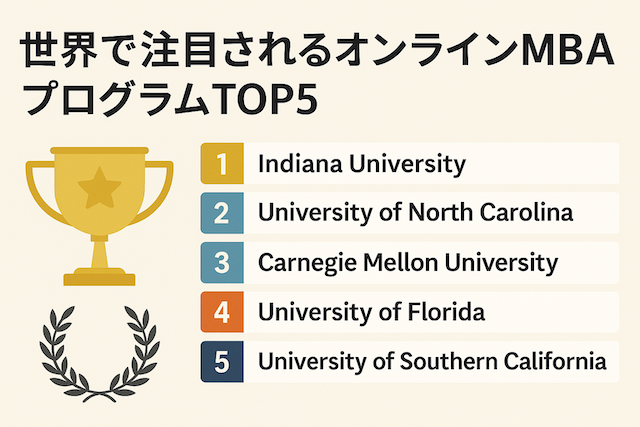
Top 5 Online MBA Programs Drawing Global Attention
01
Introduction
In recent years, the way people study for an MBA (Master of Business Administration) has evolved significantly. Attending campus full time used to be the norm, but today the **online MBA** is spreading rapidly and is being chosen by business professionals around the world. The background is that advances in the internet and educational technology have made it possible to take the curricula of prestigious business schools regardless of place or time.
In addition to the flexibility of studying alongside work and family, an online MBA has the advantage of being easier on the budget than full-time study abroad. You can also interact with students from around the world, which makes it appealing as a way to build a global network.
This article introduces the **top 5 online MBA programs** that are drawing particular attention as of 2025 and are well regarded in global rankings. Compare the features and strengths of each program and use this as a reference for considering the option that suits you.
02
1. IE Business School (Madrid, Spain)
IE Business School is a pioneer of online MBAs in Europe. Students with diverse backgrounds gather from around the world, and it is highly regarded for allowing you to learn from a global perspective.
- **Features**: Uses a hybrid format, with intensive short sessions in Madrid in addition to online classes. You can experience learning both in person and online.
- **Strengths**: Emphasizes entrepreneurship, with many courses specializing in startups and innovation. It also has strong networks with world-renowned entrepreneurs and investors.
- **Duration / format**: About 15 months. Mainly online classes, with the option to combine in-person sessions in Madrid as needed.
- **Recommended for**: People considering a future career in entrepreneurship or the venture field, and people who want to build an international network.
03
2. Warwick Business School (UK)
Warwick Business School (WBS) is a highly regarded program worldwide that is **consistently ranked near the top in the Financial Times online MBA rankings**. It is especially well known in Europe, and its curriculum builds strategic thinking and analytical skills.
- **Features**: You can study entirely online, and those who wish can also attend short intensive sessions at the campus in Coventry, UK.
- **Strengths**: Focuses on data analysis, strategic management, and international business, making it ideal for those aiming at consulting or management roles. Its alumni network also spans the globe.
- **Duration / format**: Usually 2-3 years. Its flexible study style lets you keep studying comfortably while working.
- **Recommended for**: People aiming to advance to strategy consulting or management levels, and people pursuing careers that value data and analytics.
04
3. Indiana University Kelley School of Business (USA)
Indiana University's Kelley School of Business has long been recognized as **one of the best-known online MBAs in the US**. With relatively reasonable tuition and a flexible study style, it is popular as a program with excellent cost performance.
- **Features**: Centered on online learning, with intensive sessions of a few days built in (on-site programs at the Indiana University campus or overseas).
- **Strengths**: Offers a very wide range of electives, allowing you to deepen your expertise in areas such as accounting, marketing, supply chain, and finance to match your career.
- **Duration / format**: Can typically be completed in about 2 years. In addition to fully online study, you can choose short in-person sessions that emphasize networking.
- **Recommended for**: People who want to earn a prestigious US MBA while keeping costs down, and people who want to sharpen specialized skills directly tied to practical work.
05
4. University of North Carolina Kenan-Flagler Business School (USA)
MBA@UNC at the University of North Carolina Kenan-Flagler Business School is attracting worldwide attention as an **online MBA that emphasizes live classes**. Although online, many classes are interactive and immersive, and a major feature is that you can discuss in real time with professors and classmates.
- **Features**: Besides recorded lectures, real-time virtual classes are held several times a week. There are also plenty of networking and group-work opportunities after class.
- **Strengths**: Focuses on leadership development, organizational management, and strategic thinking, making it ideal for working adults aiming for management and executive positions.
- **Duration / format**: Usually completed in 2-3 years. Mainly online, but participation in short in-person sessions held around the world (Global Immersions) is also encouraged.
- **Recommended for**: People who want an experience close to in-person even online, and people who want to intensively build leadership and management skills.
06
5. Imperial College Business School (London, UK)
Imperial College Business School is a division of a world-class science and technology university based in London, with a strength in **education that merges technology and business**. This character is strongly reflected in its online MBA as well, offering a cutting-edge learning experience that makes full use of digital platforms.
- **Features**: Uses the “Imperial Hub” learning platform developed specifically for the online MBA, integrating live classes, discussions, and collaborative projects.
- **Strengths**: Focuses on technology, innovation, and sustainability, with strong synergy with STEM fields. It is especially popular among those aiming at digital strategy or new business development.
- **Duration / format**: About 2 years. Fully online, but short exchange programs at the London campus are also available.
- **Recommended for**: People who want to advance in tech and the digital industry, and people interested in sustainability and innovation.
07
Is an Online MBA Realistic for Japanese Students? The English Hurdle
In an online MBA, the classes, materials, and discussions are basically all conducted in English. This means **a certain level of English is a prerequisite**. To understand lectures, speak actively in discussions, and write reports, a level of at least around 90 on the TOEFL iBT or IELTS 6.5 or higher is often considered the guideline.
For this reason, an online MBA is not suited to people who are only just starting to study English. Rather, it is the ideal choice for people who already have a certain level of English and want to further sharpen business skills that work globally.
On the other hand, even for Japanese students who are not strong in English, there are **benefits to an online MBA**. For example:
- You do not need to move abroad to study, so there is less burden from changes in your living environment.
- Classes can be watched repeatedly from recorded archives, so you can review parts you missed afterward.
- Interacting with students from around the world naturally builds practical English ability.
However, taking it on with no confidence in English at all carries the risk of being unable to keep up with classes and getting only half the value. That is why it is important to **spend a period studying English before the MBA to solidify your foundation**.
For example, a realistic and recommended route is to study intensively for several months at an English school in Cebu, Philippines, strengthen your listening and speaking, and then take on an online MBA.
08
Summary
The online MBA is drawing attention from business professionals around the world as a new alternative to the traditional full-time MBA. In particular, the **5 programs** introduced here are consistently ranked near the top in international rankings and are highly regarded for the quality of their education and the breadth of their networks.
- **IE Business School**: Emphasis on entrepreneurship and innovation
- **Warwick Business School**: Strengths in strategic thinking and data analysis
- **Indiana Kelley**: Cost performance and a wide range of choices
- **UNC Kenan-Flagler**: Live classes and leadership development
- **Imperial College**: A fusion of technology and business
When choosing an online MBA, it is important to use as your criterion not just rankings and brand but whether it fits **your career goals, lifestyle, and budget**.
For those who want to be active on the global stage, the online MBA will be a powerful option for “getting a world-class education while working.”
09
Frequently Asked Questions (FAQ)
Q1. What is the biggest difference between an online MBA and a full-time (in-person) MBA?
A1. The biggest difference is the study format and flexibility. An online MBA is easy to balance with work and family and can be done from anywhere. A full-time MBA, on the other hand, allows focused study but requires you to interrupt your career.
Q2. Is an online MBA degree valued the same as an in-person one?
A2. When awarded by the same university and business school, the degree carries equal weight. It is treated as a regular degree on resumes and LinkedIn, and recognition among employers is growing.
Q3. Is an online MBA suitable for Japanese students who are not strong in English?
A3. Because classes, discussions, and assignments are conducted in English, a certain level of English is required. If your foundation is insufficient, we recommend building it with intensive English study before enrollment.
Q4. About what English level is required?
A4. As a guideline, around IELTS 6.5 and TOEFL iBT 90 are common. Requirements differ by school and track, so be sure to check each school's official requirements.
Q5. Are the GMAT/GRE required?
A5. It depends on the school. Scores may be waived based on work experience or academic achievements, but submitting them can be advantageous if you want to strengthen your application.
Q6. What is the typical tuition? Is it cost-effective?
A6. As a guideline, the total ranges widely from about JPY 3,000,000 to over JPY 10,000,000. Because commuting costs and opportunity costs (income lost by leaving your job) are kept down, it can be more cost-effective than full time.
Q7. How long does it take?
A7. Most take 20-36 months. Some programs allow flexible pacing (accelerated or extended) so you can study while working.
Q8. What is the difference between synchronous (live) and asynchronous (on-demand)?
A8. Synchronous is real-time classes with high interactivity, while asynchronous is mainly recorded content with more freedom in timing. Many top schools combine both.
Q9. Does networking work online?
A9. It works through virtual classes, team assignments, Slack/forums, and short in-person sessions (residencies/immersions). The alumni network is shared with in-person students.
Q10. Is career support (job search support) available?
A10. Many schools offer career coaching, resume review, interview preparation, job listings, and alumni introductions even for online students. The scope offered varies by school.
Q11. How are time zone issues handled?
A11. Accommodations include multiple time slots for live classes, or the option to watch recordings and do alternative assignments. Check each school's policy on attendance requirements.
Q12. How should I judge the quality of a program?
A12. Check accreditation (AACSB/AMBA/EQUIS, etc.), faculty research and practical experience, alumni outcomes, the alumni network, career data, and how up to date the curriculum is (data/tech/sustainability).
Q13. Which accreditations are important?
A13. Schools holding several of the three major accreditations (AACSB, AMBA, EQUIS) tend to have higher international standing.
Q14. How are assessments and exams conducted online?
A14. Methods include reports, case analyses, group projects, oral presentations, and proctored online exams.
Q15. How much study time is needed to balance with work?
A15. It depends on the course, but it is generally reasonable to expect about 10-20 hours per week. It may increase during busy periods.
Q16. What are the main admission requirements?
A16. A bachelor's degree, work experience (2-5 years or more as a guideline), proof of English ability, recommendation letters, essays, and interviews. The GMAT/GRE may be optional or required.
Q17. Are scholarships or installment payments available?
A17. Many schools have scholarships, merit-based tuition support, and installment payment plans. Also consider incentives for early applicants.
Q18. Is a residency (short in-person session) required?
A18. Some schools require it and others make it optional. It is often recommended to strengthen networking and for leadership exercises.
Q19. Can I expect career advancement or a higher salary after an online MBA?
A19. There are success stories such as role changes (management/strategy/product), industry changes, and internal promotions, but results depend on the school, individual effort, and market conditions.
Q20. I can't decide which school to choose.
A20. Compare based on your career goals (entrepreneurship, strategy, finance, tech, etc.), study format (synchronous/asynchronous, residency or not), time zone, tuition and scholarships, accreditation/rankings, and alumni career paths and geographic distribution.
Q21. What is a realistic way to prepare if I'm worried about my English?
A21. It is effective to strengthen listening and speaking with 3-6 months of intensive English study and practice case-discussion expressions before starting your application and coursework.
Q22. What is the typical application timeline?
A22. As a guideline: 6-9 months before applying, check requirements and prepare for exams; 3-6 months before, prepare essays, recommendations, and interviews; 1-3 months before enrollment, register for courses and set up your technical environment.
Q23. What are the technical requirements (devices, internet)?
A23. You need a stable high-speed internet connection, a PC with a webcam and microphone, an up-to-date browser, and an environment for using the class platform (Zoom, etc.).
Q24. Does an online MBA affect future overseas work or immigration?
A24. The degree itself is a plus, but work visas and immigration depend on each country's system. Keep in mind that a degree does not mean a visa will be granted.
Q25. What are the red flags (signs to avoid)?
A25. Be wary of a lack of accreditation, opaque alumni data, extremely short completion times, a lack of support that matches the tuition, and exaggerated job placement claims.
MBA Study Abroad Guide: Everything About Overseas MBA, Domestic MBA, and Online MBA10
Related article
11
Recommended Courses
The first step in IELTS preparation is choosing the right environment
With one-on-one classes and real-format mock exams, we help you reach your target score by the most direct route.