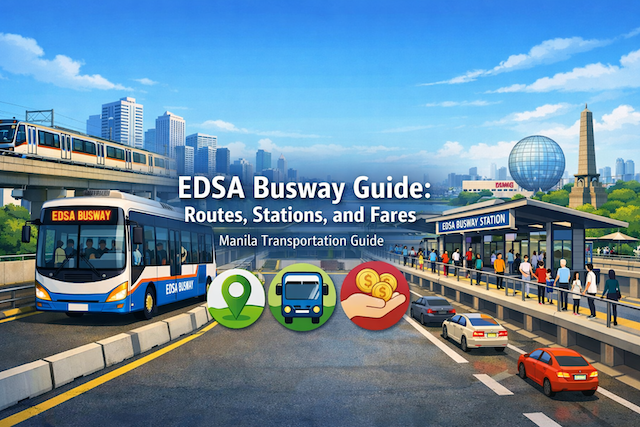
EDSA Busway Guide: Routes, Stations, and Fares:Manila Transportation Guide
Introduction to the EDSA Busway
The EDSA Busway is one of the most important public transportation projects in Metro Manila. Built along Epifanio de los Santos Avenue (EDSA), the city’s main north–south artery, the busway was designed to provide a faster, more reliable alternative to traditional buses stuck in mixed traffic. Today, it serves hundreds of thousands of commuters daily and has become a core part of Manila’s modern transport system.
For travelers, expats, and first-time visitors, the EDSA Busway offers a practical way to move across major business districts such as Quezon City, Ortigas, Makati, and Pasay without dealing with heavy congestion. This guide explains how the system works, its routes and stations, fare structure, and practical tips for using it efficiently.
What Is the EDSA Busway?
The EDSA Busway is a dedicated, center-lane bus rapid transit–style system. Unlike traditional buses that share the road with private vehicles, EDSA Busway buses operate on exclusive lanes located in the middle of EDSA. This setup allows buses to bypass traffic and maintain more predictable travel times, especially during peak hours.
The system is operated under government regulation, with standardized routes, fixed stops, and cashless fare collection. It connects seamlessly with MRT-3 stations, making it a crucial alternative when trains are crowded or temporarily unavailable.
Why the EDSA Busway Matters in Manila
Metro Manila is known for severe traffic congestion, particularly along EDSA. The busway was introduced to address several long-standing issues:
-
Unpredictable bus travel times
-
Dangerous curbside loading and unloading
-
Overlapping and confusing bus routes
-
Lack of discipline among provincial and city buses
By centralizing bus operations and limiting stops to designated stations, the EDSA Busway has significantly reduced travel times for many commuters. In some cases, trips that once took over two hours can now be completed in under an hour.
Overview of EDSA Busway Routes
Northbound and Southbound Directions
The EDSA Busway operates in two main directions:
-
Northbound: From Pasay and Parañaque areas toward Quezon City and North EDSA
-
Southbound: From Quezon City toward Makati, Pasay, and PITX
Buses travel exclusively along EDSA, stopping only at official busway stations located at or near MRT-3 stations and major interchanges.
Route Coverage
The busway spans almost the entire length of EDSA, covering key urban zones:
This wide coverage makes the EDSA Busway especially useful for cross-city travel.
Complete List of EDSA Busway Stations
Stations are typically located in the center of EDSA and accessed via footbridges or connected directly to MRT-3 stations. While station names and configurations may evolve, the major stops include:
North EDSA Area Stations
-
North Avenue
-
Quezon Avenue
-
GMA–Kamuning
These stations serve Quezon City residents and connect with MRT-3 North Avenue and GMA–Kamuning stations.
Cubao and Ortigas Stations
This section is heavily used by office workers commuting to and from business districts and shopping centers.
Makati and Guadalupe Stations
These stations provide access to Makati CBD, one of the country’s main financial hubs.
Pasay and Southern Stations
PITX is a major transport hub connecting buses from southern Metro Manila and nearby provinces.
How to Access EDSA Busway Stations
Most stations are accessible through elevated walkways or MRT station concourses. Passengers must cross EDSA using footbridges; direct street-level access is not allowed for safety reasons.
Security personnel and traffic enforcers are usually present to guide passengers, especially at busy stations. Elevators are available at select stations, but availability may vary.
EDSA Busway Fare System Explained
Cashless Fare Policy
The EDSA Busway uses a cashless fare system. Passengers must pay using stored-value cards or approved electronic payment methods. Cash payments are generally not accepted onboard.
Commonly accepted payment options include:
It is strongly recommended to have a loaded Beep card before boarding.
Fare Structure
Fares on the EDSA Busway are distance-based, meaning the amount you pay depends on how far you travel. Compared to traditional buses, fares are generally affordable and competitive with MRT-3 pricing.
As a general guide:
Exact fare tables may change due to government regulation, so checking updated signage at stations is advised.
How to Pay and Enter the Busway
At most stations, passengers tap their card at the entry gate before boarding. Some stations may have onboard validators instead. Always wait for the green signal before entering.
Upon alighting, passengers may need to tap out, depending on the system in use at that station.
Operating Hours of the EDSA Busway
The EDSA Busway operates daily, including weekends and holidays.
Typical operating hours are:
Operating hours may be extended during peak seasons or special events. Frequency is highest during weekday rush hours.
Peak Hours and Travel Time Expectations
Morning Rush
Morning peak hours usually run from 6:00 AM to 9:00 AM. Buses are frequent, but stations can become crowded, especially in Quezon City and Ortigas.
Evening Rush
Evening peak hours are typically from 5:00 PM to 9:00 PM, with heavy demand in Makati, Ortigas, and Cubao.
Despite crowding, the busway remains faster than regular buses because it avoids mixed traffic.
EDSA Busway vs MRT-3
Speed and Reliability
Comfort and Capacity
Many commuters choose the busway when MRT-3 lines are long or temporarily disrupted.
Safety and Security on the EDSA Busway
The busway is considered relatively safe due to:
Standard precautions still apply. Keep valuables secure and be mindful of your belongings during peak hours.
Rules and Etiquette for Passengers
To ensure smooth operations, passengers are expected to follow these rules:
-
Queue properly at stations
-
Allow passengers to exit before boarding
-
Do not eat or drink inside buses
-
Respect priority seating for elderly, pregnant passengers, and persons with disabilities
Failure to follow rules may result in being denied boarding.
Accessibility for Tourists and Foreigners
For visitors unfamiliar with Manila, the EDSA Busway can seem intimidating at first. However, it is one of the more structured transport systems in the city.
Helpful tips include:
-
Study station names in advance
-
Use navigation apps to track your stop
-
Ask station staff for assistance
Most signage is in English, making it relatively tourist-friendly.
Connecting the EDSA Busway to Other Transport Modes
MRT-3 Transfers
Nearly all EDSA Busway stations are aligned with MRT-3 stations, allowing easy transfers between bus and train.
PITX Connections
At PITX, passengers can connect to:
This makes the busway a key link between Metro Manila and surrounding regions.
Common Mistakes to Avoid
-
Boarding the wrong direction bus
-
Forgetting to load your card in advance
-
Assuming all stations are street-level
-
Standing in non-designated boarding areas
Planning ahead helps avoid delays and confusion.
Is the EDSA Busway Worth Using?
For most cross-city trips along EDSA, the answer is yes. The busway is faster than traditional buses, more organized, and generally affordable. While stations can be crowded during peak hours, the overall efficiency makes it a strong option for both daily commuters and visitors.
Final Thoughts
The EDSA Busway represents a major improvement in Manila’s public transportation landscape. By offering dedicated lanes, standardized fares, and reliable routes, it provides a practical solution to one of the city’s biggest challenges: traffic congestion.
Whether you are commuting to work, exploring business districts, or traveling between transport hubs, understanding how the EDSA Busway works will save you time, money, and frustration. With proper preparation, it can be one of the most efficient ways to get around Metro Manila.
Frequently Asked Questions (FAQs)
What is the EDSA Busway?
The EDSA Busway is a dedicated bus corridor running along the center lanes of EDSA (Epifanio de los Santos Avenue) in Metro Manila. It functions like a Bus Rapid Transit (BRT)-style system, where buses operate in protected lanes with fixed stations. The main goal is to provide faster and more reliable travel compared to regular buses that are stuck in mixed traffic. For many commuters and visitors, it is one of the easiest ways to move between Quezon City, Ortigas, Makati, and Pasay without unpredictable delays.
Where does the EDSA Busway operate?
The busway operates along EDSA, generally spanning the major north-to-south corridor of Metro Manila. Stations are positioned near key MRT-3 stops and important interchanges. Depending on the current operating plan, the busway commonly connects northern points such as North Avenue and Quezon Avenue down to southern terminals such as Taft Avenue and PITX (Parañaque Integrated Terminal Exchange). Because EDSA is the backbone road of the metro, the busway is useful for travelers moving between business districts, shopping areas, and transport hubs.
How do I enter an EDSA Busway station?
Most EDSA Busway stations are located in the middle of EDSA, so you typically enter via footbridges, elevated walkways, or connections through MRT station concourses. You cannot usually access stations directly from street level because the busway lanes are separated for safety. Follow signs toward “EDSA Busway” or “Busway Station,” then queue at the station entrance or platform area. In busy stops, security or station personnel may be present to guide passengers.
Is the EDSA Busway the same as MRT-3?
No. MRT-3 is a rail system, while the EDSA Busway is a bus-based system using exclusive lanes. They often run parallel along EDSA and many busway stations are near MRT-3 stations, which makes transfers convenient. MRT-3 can be faster end-to-end, but it may also be more crowded at peak times. The busway is a strong alternative when MRT lines are long, when you prefer surface travel, or when you need a route that fits your origin and destination better.
How much is the fare on the EDSA Busway?
Fares are typically distance-based, meaning you pay more for longer trips and less for shorter trips. The exact fare table can change depending on government regulations and operator policies, so it is best to check the latest posted fares at stations. In general, the cost is competitive with other public transport options in Metro Manila. If you are budgeting for travel, plan for small variations and always keep extra stored value loaded on your card.
Can I pay cash on the EDSA Busway?
Most operations use a cashless payment system, commonly through contactless stored-value cards such as a Beep card or other approved options. Cash payment is usually not accepted onboard, and even if some stations allow alternative methods, relying on cash can slow you down and may cause you to be denied boarding. For the smoothest experience, buy a reloadable card, keep it topped up, and bring it with you whenever you plan to use the busway.
How do I know which direction to take?
Like most transit systems, the EDSA Busway runs in two directions: northbound and southbound. Northbound generally moves toward Quezon City and North EDSA, while southbound heads toward Makati, Pasay, and PITX. Stations typically have signage showing the direction and key stops. To avoid mistakes, identify your destination station first, then confirm whether it is north or south of your current location. If you are unsure, ask station personnel or check a navigation app before boarding.
What are the busiest stations on the EDSA Busway?
Busiest stations tend to be those near major business districts, transfer points, and commercial hubs. Examples often include North Avenue, Quezon Avenue, Cubao area stations, Ortigas, Guadalupe, Ayala, and Taft Avenue. Passenger volume is especially heavy during weekday rush hours. If you are traveling with luggage or want a more comfortable ride, consider traveling outside peak times when queues are shorter and buses are less crowded.
What time does the EDSA Busway operate?
Operating hours generally start early in the morning and extend into late evening. Exact schedules can change, and some service patterns may be adjusted during holidays, special events, or operational updates. As a practical rule, plan your trip within typical commuter hours (early morning to late night) and avoid assuming 24/7 operation. If you are traveling very early or very late, check station announcements or official updates whenever possible.
Is the EDSA Busway safe for tourists?
For most travelers, the EDSA Busway is considered relatively safe because it uses fixed stations, controlled boarding areas, and dedicated lanes. That said, Metro Manila is a large, crowded city, so basic precautions are still important. Keep your phone and wallet secure, watch your bag in queues, and stay alert in crowded areas. If you are new to Manila, it helps to travel during daytime hours until you feel confident using the system.
Can I bring luggage on the busway?
Small luggage and backpacks are generally allowed, but large suitcases may be inconvenient during peak hours when buses and platforms are crowded. If you must travel with bulky luggage, try to ride during off-peak times and position your bag so it does not block aisles or doors. Be considerate of other passengers, and follow any posted station rules. If you are traveling to PITX or connecting to provincial buses, planning your luggage strategy in advance will make transfers smoother.
What should I do if I miss my stop?
If you miss your stop, remain calm. Get off at the next station where it is safe and permitted, then transfer to the opposite direction platform to return to your intended station. Because stations are placed at major interchanges, it is usually manageable to correct mistakes, though it may take extra time. To reduce the risk, track your location with a map app and pay attention to station announcements or visible station name markers as you approach each stop.