
MBA Study Abroad Guide
How to Improve Your English Quickly and Intensively: Combining Study Abroad and Online Learning
01
Introduction
Many working adults and students want to “improve their English efficiently in a short time.” For those preparing for MBA admission, overseas assignments or a career change in particular, producing results in limited time is a major challenge.
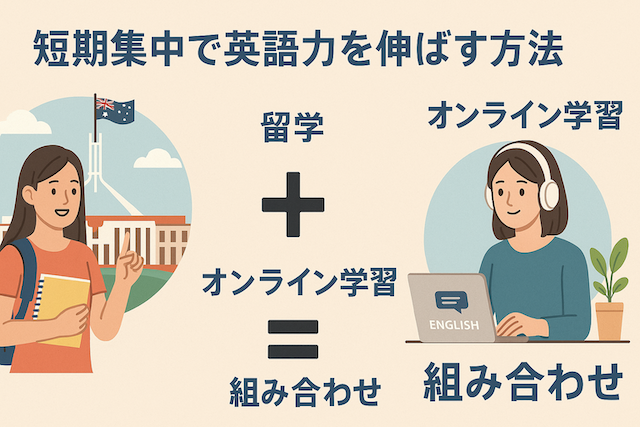
However, English ability tends to plateau with self-study alone, and to gain big results from short, intensive study you need to design your learning environment carefully. One effective method is a hybrid learning style that combines “study abroad” and “online learning.”
By placing yourself in a practical environment while studying abroad, and using online learning for advance preparation and continued study after returning home, you can boost your English dramatically even in a short time. This article explains the specific methods and how to build an effective schedule.
02
Strengths of Short-Term Study Abroad
Short-term study abroad is a very effective method for those who want to raise their English ability all at once in a short time. Even in a limited period of a few weeks to a few months, it offers the following benefits.
- **Fully immerse yourself in an English environment** By living locally, you have no choice but to use English outside of class too. Meals, shopping, transportation and everything else in daily life become learning opportunities, naturally training your listening ability and response speed.
- **Intensive speaking practice** In programs centered on one-on-one lessons, such as study in Cebu, Philippines, you can strengthen the “speaking ability” that Japanese people find difficult in a short time. Compared with group classes, the time you spend speaking is overwhelmingly longer.
- **Results come easily in a short time** Many schools have curricula built on the premise of “producing results in a short time,” and you can choose an intensive program to suit your purpose, such as TOEFL/IELTS preparation or business English.
By putting yourself in an environment where “you have no choice but to use English,” short-term study abroad makes possible a big leap that domestic study alone cannot provide.
03
Strengths of Online Learning
The greatest appeal of online learning is that you can continue it regardless of time and place. Combined with short-term study abroad, it plays a role in further enhancing the learning effect.
- **Ideal for advance preparation** By using online English conversation before studying abroad to get used to basic grammar and everyday conversation, you will understand classes locally more smoothly. Going abroad with your foundation firm is efficient because you can concentrate on output locally.
- **Study while keeping costs down** Studying abroad costs money, but online learning can be continued relatively cheaply. If you use online learning before and after short-term study abroad, you can keep your total study cost down while maintaining the effect.
- **Helps maintain and strengthen English ability after study abroad** If your English environment disappears after you return home, the English ability you worked to build easily declines. If you continue online learning, you can maintain the habit of using English, and also move smoothly on to business English or specialized English.
Online learning serves as a “bridge” that brings out the full effect of study abroad and prevents a decline in English ability after returning home.
04
Benefits of Combining Study Abroad and Online Learning
Combining short-term study abroad with online learning creates a synergy that neither provides alone. Let us look at the benefits from the following three perspectives.
- **Maximizing learning efficiency** By firming up the basics online beforehand and then concentrating on practical output while studying locally, learning efficiency rises dramatically. A major strength is that you can establish a cycle of “preparation (online) → practice (study abroad) → review (online).”
- **Results come easily even in a short time** Even if your stay abroad is as short as two weeks or one month, advance preparation through online learning and continuation after returning home make visible results easier to achieve in a short time. Making the most of limited time is especially valuable for working adults.
- **Ensures continuity of learning** Study abroad alone has the problem that “after returning home, you have fewer chances to use English,” but combining it with online learning solves that problem. By continuing to use English after returning home, you can further build on the skills you acquired.
05
Example of an Effective Study Schedule
To achieve results through short, intensive study, a study plan that is aware of three phases (**before, during and after study abroad**) is effective.
1. Before Study Abroad (1 to 2 months)
- **Use online learning** Get used to conversation with 25 to 50 minutes of online English conversation every day Review junior-high and high-school level grammar and basic vocabulary
- **Clarify your purpose** Decide in advance whether it is raising your TOEFL/IELTS score, strengthening everyday conversation, or business English
Ideally, finish the groundwork for putting “usable English” into practice during study abroad here.
2. During Study Abroad (2 to 8 weeks)
- **Concentrated output in one-on-one lessons** Through 5 to 7 lesson periods a day, thoroughly strengthen speaking and listening
- **Make all of your life English** Try meals, shopping and getting around in English too
- **Set weekly goals** Set concrete targets such as “this week I will speak for 10 minutes in a presentation” or “I will speak up actively in discussions”
The most important learning point during study abroad is to “keep using English without fearing mistakes.”
3. After Study Abroad (from 3 months)
- **Review and develop through online learning** Repeatedly practice the expressions you learned during study abroad Shift to new areas such as business English or specialized English
- **Secure places to practice** Participate in meetings and study groups held in English Continue listening to overseas news and podcasts
If you keep up your studies after returning home, you can “keep building” the ability you gained in short-term study abroad.
06
Summary
To improve your English in a short, intensive period, it is effective to combine “study abroad” and “online learning” well.
- Firm up the basics through online learning before study abroad
- During study abroad, maximize output in an English-immersion environment
- After study abroad, continue and develop further through online learning
By creating this three-part flow, you can boost your English dramatically even in a limited time. For those with concrete goals such as MBA preparation or an overseas assignment in particular, it can be called the best learning method for achieving both efficiency and results.
07
Frequently Asked Questions
How many weeks of short-term study abroad is effective?
If you aim for intensive improvement, **2 to 4 weeks** is enough to feel the effect. If your foundation is already in place, staying at a school centered on one-on-one lessons greatly improves speaking and listening. If you have time to spare, extending to 8 weeks increases how well it sticks.
Should online learning be done before or after study abroad?
**Both before and after are essential.** Use the time before study abroad to prepare basic grammar and frequent expressions, and the time after for review and application (business English, exam preparation), which completes the learning cycle.
How much daily study time is needed?
Before and after study abroad, **60 to 90 minutes a day** is a guide (2 to 3 online conversation sessions of 25 minutes + 15 to 20 minutes of review). During study abroad, immerse yourself with 5 to 7 lesson periods plus 1 to 2 hours of self-study.
Can working adults get results in a short time?
Yes. By **limiting goals by use** (e.g., opening remarks and facilitation in meetings, 10 email templates, a 10-minute presentation) and repeating through role-play, your practical ability improves even in a short time.
Who is study in Cebu suited for?
It is ideal for those whose top priority is strengthening speaking and who want to **maximize one-on-one speaking time** in short, intensive study. It offers high cost performance, and the travel time from Japan is relatively short.
What is the approximate cost? (rough estimate)
For a 2- to 4-week stay in Cebu, **roughly JPY 150,000 - 350,000 plus airfare**, including lessons, dormitory and meals, is typical. Online learning starts from about JPY 5,000 - 15,000 per month. It varies by school, season and room type.
Is it also effective for exam preparation such as TOEFL/IELTS?
Yes. Firm up **vocabulary, grammar and listening basics** online before study abroad, correct your speaking and writing output during study abroad, and after returning home repeat mock exams and reinforcement of weak points.
Will it improve MBA preparation and case-method skills?
Yes. Practice the pattern of **summary → opinion → reasoning → rebuttal → restatement** online, and during study abroad focus on immediate responses and discussion, which improves how you structure your statements and your quickness.
What does a specific one-week model look like?
Example: Monday to Friday, online 25 minutes x 2 (morning and evening) + 20 minutes of vocabulary; Saturday, 60 minutes of mock interview/case discussion; Sunday, rest + watching English media. During study abroad, full lessons on weekdays, a quiz and reinforcement of weak points on Saturday, and Sunday off.
What materials should I use?
Basics: a textbook for a full review of junior-high to first-year high-school grammar + a collection of frequent phrases. Output: role-play scenarios, email template collections, and prompts for case discussion. News/podcasts for ear training.
What are the tips for not giving up?
Make a routine of **quantifying your achievement criteria** (WPM, speaking time, vocabulary coverage, mock exam score) and **visualizing weekly** (recording, self-review, instructor feedback). Cut learning into small weekly “deadlines.”
How can I keep my English from declining after I return home?
For the first four weeks, make sure to keep up **the same frequency of online output as during study abroad** (5 days a week, 25 minutes or more), and reuse the expressions you learned in at least 3 different situations. Secure real practice such as English meetings/study groups at least twice a month.
Is it effective from any level?
Yes. Focus on **repeating pattern expressions + reading aloud** for beginners, **summarizing and forming opinions** for intermediate learners, and **critical discussion in a specialist area** for advanced learners to improve at every level.
What should be prioritized in online content?
In this order: (1) getting your mouth used to high-frequency phrases, (2) scripting your own work/study scenes, (3) correcting errors with immediate feedback. Record → self-score → perform again to make it stick.
How do I measure the effect?
Measure **minutes spoken, number of self-corrections and number of vocabulary types** weekly, and check mock exams and shadowing WPM monthly. Compare the “clarity of the first minute” using recordings of interview role-plays.
08
Related article
09
Recommended Courses
The first step in IELTS preparation is choosing the right environment
With one-on-one classes and real-format mock exams, we help you reach your target score by the most direct route.