
MBA Study Abroad Guide
English Needed for MBA Preparation: TOEFL and IELTS Score Guidelines
01
Introduction
For many applicants aiming at an MBA overseas, the first big hurdle is English ability. An MBA demands advanced English in classes, discussions, presentations and case studies alike. For this reason, submitting an official score such as TOEFL or IELTS is a required condition of application, and if you do not meet the standard you cannot even become eligible to apply. This article organizes the TOEFL and IELTS score guidelines needed when aiming for an MBA and explains how much English ability you should prepare.
02
The Importance of English Tests in MBA Applications
MBA programs center on interactive classes such as case studies, group discussions, team projects and presentations. Therefore, not just reading ability but **advanced English in all four skills: listening, speaking, reading and writing** is essential.
Schools place importance on TOEFL and IELTS scores to judge whether applicants can keep up with classes after admission and discuss sufficiently with classmates. Because an MBA requires not only reading academic papers but also the ability to speak up on the spot and express oneself logically, low speaking or writing scores can be a disadvantage.
Many schools also publish a "minimum score" (cutoff) and an "average score of admitted students," and if you clear the minimum but fall short of the average, your chance of admission tends to be low. English tests are therefore not a mere formality but **a factor that greatly influences whether you are admitted to an MBA**.
03
TOEFL Score Guidelines
The TOEFL iBT is an English test widely used especially by MBA programs in the United States and Canada. It focuses on academic content, and the Reading and Listening sections are difficult, so solid preparation is needed.
- **Minimum level**: around 80 Some graduate schools accept about 80 as an eligibility requirement. For an MBA, however, this score is often judged too low to keep up in class, and admission can hardly be expected.
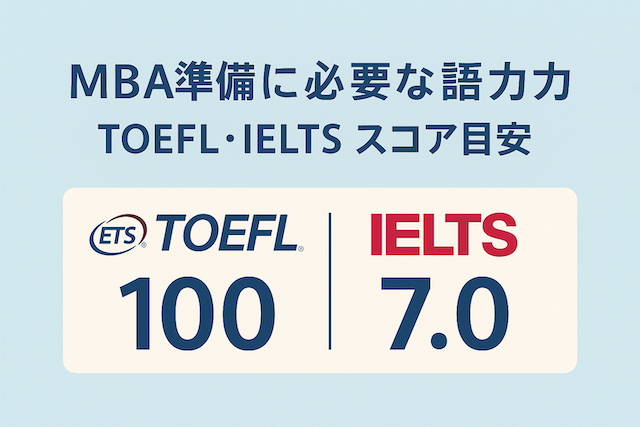
- **Competitive score**: 100 or higher At many mid- to upper-tier schools, the average of admitted students is around 100. If you are aiming for an MBA, you should treat this level as a goal.
- **Top-school guideline**: 105-110 or higher Top schools such as Harvard, Stanford and Wharton often require 105 or higher. Whether you can secure 25 or more in Speaking and Writing in particular is a key point.
Another point to note is that some schools require "a certain score in each section." Even with a high total, a markedly low Speaking score alone may mean you do not meet the eligibility requirements, so you need to aim for **a balanced score**.
04
IELTS Score Guidelines
IELTS is an English test widely used by MBA programs in the UK, Europe, Australia and Asia. Compared with TOEFL, it features an interview-format Speaking test, and real communication ability is strongly tested.
- **Minimum level**: 6.5 IELTS 6.5 is the eligibility requirement set by many MBA programs. However, many require 6.0 or higher in each section, so falling significantly short in even one means you do not meet the requirement.
- **Competitive score**: 7.0-7.5 At many mid- to upper-tier schools, the average score of admitted students clusters in this range. Beyond 7.0, you are increasingly judged as "able to keep up fully in class."
- **Top-school guideline**: 7.5-8.0 This level is needed if you are aiming for top European schools such as London Business School (LBS), INSEAD and HEC Paris. Whether you can score high in Speaking and Writing in particular decides the outcome.
Because IELTS emphasizes "practical English ability," building **the ability to speak and write logically** and **natural conversational English**, rather than mere test-taking techniques, leads to higher scores.
05
Choosing Between TOEFL and IELTS
In MBA applications you will almost always submit either TOEFL or IELTS, but how to choose depends on your target schools and your own strengths.
1. Choose by the region of your target schools
- **Applicants to North American MBAs** → TOEFL is mainstream. Business schools in the US and Canada often require TOEFL scores.
- **Applicants to European and Asian MBAs** → IELTS predominates. The UK, France, Singapore, Hong Kong, Australia and others treat IELTS submission as standard.
2. Choose by your strengths
- **People suited to TOEFL**: Those strong at reading and listening to academic texts and used to the online test format.
- **People suited to IELTS**: Those good at everyday conversation and face-to-face speaking, and who find it easy to build logical written expression in English.
3. Choose by application flexibility
Some schools accept only TOEFL or only IELTS. It is therefore important to check each school's requirements once you have drawn up your list of target schools.
The **conclusion** is that it is wise to put your target schools' requirements first and choose the test on which you are more likely to score high.
06
Setting a Score Goal and Steps for Preparation
For English test preparation for MBA applications, it is important to proceed with a clear goal and plan rather than studying blindly. Following the steps below will help you study efficiently.
1. Check your target schools' official requirements
First, look up the **minimum score (cutoff) and the average score of admitted students** on your target schools' websites. It is important to understand the actual level of admitted students, not just the minimum.
2. Find out your current score
Quantify your current ability through practice tests and past papers. Identifying your weak sections is the first step to efficient study.
3. Calculate the score gap you need to close
Work out the difference between your current score and target score, and calculate backward how much study time and effort is needed. For example, from "current 85 to target 100," plan a strategy for a 15-point improvement.
4. Make a study plan
- Weekdays: focus on Reading and Listening input
- Weekends: strengthen Speaking and Writing output
- Take practice tests regularly to check progress
Building a study plan in stages across the short, medium and long term like this is effective.
5. Emphasize practical practice
MBA classes demand quick responses and logical expression. By going beyond test preparation and practicing discussions and presentations in English, you both raise your score and prepare for after admission.
07
Summary
For aspiring MBAs, English tests such as TOEFL and IELTS are not mere formalities but **an important factor that greatly influences your chance of admission**.
- For **TOEFL**, 100 or higher, and 105-110 for top schools, is the guideline
- For **IELTS**, 7.0-7.5, and 7.5-8.0 for top schools, is needed
It is common to prepare with these levels in mind.
After admission, an MBA in particular requires advanced English through discussions and case studies, so beyond test preparation, **developing practical speaking and writing ability** is indispensable.
By starting preparation early, checking your target schools' requirements, choosing the test format that suits you and studying according to plan, you can greatly raise your chance of a successful application.
08
Frequently Asked Questions
Should I submit TOEFL or IELTS for an MBA application?
First check your target schools' requirements. In general, North American MBAs mostly adopt TOEFL, while European and Asian MBAs tend to treat IELTS submission as standard. More schools accept either, so it is practical to choose the one on which you are more likely to score high.
What score guideline is needed to be admitted to an MBA?
TOEFL iBT: **100 or higher** is the competitive guideline, and top schools **105-110+** / IELTS Academic: **7.0-7.5** is the competitive guideline, and top schools **7.5-8.0**. Many schools set "section minimums" in addition to an overall minimum.
Do the minimum scores for each section matter?
Yes. Even if your total meets the standard, a low score in a particular section such as Speaking or Writing may lead to rejection or a request to resubmit. Be sure to check each school's section minimums.
Can I use TOEFL MyBest(TM) (Superscore)?
It depends on the school. Some accept MyBest(TM) scores, while others use only scores from a single test date. If it is not stated in the application guidelines, prepare assuming a single-day score.
How long are scores valid?
In general, both TOEFL and IELTS are valid for **two years from the test date**. Check that your score is valid at the application deadline.
Is the online (at-home) version accepted?
Some schools accept it, but they may ask for additional assessment after you arrive on campus. To be safe, if possible choose a test center or a format the school explicitly permits.
Is there an exemption (waiver) from the English requirement?
Yes. In some cases a waiver or substitute is allowed, for example for graduates of English-speaking universities, those with a certain number of years of English-language work experience, or where English is the company's official language. However, it is not applied automatically, so **an individual request** and supporting documents are required.
Can I apply with IELTS 6.5 / TOEFL in the 90s?
If you reach the minimum you may be able to apply, but your chance of admission goes down. If you are aiming for scholarships or higher-ranked schools, aim for **IELTS 7.0+ / TOEFL 100+**.
Is there a TOEFL-IELTS score conversion table?
Strict conversion is not possible, but a general guide is as follows. TOEFL 100 = IELTS 7.0 / TOEFL 105 = IELTS 7.5 / TOEFL 110 = IELTS 8.0. Follow each school's standards for the final judgment.
How many times can I retake it? How long should I wait?
There is no clear limit on the number of retakes, but taking the test frequently in a short period lowers study efficiency. We recommend reinforcing your weak points in a **2-4 week** study cycle before retaking.
What are practical ways to improve Speaking and Writing?
Instead of memorizing templates, master a pattern of **logical development (claim -> reasons -> specific examples -> implications)** / record a 60-90 second Speaking answer on one question a day -> self-score -> work on rephrasing and strengthening connectives / for Writing, use **task-type past questions** and focus on consistency of argument and paragraph structure
What should I do if my score will not arrive or be reflected just before the application deadline?
In addition to sending the official score, submit a **PDF of the unofficial score report** and explain the situation to the admissions office by email. Also be careful about the deadline time (local time).
Can I use the Duolingo English Test (DET) or PTE?
Some MBAs accept them, but acceptance varies by school. If your first-choice group of schools does not clearly accept DET/PTE, prioritize TOEFL/IELTS.
Should I aim for the average score or the minimum score?
The minimum score is merely "eligibility to apply." In practice, it is safer to set **the average of admitted students** (or the median of the most recent class) as your target.
Can the rest of my application make up for my English ability?
Essays, recommendation letters and interviews convey your English proficiency, but **it is difficult to fully substitute for a shortfall in test scores**. First make sure you clear the score standard.
09
Related article
10
Recommended Courses
The first step in IELTS preparation is choosing the right environment
With one-on-one classes and real-format mock exams, we help you reach your target score by the most direct route.