2026年3月30日
3D ACADEMY offers affordable English study programs in Cebu, Philippines – perfect for beginners, professionals, and exam takers.

3D UNIVERSAL ENGLISH INSTITUTE INC
info.3d-universal.com
8:00-17:00(Mon-Fri)
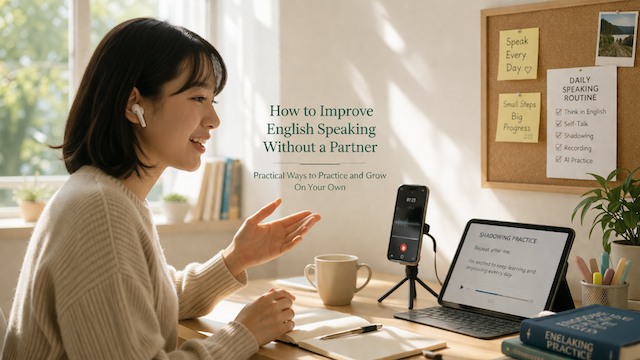
How to Improve English Speaking Without a Partner
Contents
- How to Improve English Speaking Without a Partner
- Why You Don’t Need a Partner to Improve Speaking
- Method 1: Think in English Daily
- Method 2: Use Self-Talk (Speaking to Yourself)
- Method 3: Shadowing (Imitate Native Speakers)
- Method 4: Record Yourself Speaking
- Method 5: Use AI for Speaking Practice
- Method 6: Practice Speaking with Topics
- Method 7: Learn and Use Useful Phrases
- Method 8: Improve Pronunciation Separately
- Method 9: Build a Daily Speaking Routine
- Method 10: Focus on Fluency, Not Perfection
- Common Challenges and How to Overcome Them
- Advanced Strategy: Simulate Real Conversations
- Long-Term Improvement Plan
- Final Thoughts
- FAQs (Frequently Asked Questions)
- Can I really improve my English speaking without a partner?
- What is the best way to practice speaking alone?
- How long should I practice English speaking each day?
- Is talking to myself in English a good method?
- How can I improve pronunciation without a teacher?
- Should I focus on grammar when practicing speaking alone?
- Can AI help me improve English speaking without a partner?
- What should I do if I do not know enough vocabulary to speak?
- How do I stay motivated when practicing alone?
- How long does it take to become more fluent in speaking?
How to Improve English Speaking Without a Partner
Learning to speak English fluently without a partner may seem challenging at first, but in reality, it is entirely possible—and often more efficient—when done correctly. Many learners assume that conversation requires another person, but modern methods, especially with the help of AI and self-training techniques, allow you to practice speaking effectively on your own.
In this guide, you will learn practical, proven strategies to improve your English speaking skills independently. Whether you are a beginner or an intermediate learner, these methods will help you build confidence, fluency, and natural communication skills without relying on a partner.
Why You Don’t Need a Partner to Improve Speaking
Before diving into techniques, it’s important to understand why practicing alone can actually be powerful.
When you practice alone, you gain:
- Full control over your pace – No pressure to keep up with someone else
- Unlimited speaking time – You can speak as long as you want
- Freedom to make mistakes – No fear of judgment
- Focused repetition – You can repeat difficult phrases until they feel natural
In traditional conversations, your speaking time is often limited. When practicing alone, you can maximize output—which is the most critical factor in improving speaking ability.
Method 1: Think in English Daily
One of the most effective ways to improve speaking is to start thinking in English.
How to Do It
Instead of translating from your native language, train your brain to form thoughts directly in English.
For example:
- Instead of: 「明日何をする?」 → “What will I do tomorrow?”
- Think directly: “What should I do tomorrow?”
Practice Routine
- Describe your day in your head
- Plan your schedule in English
- Ask yourself questions like:
- “What am I doing now?”
- “Why did I choose this?”
Why It Works
Speaking is simply external thinking. If your internal thinking becomes English, speaking becomes natural and automatic.
Method 2: Use Self-Talk (Speaking to Yourself)
Self-talk is one of the most underrated but powerful techniques.
What is Self-Talk?
It means speaking out loud to yourself in English.
Examples
- Describe what you are doing:
- “I’m making coffee now.”
- Explain your thoughts:
- “I think this is a good idea because…”
- React to situations:
- “That was surprising.”
How to Practice
Start with 5–10 minutes per day:
- Choose a simple topic
- Speak continuously
- Don’t worry about mistakes
Key Rule
Fluency first, accuracy later.
The goal is to keep speaking without stopping.
Method 3: Shadowing (Imitate Native Speakers)
Shadowing is a technique where you repeat what a native speaker says immediately after hearing it.
How to Do Shadowing
- Choose audio (podcasts, YouTube, movies)
- Listen to a sentence
- Repeat it instantly, matching:
- Pronunciation
- Intonation
- Rhythm
Example
Audio:
“I think it’s a great opportunity.”
You repeat immediately:
“I think it’s a great opportunity.”
Benefits
- Improves pronunciation
- Builds natural speaking rhythm
- Helps you speak faster and more smoothly
Tip
Start slow. Use subtitles if needed, then gradually remove them.
Method 4: Record Yourself Speaking
Recording your voice is one of the fastest ways to improve.
Why Recording Works
When you speak, you don’t notice your mistakes.
When you listen, you become aware of:
- Pronunciation issues
- Grammar mistakes
- Awkward phrasing
How to Practice
- Choose a topic (e.g., your day, opinions)
- Speak for 1–3 minutes
- Record it
- Listen and analyze
What to Look For
- Are you pausing too much?
- Are sentences incomplete?
- Do you repeat the same words?
Advanced Tip
Record again after correction and compare.
Method 5: Use AI for Speaking Practice
AI tools have completely changed how people practice speaking alone.
How AI Helps
- Simulates real conversations
- Provides instant feedback
- Allows unlimited practice
Example Activities
- Ask AI to role-play:
- “Act as a hotel receptionist.”
- “Let’s do a job interview.”
- Practice daily conversations
- Get corrections and suggestions
Why This Is Powerful
It combines the benefits of solo practice and real interaction—without needing a human partner.
Method 6: Practice Speaking with Topics
Random speaking is good, but structured topics are better.
How to Use Topics
Choose one topic per day:
- Travel
- Work
- Hobbies
- Technology
Practice Method
- Think for 1 minute
- Speak for 2–3 minutes
- Expand ideas
Example Topic: Travel
- “I love traveling because…”
- “My favorite place is…”
- “If I could go anywhere…”
Goal
Develop the ability to speak continuously on any topic.
Method 7: Learn and Use Useful Phrases
Instead of memorizing individual words, learn phrases.
Why Phrases Matter
Native speakers don’t build sentences word by word—they use chunks.
Examples
Instead of learning:
- “interesting”
Learn:
- “That’s really interesting.”
- “I find it interesting because…”
Practice
- Collect useful phrases
- Use them in self-talk
- Repeat them until natural
Method 8: Improve Pronunciation Separately
Speaking fluency and pronunciation are different skills.
Key Areas to Focus On
- Sounds (R/L, TH, etc.)
- Stress and rhythm
- Sentence flow
Practice Techniques
- Use pronunciation apps
- Repeat after native speakers
- Record and compare
Important Tip
Clear pronunciation improves confidence significantly.
Method 9: Build a Daily Speaking Routine
Consistency is more important than intensity.
Sample 30-Minute Routine
- 5 min: Thinking in English
- 10 min: Self-talk
- 5 min: Shadowing
- 5 min: Recording
- 5 min: AI conversation
Why Routine Works
- Builds habit
- Ensures balanced practice
- Prevents burnout
Method 10: Focus on Fluency, Not Perfection
Many learners struggle because they try to speak perfectly.
Common Mistake
Stopping mid-sentence to correct grammar.
Better Approach
Keep speaking, even with mistakes:
- “I go yesterday… I mean, I went yesterday.”
Why It Matters
Fluency comes from flow, not perfection.
Common Challenges and How to Overcome Them
1. “I don’t know what to say”
Solution:
- Use topic lists
- Ask yourself questions
2. “I feel awkward speaking alone”
Solution:
- Start quietly
- Practice in private
- Remember: this is normal
3. “I forget words”
Solution:
- Paraphrase
- Use simple language
Example:
Instead of stopping:
- “It’s like… something you use for…”
Advanced Strategy: Simulate Real Conversations
Even without a partner, you can simulate dialogue.
How to Do It
Ask and answer your own questions:
- “Where are you from?”
- “I’m from Japan.”
Add Variation
- Change roles
- Add emotions
- Practice different scenarios
Long-Term Improvement Plan
To see real progress, follow a structured plan:
Month 1
- Focus on thinking in English
- Daily self-talk
Month 2
- Add shadowing
- Start recording
Month 3
- Use AI conversations
- Practice complex topics
Result
You will notice:
- Faster speaking
- Less hesitation
- More natural expression
Final Thoughts
Improving English speaking without a partner is not only possible—it can be extremely effective if you use the right methods. By combining techniques such as self-talk, shadowing, recording, and AI-based practice, you can create a powerful, flexible learning system tailored to your needs.
The key is consistency and output. Speaking is a skill, and like any skill, it improves through regular practice.
You don’t need a partner to start.
You just need to start speaking.
And once you do, improvement is inevitable.
FAQs (Frequently Asked Questions)
Can I really improve my English speaking without a partner?
Yes, you absolutely can improve your English speaking without a partner. While live conversation is helpful, it is not the only way to build speaking ability. Many learners make strong progress by practicing alone through self-talk, shadowing, recording their voice, thinking in English, and using AI tools for conversation practice. The most important factor is not whether you have a partner, but whether you speak consistently. If you create a daily routine and actively produce English every day, your fluency, confidence, and pronunciation can improve significantly over time.
What is the best way to practice speaking alone?
One of the best ways is to combine several methods instead of relying on only one. For example, you can start by thinking in English for a few minutes, then do self-talk about your daily life, and later record yourself speaking on a simple topic. You can also use shadowing to copy the rhythm and pronunciation of native speakers. This combination helps you improve fluency, vocabulary, pronunciation, and confidence at the same time. The key is to keep speaking actively rather than only reading or listening passively.
How long should I practice English speaking each day?
You do not need several hours a day to improve. Even 20 to 30 minutes of focused daily speaking practice can make a big difference if you stay consistent. For beginners, 10 to 15 minutes of self-talk and shadowing can be enough to build a habit. Intermediate learners may benefit from 30 to 45 minutes that include recording, topic speaking, and AI conversation practice. Daily repetition is more effective than doing a long session once a week. Small but regular speaking practice trains your brain to use English more naturally.
Is talking to myself in English a good method?
Yes, talking to yourself in English is one of the most practical and effective methods for solo learners. It helps you turn passive knowledge into active speaking ability. When you describe your actions, explain your opinions, or talk about your plans out loud, you train yourself to form sentences quickly. This reduces hesitation and improves fluency. At first, self-talk may feel strange, but that feeling usually disappears once it becomes part of your routine. It is a private and pressure-free way to practice as much as you want.
How can I improve pronunciation without a teacher?
You can improve pronunciation on your own by listening carefully to native speakers and repeating what you hear. Shadowing is especially useful because it trains your mouth, ears, and speaking rhythm at the same time. Recording your voice also helps because you can compare your pronunciation with the original audio. Focus not only on individual sounds, but also on stress, intonation, and sentence rhythm. Try short clips from podcasts, interviews, or videos, and repeat them many times. Improvement comes from careful listening and repeated imitation.
Should I focus on grammar when practicing speaking alone?
You should pay attention to grammar, but it should not be your main focus during speaking practice. If you stop every few seconds to correct yourself, you may lose confidence and speaking flow. It is usually better to focus on expressing your ideas first and reviewing mistakes later. For example, you can record yourself speaking, listen again, and notice grammar problems after the practice session. This allows you to build fluency while still improving accuracy. Speaking practice works best when communication comes first and correction comes second.
Can AI help me improve English speaking without a partner?
Yes, AI can be extremely helpful for solo speaking practice. AI tools can give you conversation prompts, role-play real-life situations, ask follow-up questions, and sometimes even correct your English. This makes practice more interactive than traditional solo study. For example, you can ask AI to act like an interviewer, a customer, a travel agent, or a friend in casual conversation. You can also use AI to generate speaking topics, sample answers, and vocabulary for specific situations. It is one of the easiest ways to simulate real conversation without a human partner.
What should I do if I do not know enough vocabulary to speak?
If your vocabulary feels limited, do not wait until you know every word before speaking. Start with the words and phrases you already have. Simple English is still useful English. When you forget a word, try to explain it in another way. This skill is called paraphrasing, and it is very important in real communication. You should also learn vocabulary in phrases instead of isolated words. For example, instead of memorizing only the word “recommend,” learn phrases like “I would recommend this” or “I highly recommend it.” This makes speaking easier and more natural.
How do I stay motivated when practicing alone?
Motivation becomes easier to maintain when your practice is simple, realistic, and measurable. Set a small daily goal, such as speaking for 10 minutes, recording one answer, or practicing one topic. Keep track of your progress by saving recordings and listening to older ones every few weeks. When you hear your improvement, motivation grows naturally. It also helps to choose topics that are interesting to you, such as travel, work, hobbies, or daily life. If practice feels personal and manageable, you are much more likely to continue.
How long does it take to become more fluent in speaking?
The answer depends on your level, your consistency, and how actively you practice. Some learners notice small improvements in confidence and speed within a few weeks. More noticeable fluency usually develops over a few months of regular speaking practice. If you speak English every day, even alone, your brain gradually becomes faster at producing sentences. The biggest mistake is expecting instant results. Fluency is built step by step. With steady daily practice, especially through self-talk, shadowing, recording, and AI conversation, your speaking ability can improve much more than you might expect.
How to Improve English Speaking Using AI Apps (Complete Guide 2026)

How to Register for eTravel Philippines (2025 Guide)
Step-by-step guide to completing your eTravel registration before arriving in the Philippines, with images and tips.

Night Market in Cebu – Things You Don’t Know About Cebu Life
Discover the hidden charm of Cebu’s night markets, from street food stalls to local life tips you won’t find in tourist guides.

How to Use ChatGPT for IELTS Preparation: A Complete Guide
Learn how to prepare for IELTS using ChatGPT — including strategies for Writing, Reading, Listening, Speaking, and grammar support.

How to Build a Website Without Coding Using ChatGPT
Discover how to build your own website using AI—no coding skills needed. From structure planning to SEO and design, let ChatGPT guide you.