2026年3月30日
3D ACADEMY offers affordable English study programs in Cebu, Philippines – perfect for beginners, professionals, and exam takers.

3D UNIVERSAL ENGLISH INSTITUTE INC
info.3d-universal.com
8:00-17:00(Mon-Fri)
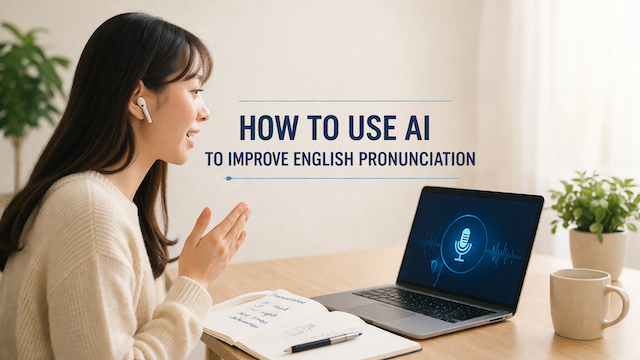
How to Use AI to Improve English Pronunciation
Contents
- How to Use AI to Improve English Pronunciation
- Introduction: Why Pronunciation Matters More Than Ever
- What Makes English Pronunciation Difficult?
- How AI Helps Improve Pronunciation
- Best AI Methods to Improve English Pronunciation
- 1. Use Speech Recognition Tools Daily
- 2. Shadowing with AI Assistance
- 3. Use AI for Phonetic Training
- 4. Record and Analyze Your Voice
- 5. Practice Minimal Pairs with AI
- 6. Use AI Chatbots for Real Conversations
- 7. Focus on Intonation and Rhythm
- Daily 30-Minute AI Pronunciation Routine
- Common Mistakes to Avoid
- Best AI Tools for Pronunciation Improvement
- How Long Does It Take to Improve?
- Final Thoughts: AI as Your Personal Pronunciation Coach
- FAQs (Frequently Asked Questions)
- What is the best way to use AI to improve English pronunciation?
- Can AI really correct my English pronunciation accurately?
- Which English pronunciation problems can AI help with most?
- How often should I practice pronunciation with AI?
- Is it better to use AI voice chat or pronunciation apps?
- Can AI help me sound more natural, not just more correct?
- Do I need a native accent when using AI for pronunciation practice?
- What should I say to AI during pronunciation practice?
How to Use AI to Improve English Pronunciation
Introduction: Why Pronunciation Matters More Than Ever
In today’s globalized world, English pronunciation is no longer just about sounding “native.” It’s about being clearly understood, communicating confidently, and avoiding misunderstandings in both professional and personal settings. Many English learners struggle not because they lack vocabulary or grammar, but because their pronunciation prevents effective communication.
Traditionally, improving pronunciation required access to native speakers, language schools, or expensive tutors. However, with the rise of AI-powered tools, learners can now practice pronunciation anytime, anywhere, with instant feedback.
Artificial intelligence has transformed language learning by offering personalized, scalable, and interactive solutions. From speech recognition to real-time corrections, AI can simulate a private tutor experience at a fraction of the cost.
In this guide, we’ll explore how to use AI effectively to improve your English pronunciation, step by step.
What Makes English Pronunciation Difficult?
Before diving into AI tools, it’s important to understand why pronunciation is challenging.
1. Sounds That Don’t Exist in Your Native Language
Many learners struggle with sounds that don’t exist in their first language. For example:
- /θ/ as in “think”
- /ð/ as in “this”
- /r/ vs /l/ distinctions
Without exposure and practice, these sounds are difficult to produce naturally.
2. Stress and Intonation Patterns
English is a stress-timed language. This means:
- Some syllables are emphasized
- Others are reduced or weakened
For example:
- “PHO-to-graph” vs “pho-TO-gra-phy”
AI tools can help identify these patterns more effectively than traditional methods.
3. Connected Speech
Native speakers don’t speak word by word. Instead, they connect sounds:
- “Want to” → “wanna”
- “Going to” → “gonna”
Understanding and practicing connected speech is essential for natural pronunciation.
How AI Helps Improve Pronunciation
AI provides several advantages that traditional learning methods cannot match.
1. Instant Feedback
Unlike human teachers, AI tools can:
- Analyze your pronunciation instantly
- Highlight specific errors
- Suggest corrections in real time
This allows for faster improvement.
2. Unlimited Practice
You can practice:
- Anytime (24/7)
- Anywhere (phone, laptop, tablet)
- Without embarrassment or pressure
Consistency is the key to pronunciation improvement, and AI makes it easy.
3. Personalized Learning
AI adapts to your level and identifies:
- Your weak sounds
- Common mistakes
- Progress over time
This creates a customized learning experience.
Best AI Methods to Improve English Pronunciation
Let’s break down practical ways to use AI effectively.
1. Use Speech Recognition Tools Daily
Speech recognition is one of the most powerful AI features.
How It Works
You speak into a device, and AI:
- Converts speech to text
- Detects pronunciation accuracy
- Flags incorrect sounds
How to Practice
- Choose a sentence
- Speak clearly into the AI tool
- Compare output with the correct sentence
- Repeat until accurate
Recommended Tools
- ChatGPT (voice mode)
- Google Speech-to-Text
- ELSA Speak
- Speechling
Pro Tip
If AI misunderstands your sentence, it’s a strong signal that your pronunciation needs adjustment.
2. Shadowing with AI Assistance
Shadowing is a highly effective technique used by professional interpreters.
What Is Shadowing?
You listen to native audio and repeat it immediately, trying to match:
- Pronunciation
- Rhythm
- Intonation
How AI Enhances Shadowing
AI can:
- Provide high-quality audio samples
- Slow down playback
- Analyze your imitation
Step-by-Step Process
- Play a short sentence
- Listen carefully
- Repeat immediately
- Record your voice
- Compare with the original
Best Practice
Use short clips (5–10 seconds) and repeat multiple times.
3. Use AI for Phonetic Training
AI tools can break words into phonetic sounds, helping you understand pronunciation at a deeper level.
Why This Matters
Instead of guessing pronunciation, you:
- Learn exact mouth positions
- Understand sound structure
- Build consistency
Example
Word: “thought”
Phonetic: /θɔːt/
AI can help you:
- Hear each sound clearly
- Practice individually
- Combine sounds smoothly
4. Record and Analyze Your Voice
One of the most underrated techniques is self-recording.
How AI Helps
AI tools can:
- Transcribe your speech
- Highlight pronunciation errors
- Suggest improvements
Practice Method
- Record yourself speaking
- Use AI to transcribe
- Compare with the original text
- Identify mistakes
- Re-record and improve
Key Benefit
You become aware of your own pronunciation patterns, which is crucial for long-term improvement.
5. Practice Minimal Pairs with AI
Minimal pairs are words that differ by only one sound:
- ship / sheep
- bit / beat
- rice / lice
Why This Is Important
These small differences can completely change meaning.
AI Practice Method
- Listen to both words
- Repeat each word
- Use AI to check accuracy
- Alternate between the two
Result
Improved clarity and precision in pronunciation.
6. Use AI Chatbots for Real Conversations
Practicing pronunciation in isolation is not enough. You need real conversation.
How AI Chatbots Help
AI can simulate:
- Daily conversations
- Business situations
- Casual chats
Benefits
- No pressure or judgment
- Immediate correction
- Real-world speaking practice
Example Activities
- Role-playing a job interview
- Ordering food
- Small talk practice
7. Focus on Intonation and Rhythm
Pronunciation is not just about individual sounds.
What to Practice
- Rising and falling tones
- Sentence stress
- Natural rhythm
AI Advantage
AI can:
- Analyze pitch patterns
- Provide model sentences
- Compare your rhythm to native speakers
Daily 30-Minute AI Pronunciation Routine
Consistency is more important than intensity. Here’s a simple routine:
0–5 Minutes: Warm-Up
- Practice difficult sounds
- Use phonetic exercises
5–15 Minutes: Shadowing
- Repeat native audio
- Focus on rhythm and intonation
15–25 Minutes: Speaking Practice
- Use AI chatbot
- Engage in conversation
25–30 Minutes: Review
- Record your voice
- Analyze mistakes
Common Mistakes to Avoid
1. Focusing Only on Vocabulary
Many learners ignore pronunciation while expanding vocabulary. This leads to communication problems.
2. Not Recording Yourself
Without hearing your own voice, it’s hard to improve.
3. Practicing Passively
Listening alone is not enough. Active speaking is essential.
4. Ignoring Feedback
AI provides valuable feedback—use it consistently.
Best AI Tools for Pronunciation Improvement
Here are some popular options:
ChatGPT (Voice Mode)
- Real-time conversation
- Flexible practice scenarios
ELSA Speak
- Detailed pronunciation scoring
- Targeted exercises
Speechling
- Human + AI feedback
- Structured practice
YouGlish
- Real-life pronunciation examples from YouTube
How Long Does It Take to Improve?
With consistent daily practice:
- 2 weeks: Noticeable awareness
- 1–2 months: Improved clarity
- 3–6 months: Strong pronunciation confidence
The key is consistency and correct practice methods.
Final Thoughts: AI as Your Personal Pronunciation Coach
AI is not just a tool—it’s a powerful learning partner.
By using AI effectively, you can:
- Practice without limits
- Receive instant feedback
- Build confidence quickly
However, the most important factor is your commitment. Even the best AI tools won’t help if you don’t practice regularly.
Start with just 30 minutes a day, stay consistent, and you’ll see significant improvement in your English pronunciation.
Your voice is your identity in communication—make it clear, confident, and understood.
FAQs (Frequently Asked Questions)
What is the best way to use AI to improve English pronunciation?
The best way to use AI to improve English pronunciation is to combine several functions instead of relying on only one. For example, you can use AI voice chat for real conversation practice, speech recognition for accuracy checks, text-to-speech tools for listening to model pronunciation, and pronunciation apps for targeted correction. A practical routine might include listening to a sentence, repeating it aloud, recording your voice, and asking AI to identify unclear words or sounds. This works well because pronunciation improvement requires both input and output. You need to hear correct English clearly, and you also need to produce it yourself many times. AI makes this easier because it offers immediate feedback and allows unlimited repetition without pressure. The most effective learners usually practice a little every day rather than doing long sessions once in a while. Even 15 to 30 minutes of focused practice with AI can make a noticeable difference over time.
Can AI really correct my English pronunciation accurately?
AI can be very helpful for pronunciation correction, especially for common issues such as vowel sounds, consonant confusion, word stress, and sentence rhythm. Modern AI tools use speech recognition and audio analysis to compare your spoken English with expected pronunciation patterns. While AI is not perfect, it is accurate enough to help most learners improve significantly. It is especially useful for identifying repeated problems, such as dropping word endings, mispronouncing the “th” sound, or placing stress on the wrong syllable. However, AI should be treated as a strong support tool rather than a magical solution. Some advanced pronunciation features, such as emotional tone, regional accent nuance, or highly subtle rhythm differences, may still be easier to refine with a human teacher. Still, for daily self-study, AI is one of the most practical and affordable ways to improve pronunciation.
Which English pronunciation problems can AI help with most?
AI is especially effective for problems that appear clearly in speech patterns. These include difficult consonants like /r/ and /l/, /b/ and /v/, or /s/ and /sh/. It can also help with vowel length, such as the difference between “ship” and “sheep,” and with final sounds, such as pronouncing the ending in words like “worked,” “lived,” or “cats.” In addition, AI can support improvement in word stress, sentence stress, linking, and intonation. These areas matter because pronunciation is not only about single sounds. If your rhythm is unnatural or your stress is placed incorrectly, native speakers may still struggle to understand you even if your individual sounds are mostly correct. AI can point out these repeated errors and give you a chance to practice them again and again until they become more natural.
How often should I practice pronunciation with AI?
It is better to practice consistently than to practice for a very long time only occasionally. For most learners, 20 to 30 minutes a day is a realistic and effective target. You can divide that time into short sections: five minutes for listening, ten minutes for repeating model sentences, ten minutes for voice interaction, and five minutes for review. Daily repetition helps your mouth, ears, and brain work together. Pronunciation improvement is partly physical because you are training new habits in your tongue, lips, and jaw. Short daily sessions are often more effective than one long session each week because your muscles and listening ability need repeated exposure. If you are very busy, even ten focused minutes every day can still help. The important point is regular practice with clear attention to feedback.
Is it better to use AI voice chat or pronunciation apps?
Both are useful, but they help in different ways. AI voice chat is better for natural speaking practice because it lets you respond in real time and develop confidence in conversation. Pronunciation apps are usually better for focused correction because they often give you scores, highlight individual sounds, and organize practice by skill. A strong approach is to use both. You can use a pronunciation app to train specific weak sounds and then use AI voice chat to apply those improvements in longer, more natural speech. For example, if you often confuse “light” and “right,” you can practice the sounds in an app and then use AI conversation to include those words in real sentences. This combination helps move your pronunciation from practice mode into actual communication.
Can AI help me sound more natural, not just more correct?
Yes, AI can help you sound more natural if you use it for rhythm, stress, and intonation practice instead of focusing only on single words. Many learners pronounce words correctly one by one but still sound unnatural because their speech is too flat, too slow, or too disconnected. AI can generate sample sentences, read them aloud, and let you imitate natural pacing and tone. It can also help you practice connected speech, where native speakers link words together smoothly. For example, “want to” often sounds closer to “wanna” in fast speech, and “did you” may sound like “didja.” Learning these patterns helps your English sound more fluent and easier to understand. Natural pronunciation is not about copying an accent perfectly. It is about speaking with smooth rhythm, clear stress, and comfortable flow.
Do I need a native accent when using AI for pronunciation practice?
No, you do not need a native accent. The real goal of pronunciation practice should be clarity, confidence, and ease of communication. AI can help you become easier to understand without forcing you to erase your identity or sound exactly like someone from the United States or the United Kingdom. Many successful English speakers have international accents, but they speak clearly and naturally enough to communicate well in meetings, travel situations, interviews, and everyday life. If you focus too much on sounding native, you may become frustrated or overly self-conscious. A better goal is to make your speech understandable, smooth, and confident. AI is excellent for this because it helps you reduce major pronunciation problems while letting you keep your own voice.
What should I say to AI during pronunciation practice?
You can say many kinds of things depending on your level and your goals. Beginners can read short everyday sentences such as self-introductions, shopping phrases, or travel expressions. Intermediate learners can practice opinion sentences, daily routines, and short stories. Advanced learners can use AI for meetings, presentations, interviews, or discussions about complex topics. You can also ask AI to create pronunciation drills with minimal pairs, common difficult words, or sentences that focus on stress and intonation. Another effective method is to ask AI to give you one sentence at a time, read it aloud, and then repeat it until it feels natural. The more relevant the content is to your real life, the more useful the practice becomes. Pronunciation improves faster when you practice language you actually want to use.
How to Improve English Speaking Using AI Apps (Complete Guide 2026)

How to Register for eTravel Philippines (2025 Guide)
Step-by-step guide to completing your eTravel registration before arriving in the Philippines, with images and tips.

Night Market in Cebu – Things You Don’t Know About Cebu Life
Discover the hidden charm of Cebu’s night markets, from street food stalls to local life tips you won’t find in tourist guides.

How to Use ChatGPT for IELTS Preparation: A Complete Guide
Learn how to prepare for IELTS using ChatGPT — including strategies for Writing, Reading, Listening, Speaking, and grammar support.

How to Build a Website Without Coding Using ChatGPT
Discover how to build your own website using AI—no coding skills needed. From structure planning to SEO and design, let ChatGPT guide you.