2025年12月18日
3D ACADEMY offers affordable English study programs in Cebu, Philippines – perfect for beginners, professionals, and exam takers.

3D UNIVERSAL ENGLISH INSTITUTE INC
info.3d-universal.com
8:00-17:00(Mon-Fri)
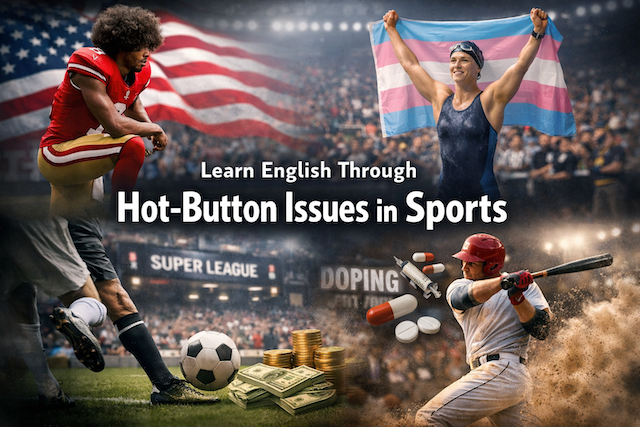
Learn English Through Hot-Button Issues in Sports
Contents
- Learn English Through Hot-Button Issues in Sports
- Why Sports Controversies Are Ideal for Learning English
- Athlete Activism and Freedom of Speech
- Gender Equality and Pay Gaps in Sports
- Performance-Enhancing Drugs and Doping Scandals
- Racism and Discrimination in Sports
- Transgender Athletes and Fair Competition
- Sportswashing and Ethics of Hosting Major Events
- Technology and Refereeing Decisions
- How to Use Sports Debates to Improve English Skills
- Common Expressions Used in Sports Debates
- Why This Method Works for Advanced Learners
- Conclusion: Learn English Where Passion Meets Language
- FAQs (Frequently Asked Questions)
- Is it really effective to learn English through controversial sports topics?
- What level of English do I need to use this method?
- Which sports hot-button issues are best for learning English?
- How do I avoid learning biased or misleading English from sports debates?
- What vocabulary should I focus on when studying controversial sports topics?
- How can I practice speaking without turning the conversation into a fight?
- What is a simple weekly study plan using sports hot-button issues?
- How do I learn grammar naturally from these debates?
- Can this method help with writing essays, not just casual conversation?
- How can I expand my listening skills when speakers talk too fast?
- Are there any risks or topics I should handle carefully?
Learn English Through Hot-Button Issues in Sports
Sports are more than games. They are deeply connected to culture, identity, money, politics, and social values. Because of this, hot-button issues in sports—topics that spark strong opinions and debate—are powerful tools for learning real, modern English.
If you want to improve your English reading, listening, speaking, and critical thinking skills at the same time, studying controversial sports topics is one of the most effective and engaging methods. These discussions appear daily in news articles, podcasts, interviews, social media, and casual conversations with native speakers.
This article explains how you can learn English through hot-button issues in sports, while also understanding the language, expressions, and argument styles used by fluent speakers.
Why Sports Controversies Are Ideal for Learning English
Sports controversies use natural, emotional, and opinion-driven language, which makes them perfect learning material.
When people discuss sensitive sports topics, they often use:
-
Persuasive language
-
Strong adjectives and verbs
-
Idioms and metaphors
-
Comparative and conditional sentences
-
Agreement and disagreement phrases
Unlike textbook English, this language reflects how people actually speak and write in real life.
Another advantage is motivation. Sports debates naturally pull you in, making it easier to stay focused and remember vocabulary.
Athlete Activism and Freedom of Speech
One of the most debated topics in modern sports is whether athletes should use their platform to express political or social opinions.
Examples include:
-
Kneeling during national anthems
-
Wearing protest symbols
-
Speaking out against governments or institutions
Key English Vocabulary and Phrases
-
Freedom of speech
-
Take a stand
-
Use one’s platform
-
Public backlash
-
Divisive issue
-
Spark controversy
Useful Sentence Structures
-
“Some people argue that athletes should stay out of politics.”
-
“Others believe that silence is also a political statement.”
-
“This issue has divided fans, sponsors, and organizations.”
This topic helps you practice balanced arguments, a crucial skill in advanced English.
Gender Equality and Pay Gaps in Sports
Pay inequality between male and female athletes is a global hot-button issue, especially in football (soccer), basketball, and tennis.
Discussions often compare:
-
Prize money
-
Sponsorship opportunities
-
Media coverage
-
Viewership numbers
Key Vocabulary
-
Gender pay gap
-
Equal pay
-
Revenue generation
-
Market demand
-
Institutional bias
Common Debate Language
-
“Supporters claim that female athletes deserve equal compensation.”
-
“Critics argue that pay should reflect revenue, not gender.”
-
“The debate highlights deeper social inequalities.”
This topic is excellent for learning comparative language, data-based arguments, and formal opinion writing.
Performance-Enhancing Drugs and Doping Scandals
Doping scandals are classic sports controversies that appear frequently in news headlines.
These discussions involve:
-
Fair play
-
Ethics
-
Rule enforcement
-
Reputation damage
Important Vocabulary
-
Performance-enhancing drugs (PEDs)
-
Anti-doping agency
-
Lifetime ban
-
Stripped of titles
-
Level playing field
Advanced Sentence Examples
-
“The athlete’s legacy was permanently damaged by the scandal.”
-
“Strict testing policies aim to preserve fairness in competition.”
-
“Some argue that the pressure to win encourages unethical behavior.”
This topic is ideal for learning formal English, especially in news reports and analytical writing.
Racism and Discrimination in Sports
Racism remains one of the most emotionally charged issues in global sports.
This topic includes:
-
Racist abuse from fans
-
Discriminatory policies
-
Unequal treatment by officials or media
Key Vocabulary
-
Racial abuse
-
Systemic racism
-
Zero-tolerance policy
-
Condemn
-
Accountability
Natural Expressions
-
“The league issued a strong statement condemning the incident.”
-
“Players are calling for stricter punishments.”
-
“This problem reflects broader issues in society.”
Learning this topic helps you understand emotional tone, formal apologies, and strong moral language.
Transgender Athletes and Fair Competition
The participation of transgender athletes in sports is one of the most complex and sensitive debates today.
Arguments often focus on:
-
Fairness
-
Biological differences
-
Inclusion
-
Human rights
Useful Vocabulary
-
Eligibility rules
-
Competitive advantage
-
Inclusion
-
Fair competition
-
Regulatory framework
Debate-Oriented English
-
“Supporters emphasize inclusion and equal opportunity.”
-
“Opponents raise concerns about competitive fairness.”
-
“There is no simple solution to this issue.”
This topic helps learners practice careful, respectful language, which is essential for advanced communication.
Sportswashing and Ethics of Hosting Major Events
Some countries or organizations are accused of using sports events to improve their public image despite human rights concerns.
This topic often appears in discussions about:
-
World Cups
-
Olympics
-
International tournaments
Key Vocabulary
-
Sportswashing
-
Human rights record
-
Global scrutiny
-
Ethical concerns
-
International pressure
High-Level English Examples
-
“Critics argue that hosting the event distracts from serious issues.”
-
“Supporters claim that sports can drive positive change.”
-
“The controversy has drawn international attention.”
This issue is excellent for learning academic-style English and global news language.
Technology and Refereeing Decisions
Technology like VAR (Video Assistant Referee) has changed sports dramatically—and sparked endless debate.
Common discussion points include:
-
Accuracy vs. flow of the game
-
Human error vs. technology
-
Consistency in decisions
Vocabulary to Learn
-
VAR
-
Margin of error
-
Inconsistent rulings
-
Game flow
-
Refereeing standards
Realistic Conversation Phrases
-
“VAR has taken the emotion out of the game.”
-
“At least the decisions are more accurate now.”
-
“The system still needs improvement.”
This topic is perfect for practicing casual spoken English used by fans.
How to Use Sports Debates to Improve English Skills
To maximize learning, do more than just read.
Reading
-
Read sports opinion articles
-
Compare headlines from different countries
-
Highlight repeated phrases and expressions
Listening
-
Watch sports talk shows and debates
-
Listen to podcasts with opposing opinions
-
Pay attention to tone and emphasis
Speaking
-
Practice explaining both sides of an issue
-
Use phrases like “I partly agree” or “From my perspective”
-
Debate with language partners
Writing
-
Write short opinion essays
-
Summarize arguments neutrally
-
Practice structured paragraphs with examples
Common Expressions Used in Sports Debates
Learning these phrases will instantly make your English sound more natural:
-
“This issue has divided opinion.”
-
“There are valid arguments on both sides.”
-
“The controversy shows no sign of ending.”
-
“Public reaction has been mixed.”
-
“The debate goes beyond sports.”
These expressions appear frequently in news articles and discussions.
Why This Method Works for Advanced Learners
Hot-button sports issues push you beyond basic vocabulary.
They require you to:
-
Understand nuance
-
Express disagreement politely
-
Analyze complex ideas
-
Adapt tone depending on context
This is exactly what advanced English users need.
You are not just learning English—you are learning how English is used to persuade, criticize, defend, and reflect.
Conclusion: Learn English Where Passion Meets Language
Learning English through hot-button issues in sports combines language, culture, and real-world relevance. These topics expose you to authentic vocabulary, natural sentence structures, and emotional expression that textbooks rarely provide.
If you want to sound more fluent, confident, and informed, follow sports debates closely. Read them, listen to them, talk about them, and write about them.
Sports may begin with a game—but for English learners, they open the door to powerful, real-life communication.
FAQs (Frequently Asked Questions)
Is it really effective to learn English through controversial sports topics?
Yes, it can be highly effective because hot-button sports issues generate authentic English in real contexts. You will see natural vocabulary, persuasive phrases, and emotional tone in articles, interviews, podcasts, and social media. These topics also repeat across platforms, which helps you encounter the same expressions many times. The key is to study actively: collect useful phrases, summarize arguments, and practice responding in your own words. If you only read passively, you may enjoy the content but improve more slowly. Treat each debate like a language lesson and you will build vocabulary, fluency, and critical thinking together.
What level of English do I need to use this method?
This approach works best from upper-beginner to advanced levels, but the strategy changes depending on your level. If you are upper-beginner or lower-intermediate, focus on short news summaries, simple opinion videos, and vocabulary lists. If you are intermediate, move to longer articles, debate clips, and podcasts with clear speakers. If you are advanced, challenge yourself with editorials, legal or policy discussions, and interviews where speakers use sarcasm, nuance, or indirect criticism. No matter your level, start with one topic you already understand in your native language, because background knowledge reduces confusion and increases comprehension.
The best issues are the ones that produce frequent, high-quality content and clear opposing viewpoints. Common choices include athlete activism and freedom of speech, pay equity in women’s sports, doping and punishment systems, racism and discrimination, transgender participation policies, the ethics of hosting major events, and technology in officiating such as VAR. Pick one or two topics at first. If you jump between too many debates, you may learn scattered vocabulary without building depth. When you stay with one issue for a few weeks, you learn topic-specific words, common argument patterns, and recurring expressions like “critics argue,” “supporters claim,” or “the debate centers on.”
How do I avoid learning biased or misleading English from sports debates?
Sports discussions can be emotional and sometimes biased, so you should compare multiple sources. Read or watch at least two viewpoints, ideally from different outlets or commentators. Separate facts from opinions by noticing signal phrases. Facts often include numbers, dates, rules, and direct quotes. Opinions often include strong adjectives, assumptions, and claims without evidence. You can also practice rewriting the same idea in neutral language. For example, replace “disgusting behavior” with “behavior that many people criticized.” This not only reduces bias but also teaches you academic-style English that is useful in essays and formal conversations.
What vocabulary should I focus on when studying controversial sports topics?
Focus on three categories: debate vocabulary, sports policy vocabulary, and emotion or tone vocabulary. Debate vocabulary includes words like “argument,” “counterargument,” “claim,” “evidence,” “justify,” “criticize,” and “compromise.” Policy vocabulary includes “eligibility,” “regulation,” “ban,” “sanction,” “enforcement,” “governing body,” and “guidelines.” Tone vocabulary includes “outrage,” “backlash,” “praise,” “condemn,” “polarizing,” and “controversial.” Also learn common collocations, which are word pairs that native speakers use naturally, such as “public backlash,” “strong reaction,” “heated debate,” “level playing field,” and “zero-tolerance policy.”
How can I practice speaking without turning the conversation into a fight?
Use softening and respect phrases. Start with neutral framing like “I can see both sides” or “This topic is complicated.” When you disagree, say “I understand that point, but…” or “I’m not fully convinced because…” Ask questions instead of attacking. For example, “What evidence supports that view?” or “How would you apply that rule fairly?” You can also practice role-switching: argue for one side for two minutes, then switch to the other side. This trains flexibility, reduces emotional attachment, and improves your ability to communicate calmly in English even when the topic is sensitive.
Try a four-day cycle and repeat it weekly. Day 1: read one short article and highlight ten useful phrases. Day 2: watch a debate clip and write a five-sentence summary. Day 3: record yourself giving a one-minute opinion using at least five phrases from Day 1. Day 4: write a short paragraph presenting both sides neutrally. On the weekend, review your vocabulary and rewrite one old summary with better grammar and stronger connectors like “however,” “therefore,” “in contrast,” and “as a result.” This plan balances input and output, which is crucial for real improvement.
How do I learn grammar naturally from these debates?
Pay attention to repeated sentence patterns instead of isolated rules. Sports debates often use contrast structures (“Although X, Y”), cause-and-effect (“This led to…”), and conditional statements (“If the league changes the rule, then…”). Collect examples and make your own variations. For instance, take “Some argue that pay should reflect revenue” and create “Some argue that punishment should reflect intent.” This method trains grammar through templates, which helps you speak and write faster. After you practice, you can check grammar more formally, but the main goal is to build automatic patterns.
Can this method help with writing essays, not just casual conversation?
Yes. Many sports controversies are similar to topics used in academic writing: fairness, ethics, regulation, discrimination, and economics. When you study these debates, you learn how English writers build arguments with claims, reasons, and examples. To make it more academic, practice writing structured paragraphs with a topic sentence, evidence, and a concluding sentence. Use neutral connectors and avoid slang. You can also write mini “for and against” essays. Over time, your vocabulary becomes more formal, and you get better at presenting complex ideas clearly, which is valuable for exams and professional communication.
How can I expand my listening skills when speakers talk too fast?
Use a layered listening approach. First, listen for the main idea without stopping. Second, replay and focus on key phrases, especially repeated ones. Third, slow down the playback and shadow the speaker by repeating a sentence immediately after you hear it. If possible, use captions as a support, but do not depend on them forever. Write down short chunks, not the entire talk. You can also train your ear by learning common debate fillers like “to be honest,” “I mean,” “the thing is,” and “at the end of the day.” These appear constantly and make fast speech easier to follow.
Are there any risks or topics I should handle carefully?
Yes. Some topics involve identity, race, gender, politics, and national pride, which can trigger strong emotions. When you use these topics for learning, focus on language skills rather than “winning” a debate. Avoid insulting labels, and do not assume someone’s intentions. If you are studying in a group, choose ground rules such as listening fully, using respectful language, and separating personal attacks from criticism of ideas. If a topic feels too intense, switch to a lower-conflict issue like technology in officiating or salary caps. You can still learn debate English without high emotional risk.

How to Register for eTravel Philippines (2025 Guide)
Step-by-step guide to completing your eTravel registration before arriving in the Philippines, with images and tips.

Night Market in Cebu – Things You Don’t Know About Cebu Life
Discover the hidden charm of Cebu’s night markets, from street food stalls to local life tips you won’t find in tourist guides.

How to Use ChatGPT for IELTS Preparation: A Complete Guide
Learn how to prepare for IELTS using ChatGPT — including strategies for Writing, Reading, Listening, Speaking, and grammar support.

How to Build a Website Without Coding Using ChatGPT
Discover how to build your own website using AI—no coding skills needed. From structure planning to SEO and design, let ChatGPT guide you.